


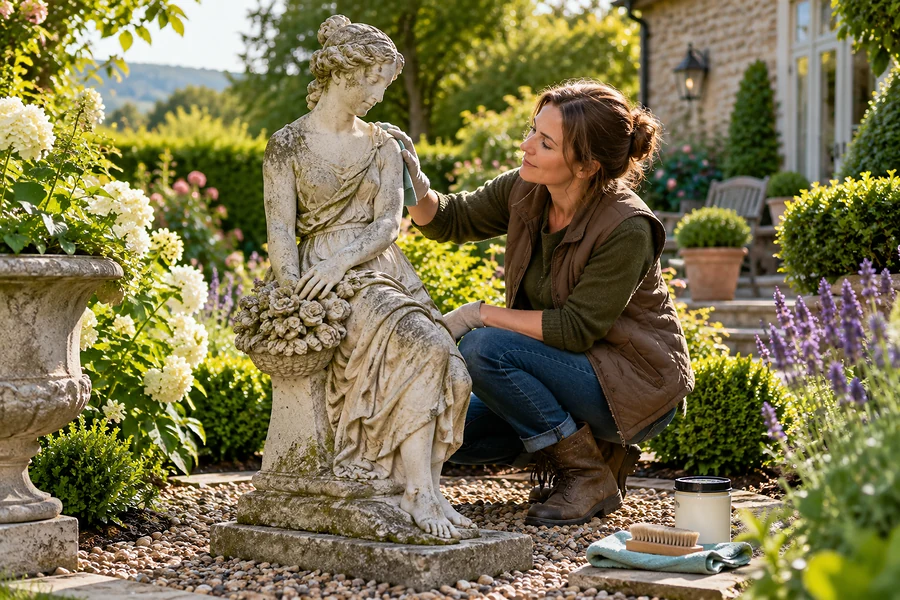
Garden statues are built for outdoor display, but that does not make them immune to water, frost, sunlight, unstable soil, biological growth, or neglected cracks.
To protect garden statues, keep them on stable, well-drained bases, prevent standing water, repair cracks early, use a compatible exterior sealer when appropriate, clean them gently, and protect vulnerable pieces during winter. Concrete and cast-stone statues are especially at risk when moisture penetrates the material and repeatedly freezes and thaws.
Protecting concrete statues requires more than waterproofing. Good drainage, stable placement, moisture control, compatible finishes, early crack repairs, and regular inspections prevent freeze-thaw damage effectively.
What Weather Conditions Damage Garden Statues the Most?
Different environments create different problems, but moisture is involved in many of the most serious forms of deterioration.
The greatest threats to many outdoor concrete and cast-stone statues are repeated wetting, freeze-thaw cycles, standing water, cracks that allow deeper water penetration, deicing salts, and unstable support. Sunlight mainly affects paints and decorative finishes, while water and freezing can damage the concrete itself.
Freeze-Thaw Cycles
Freezing temperatures are particularly destructive when a porous statue has absorbed significant moisture.
When water inside pores freezes, it expands. Repeated cycles can gradually cause:
- Scaling
- Surface flaking
- Cracks
- Spalling
- Loss of fine details
- Broken edges
The Cast Stone Institute specifically identifies saturation followed by repeated freezing and thawing as a major cause of freeze-thaw failure. It also emphasizes that drainage and avoiding persistently wet conditions are essential even when high-quality cast stone is used.
A statue does not need to sit underwater to become vulnerable.
Water can collect in:
- Folded clothing details
- Bowls
- Planters
- Fountain basins
- Deep recesses
- Cracks
- Hollow sections
Those small reservoirs can create repeated local damage during winter.
Rain and Standing Water
Rain itself is not automatically destructive.
The problem is water that cannot leave.
A statue sitting directly in wet soil may remain damp long after the surrounding garden appears dry.
I would be particularly cautious about:
- Clay-heavy soil
- Low areas where water pools
- Irrigation directed toward the base
- Downspouts
- Mulch that stays continuously wet
Cast Stone Institute guidance repeatedly emphasizes proper water drainage because even durable cementitious materials perform poorly when repeatedly subjected to saturated conditions.
Deicing Salts
If a statue sits near a driveway, entrance, or walkway, winter deicing products may create another problem.
The Cast Stone Institute notes that freeze-thaw deterioration can be made worse by exposure to deicing salts.
I would therefore avoid placing valuable concrete ornaments where road salt or treated snow is routinely pushed against them.
Strong Sunlight
Sun exposure affects the decorative finish more quickly than the structural concrete.
UV exposure can gradually contribute to:
- Paint fading
- Pigment changes
- Sealer deterioration
- Chalky finishes
Concrete Network notes that direct UV exposure can shorten the life of decorative finishes and sealers on exterior concrete.
So a faded statue is not necessarily structurally damaged.
Sometimes the concrete is still healthy while the decorative coating simply needs attention.
Should You Seal Concrete Garden Statues?
In many cases, a suitable water-repellent treatment can help, but the product needs to match the statue.
A compatible exterior concrete sealer can reduce water penetration and help protect against moisture-related deterioration, staining, and freeze-thaw damage. However, excessive or incompatible coatings can trap moisture, peel, cloud, or hide fine detail, so more sealer is not automatically better.
Concrete Network explains that sealing exterior concrete helps limit water penetration, which can reduce risks such as cracking, spalling, pitting, and freeze-thaw deterioration.
Penetrating vs. Film-Forming Sealers
For an unpainted concrete statue, I often prefer considering a penetrating water repellent before a heavy glossy coating.
Penetrating sealers can help preserve a more natural appearance.
Common categories include:
- Silane
- Siloxane
- Siliconate
- Other reactive penetrating systems
Concrete Network notes that penetrating sealers are commonly used where a natural appearance and outdoor protection are desired.
Painted statues are different.
If a statue already has decorative paint or a surface coating, the protective product must be compatible with that finish.
Applying the wrong chemistry on top of an existing layer can create:
- Peeling
- Softening
- Cloudiness
- Adhesion failure
Do Not Over-Seal
This is an important mistake to avoid.
Concrete Network warns that excessive sealer buildup can trap moisture and lead to blistering, bubbling, cloudy surfaces, cracking, or peeling.
For detailed statuary, multiple thick coatings can also gradually soften sculptural details.
I would rather apply an appropriate system correctly than keep adding layers every year.
How Often Should You Reseal?
There is no universal statue schedule.
For general exterior concrete, contractors commonly recommend resealing roughly every 2–5 years, depending on product type, climate, weather exposure, and wear.
A statue receives less foot traffic than a patio, so its actual interval may differ.
I would watch the surface instead.
Possible signs that protection is weakening include:
- Water soaking in quickly
- Uneven darkening after rain
- Peeling coating
- Loss of sheen
- Surface wear
- Fading
The existing product should ideally be identified before another coating is applied.
How Do You Protect Garden Statues During Winter?
Winter preparation is one of the most effective ways to extend the life of vulnerable outdoor statuary.
Before freezing weather, remove trapped water, inspect cracks, improve drainage, clean the surface, and move small or fragile statues into a dry sheltered location if practical. Large statues that remain outdoors should be kept stable, well drained, and protected from prolonged saturation rather than tightly wrapped in a way that traps moisture.
Empty Anything That Holds Water
This is particularly important for:
- Birdbaths
- Fountains
- Planters
- Urns
- Bowls
Water trapped in these areas can freeze repeatedly.
If a fountain is not intended for winter operation, drain it thoroughly before freezing temperatures arrive.
Move Small Pieces Indoors
Small ornaments are relatively easy to protect.
I would strongly consider winter storage for:
- Thin decorative statues
- Delicate figurines
- Small concrete animals
- Already cracked pieces
- Detailed cast stone
- Valuable sentimental ornaments
An unheated but dry shed, garage, or protected structure can reduce direct rain and freeze-thaw saturation.
The goal is not necessarily warmth.
It is often dryness.
Be Careful With Covers
A cover can be useful, but it should not create a moisture trap.
Wrapping a damp concrete statue tightly in non-breathable plastic may retain water against the surface.
If a cover is used, I want:
- Air circulation
- Protection from direct precipitation
- No water pooling at the base
The statue should ideally be dry before covering.
How Important Is the Base Under a Garden Statue?
More important than many people realize.
A stable, well-drained base protects a statue from tilting, prolonged ground moisture, settlement, and accidental impact. Concrete ornaments should generally sit on a level surface such as a concrete pad, stone, paver, or properly compacted gravel base rather than directly in soft, constantly wet soil.
Avoid Direct Contact With Wet Soil
Concrete is porous.
If the bottom remains in contact with wet ground, moisture can continually move into the material.
That becomes particularly problematic before freezing weather.
A small raised base can improve:
- Drainage
- Stability
- Airflow
- Cleanliness
Heavy Statues Need Level Support
A large garden statue may weigh hundreds of pounds.
If the ground settles unevenly, the statue can tilt.
That can create stress at:
- Ankles
- Pedestals
- Thin columns
- Narrow bases
Eventually, cracking or tipping may occur.
I therefore treat the base as part of the installation, not an afterthought.
Secure Tall Pieces Appropriately
Tall or narrow ornaments may also need additional anchoring in windy locations.
The correct approach depends on:
- Statue weight
- Shape
- Base dimensions
- Local wind exposure
- Manufacturer design
For very large or architecturally significant pieces, professional installation is worth considering.
How Should You Clean Garden Statues Without Damaging Them?
Cleaning should remove dirt without eroding the surface.
Use the gentlest effective method first: soft brushes, clean water, and mild compatible cleaners. Aggressive acids, harsh pressure washing, abrasive tools, and unknown chemicals can damage concrete, decorative finishes, or previous repairs. Historic or valuable sculptures require even greater caution.
The Cast Stone Institute advises using manufacturer-appropriate cleaners and warns that cast-stone cleaning methods must be selected carefully to avoid surface damage.
The National Park Service’s conservation work on historic concrete sculpture similarly demonstrates the importance of controlled cleaning rather than aggressive surface removal.
Start With Dry Cleaning
For loose dirt:
- Brush away leaves.
- Remove cobwebs.
- Use a soft brush for dry debris.
- Rinse gently where appropriate.
Treat Biological Growth Carefully
Moss and algae often grow where a statue remains damp.
Before repeatedly cleaning them away, I would solve the moisture condition if possible.
Otherwise, the growth will simply return.
Avoid High Pressure on Fragile Details
Pressure washing can be useful on some robust concrete surfaces.
It can also damage:
- Old paint
- Weak concrete
- Crumbling edges
- Fine sculptural detail
- Previous repairs
For older statues, low-pressure cleaning is generally safer.
The National Park Service has recommended regular low-pressure cleaning as part of maintenance planning for conserved outdoor concrete sculpture.
Should Cracks and Chips Be Repaired Immediately?
Early repair is usually easier than waiting for deterioration to spread.
Small cracks and chips should be monitored and repaired when they allow water penetration or continue growing. Large cracks, loose pieces, exposed reinforcement, or widespread spalling may indicate deeper deterioration and should be evaluated before simply applying cosmetic patch material.
The Cast Stone Institute recommends addressing significant chips promptly and matching repair materials as closely as practical to the original cast stone.
Why Cracks Matter
The crack itself may initially be small.
The real problem is that it can provide a route for:
- Rainwater
- Meltwater
- Oxygen
- Salts
If reinforcement is present, water reaching steel can eventually lead to corrosion.
The National Park Service has documented exactly this mechanism in outdoor concrete sculpture: water infiltration contributed to reinforcement corrosion, rust expansion, freeze-thaw damage, and structural instability.
Do Not Simply Paint Over Structural Damage
Paint can hide a crack.
It does not repair it.
If the crack is actively moving or moisture is entering beneath the finish, covering it may only delay recognition of the real problem.
Watch for Rust Stains
Orange-brown streaks may indicate internal metal corrosion.
That deserves more attention than ordinary surface dirt.
As reinforcement corrodes, expanding rust products can push outward on surrounding concrete.
This can eventually lead to spalling.
How Should Painted Garden Statues Be Protected?
Painted statues require both concrete maintenance and finish maintenance.
Exterior paint or decorative coatings protect appearance but will gradually weather. Use coatings compatible with cementitious surfaces, prepare the substrate carefully, allow repairs to cure, and avoid repeatedly sealing over damaged paint without correcting the underlying problem.
The National Park Service’s conservation of outdoor concrete sculpture demonstrates the importance of coating compatibility, substrate preparation, curing, UV performance, and breathability when protecting exposed concrete artworks.
Expect Finish Maintenance
A concrete statue may remain structurally sound for decades while being repainted several times.
That is normal.
Think of:
concrete life
and
paint life
as different maintenance cycles.
UV Resistance Matters
If a statue sits in full sun, choose exterior products intended for UV exposure.
Otherwise, colors may fade well before the concrete fails.
Breathability Can Matter
On porous mineral substrates, an overly impermeable coating can create moisture problems if water gets behind it.
For valuable concrete art, conservation projects often choose coating systems specifically for compatibility and vapor behavior rather than simply selecting the thickest coating available.
My insights: Don’t Let the Elements Destroy Your Garden Statues- How to Protect Them
After reviewing concrete durability guidance, cast-stone technical information, sealer recommendations, and outdoor sculpture conservation experience, I think most garden-statue damage can be understood through one central idea:
control water before trying to control everything else.
Don’t Let the Elements Destroy Your Garden Statues: How to Protect Them starts with preventing unnecessary moisture saturation. Stable placement, drainage, crack repair, compatible sealing, winter preparation, gentle cleaning, and periodic inspection work together. A statue that stays relatively dry and structurally stable generally has a much better chance of surviving decades outdoors.
My First Insight: Water Is Usually the Main Enemy
People often focus first on cold weather.
But freezing becomes most destructive when the statue is wet.
Cast Stone Institute guidance makes this relationship clear: freeze-thaw failure develops when pore structures become saturated and repeatedly cycle through freezing and thawing.
So my first priorities are:
drainage + dryness + crack control.
Not simply:
more coating.
My Second Insight: Protect the Base Before the Surface
People often spend money on sealers while leaving a statue directly in muddy soil.
I would reverse that order.
First provide:
- Stable support
- Drainage
- Separation from saturated ground
Then consider surface treatment.
The base influences moisture and structural stability every day of the year.
My Third Insight: Sealers Are Helpful, Not Magical
A sealer can reduce water absorption.
It cannot correct:
poor concrete,
deep structural cracks,
unstable foundations,
or badly corroded reinforcement.
Concrete Network’s guidance also warns that excessive sealing can trap moisture and create its own appearance and performance problems.
So I treat sealer as one layer of protection.
Not the entire strategy.
My Fourth Insight: Small Cracks Become Winter Problems
A hairline crack in summer may appear harmless.
Then autumn rain enters it.
Winter arrives.
Water freezes.
The crack widens.
More water enters.
The cycle repeats.
This is why annual inspection is so valuable.
I would inspect statues at least:
before winter
and
after winter.
My Fifth Insight: Valuable Statues Deserve Different Treatment
An inexpensive modern garden ornament and a historic sculptural object should not receive the same repair strategy.
For ordinary pieces, compatible patching and repainting may be perfectly reasonable.
For:
- Historic statues
- Valuable sculptures
- Heirloom pieces
- Artist-made concrete work
I would be much more conservative.
The National Park Service’s concrete conservation projects demonstrate how inappropriate previous repairs and coatings can create additional long-term problems.
My Sixth Insight: A Weathered Appearance Is Not Always Damage
Outdoor statues naturally change.
They may develop:
- Patina
- Moss
- Darkening
- Surface variation
- Faded paint
Some changes are cosmetic.
Others indicate active deterioration.
I distinguish between them.
Mostly cosmetic:
- Mild discoloration
- Stable patina
- Light biological growth
- Faded paint
More concerning:
- Growing cracks
- Flaking concrete
- Spalling
- Loose sections
- Rust staining
- Tilting
- Exposed reinforcement
Protection should focus on real deterioration rather than trying to make every old statue look newly manufactured.
My Seventh Insight: The Best Maintenance Plan Is Seasonal
I would use a simple annual cycle.
| Season | What I would do |
|---|---|
| Spring | Inspect winter cracks, clean gently, repair damage |
| Summer | Check fading, biological growth, and drainage |
| Autumn | Clear debris, inspect sealer, drain fountains and bowls |
| Before freezing | Repair water-entry points and store vulnerable pieces |
| Winter | Keep water from collecting where practical |
This routine is more effective than ignoring the statue for ten years and then applying a heavy coating after damage has already occurred.
My Garden Statue Protection Checklist
Before harsh weather arrives, I would check:
- Is the statue level?
- Is the base dry and stable?
- Can rainwater drain away?
- Are there any new cracks?
- Is water collecting in bowls or recesses?
- Is paint peeling?
- Does the existing sealer still repel water?
- Are rust stains appearing?
- Is moss indicating persistent dampness?
- Can a small fragile piece be stored indoors?
- Are damaged areas repaired with compatible materials?
If I can answer those questions each year, major deterioration becomes much easier to catch early.
My Final View
Garden statues are often damaged slowly.
One rainstorm usually does not destroy a concrete figure.
One cold night usually does not destroy it either.
The problem is repetition.
Water enters.
The statue stays wet.
The temperature falls.
The water freezes.
The material expands.
A crack forms.
More water enters.
Another winter arrives.
That repeated cycle is why moisture management is the foundation of protection.
The Cast Stone Institute’s technical guidance, general concrete maintenance recommendations, and National Park Service conservation experience all point in the same direction: quality material lasts longest when it is properly drained, protected from persistent saturation, inspected, and repaired before small defects become large ones.
So if I wanted to protect a garden statue for decades, I would prioritize five things:
a stable base, good drainage, early crack repair, appropriate surface protection, and winter moisture control.
Everything else builds on those basics.
Conclusion
Protect garden statues by controlling moisture, improving drainage, repairing cracks, using compatible sealers, and preparing vulnerable pieces for winter. Good maintenance can preserve outdoor statuary for decades.

