
Greenery can soften a room, add height, and make an empty corner feel finished. But keeping living plants healthy is not practical in every home or commercial environment.
The main benefits of artificial plants are low maintenance, predictable appearance, freedom from sunlight and watering requirements, flexible placement, and long-term decorative use. High-quality faux greenery can provide color and botanical form in dark rooms, offices, rentals, hospitality spaces, and difficult-to-reach areas where living plants would struggle.
Modern faux plants look more realistic, but they do not replace living greenery. Their main advantage is solving design problems where real plants cannot thrive.
What Are the Main Benefits of Artificial Plants?
The appeal of artificial plants begins with predictability.
Artificial plants provide permanent greenery without watering schedules, pruning, fertilizing, repotting, sunlight management, or seasonal decline. They can be placed almost anywhere indoors, maintain a consistent shape throughout the year, and are especially practical when plant care would otherwise become difficult, unreliable, or expensive.
1. No Watering Schedule
Living plants need different amounts of water depending on:
- Species
- Pot size
- Temperature
- Humidity
- Season
- Light
- Soil conditions
Artificial plants need none.
This can be particularly valuable in:
vacation homes,
short-term rentals,
offices,
hotel rooms,
retail stores,
and second homes.
There is no need to arrange plant care when a property is empty.
2. No Natural Light Requirement
This may be the single biggest practical advantage.
A real fiddle leaf fig, olive tree, monstera, or succulent cannot remain healthy indefinitely in a windowless room simply because that is where the interior needs greenery.
Artificial plants can.
That makes them useful for:
- Basements
- Internal bathrooms
- Windowless offices
- Hallways
- Reception zones
- Deep shelving
- Interior retail areas
The plant becomes a visual design element rather than a biological system that must be matched to environmental conditions.
3. No Pruning or Repotting
Living plants eventually change scale.
Roots grow.
Branches lean.
Plants outgrow pots.
Leaves fall.
Those changes are part of the beauty of living greenery, but they also create work.
Artificial greenery remains approximately the size originally selected.
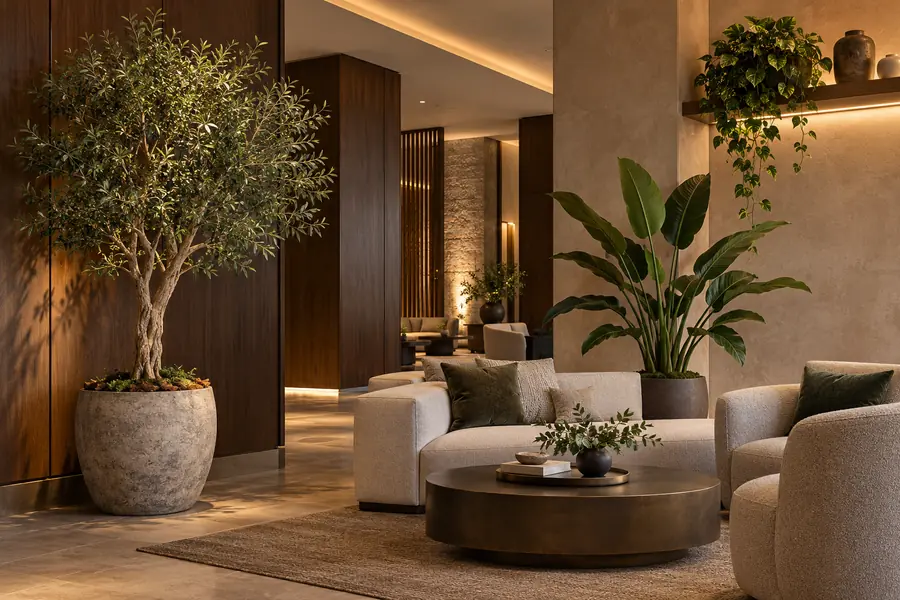
For interior designers, that predictability can be useful because a six-foot faux olive tree will continue to fill approximately the same architectural volume year after year.
4. No Seasonal Dormancy
Some living plants slow down or change appearance seasonally.
Others may struggle when indoor heating begins.
Artificial plants provide the same visual color throughout the year.
This can be especially useful in businesses that need their interiors to maintain a consistent presentation.
5. Easy Styling Control
Artificial branches can often be bent and reshaped.
House Beautiful’s 2026 styling advice recommends varying stem lengths, bending branches, introducing slight drooping, and avoiding factory-perfect symmetry to make faux greenery appear more natural.
This gives the owner unusually direct control over:
height,
spread,
direction,
and silhouette.
Living plants decide how they grow.
Faux plants let the designer decide.
Where Are Artificial Plants More Practical Than Real Plants?
Artificial greenery becomes most valuable where normal plant care conflicts with the space.
Faux plants are particularly practical in locations with inadequate daylight, inconsistent maintenance, difficult physical access, strict visual standards, or long periods without occupants. They can also be useful where soil, irrigation, fallen leaves, or regular plant replacement would complicate operations.
Windowless Offices
A windowless office may benefit visually from greenery even though many living plants would struggle.
A faux ficus or floor tree can introduce:
height,
organic form,
and color
without requiring grow lights.
Artificial nature should not be confused with actual daylight or outdoor access, but visually nature-like environments can still affect how people perceive indoor spaces. Research comparing visual exposure to real plants, artificial plants, plant images, and no plants suggests that artificial greenery can provide some positive subjective response, although living plants generally performed better for relaxation.
Hotels and Vacation Rentals
Hospitality spaces have a different problem.
A plant may need to look presentable regardless of:
which employee is working,
how long a room is vacant,
or whether housekeeping understands its exact care needs.
Artificial greenery can provide consistency.
A faux plant does not suddenly develop yellow leaves before an important booking.
High Shelves and Difficult Installations
Consider a trailing plant positioned eight feet above the floor.
A living version requires someone to:
reach it,
water it,
inspect it,
and remove runoff.
A faux version needs occasional cleaning.
For inaccessible areas, that is a meaningful difference.
Restaurants and Retail Interiors
Commercial spaces may use greenery to:
define zones,
soften hard finishes,
fill dead corners,
or create visual branding.
Artificial foliage allows that composition to remain relatively stable.
However, commercial installations still require attention to:
fire requirements,
mounting,
cleaning,
and material specifications.
A large artificial green wall should be treated more like an installed interior finish than like a decorative houseplant.
Do Artificial Plants Help With Allergies, Pets, or Indoor Air Quality?
This is an area where artificial-plant benefits are often exaggerated.
Artificial plants do not produce pollen and do not contain naturally toxic plant tissues, but they are not automatically hypoallergenic or pet-safe. Faux foliage can accumulate household dust, while chewing plastic, wire, foam, or decorative stones can create physical hazards for pets. Artificial plants also do not purify indoor air.
Artificial Plants Do Not Produce Pollen
A synthetic plant does not flower biologically and does not release plant pollen.
That may make faux greenery useful for someone who wants the visual appearance of a specific flowering or leafy species without introducing that living plant.
However, artificial plants collect dust.
EPA identifies household dust and pollen as indoor particulate contaminants and recommends regular cleaning with methods such as damp dusting to limit buildup.
So faux plants should not be described simply as:
“allergy-free.”
They still need cleaning.
Faux Plants Avoid Botanical Toxicity—but Add Other Risks
Some popular living houseplants can be toxic to pets.
ASPCA notes that plants such as pothos, peace lily, philodendron, monstera, dieffenbachia, and several other common indoor species can cause problems when chewed or swallowed by animals.
Artificial versions do not contain those natural plant toxins.
But that does not make them edible or harmless.
Plastic leaves, internal wires, foam, glue, and decorative stones can become choking or intestinal hazards if swallowed.
ASPCA separately warns that swallowed pieces of plastic products can create gastrointestinal obstruction.
For a pet that aggressively chews objects, I would still position faux greenery out of reach.
Artificial Plants Do Not Clean the Air
This claim should be removed from artificial-plant marketing entirely.
Artificial greenery has no biological mechanism for meaningful indoor air purification.
Even real houseplants have been substantially overpromoted in this area.
A peer-reviewed review by Cummings and Waring found that ordinary potted plants remove VOCs far too slowly under real-world building conditions to compete meaningfully with normal air exchange and ventilation.
So buy faux plants for:
appearance,
placement,
and convenience.
Not air filtration.
Are Artificial Plants Better Value Than Living Plants?
The answer depends on time horizon, quality, and use.
Artificial plants can offer strong long-term value when they replace plants that repeatedly die, require professional maintenance, or need frequent seasonal replacement. However, premium faux trees can have a high upfront price, and their value improves only when they are kept, maintained, and styled for a long time rather than treated as disposable décor.
Artificial Plants Have Predictable Costs
A faux tree usually requires:
the plant,
a planter,
possibly base filler,
and occasional cleaning.
A living tree may also require:
soil,
fertilizer,
watering,
repotting,
pruning,
pest treatment,
and replacement.
That does not automatically make artificial greenery cheaper.
A healthy living pothos may cost very little to maintain.
The comparison becomes more favorable to faux plants when the location is difficult for living vegetation.
Commercial Maintenance Can Be Expensive
In a business environment, plant ownership may include professional maintenance visits.
A large hotel or office with dozens of living plants can require recurring service.
Artificial plants reduce that biological maintenance requirement.
They still need:
dusting,
repair,
inspection,
and occasional replacement.
“Low maintenance” is accurate.
“Maintenance-free” is usually not.
Longevity Matters
A good faux plant that remains in use for many years can provide significantly more value than one replaced every season because the owner gets tired of it.
That is also important environmentally.
Artificial plants often combine:
plastics,
synthetic textiles,
metal wire,
foam,
paint,
and adhesives.
These mixed constructions may be difficult to recycle.
Therefore, their strongest sustainability strategy is often:
keep them in service longer.
Are Artificial Plants Still Stylish in 2026?
Yes, but the quality standard is higher.
Artificial plants remain a legitimate interior design tool in 2026, particularly when they are realistic, large enough to feel intentional, and integrated with natural materials. At the same time, some designers are increasingly critical of generic faux greenery that appears dusty, repetitive, or used merely to fill empty surfaces.
Architectural Digest continues to recommend lifelike artificial plants for modern interiors and notes their usefulness for people who travel or do not want ongoing plant care.
House Beautiful similarly reports that designers find larger faux trees particularly convincing because they function almost like sculpture and are usually viewed from farther away. The publication also recommends combining them with authentic materials such as wood and stone and avoiding excessive use.
Homes & Gardens offers the counterargument. Some designers interviewed in 2026 said faux plants can feel static, collect dust, fade, and cheapen otherwise carefully designed interiors.
I think both views are useful.
They establish a simple rule:
fauxliage works best when it is intentional rather than automatic.
One Large Plant Often Works Better Than Many Small Ones
A seven-foot faux olive tree can:
balance furniture,
fill vertical space,
and soften a corner.
Ten small fake succulents scattered across shelves can begin to feel repetitive.
Large artificial plants often work better because viewers read their overall silhouette before examining individual leaves.
Planter Quality Matters
A convincing plant in a tiny plastic nursery container can still look inexpensive.
Upgrade the base using:
terracotta,
ceramic,
stone,
plaster,
or a woven basket.
House Beautiful specifically emphasizes planter choice and natural surrounding materials as major factors in making faux greenery convincing.
Artificial Plants Need Imperfection
Factory-perfect foliage often looks artificial.
Vary:
branch direction,
leaf angle,
height,
and density.
A slightly sparse section can actually increase realism.
What Are the Downsides of Artificial Plants?
The benefits are real, but so are the limitations.
Artificial plants do not grow, change, reproduce, provide horticultural interaction, or fully duplicate the sensory qualities of living greenery. They collect dust, may fade, can look cheap when poorly manufactured, and are commonly made from mixed synthetic materials that complicate recycling.
They Are Static
A living plant produces:
new leaves,
new stems,
seasonal changes,
and unpredictable shapes.
That sense of life is impossible to reproduce completely.
Homes & Gardens’ 2026 criticism of faux plants focuses partly on this static quality.
They Cannot Fully Reproduce Nature’s Psychological Effects
Experiments comparing real and artificial plants suggest overlap in some visual responses, but living greenery frequently performs better for perceived:
naturalness,
relaxation,
and comfort.
A study involving elementary students similarly found stronger attention-related responses to real foliage than artificial plants or plant images.
That does not make fake plants psychologically useless.
It simply means they should not be presented as equal substitutes for living nature.
They Need Cleaning
Dust collects on artificial foliage just as it collects on:
shelves,
lamps,
and furniture.
Complex artificial palms and trees can actually provide a large surface area for dust.
Regular cleaning should therefore be considered part of the ownership cost.
Cheap Versions Can Age Poorly
Low-quality artificial plants may develop:
fading,
brittleness,
detached leaves,
visible glue,
or warped stems.
A better long-term purchase often means choosing:
fewer,
better-made
plants.
How Do You Choose Artificial Plants That Look Real?
The best benefits disappear if the plant looks obviously synthetic.
Choose faux plants with species-appropriate shine, multiple shades of green, irregular branch lengths, natural proportions, believable trunks, flexible stems, and enough space between leaves to avoid a perfectly manufactured silhouette. Then upgrade the planter and reshape the plant after unpacking.
Check the Leaf Finish
Different plants require different surfaces.
Olive leaves should generally be more muted.
Rubber plants can have more sheen.
Succulents should feel fleshy or waxy rather than thin.
A universal glossy finish is a warning sign.
Look for Color Variation
Real leaves rarely have exactly the same tone.
Look for:
dark and light greens,
veining,
subtle edge variation,
and different leaf maturity.
Examine the Trunk
Large faux trees often fail at the trunk.
Look for:
natural taper,
irregular branching,
texture,
and believable transitions between branches.
Avoid Perfect Symmetry
House Beautiful recommends reshaping artificial plants by varying stems, bending branches, and adding natural-looking droop.
This should be done immediately after unpacking.
Match Quality to Viewing Distance
A coffee-table succulent requires better close-up detailing than a six-foot tree across the room.
Spend where people can see the details.
My insights: Embracing Fauxliage: The Benefits of Artificial Plants
After comparing current 2026 design commentary with research on plant perception, indoor air quality, pet safety, and practical maintenance, I think artificial greenery is most valuable when it is treated honestly.
Embracing Fauxliage: The Benefits of Artificial Plants means recognizing faux greenery as a practical visual design tool rather than pretending it duplicates every benefit of living plants. Its real strengths are placement freedom, low maintenance, stable appearance, predictable scale, and the ability to bring botanical form into environments where healthy living plants are difficult to maintain.
My First Insight: Freedom of Placement Is the Biggest Benefit
Most lists begin with:
“no watering.”
I think they miss the more powerful advantage.
Artificial plants separate greenery from horticulture.
You can place them where the design needs them rather than where the plant can survive.
That changes everything.
A dark interior corner can hold a six-foot tree.
A windowless bathroom can have foliage.
A high restaurant shelf can have trailing greenery.
A vacation home can remain visually green while empty.
That freedom is the core value of fauxliage.
My Second Insight: Artificial Plants Are Best Where Real Plants Would Fail
I would not automatically replace a thriving real plant with a fake one.
That makes little sense.
The strongest use of artificial greenery is in places where the alternative is:
a dying plant
or
no plant.
This is where faux foliage stops being imitation and becomes a practical design material.
My Third Insight: Low Maintenance Is Not Zero Maintenance
The phrase “maintenance-free” is useful marketing but incomplete.
Artificial plants still need:
dust removal,
reshaping,
occasional repairs,
and replacement when materials fade or degrade.
EPA’s guidance on indoor particulate matter reinforces the value of regular dust removal, particularly in households sensitive to indoor allergens.
I prefer the phrase:
low biological maintenance.
There is no:
watering,
fertilizing,
or repotting.
But there is still housekeeping.
My Fourth Insight: Faux Plants Solve Botanical Toxicity but Not Pet-Proofing
Artificial monstera does not contain the calcium oxalate crystals that make living monstera problematic when chewed by pets.
That is useful.
ASPCA currently lists several familiar houseplants—including monstera, pothos, philodendron, and peace lily—as plants capable of causing irritation or illness when animals chew them.
But a faux monstera containing:
wire,
plastic,
and foam
still should not become a dog toy.
The right claim is:
no botanical plant toxin.
Not:
completely pet-safe.
My Fifth Insight: Air-Purifying Claims Should Be Removed From the Conversation
This is one of the clearest conclusions.
Artificial plants do not clean indoor air.
And even ordinary living potted plants are not effective substitutes for ventilation under real building conditions.
That means faux plants should be evaluated honestly on the benefits they actually provide.
Fortunately, those benefits are already substantial.
We do not need pseudoscience to justify them.
My Sixth Insight: Visual Greenery May Still Have Value
The fact that a plant is artificial does not mean the eye experiences nothing.
Studies comparing living plants, artificial plants, plant imagery, and control conditions suggest people can respond psychologically to visual greenery, although living plants often create stronger relaxation and naturalness responses.
Therefore, I would describe faux greenery as providing:
visual nature cues
rather than
the full benefits of nature.
That distinction is accurate and useful.
My Seventh Insight: Large Faux Plants Often Offer Better Design Value
A large artificial tree can serve almost like furniture.
It creates:
height,
balance,
softness,
and vertical structure.
House Beautiful’s designer commentary supports this approach, noting that larger faux plants are often more convincing because they are viewed from farther away and operate as sculptural forms.
If my budget allowed either:
six inexpensive small fake plants
or
one convincing large tree,
I would usually choose the tree.
My Eighth Insight: Artificial Plants Should Be Long-Term Objects
If artificial greenery is purchased, styled briefly, and thrown away when the trend changes, many of its practical benefits weaken.
I prefer:
neutral species,
good construction,
replaceable planters,
and timeless scale.
An olive tree, ficus, palm, or simple trailing plant can survive many decorating changes.
The planter can change.
The room can change.
The artificial plant can remain.
That is a more sensible ownership model.
My Ninth Insight: Mixing Real and Faux Is Often Better Than Choosing Sides
The strongest interiors do not necessarily need a strict rule.
Use:
living pothos near a window,
faux tree in the dark corner,
real herbs in the kitchen,
and artificial trailing greenery above difficult cabinetry.
The result gains the strengths of both categories.
Real greenery provides change and interaction.
Artificial greenery provides consistency and placement freedom.
My Tenth Insight: “Fauxliage” Works Best When It Is Treated Like Design, Not Filler
This is the difference between stylish artificial plants and tacky ones.
Do not use faux greenery simply because there is an empty space.
Use it when the plant contributes:
scale,
color,
shape,
or balance.
Architectural Digest and House Beautiful both emphasize that quality, scale, and thoughtful styling matter when artificial greenery is incorporated into interiors.
The plant should have a reason to be there.
My Practical Benefit Ranking
| Benefit | How important I think it is |
|---|---|
| Works without natural light | Very high |
| No watering | Very high |
| Predictable appearance | High |
| Flexible placement | Very high |
| No pruning or repotting | High |
| Avoids botanical plant toxicity | Useful, with caveats |
| Useful in hard-to-reach areas | Very high |
| Good for frequently vacant properties | Very high |
| Visual nature cues | Moderate |
| Air purification | None |
| Completely maintenance-free | No |
| Equivalent to living nature | No |
My Final View
The benefits of artificial plants are strongest when we stop asking them to behave like real plants.
They are not:
air filters,
living organisms,
gardening experiences,
or perfect substitutes for nature.
They are durable decorative objects designed to reproduce botanical form.
Used for that purpose, they can be extremely effective.
They bring visual greenery into places where sunlight, watering, accessibility, travel, or operational consistency make living plants difficult.
That is enough.
Fauxliage does not need to defeat real plants to justify its place in modern interiors.
It simply needs to solve a different problem well.
Conclusion
Artificial plants offer practical, reliable greenery without watering or light requirements. Their greatest strength is simple: they bring botanical form to spaces where living plants may not thrive.