


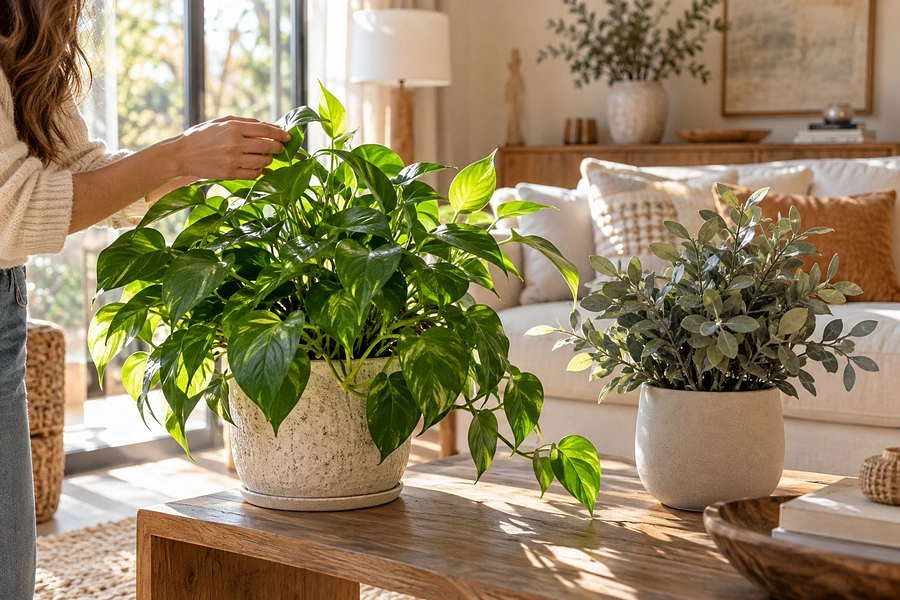
Fake plants can reproduce color, shape, and greenery remarkably well. What they cannot reproduce is the experience of living with something that grows, responds, changes, and needs care.
The fundamental difference between fake and real plants is not simply appearance. Artificial plants are static decorative objects, while real plants are living systems. They grow toward light, produce new leaves, change with seasons and conditions, respond to care, and create opportunities for touch, smell, observation, and interaction that artificial greenery cannot fully reproduce.
A 2026 University of Cambridge study found that 88% of surveyed university students preferred real indoor plants to artificial ones. Participants repeatedly valued growth, change, fragrance, texture, interaction, and the experience of caring for a living organism. Importantly, this was a preference and perception study rather than proof that real plants cause every claimed health benefit.
That distinction helps explain why a very realistic artificial tree can decorate a room beautifully while still providing a different experience from a living ficus, palm, or monstera.
Why Do Real Plants Feel Different From Fake Plants?
The biggest difference is movement through time.
Real plants continuously respond to their environment. Leaves emerge, stems lengthen, flowers open, older foliage changes, and growth shifts according to light, water, temperature, and care. Artificial plants preserve one visual moment indefinitely. That stability is useful for decoration, but it removes the biological change that makes living plants interactive.
Real Plants Are Never Completely Finished
When I place an artificial olive tree in a corner, I can bend the branches until the silhouette looks natural.
Then the design is largely finished.
Six months later, the tree should look almost exactly the same apart from dust or accidental movement.
A living plant behaves differently.
A new leaf may appear.
A stem may turn toward a brighter window.
One side may become fuller.
A flower may open.
A leaf may yellow and need to be removed.
The plant slowly changes the composition of the room.
The 2026 Cambridge study found that participants specifically valued this developmental quality. Respondents described living plants as things that transform over time rather than remaining visually fixed.
That makes a real plant less predictable.
It also makes it more engaging.
Growth Creates Visual Variation Automatically
Designers often work hard to make artificial plants less symmetrical.
They bend branches.
Rotate leaves.
Adjust stems.
Introduce gaps.
The reason is simple: perfect repetition looks manufactured.
Living plants create irregularity naturally.
They respond differently to:
- Light direction
- Water availability
- New growth
- Pruning
- Seasonal changes
- Room conditions
That means the silhouette is not permanently locked.
A monstera may develop larger leaves.
A trailing pothos may extend toward the floor.
An orchid may flower and later become primarily foliage.
This continual change is difficult to simulate with a static object.
Real Plants Occupy the Senses Differently
Artificial greenery primarily operates visually.
Premium faux plants can add realistic texture, and people can certainly touch them, but living plants may add more sensory variation.
The Cambridge survey found respondents describing real plants as multisensory because they could provide texture, fragrance, changing form, shadows, and tactile interaction. Real plants were preferred to artificial plants, cut flowers, and two-dimensional plant representations by many respondents for precisely this reason.
A fragrant jasmine is not only green.
An herb garden is not only decorative.
A flowering plant is not visually identical from week to week.
That sensory variability is part of the difference.
Does Caring for Real Plants Actually Change the Experience?
Yes. The need for care can be an inconvenience, but it is also one of the qualities artificial plants cannot reproduce.
Watering, pruning, rotating, propagating, repotting, and monitoring a living plant create repeated interactions between a person and the space. In the 2026 Cambridge survey, participants associated caring for plants with emotional engagement, fulfilment, attachment, and a stronger sense of connection to their surroundings. Artificial plants remove most of that relationship because they require cleaning rather than cultivation.
Care Creates a Feedback Loop
With a real plant, I do something and observe what happens.
I move it closer to light.
New growth becomes stronger.
I forget to water it.
Leaves droop.
I prune one stem.
New branching appears.
That feedback creates an interaction.
Artificial plants do not respond.
I can dust a fake tree and reshape its leaves, but the tree does not biologically change because of what I did.
This is what makes the word static useful.
It is not an insult to artificial plants.
It describes their function accurately.
They are designed to maintain a controlled appearance.
Growth Can Create Attachment
The Cambridge study found that some respondents described caring for indoor plants almost as developing a relationship with them. Participants valued watching plants develop, propagate, flower, or recover after care.
That attachment can also connect people more strongly to a room.
A plant is no longer simply:
the green object beside the sofa.
It becomes:
the plant I propagated last year,
or:
the ficus that finally grew new leaves after I moved it.
Artificial plants can still have sentimental value, but that value usually comes from the person, event, or place associated with them rather than a biological relationship developing over time.
Maintenance Is Both the Advantage and the Problem
The same characteristic that makes real plants engaging also makes them unsuitable for some environments.
Living plants need the correct combination of:
- Light
- Water
- Temperature
- Humidity
- Growing medium
- Nutrients
- Space
The Royal Horticultural Society emphasizes that plant selection should match the actual indoor environment because light, temperature, and humidity vary significantly between locations.
This means real plants are not automatically the correct answer.
If a hotel corridor has insufficient usable light, a living tree may slowly decline.
If a homeowner travels constantly, a demanding plant may become a burden.
If a commercial facility cannot provide horticultural maintenance, unhealthy living greenery may look worse than premium artificial foliage.
The difference is therefore not:
real good, fake bad.
It is:
living and static materials solve different problems.
Do Real Plants Really Improve Indoor Air More Than Fake Plants?
Real plants perform photosynthesis and biological processes that artificial plants cannot, but this subject is often exaggerated.
Real plants should not be treated as effective substitutes for ventilation or air filtration. A major peer-reviewed analysis found that ordinary potted plants remove indoor volatile organic compounds far too slowly to meaningfully compete with normal building air exchange. Their strongest everyday value indoors is better understood through nature connection, visual experience, interaction, and wellbeing rather than as household air-purification equipment.
The “Plants Clean the Air” Claim Needs Context
Many people have heard that houseplants purify indoor air.
That idea came partly from small chamber experiments where plants were shown to remove certain volatile organic compounds.
The problem is scale.
Researchers Bryan Cummings and Michael Waring reviewed 12 earlier studies and standardized 196 experimental results.
Their analysis found that the pollutant-removal rate of normal potted plants was extremely low compared with ventilation in real buildings. Depending on the conditions, roughly 10 to 1,000 plants per square meter of floor area would be required to compete with ordinary air exchange.
So I would not buy a monstera because I expect it to function like an air purifier.
For actual indoor-air-quality management, source control, appropriate ventilation, and filtration are much more important.
Real Plants Still Perform Biological Processes
This does not mean a living plant is biologically equivalent to plastic foliage.
It obviously is not.
Living plants:
photosynthesize,
respire,
transpire,
grow,
and exchange water and gases with their environment.
The RHS explains that plants lose water through leaf pores through transpiration, with the rate affected by humidity and other environmental conditions.
Artificial plants perform none of these processes.
The important point is to describe that biological distinction accurately without turning one potted plant into an HVAC system.
The Stronger Difference Is Experiential
The 2026 Cambridge research is useful here.
Students frequently believed real plants improved air quality, but the study also documented reasons unrelated to that belief:
- They liked watching plants grow.
- They valued fragrance.
- They touched the foliage.
- They enjoyed caring for plants.
- They considered real plants more authentic.
- They felt more connected to nature around living plants.
Those experiential qualities do not depend on exaggerated air-cleaning claims.
They exist because the plant is alive.
Are Fake Plants Still Useful If Real Plants Provide More Interaction?
Absolutely. Static can be a benefit.
Artificial plants are useful precisely because they do not grow, wilt, require watering, respond to low light, drop leaves, or change unpredictably. They provide controlled greenery in places where living plants would be difficult to maintain. The mistake is expecting artificial plants to deliver every sensory and interactive quality of living vegetation simply because they reproduce its appearance.
Artificial Plants Provide Predictability
A commercial designer may need a tree to remain exactly:
eight feet tall,
five feet wide,
and consistently green.
A real tree does not sign that contract.
A high-quality artificial tree can.
That makes faux greenery useful in:
- Windowless spaces
- Difficult commercial interiors
- Seasonal displays
- Vacation properties
- High shelves
- Short-term events
- Retail installations
- Areas with unreliable maintenance
There are environments where predictable appearance is more important than biological interaction.
Artificial Plants Can Solve Light Problems
The RHS notes that many living houseplants struggle when positioned far from windows and that normal domestic lighting is often inadequate for plant growth unless suitable supplemental grow lighting is provided.
Artificial greenery has no such requirement.
I can place a faux ficus in a dark corridor.
I can put an artificial olive tree in a windowless conference room.
Its visual condition will not deteriorate because photosynthetic light is insufficient.
That is a legitimate design advantage.
Artificial Plants Can Be Highly Realistic
Modern molded foliage, detailed trunks, varied leaf colors, and wired branches can make high-quality faux trees extremely convincing.
But realism does not turn them into living plants.
This is where I think the distinction becomes useful:
visual realism is not biological equivalence.
A premium artificial olive tree might look more perfect than a struggling real olive tree.
The real tree still grows and responds.
The fake tree still remains essentially static.
Both facts can be true.
Fake Plants Can Support a Nature-Inspired Aesthetic
Biophilic design is broader than simply putting potted living plants everywhere.
It can involve:
- Natural light
- Views outdoors
- Natural materials
- Organic forms
- Water
- Greenery
- Nature-related patterns
A current 2026 commercial biophilic-design discussion similarly emphasizes that plants are only one part of nature-connected design and that different spaces may call for different strategies.
That means artificial plants can still contribute visually to a nature-inspired interior.
They simply do not provide the complete experience of living vegetation.
Why Does “Static Versus Living” Matter in Interior Design?
The distinction changes how I think about greenery as a design material.
Artificial plants behave like furniture or sculpture: I select their size, shape, and position, then expect them to remain stable. Real plants behave like living design assets: their appearance depends on environmental conditions and continued care, and their growth introduces change into the interior. Designing successfully with plants therefore requires planning for their future condition, not just their installation-day appearance.
Real Plants Introduce Time Into a Room
Most interior objects are static.
A chair does not grow.
A lamp does not unfold new surfaces.
A marble table does not turn toward sunlight.
A real plant does.
That introduces time as part of the design.
A small plant can become large.
A climbing plant can cover a support.
A tree may need pruning.
Leaves may orient toward light.
The room slowly changes.
This is one reason living plants can make an interior feel less staged.
Living Plants Must Be Designed Around Their Environment
I cannot choose a plant only because it looks beautiful in a rendering.
I have to consider:
- Actual usable light
- Distance from windows
- HVAC drafts
- Temperature
- Humidity
- Access for watering
- Drainage
- Mature dimensions
- Maintenance access
Current commercial biophilic-design guidance stresses exactly this point: living plant installations need environmental and operational planning because plants respond continuously to their surroundings.
This is fundamentally different from specifying an artificial tree.
Maintenance Becomes Part of the Design
For a faux plant, maintenance largely means:
dusting,
cleaning,
and occasional reshaping.
For a real plant, maintenance influences the appearance itself.
If horticultural care fails, the design fails.
That means a commercial project should ask:
Who waters it?
Who prunes it?
Who replaces declining specimens?
Can maintenance staff reach it?
Is there enough light?
How will it look after twelve months?
Those questions are not separate from design.
They are part of designing with something alive.
My insights: Fake Plants are static. Real plants make the difference
After comparing current 2026 research on indoor-plant preferences with established indoor-air-quality evidence, I think the strongest argument for real plants has little to do with claiming that artificial plants are ugly or that houseplants dramatically purify a building.
Fake plants are static. Real plants make the difference because living plants introduce growth, response, care, sensory variation, and change into an interior. Artificial plants can reproduce the visual form of nature and are often more practical, but they cannot reproduce the ongoing relationship created by a living organism responding to its environment.
My First Insight: The Difference Is a Process, Not an Appearance
This is the most important point.
A photograph captures a moment.
In one photograph, an excellent artificial plant may look almost indistinguishable from a living one.
But come back six months later.
The artificial tree should look essentially unchanged.
The real plant may have:
grown,
flowered,
leaned,
been pruned,
lost old leaves,
or produced new ones.
The difference becomes visible through time.
That is why I see real plants as processes rather than objects.
My Second Insight: Interaction May Matter More Than Perfection
Artificial plants can be more visually perfect.
Every leaf can stay green.
Nothing wilts.
No branch grows in the wrong direction.
But perfect stability is not necessarily the same as a stronger experience.
The Cambridge study suggests that participants valued exactly the qualities that make real plants less predictable: fragility, growth, change, smell, texture, and the act of caring for them.
In that survey, 88% preferred real plants over fake ones.
I would not generalize that number to every population because the respondents were university students and the research relied on surveys collected between 2022 and 2023.
But the reasons they gave are revealing.
People were responding to aliveness, not simply greenness.
My Third Insight: Real Plants Should Not Be Sold Through Bad Science
I think the case for living plants becomes stronger when exaggerated claims are removed.
Houseplants should not be promoted as a replacement for proper ventilation or filtration.
The Cummings and Waring review found that passive VOC removal by ordinary potted plants is far too small to provide meaningful air-cleaning performance in normal buildings.
Real plants do not need an exaggerated “air purifier” story to have value.
They already offer something artificial plants cannot:
living interaction.
That is a more defensible argument.
My Fourth Insight: Fake Plants Are Best Where Stability Is the Requirement
If I need a tree in:
a dark hallway,
an inaccessible ledge,
an occasionally occupied property,
or a location where no one can provide reliable horticultural maintenance,
I may choose artificial.
That is not a design failure.
It is appropriate specification.
The RHS makes clear that real plants have specific environmental requirements and that location strongly influences whether they thrive.
I would rather use one excellent artificial tree than force a real tree to slowly decline in unsuitable conditions.
My Fifth Insight: Real Plants Are Strongest Where People Can Experience Them
If I choose living plants, I want them where their aliveness matters.
Good locations include:
- Desks
- Dining areas
- Kitchens
- Living rooms
- Reception spaces
- Breakout spaces
- Areas near seating
- Places where people pass regularly
The Cambridge research found value in three-dimensional interaction and suggested that distributing plants throughout spaces can strengthen perceived connection to nature. Participants also valued touching, smelling, observing, and caring for plants.
That means I do not necessarily want one enormous plant hidden in a distant corner.
Several thoughtfully located living plants may create more opportunities for everyday interaction.
My Sixth Insight: Hybrid Interiors Often Make the Most Sense
I do not think interiors need to choose a team:
100% real
or
100% fake.
A more intelligent strategy might be:
| Location | Plant approach |
|---|---|
| Bright living-room window | Real plant |
| Kitchen herbs | Real |
| Desk | Small real plant |
| Dark hallway | High-quality artificial |
| High inaccessible shelf | Artificial |
| Windowless meeting room | Artificial or horticultural lighting + real |
| Main lobby focal tree | Real if professionally maintained |
| Temporary retail display | Artificial |
| Large biophilic installation | Living where operationally practical |
This lets living plants provide interaction where the environment supports them and artificial greenery provide dependable visual coverage where it does not.
My Seventh Insight: A Healthy Real Plant Beats the Idea of a Real Plant
This deserves emphasis.
A dying living plant does not automatically create a stronger interior than a beautiful artificial one.
Brown leaves, pests, sparse growth, and stressed foliage can undermine the intended connection to nature.
That is why plant selection matters.
The RHS recommends matching plants to actual light, humidity, and temperature conditions rather than choosing species only for appearance.
For commercial projects, current 2026 biophilic-design guidance similarly emphasizes that plant health, horticultural knowledge, maintenance access, HVAC conditions, and replacement planning must be considered from the beginning.
The real goal is not simply:
use something alive.
It is:
create conditions where living greenery can remain alive and visually successful.
My Final View
“Fake plants are static. Real plants make the difference” captures a real distinction, but I would not use it to dismiss artificial greenery.
Fake plants succeed by staying still.
That is their advantage.
They provide greenery without requiring the room to support a living organism.
They can occupy dark corners.
They can maintain a specific height.
They can create permanent visual structure.
They can look excellent for years with cleaning and occasional reshaping.
Real plants offer something different.
They introduce time.
A new leaf appears.
A stem turns.
A flower opens.
The plant becomes larger.
Someone waters it.
Someone notices that it needs more light.
Someone propagates it and creates another plant.
Those repeated changes transform greenery from a static visual reference to nature into an ongoing interaction with nature.
Current research supports the importance of that distinction. In the Cambridge 2026 study, participants overwhelmingly preferred real plants and repeatedly described growth, change, touch, fragrance, care, and emotional attachment as reasons.
At the same time, science gives us an important boundary: ordinary houseplants should not be marketed as powerful indoor air cleaners. Ventilation and appropriate filtration remain far more important for managing indoor pollutants.
So I would not say real plants are better because they perform miracles.
I would say they are different because they are alive.
And in a built environment filled mostly with static materials—walls, furniture, glass, stone, metal, plastics, and screens—that small amount of growth and change can make a meaningful experiential difference.
Conclusion
Fake plants preserve an image of nature. Real plants introduce growth, change, care, and interaction. Use artificial greenery where stability matters and living plants where their aliveness can genuinely be experienced.

