


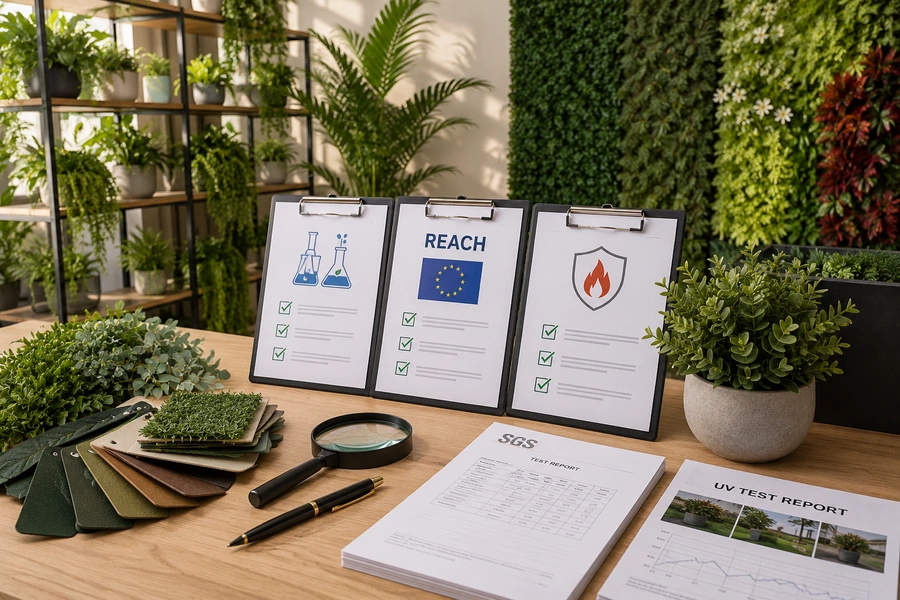
Faux plants can pass one test yet fail another, leaving buyers exposed to chemical restrictions, fading claims, rejected venues, delayed projects, and costly replacements.
Faux plant compliance requires three separate checks: REACH chemical obligations for the intended market, documented UV weathering performance for the exact product, and fire-test evidence accepted by the venue or authority. None is a universal certification, so buyers must verify scope, edition, sample identity, test conditions, results, and production consistency.
A polished certificate is not enough. It may cover only raw plastic, one leaf material, an outdated product, or a sample that differs from the goods being purchased. I therefore connect every document to the exact SKU, components, production revision, batch, installation environment, and destination market.
What Certifications Do Faux Plants Actually Need?
There is no single international certificate that automatically proves an artificial plant is chemically compliant, UV-resistant, fire-retardant, outdoor-safe, and acceptable for every commercial building.
The documents required for faux plants depend on the destination country, product materials, indoor or outdoor use, installation type, customer contract, and locally adopted building rules. REACH addresses chemical obligations in the EU, UV standards evaluate weathering, and fire standards measure flame behavior. They are separate compliance areas.
Certification, regulation, and testing are different
Buyers often use the word “certification” for every laboratory document. I separate the terms more carefully.
| Document or Requirement | What It Does | What It Does Not Prove |
|---|---|---|
| REACH declaration | States chemical compliance for an identified product and market | Outdoor durability or fire performance |
| Chemical test report | Reports results for selected substances | Compliance with substances that were not tested |
| ASTM UV report | Describes accelerated weathering exposure and changes | A guaranteed number of outdoor years |
| Fire-test report | Records performance under one test method | Acceptance in every venue or country |
| Supplier specification | Defines materials and construction | Independent verification |
| Inspection report | Confirms sampled production matches specifications | Long-term performance by itself |
| Warranty | Defines a commercial remedy | Regulatory compliance |
REACH is an EU chemical regulation supported by lists, restrictions, communication duties, and supply-chain obligations. ASTM G154 and G155 are laboratory exposure practices. Fire requirements are determined by the adopted code, test method, occupancy, installation, and reviewing authority.
“Certified” must always be followed by five questions
Whenever a supplier says that a faux plant is certified, I ask:
- Certified or tested to what requirement?
- Which exact standard and edition were used?
- Which product, SKU, color, and components were tested?
- Which laboratory issued the report?
- What result and acceptance limit were recorded?
A statement such as “REACH, UV, and fire certified” is too broad for a purchase order.
A stronger statement would identify:
- Product name and SKU
- Leaf, stem, trunk, backing, glue, and coating
- Destination market
- Relevant substance list
- UV test method and cycle
- Fire-test method
- Report numbers
- Laboratory
- Production date
- Approved product construction
Build one compliance matrix for every project
I recommend creating a simple project matrix before requesting quotations.
| Project Condition | Evidence to Request |
|---|---|
| EU retail product | REACH assessment and supporting chemical evidence |
| Outdoor hotel planter | UV report, installation specification, warranty |
| Indoor hotel lobby tree | Fire documentation required by project or venue |
| Green wall in public space | Chemical, fire, fixing, and maintenance documents |
| Outdoor green wall | REACH, UV, fire where required, structural details |
| Event installation | Venue-approved fire documentation and safe fixing |
| Custom-colored product | Updated chemical and UV review for the new formulation |
Changing a pigment, plasticizer, coating, adhesive, backing, or flame-retardant additive can affect the compliance package. Product changes should trigger document review rather than automatic reuse of an older report.
How Does REACH Apply to Artificial Plants?
REACH does not approve artificial plants through one universal certificate. It controls substances and creates obligations for companies manufacturing, importing, or supplying chemicals, mixtures, and articles in the EU and EEA.
Artificial plants are normally treated as articles or complex objects containing several articles and materials. Buyers should review REACH Annex XVII restrictions, Candidate List substances, supplier communication duties, and possible SCIP obligations. Testing should follow the actual bill of materials instead of using one generic chemical panel for every faux plant.
Start with a component map
A faux tree may contain:
- PE leaves
- PVC stem sleeves
- Polyester flowers
- PU coatings
- Metal wire
- Fiberglass or molded trunks
- Natural wood
- Adhesives
- Pigments
- UV stabilizers
- Flame-retardant additives
- Foam
- Plastic or metal planter components
Each material can create a different chemical question.
I therefore divide the product into homogeneous or practical component groups before building the test plan.
| Component | Possible Compliance Focus |
|---|---|
| Flexible polymer leaves or sleeves | Restricted plasticizers and relevant additives |
| Pigments and coatings | Restricted substances relevant to formulation |
| Textile petals | Dyes, coatings, and relevant restrictions |
| Adhesives | Chemical composition and Candidate List screening |
| Metal wire or parts | Restricted substances relevant to intended use |
| UV additives | Candidate List, restriction, or other chemical status |
| Flame-retardant system | Chemical status plus fire performance |
| Recycled plastic | Greater need for traceable input control |
ECHA maintains the REACH Candidate List and Annex XVII Restriction List. Annex XVII entries include specific substances, product scopes, concentration limits, and conditions, so a laboratory test plan must match the materials and intended market.
REACH compliance is broader than a laboratory report
A laboratory can test selected chemicals, but it cannot prove compliance with substances that were not included in the test request.
My REACH review normally includes:
- Bill of materials.
- Supplier substance declarations.
- Current Candidate List screening.
- Applicable Annex XVII entries.
- Targeted laboratory testing.
- Assessment of new pigments, coatings, additives, and recycled content.
- Product identity and revision control.
- EU importer or responsible supply-chain information where applicable.
I would not accept a report titled only “REACH Test” without seeing the substance list and legal basis used.
Candidate List substances require special attention
The Candidate List contains substances of very high concern and is updated by ECHA. REACH Articles 7 and 33 can create obligations for articles containing Candidate List substances, depending on concentration, quantity, exposure, and supply-chain circumstances. ECHA’s current Candidate List identifies the relevant legal obligations attached to listed substances.
When a Candidate List substance exceeds 0.1% weight by weight in an article, communication duties can apply. Separate SCIP notification duties under the EU Waste Framework Directive can also apply to suppliers placing qualifying articles or complex objects on the EU market.
This is important for complex faux plants.
A complete artificial tree may contain several component articles. Buyers should not assume that averaging one substance across the total tree weight always resolves the assessment.
UV additives must also pass the chemical review
A product may need UV stabilizers to resist outdoor fading, but the chosen additive must still be suitable for the destination market.
For example, ECHA documentation identifies UV-328 as a substance of very high concern and describes regulatory controls connected with its use in plastics and articles. This shows why “contains UV absorber” is not enough information. Buyers need the additive identity and regulatory status.
A UV-resistant formulation can perform well in a weathering chamber while creating a separate chemical-compliance concern.
My recommended REACH document package
| Document | Required Detail |
|---|---|
| Supplier declaration | Exact company, product, SKU, revision, and market |
| Bill of materials | Major materials and components |
| Annex XVII assessment | Applicable entries and conclusions |
| Candidate List declaration | List date and concentration conclusion |
| Test reports | Component identity, methods, detection limits, and results |
| SCIP information | Where legally applicable |
| Change-control statement | Notification before material changes |
| Production traceability | Batch or manufacturing period |
I would place these requirements in the purchase order.
A short declaration saying “all products comply with REACH” can support the file, but it should not replace traceable material and testing evidence.
What Does UV-Tested Mean for Faux Plants?
UV testing does not certify a plant as permanently fade-proof. It exposes a material or product to controlled light, temperature, and sometimes moisture so buyers can compare changes.
A useful faux-plant UV report identifies the exact test specimen, ASTM or ISO method, lamp or filter, irradiance, temperature, moisture cycle, duration, replicates, evaluation method, and acceptance criteria. ASTM G154 and G155 control exposure equipment and conditions, but they do not automatically define a product-specific pass result or outdoor lifespan.
ASTM G154 and ASTM G155 are not interchangeable labels
ASTM currently lists:
- ASTM G154-23 for fluorescent-ultraviolet lamp apparatus.
- ASTM G155-25 for xenon-arc lamp apparatus.
- ASTM D4329-21 for fluorescent-UV exposure procedures specifically applicable to plastics using G154 equipment.
ASTM G154 uses fluorescent UV exposure and controlled environmental conditions.
ASTM G155 uses optically filtered xenon-arc light under controlled conditions. Filter combinations can be selected to represent different exposure environments.
Neither standard should be reduced to the phrase “UV tested.”
A complete UV report should show the cycle
I request:
| Report Item | Why It Matters |
|---|---|
| Exact SKU and color | Different pigments can age differently |
| Tested component | Leaf, flower, stem, coating, or complete product |
| Test standard and edition | Confirms the method used |
| Lamp or filter | Defines the radiation source |
| Irradiance | Defines exposure intensity |
| Black-panel or chamber temperature | Heat affects degradation |
| Moisture cycle | Condensation or spray affects performance |
| Exposure hours | Records duration, not outdoor years |
| Number of specimens | Supports repeatability |
| Control sample | Supports comparison |
| Evaluation method | Defines how change was measured |
| Acceptance limit | Converts results into a buying decision |
ASTM states that G154 and G155 provide exposure practices rather than one universal result. Different conditions can produce different outcomes.
Measure more than visible fading
A faux plant can remain green but still become brittle.
My outdoor performance review can include:
- Instrumental color change
- Visual color rating
- Gloss change
- Cracking
- Chalking
- Brittleness
- Leaf tearing
- Coating adhesion
- Leaf-to-stem attachment
- Stem flexibility
- Backing-grid strength
- Glue failure
For green-wall panels, I would test the foliage and the backing.
For flowering plants, I would evaluate every important color separately. A red bougainvillea pigment may age differently from the green leaves attached to the same product.
Do not convert laboratory hours directly into years
A supplier may claim:
1,000 laboratory hours equals five outdoor years.
I would reject that conversion unless the supplier provides validated correlation for the exact material, product design, exposure cycle, climate, orientation, and failure criterion.
ASTM G154 and G155 do not establish a universal hours-to-years formula. They provide controlled accelerated exposure so materials can be compared under reported conditions.
Create a project-specific pass requirement
The buyer must define what is acceptable.
An example procurement requirement might state:
- No cracking or leaf loss.
- No significant loss of flexibility.
- Color change below an agreed instrumental limit.
- No visible coating separation.
- Leaf attachment remains functional.
- Tested under the agreed cycle for the stated duration.
The actual limits should match the hotel, retail, event, residential, or landscape application.
A green wall viewed from ten meters may tolerate more color change than a premium topiary placed beside a hotel entrance.
Which Fire-Retardant Standards Should Buyers Request?
“Fire retardant,” “flame resistant,” and “fireproof” are frequently used as though they mean the same thing. They do not provide enough information for commercial approval.
Buyers should first ask the venue, designer, code consultant, or authority which fire standard and edition apply. In U.S. projects, artificial decorative vegetation may need NFPA 701 Test Method 1 or 2 evidence under the adopted fire code. The report must cover the relevant product construction rather than an unrelated raw material.
NFPA 701 is a test method, not universal venue approval
The 2024 International Fire Code states that artificial decorative vegetation covered by its provisions must meet the flame-propagation criteria of NFPA 701 Test Method 1 or Test Method 2, as appropriate. It also provides an alternative route involving NFPA 289.
The applicable route depends on factors such as:
- Product construction
- Material form
- Installation
- Occupancy
- Adopted code
- Venue policy
- Reviewing authority
A product that passes one fire test is not automatically approved for every wall, ceiling, lobby, event venue, hotel, or shopping center.
Test the production construction
A faux green wall can include:
- Leaves
- Backing grid
- Fasteners
- Adhesives
- Fabric
- Foam
- Decorative flowers
- Added logos or lighting
Testing only one loose leaf may not represent the complete installed system.
I ask whether the report covers:
| Product Area | Verification Question |
|---|---|
| Foliage | Is the tested formulation identical? |
| Backing | Was the grid or fabric included? |
| Adhesive | Is the same glue used in production? |
| Coating | Was the tested product coated? |
| Added flowers | Are they covered by the report? |
| Trunk or frame | Does the project require separate review? |
| Product density | Does production match the tested specimen? |
| Color variants | Do pigments or additives change the formulation? |
Understand how fire performance is created
Artificial plants can use different approaches:
- Flame-retardant additives compounded into the polymer
- Treated textile leaves or petals
- Factory-applied coatings
- Post-production topical treatment
- A combination system
Compounded protection can reduce dependence on a surface coating, but it still needs relevant testing.
Topical treatments can be useful, but buyers need to know:
- Which material was treated
- Application rate
- Drying or curing conditions
- Whether cleaning affects the treatment
- Whether retreatment is needed
- Whether the tested specimen matches production
Request a complete fire report
My fire-document checklist includes:
- Product and SKU.
- Product photographs.
- Materials and construction.
- Test standard.
- Test-method number.
- Standard edition.
- Laboratory identity.
- Report number and date.
- Specimen conditioning.
- Number and dimensions of specimens.
- Recorded results.
- Pass/fail conclusion.
- Any limitations.
- Confirmation that production matches the tested sample.
I also request a written supplier statement confirming that no unapproved material change will be made.
Avoid the word “fireproof”
Artificial foliage can still burn, melt, deform, smoke, or be damaged by heat.
A more accurate product description is:
Tested to the stated flame-performance method under the reported conditions.
Commercial installations should also remain away from candles, open flames, hot lighting, heating equipment, and other ignition sources where required. NFPA development material specifically addresses combustible artificial decorative vegetation and controls concerning open flames.
My insights: What Should Buyers Verify in a Faux Plants Certifications Guide Covering REACH, UV, and Fire Retardancy?
The biggest sourcing error is collecting three impressive-looking certificates without checking whether they describe the same product.
Buyers should verify faux plants through one connected compliance file. The REACH assessment, UV report, fire evidence, product specification, and inspection record should identify the same SKU, materials, colors, construction, factory, and revision. The strongest documents become weak when production no longer matches the samples that were assessed or tested.
My five-layer verification model
| Layer | Main Question |
|---|---|
| 1. Market | Where will the product be sold and installed? |
| 2. Product | What exact materials and components are included? |
| 3. Test | Which method and conditions were used? |
| 4. Production | Does bulk production match the tested sample? |
| 5. Installation | Will the venue or authority accept the evidence? |
REACH, UV, and fire testing can affect each other
These three requirements should not be managed by separate teams without communication.
For example:
- A UV absorber may affect chemical compliance.
- A flame-retardant additive may change color or outdoor aging.
- A surface UV coating may alter fire behavior.
- A pigment change may affect REACH screening and fading.
- Recycled plastic may change chemical consistency.
- A new adhesive may affect both chemical and fire documentation.
This is why I treat compliance as a product-development process rather than paperwork completed after manufacturing.
Test the finished product whenever practical
Raw-resin reports provide useful supporting information.
They do not automatically represent:
- Pigments
- Recycled content
- Adhesives
- Coatings
- Textile flowers
- Wire sleeves
- Assembly processes
For UV performance, I prefer finished leaves or completed product sections.
For fire performance, I prefer the production construction required by the applicable test.
For REACH, I use component-level chemical analysis based on the actual bill of materials.
Add compliance requirements to the purchase order
My purchase order would state:
- Approved SKU and product drawing
- Materials and formulations
- Prohibited substitutions
- Required REACH declaration
- Required substance testing
- Required UV method and pass limits
- Required fire test and edition
- Report identification
- Change-notification requirement
- Pre-shipment inspection
- Corrective action for non-compliance
This makes the documents commercially enforceable instead of optional sales attachments.
Audit the reports before paying the balance
I check for common warning signs:
| Warning Sign | Buyer Risk |
|---|---|
| Different supplier name | Report may belong to another company |
| Missing SKU | Product scope is unclear |
| Old product photograph | Construction may have changed |
| Raw-material-only test | Finished product is not represented |
| Unreadable report number | Authenticity is difficult to verify |
| No test conditions | UV result cannot be interpreted |
| No acceptance criteria | “Passed” has no defined meaning |
| Different color | Pigment or additive system may differ |
| Missing laboratory pages | Results may be incomplete |
| Edited PDF | Document integrity is uncertain |
I would verify important reports directly with the laboratory when the order value, project risk, or venue requirement justifies it.
My final compliance rule
A reliable faux-plant compliance file should answer four questions clearly:
What exact product was assessed?
Which legal requirement or test method was applied?
What were the actual conditions and results?
Does current production still match the assessed sample?
When any answer is missing, the buyer has a marketing claim rather than a complete compliance system.
Conclusion
Verify REACH, UV, and fire evidence separately, then connect every report to the same SKU, materials, production revision, destination market, and installation requirement.