
Are you struggling to make your cake decor pop? Many bakers find it tough to get artificial flowers and cake styles to work together. This often leads to designs that just don’t feel right.
Matching artificial flower colors with your cake’s style is simpler than you think. Focus on the cake’s theme, colors, and the overall mood you want to create. This will make your cake look professional and stunning every time.
Successfully integrating artificial flowers into cake designs requires understanding color theory and design principles. This approach ensures a cohesive and visually appealing result.
How to arrange artificial flowers on a cake?
Do you ever wonder how to make artificial flowers look natural on a cake? Many people struggle with placement, making their cake decorations look stiff or out of place. This can make a beautiful cake seem less appealing.
Arranging artificial flowers on a cake requires careful planning and a good eye for balance. Start by deciding on your focal points and then build around them. This creates a cohesive and visually pleasing design that enhances the cake.
Effective arrangement transforms a simple cake into a centerpiece. Attention to detail in placement and securing methods is key to achieving a professional finish.
Preparing Flowers for Cake Use
Before placing flowers, proper preparation is essential. This includes ensuring cleanliness and food safety, especially for artificial flowers for cake decoration.
- Cleaning: Wipe flowers with a damp cloth to remove dust. Let them dry completely.
- Stem Trimming: Cut stems to the desired length. Use floral wire for shaping or creating attachment points if needed.
- Food Safety Measures: For direct contact with the cake, use food safe artificial flowers. If flowers are not certified food safe flowers for cakes, create a protective barrier around the stems.
Barrier Methods for Flower Stems
| Method | Description | Benefits |
|---|---|---|
| Floral Tape | Wrap stems tightly with food-safe floral tape. | Easy to apply, provides a good barrier. |
| Drinking Straws | Insert stems into small, cut-down drinking straws. | Simple, effective for thicker stems. |
| Flower Picks | Use specialized plastic flower picks designed for cakes. | Very secure, easy to remove. |
| Fondant/Gum Paste | Create small fondant sleeves or holders for the stems. | Edible, blends seamlessly with the cake. |
Designing the Floral Layout
Consider the cake’s dimensions and structure when planning the layout. The design should complement the cake, not overpower it.
- Focal Points: Identify areas where you want to draw attention. These could be larger flower clusters.
- Balance: Distribute flowers to achieve visual harmony. This can be symmetrical or asymmetrical, as long as it feels balanced.
- Flow: Use smaller blooms or greenery to connect larger elements. This guides the eye across the cake naturally.
For a fake flowers for wedding cake, consider a cascading design. Start at the top and let flowers gently trail down the sides, creating a sense of movement.
Securing Flowers on the Cake
Once the design is planned, secure the flowers firmly while maintaining food safety.
- Direct Insertion (with barrier): Gently push prepared stems (with food-safe barriers) into the cake.
- Piping Gel/Royal Icing: For lighter flowers or leaves, a small amount of piping gel or royal icing can provide adhesion.
- Internal Supports: For heavier arrangements, use hidden dowels or structural supports within the cake. This prevents flowers from sinking into the cake layers.
Testing the arrangement before final placement can prevent damage and ensure stability.
What are the realest looking fake flowers?
Are you tired of artificial flowers that clearly look fake? Many customers want the beauty of real flowers without the hassle, but struggle to find realistic options. This often leads to disappointment and a less elegant display.
The realest looking fake flowers are crafted with high-quality materials and attention to detail. Look for silk, latex, or "real touch" flowers with natural color variations and realistic textures. These mimic nature’s imperfections perfectly.
Achieving realism in artificial flowers involves selecting advanced materials and manufacturing techniques. These methods aim to replicate the intricate details found in natural blooms.
Materials That Mimic Nature Best
The material composition significantly influences the realism of artificial flowers. Certain materials offer superior tactile and visual qualities.
- High-Quality Silk: This material provides a soft, delicate appearance. It allows for intricate coloring and shaping.
- Latex Flowers: These flowers possess a smooth, almost waxy surface. They are often used for blooms with thicker petals.
- "Real Touch" or PU Material: Made from polyurethane, these flowers have a remarkably natural feel. They can be molded to replicate the subtle curves and textures of fresh flowers.
Comparison of Realistic Flower Materials
| Material | Texture/Feel | Realism Level | Durability | Common Applications |
|---|---|---|---|---|
| High-Quality Silk | Soft, fabric-like | High | Good | Roses, Peonies, Hydrangeas |
| Latex | Smooth, slightly waxy | Very High | Excellent | Orchids, Lilies, Calla Lilies |
| "Real Touch" (PU) | Soft, rubbery, flexible | Extremely High | Excellent | Roses, Tulips, Peonies, Succulents |
The Importance of Color and Detail
Realistic artificial flowers feature intricate color work and subtle details that enhance their authenticity.
- Color Gradation: Natural flowers exhibit variations in color across their petals. Realistic artificial flowers incorporate subtle shading and lighter or darker edges.
- Veining and Imperfections: Replicating the delicate veins on petals and leaves, along with minor, natural imperfections, adds to the realism.
- Stem and Leaf Fidelity: Stems should have natural bends and textures. Leaves should show slight variations in color, size, and form, avoiding a uniform, manufactured look.
The meticulous study of natural specimens informs the design of high-quality artificial flowers for cake decoration. This ensures faithful reproduction of botanical features.
Craftsmanship and Structural Integrity
The construction method of an artificial flower is crucial for its realistic appearance and durability.
- Petal Arrangement: Petals should be arranged in natural, layered patterns or spirals, avoiding a flat or artificial appearance.
- Internal Wiring: High-quality flowers often contain wires within stems and petals. This allows for gentle shaping and posing, creating a more organic silhouette. This is important for a fake flowers for wedding cake to have a natural drape.
- Three-Dimensional Form: The flower should possess a full, three-dimensional shape, rather than appearing compressed or two-dimensional.
Manufacturers focusing on these details produce artificial flowers that are highly convincing.
How to color a fake flower?
Do you have artificial flowers that are the wrong shade for your cake design? It’s frustrating when you find the perfect bloom, but the color is off. This can limit your creative options and make matching difficult.
You can easily color fake flowers using various methods like spray paint, fabric dye, or acrylic paints. The key is to choose the right medium for your flower’s material. Always test a small, hidden area first to ensure good results.
Customizing the color of artificial flowers offers significant design flexibility. This allows for precise matching to specific cake themes or event palettes.
Choosing the Right Coloring Method
The most suitable coloring method depends on the artificial flower’s material. Different materials interact uniquely with various dyes and paints.
- Spray Paint: Provides quick and even coverage. Select paints formulated for fabrics or plastics.
- Fabric Dye: Ideal for silk or fabric-based flowers. It saturates the fibers, resulting in a soft, natural color.
- Acrylic Paints: Suitable for detailed work or adding accents. They can be diluted for a more translucent effect.
- Alcohol Inks: Offer vibrant, transparent colors. These work effectively on smooth, non-porous surfaces.
Coloring Method Suitability
| Flower Material | Best Coloring Methods | Notes |
|---|---|---|
| Silk/Fabric | Fabric Dye, Spray Paint (fabric-safe) | Dye offers superior fiber penetration. |
| Plastic/PU | Spray Paint (plastic-safe), Acrylics | Ensure proper paint adhesion. |
| Latex | Acrylics, Alcohol Inks | Requires careful testing for adhesion. |
Step-by-Step Coloring Process
A consistent approach ensures optimal results when coloring artificial flowers.
- Preparation: Clean flowers thoroughly and ensure they are dry. Protect your workspace with newspaper or a drop cloth.
- Ventilation: Always work in a well-ventilated area, especially when using spray paints.
- Testing: Apply the chosen coloring agent to a hidden part of the flower or a spare petal. This verifies color accuracy and material compatibility.
- Application: Apply color in thin, even coats. Multiple light coats prevent drips and maintain the flower’s texture.
- Drying: Allow sufficient drying time between coats and before handling. This prevents smudging.
For food safe artificial flowers intended for direct cake contact, use non-toxic coloring agents. If unsure, implement a barrier method.
Tips for Achieving Specific Effects
Coloring techniques can be adapted to create a range of visual effects.
- Ombre Effect: Apply a darker shade to petal tips and gradually lighten towards the center. Use a light hand with spray paint or a sponge for acrylics.
- Distressed Look: Lightly mist a contrasting color over the base. This creates an aged or weathered appearance.
- Highlighting: Use a small brush with a lighter color to emphasize veins or petal edges, adding depth.
- Custom Blends: Mix acrylic paints to create a precise custom shade that perfectly complements the cake’s design.
Experimentation with these techniques allows for highly personalized fake flowers for wedding cake designs.
What to use to arrange artificial flowers?
Are you trying to arrange artificial flowers on a cake but struggling to keep them in place? It’s frustrating when your beautiful design starts to droop or fall apart. This can ruin the presentation of your carefully baked cake.
To arrange artificial flowers securely on a cake, use food-safe floral wire, floral tape, and flower picks. For direct contact, always employ barriers like straws or special flower holders. These tools ensure stability and maintain food safety.
Proper tools and techniques are essential for creating stable and aesthetically pleasing artificial flower arrangements on cakes. This prevents movement and maintains the integrity of the design.
Essential Tools for Arranging Artificial Flowers
The right tools simplify the arrangement process and enhance the final outcome.
- Floral Wire: Used for shaping stems, creating loops, or securing individual blooms. Available in various gauges for different needs.
- Floral Tape: Wraps stems to create a clean finish and can serve as a protective barrier. Typically available in green or white.
- Flower Picks/Tubes: Small plastic tubes or picks designed to hold flower stems. They keep stems separated from the cake, essential for food safe flowers for cakes.
- Scissors/Wire Cutters: Necessary for cleanly trimming stems and cutting floral wire.
- Piping Bags and Tips (for icing): Useful for attaching lightweight elements with icing if needed.
Key Arranging Tools and Their Uses
| Tool | Primary Use | Benefit |
|---|---|---|
| Floral Wire | Shaping, securing individual elements | Flexibility, strong hold |
| Floral Tape | Wrapping stems, creating barriers | Clean finish, protects cake |
| Flower Picks | Holding stems, ensuring food safety | Secure, hygienic, easy to remove |
| Wire Cutters | Cutting wire, trimming plastic stems | Precise cuts, saves effort |
Food Safety First: Protecting Your Cake
When integrating artificial flowers for cake decoration, adhering to food safety guidelines is paramount.
- Barrier Method: Always place a physical barrier between the flower stems and the cake. This is critical even if the flowers are labeled as food safe artificial flowers, as stems may not be.
- Prevent Direct Contact: Ensure unwrapped stems do not touch the cake or frosting. This prevents potential contamination from dyes or materials.
- Separate Components: Consider mounting flower arrangements on a separate, food-safe topper or stand. This completely isolates the flowers from the cake.
Prioritizing food safety protects both the cake and its consumers.
Techniques for Secure Placement
Effective placement techniques ensure artificial flowers remain stable and visually appealing.
- Anchoring Heavy Blooms: For larger flowers, insert a floral pick into the flower base. Then, push the pick into the cake for strong anchoring.
- Building Clusters: Assemble small groups of flowers and greenery. Secure them with floral wire. Then, place the entire cluster onto the cake using a larger pick or attach with icing.
- Creating Cascades: Construct cascading arrangements on a flat, food-safe base. Gently position the entire piece onto the cake. A thin layer of royal icing can secure the base.
- Using Edible Adhesives: For very lightweight leaves or small petals, a small amount of royal icing or edible glue can hold them in place. This works best on firm cake surfaces like fondant.
These methods ensure that artificial flower arrangements remain beautiful and intact throughout any event.
My insights: The Art of Harmonious Cake and Artificial Flower Pairing
Struggling to make your artificial flowers blend seamlessly with your cake? Discover the secret to creating stunning, cohesive designs that elevate any event!
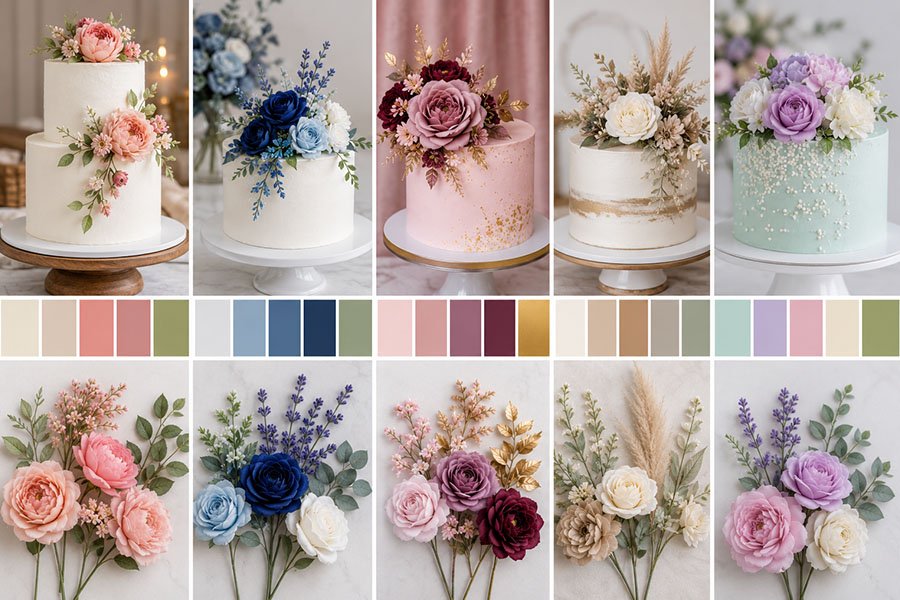
Matching artificial flower colors to your cake’s style involves harmonizing with the frosting color, design complexity, and overall theme. By strategically choosing complementary, contrasting, or monochromatic palettes, you can achieve a visually dynamic and elegant presentation that enhances the cake’s aesthetic and event’s ambiance.
Mastering the Palette: Frosting, Style, and Theory
The key to perfecting artificial flower and cake integration lies in a multi-faceted approach, considering the cake’s primary color, its overall style, and fundamental color theory principles.
Frosting Finesse: A Color Guide
The cake’s frosting color provides the foundational canvas for your floral choices.
| Cake Frosting Color | Recommended Artificial Flower Colors | Achieved Effect |
|---|---|---|
| White/Ivory | Bold (crimson, royal blue) or soft pastels (blush, lavender) | Dramatic contrast or romantic elegance |
| Colored Frosting | Analogous (neighboring on color wheel) or Complementary (opposite) | Harmonious flow or striking vibrancy |
| Naked/Rustic | Warm tones: burnt orange, terracotta, deep pink, mustard yellow | Earthy, organic, complements exposed layers |
| Metallic/Gold | Deep jewel tones (emerald, burgundy, navy) + white accents | Luxurious, sophisticated, opulent |
Style Synchronization: From Classic to Contemporary
Beyond color, the cake’s inherent style dictates the type and arrangement of artificial flowers.
| Cake Style | Flower Color Strategy & Types |
|---|---|
| Classic/Traditional | White/cream roses with subtle greenery; elegant, not overwhelming |
| Modern/Minimalist | Monochromatic (all white, blush, or sage); 1-2 flower types for sleekness |
| Rustic/Naked | Earth tones: olive green, dusty rose; wildflowers, natural textures |
| Bohemian | Mixed vibrant shades; daisies, lilacs, orchids; add berries or succulents |
| Vintage/Romantic | Soft pastels: blush, peach, lavender; roses, peonies for a nostalgic feel |
| Bold/Geek-Chic | Vibrant, unexpected colors matching the specific theme (e.g., turquoise + red) |
Applying Color Theory for Impact
Understanding basic color theory can transform your cake design from good to extraordinary.
- Complementary Colors: Opposites on the color wheel (e.g., blue and orange) create intense, vibrant arrangements, perfect for making a statement.
- Analogous Colors: Neighbors on the color wheel (e.g., blue, teal, violet) produce harmonious, calming, and cohesive designs.
- Rule of Three: Using three distinct flower types or colors often creates a balanced and aesthetically pleasing arrangement.
- Neutral Base: Starting with neutral artificial flowers (white, cream) offers maximum flexibility and can be easily accented with pops of color.
Practical Tips for Flawless Floral Cake Decor
To ensure your artificial flower decorations are both beautiful and safe, consider these practical tips:
- Quality Matters: Invest in high-quality faux flowers that authentically mimic the texture and color variations of real blooms. This elevates the overall look of your cake.
- Event Cohesion: For a unified aesthetic, select artificial flowers that align with the broader event decor, such as those used in bouquets or centerpieces.
- Seasonal Sensibility: While artificial flowers are timeless, aligning their colors with the season (e.g., pastels for spring, warm tones for fall) can enhance the thematic relevance of your cake.
- Pre-Arrangement Testing: Before placing flowers on the cake, arrange them on a flat surface to visualize the composition and ensure balance.
- Safety First: Always use barriers like wax paper, cake picks, or edible adhesive to keep artificial flowers from direct contact with the cake, ensuring hygiene and food safety.
- Customization Power: The significant advantage of artificial flowers is their limitless color potential. Don’t hesitate to dye them to perfectly match unique event palettes.
By integrating these insights and strategies, you can confidently select and arrange artificial flowers to complement any cake style, creating truly memorable and visually appealing culinary masterpieces.
Conclusion
Matching artificial flower colors with your cake style transforms any design. Focus on the cake’s theme and use food-safe tools. This ensures a stunning and professional presentation every time.