


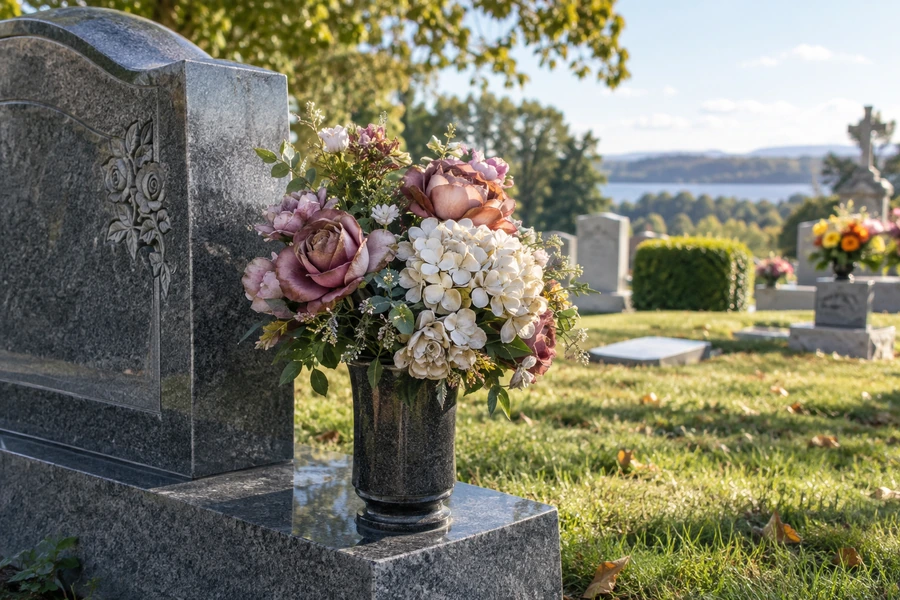
Artificial grave flowers do not wilt like fresh flowers, but outdoor sunlight, wind, rain, dirt, temperature changes, and cemetery cleanup rules can shorten their display time.
Good outdoor-rated artificial grave flowers can remain usable for several seasons, but their attractive display life varies widely. UV-treated products generally last longer than ordinary indoor silk flowers. Full sun accelerates fading, while shade extends color life. Cemetery rules may remove arrangements long before the flowers physically wear out, sometimes after only weeks or months.
The most useful way to estimate lifespan is to separate material durability from cemetery display time. A flower may remain structurally intact for years but become faded enough for cemetery staff to remove it much sooner.
How Long Do Artificial Grave Flowers Last Outdoors?
Artificial grave flowers can last from a few months to several years outdoors, depending on material quality, UV treatment, sunlight intensity, weather exposure, and maintenance.
For planning purposes, ordinary non-outdoor artificial flowers may lose their appearance within one season under harsh sun, while good UV-treated outdoor flowers can remain usable for multiple seasons. Afloral currently estimates 3–6 seasons in minimal sun, 2–4 seasons in moderate sun, and 1–2 seasons in maximum sun for its outdoor-rated products.
There Is No Universal Lifespan
You may see claims such as:
- 6 months
- 1 year
- 3 years
- 5 years
for artificial outdoor flowers.
Those numbers should not automatically be treated as universal guarantees.
Afloral specifically says that it does not guarantee outdoor longevity and describes its lifespan figures as general estimates. It also states that fading varies with sun exposure.
That is the more responsible way to think about artificial cemetery flowers.
UV-Treated Flowers Generally Last Longer
Artificial flowers intended for outdoor use are often treated or manufactured to resist UV-related fading.
Balsam Hill advises checking for an Outdoor Safe designation before placing artificial flowers outside and says these products include UV protection intended to reduce sun damage and fading.
For a grave that receives:
- Full sun
- Summer heat
- Little shade
I would prioritize outdoor-rated flowers over indoor silk stems.
Full Sun Is the Hardest Environment
Afloral’s own lifespan estimates show how strongly sunlight changes durability:
| Exposure | Current Afloral Estimate |
|---|---|
| Covered/minimal sun | 3–6 seasons |
| Moderate sun | 2–4 seasons |
| Maximum sun | 1–2 seasons |
These numbers are supplier-specific rather than cemetery-wide standards, but they illustrate an important rule:
more UV exposure = shorter attractive lifespan.
“Season” Does Not Necessarily Mean a Full Year
This is important.
Artificial-flower sellers often use the word season rather than year because many outdoor products are intended for periodic display.
Balsam Hill, for example, recommends limiting some outdoor-safe artificial floral displays to about three months per year to help maintain color.
Therefore, “four seasons” should not automatically be interpreted as four uninterrupted years of full-sun exposure.
Grave Exposure Is Often Harsher Than Home Décor
A cemetery arrangement may sit outdoors continuously with no one nearby to protect it.
It can face:
- Midday sun
- Rain
- Wind
- Frost
- Snow
- Dust
- Grass clippings
- Wildlife
- Irrigation
A covered porch arrangement may last significantly longer than the same flowers placed in an exposed cemetery.
Material Quality Matters
Outdoor artificial grave flowers may use:
- PE plastic
- UV-treated polyester
- Molded polymer petals
- Plastic greenery
- Wire stems
For cemetery use, durability can matter more than extremely soft Real Touch realism.
A flower that looks perfect at a wedding table but is designed primarily for indoor use may not be the best memorial flower.
Practical Lifespan Guide
| Flower Type | Practical Outdoor Expectation |
|---|---|
| Cheap indoor silk in full sun | Shortest |
| Indoor artificial under shade | Better, but still not ideal |
| Outdoor-rated UV-resistant | Multiple seasons possible |
| Outdoor-rated in full sun | Shorter than shaded use |
| Covered memorial placement | Strongest longevity potential |
| Premium delicate Real Touch | Product-specific |
The safest buying question is:
Is this exact flower designed for continuous outdoor use?
Do Artificial Flowers Fade in Sunlight?
Yes. UV exposure is one of the main reasons artificial cemetery flowers lose their realistic appearance.
Artificial flowers fade because sunlight gradually breaks down pigments and synthetic materials. Outdoor-safe or UV-treated products resist this process better, but they are not permanently fade-proof. Flowers placed in strong full sun usually discolor faster than the same flowers in partial shade, especially over repeated summer seasons.
Fading Often Happens Before Structural Failure
A flower may still have:
- Intact petals
- Strong stems
- Secure wire
- Stable shape
but look worn because its color has changed.
You may notice:
- Red turning pale pink
- Purple losing saturation
- Green leaves becoming yellow-green
- White flowers becoming cream or yellow
- Uneven color on the sun-facing side
At that point, the flowers are physically present but their decorative lifespan is ending.
Direct Sun Is More Important Than Rain in Many Cases
Outdoor product guidance consistently emphasizes sunlight exposure.
Balsam Hill recommends placing artificial flowers under some form of shade when possible and avoiding harsh direct sunlight and extreme weather.
For grave flowers, natural shade may come from:
- Trees
- Mausoleums
- Nearby structures
- The orientation of the headstone
But you usually cannot control the site.
That means the product specification has to match the location.
UV-Resistant Does Not Mean UV-Proof
This is one of the biggest buying mistakes.
UV-resistant means the flowers are designed to resist deterioration better.
It does not mean:
The color will remain unchanged forever.
Afloral explicitly says fading still occurs over the life of its outdoor products and varies with exposure.
White Flowers Can Age Differently
White artificial flowers may not look “faded” in the same way as red flowers.
Instead, they can become:
- Yellowed
- Gray
- Dirty-looking
Balsam Hill specifically mentions protecting artificial flowers to help prevent white blooms from turning yellow.
For long cemetery displays, cream, yellow, muted pink, or mixed-color arrangements may sometimes hide aging better than bright pure white.
Wind Causes a Different Type of Wear
Wind may not bleach color, but it can:
- Bend stems
- Loosen flower heads
- Tear fabric petals
- Pull arrangements from vases
That means outdoor longevity requires both:
UV resistance + structural strength.
Avoid loosely glued flower heads for exposed cemetery locations.
Dirt Can Make Flowers Look Older
Artificial grave flowers can collect:
- Dust
- Pollen
- Mud splash
- Grass clippings
Balsam Hill recommends routine gentle dusting for artificial florals and using soft, dry cleaning methods for many products.
For cemetery flowers, occasional inspection and gentle cleaning can extend their useful appearance even when the material itself is still sound.
How Often Should You Replace Artificial Flowers on a Grave?
There is no fixed replacement schedule. Replace them when they become faded, torn, badly dirty, structurally damaged, or no longer comply with cemetery rules.
Inspect artificial grave flowers every one to three months if practical and replace or retrieve them when they become noticeably faded, brittle, torn, loose, or unsightly. In harsh full-sun locations, replacement may be needed more often. Cemetery staff may remove arrangements themselves once they consider them faded or unsuitable for grounds maintenance.
Appearance Often Determines Removal
San Antonio National Cemetery currently allows artificial flowers, but states that they may be removed as soon as they become faded and unsightly or interfere with maintenance.
Hanford Cemetery District similarly lists several reasons artificial flowers may be removed:
- Faded
- Torn
- Damaged
- Unsightly
- Dislodged
- Interfering with maintenance
- Creating safety concerns
That means the cemetery itself may effectively determine the replacement date.
My Practical Inspection Schedule
For a family that can visit regularly, I would use:
Every 1–3 months
- Check color.
- Check stems.
- Check the vase fit.
- Remove debris.
- Replace badly faded flowers.
Before major seasons
- Refresh spring flowers.
- Check Memorial Day rules.
- Refresh fall/winter flowers where allowed.
Before cemetery cleanup dates
- Retrieve reusable arrangements.
This is more useful than deciding every arrangement must last exactly one year.
Replace Individual Stems When Possible
If only two roses have faded, the entire arrangement may not need to be discarded.
You can replace:
- Faded focal flowers
- Broken stems
- Damaged leaves
while keeping the rest.
This works particularly well with reusable cemetery-vase bouquets.
Signs Artificial Grave Flowers Need Replacement
| Sign | Action |
|---|---|
| Slight dust | Clean |
| One bent stem | Reshape |
| One faded bloom | Replace stem |
| Major color loss | Replace arrangement |
| Brittle petals | Replace |
| Loose heads | Repair or replace |
| Exposed wire | Replace |
| Arrangement falls from vase | Refit securely within cemetery rules |
| Cemetery season ends | Retrieve |
| Cleanup approaching | Retrieve if reusable |
Do Not Wait for Flowers to Become Trash
One advantage of artificial cemetery flowers is reuse.
If you retrieve an arrangement before severe deterioration, you may be able to:
- Clean it
- Replace a few stems
- Store it
- Use it next season
This reduces both cost and waste.
Are Artificial Flowers Allowed on Graves Year-Round?
Not always. Cemetery policies vary widely, and some cemeteries permit artificial flowers year-round while others restrict them to colder months or specific holiday periods.
Artificial flowers are not universally allowed on graves throughout the year. Some cemeteries permit them year-round, while others restrict artificial arrangements during mowing season or warm months. Flowers may also be removed during scheduled cleanups or whenever they become unsightly. Always check the exact cemetery’s current floral policy before purchasing a long-lasting arrangement.
Some Cemeteries Allow Artificial Flowers Year-Round
San Antonio National Cemetery allows artificial flowers but states they may be removed when faded, unsightly, or problematic for maintenance.
Texas State Veterans Cemeteries also allow fresh and artificial flowers throughout the year, while holding monthly flower pickups and removing flowers that become unsightly or interfere with landscaping.
Other Cemeteries Restrict Them by Season
Andersonville National Cemetery does not allow artificial arrangements from April 15 through October 10. Its policy allows them during the colder period and says flowers are removed when faded or unsightly.
Andrew Johnson National Cemetery similarly allows artificial flowers from November 1 through April 1 and removes floral pieces twice monthly or when they become unsightly.
This can make the cemetery’s policy a bigger lifespan limit than the artificial flower itself.
Cemetery Maintenance Can Override Material Durability
Imagine buying a bouquet rated for several seasons.
If the cemetery has a spring cleanup date, staff may remove it after:
three months.
The product did not fail.
The permitted display period ended.
This is why you need to distinguish:
product life from grave-display life.
Some Cemeteries Dispose of Flowers Immediately
Policies also vary after removal.
Texas State Cemetery regulations specify that faded artificial flowers may be removed and disposed of immediately.
Other cemeteries may temporarily hold removed artificial decorations.
Do not assume a reusable bouquet can always be collected afterward.
Check Four Things Before Buying
Before placing artificial grave flowers, ask:
- Are artificial flowers allowed?
- Are they allowed year-round?
- When are cleanup dates?
- What happens to removed arrangements?
Those four questions determine how long an arrangement can realistically stay on the grave.
My Insights: How Long Do Artificial Flowers Last on a Grave
The most accurate answer combines outdoor material durability with cemetery policy rather than promising one fixed number of months or years.
Artificial flowers on a grave can remain attractive from several months to multiple seasons. Good UV-treated outdoor flowers may last 1–6 seasons depending on exposure, based on current supplier guidance, but full sun shortens their useful appearance. More importantly, cemetery cleanup rules may limit an arrangement to weeks or months even when the flowers themselves could last much longer.
My First Insight: I Would Not Promise a Fixed Number of Years
A claim such as:
Artificial grave flowers last five years.
is too broad.
The same bouquet might last much longer in:
partial shade
than in:
full desert sun.
The same bouquet might also be removed after three months because of cemetery policy.
A better buying range is:
several months to multiple seasons, depending on product and exposure.
My Second Insight: Cemetery Rules Can Be the Real Lifespan Limit
This is the biggest insight for memorial flowers.
Afloral may estimate multiple seasons for outdoor-rated products, but a cemetery may remove artificial flowers at the end of an approved period regardless of their condition.
Therefore, buying the longest-lasting flower available is not always necessary.
First determine how long it is allowed to remain.
My Third Insight: Full-Sun Graves Need a Different Flower Specification
For an exposed cemetery plot, I would prioritize:
- Outdoor-rated material
- UV resistance
- Molded or durable petals
- Strong stem connections
- Fade-tolerant colors
over extremely delicate indoor realism.
A slightly less lifelike outdoor flower can remain respectful-looking longer than a beautiful indoor silk rose that fades quickly.
My Fourth Insight: “Outdoor Safe” Is More Useful Than “Silk”
The word silk tells you little about weather durability.
Modern artificial silk flowers are often polyester fabric.
For cemetery use, the important product language is:
- Outdoor safe
- UV resistant
- Exterior use
Balsam Hill specifically advises checking for an Outdoor Safe designation before outside use.
My Fifth Insight: Shade Is Free Lifespan
You cannot move a grave.
But when a site naturally receives partial shade, the artificial flowers benefit.
Afloral’s own ranges show a clear difference between minimal, moderate, and maximum sun exposure.
If the grave receives intense sun all day, plan for faster replacement.
My Sixth Insight: Design for Seasonal Replacement
Instead of expecting one arrangement to stay indefinitely, I prefer a rotation strategy:
Spring
- Tulips
- Daffodils
- Pastels
Summer
- Roses
- Sunflowers
- Daisies
Autumn
- Mums
- Warm foliage
Winter
- Evergreen
- White flowers
- Wreaths where permitted
Seasonal retrieval also prevents one arrangement from being destroyed by years of continuous exposure.
My Seventh Insight: Retrieve Before It Becomes Unsightly
Many cemetery rules use the word unsightly.
That judgment may occur before the flower is physically broken.
Retrieve valuable arrangements while they are still in usable condition.
Then:
- Dust them.
- Replace damaged stems.
- Store them dry.
- Reuse them later.
My Eighth Insight: Check the Vase as Carefully as the Flower
A long-lasting flower is not useful if the arrangement blows away.
Check that:
- Stems fit the cemetery vase
- Bouquet weight is appropriate
- Nothing violates the cemetery’s anchoring rules
- Wire does not create a hazard
Avoid adding unauthorized stakes, hooks, weights, or adhesives.
My Ninth Insight: Do Not Leave Sentimental Originals Outdoors
If an artificial arrangement has strong sentimental value, such as:
- Original wedding flowers
- Handmade memorial flowers
- One-of-a-kind keepsake blooms
I would not leave the original at a grave continuously.
Use a replaceable memorial copy instead.
Cemetery policies, theft, wildlife, storms, and maintenance can all cause loss.
My Tenth Insight: Plan by Exposure, Not Just Price
A more expensive flower does not automatically last longer outside.
Before buying, I would rank these factors:
- Cemetery permission
- Outdoor rating
- UV resistance
- Sun exposure
- Construction quality
- Stem security
- Color
- Realism
- Price
That order is very different from shopping for indoor wedding flowers.
Practical Grave-Flower Lifespan Guide
| Situation | Planning Expectation |
|---|---|
| Indoor-only silk in full sun | Short display life |
| Standard artificial in partial shade | Several months possible |
| Outdoor-rated UV flowers | Multiple seasons possible |
| Outdoor-rated + covered location | Best longevity |
| Strong full sun | Faster fading |
| Cemetery seasonal restriction | Policy determines maximum display |
| Scheduled cleanup | Retrieve beforehand |
| Faded or damaged arrangement | May be removed at any time |
My Recommended Buying Formula
For a cemetery arrangement I wanted to reuse, I would choose:
**outdoor-rated artificial flowers
- UV-resistant construction
- strong wired stems
- cemetery-approved vase fit
- moderate natural colors
- seasonal retrieval
- gentle cleaning and storage**
This is usually more practical than searching for a supposedly permanent flower.
My Final Answer
So, how long do artificial flowers last on a grave?
Expect anywhere from several months to several seasons, not a guaranteed number of years.
For good outdoor-rated flowers, current supplier guidance suggests that multiple seasons are possible—roughly 3–6 seasons with minimal sun, 2–4 with moderate sun, and 1–2 under maximum sun in Afloral’s product range. Those numbers are estimates rather than universal guarantees.
But the flowers may not remain on the grave that long.
Cemeteries can remove them when they:
- Fade
- Become torn
- Look unsightly
- Interfere with mowing
- Violate seasonal rules
- Reach a scheduled cleanup date
So before spending more for a long-lasting memorial bouquet, check the cemetery’s exact floral policy.
The best artificial grave flower is not simply the one that lasts the longest.
It is the one that stays respectful-looking throughout the permitted display period and can be retrieved and reused before the cemetery removes it.
Conclusion
Artificial grave flowers can last several months to multiple seasons, but UV exposure and cemetery rules often determine their real display life. Choose outdoor-rated flowers and plan seasonal retrieval.

