


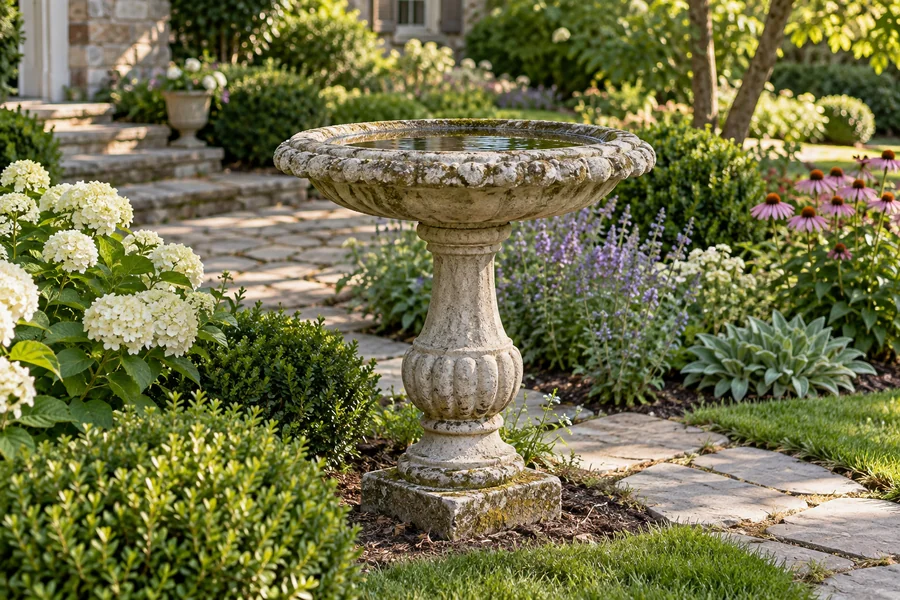
Concrete lawn ornaments look permanent, but rain, freezing temperatures, standing water, cracks, and poor installation can shorten their lifespan considerably.
Concrete lawn ornaments typically last for several decades outdoors. As a practical planning range, a well-made ornament may remain serviceable for roughly 30–80 years, while high-quality pieces protected from severe moisture and freeze-thaw damage can last even longer. Concrete quality, drainage, climate, reinforcement, sealing, and maintenance matter more than any single age estimate.
Concrete ornaments can last for decades, but lifespan depends on construction quality, moisture, freeze-thaw exposure, drainage, maintenance, and how well the piece suits its environment.
How Long Can a Concrete Lawn Ornament Stay Outdoors?
A sound concrete ornament can remain outdoors for many years because concrete is inherently durable when it is properly proportioned, cured, and protected from severe deterioration.
For normal residential landscaping, I would think in decades rather than years. A useful planning expectation is about 30–80 years for good outdoor concrete statuary, although this is not an official industry warranty. Poor-quality pieces in harsh climates may deteriorate much sooner, while exceptionally durable and well-maintained ornaments can remain serviceable for generations.
General residential concrete provides useful context. Concrete Network estimates service lives of 30+ years for concrete patios, 40+ years for driveways, and 20–40 years for sidewalks when properly installed and maintained. Decorative lawn ornaments experience different loads, but these figures demonstrate concrete’s ability to perform for decades outdoors.
Cast stone offers another useful comparison. The Cast Stone Institute states that architectural cast stone has a long history of successful use in different climates and emphasizes that long-term performance depends on quality manufacturing, appropriate design, installation, and moisture management.
Why Some Ornaments Last Much Longer Than Others
Two concrete statues may look almost identical when new but age very differently.
One might have:
- Dense, well-proportioned concrete
- Good curing
- Low water absorption
- Proper freeze-thaw resistance
- A stable base
- Good drainage
Another might contain:
- Excess water in the original mix
- Large internal voids
- Poor curing
- Thin fragile sections
- Trapped water
- Inadequate frost resistance
The difference may not be obvious during the first year.
After repeated winters, however, the better-made piece may remain almost unchanged while the weaker one begins to scale, crack, or lose details.
What Causes Concrete Lawn Ornaments to Deteriorate?
Water is involved in many of the most serious durability problems.
The main causes of deterioration are moisture absorption, repeated freezing and thawing, cracking, unstable foundations, corrosion of embedded metal, poor-quality concrete, and incompatible coatings. Sunlight may fade paint and surface finishes, but moisture entering the concrete is generally a more serious structural concern.
1. Freeze-Thaw Cycles
Freezing temperatures are one of the biggest threats to outdoor concrete.
Concrete contains pores.
When those pores become highly saturated with water and the temperature falls below freezing, the water expands as it becomes ice.
FHWA explains that water expands approximately 9% when frozen. If concrete becomes critically saturated, repeated freezing and thawing can generate damaging internal pressures.
The visible results can include:
- Scaling
- Flaking
- Surface loss
- Cracks
- Spalling
- Broken decorative details
A small statue may be particularly vulnerable where water collects in:
bowls,
folds,
horizontal surfaces,
or hollow sections.
2. Poor Freeze-Thaw Concrete
The concrete itself also matters.
ACI explains that properly distributed entrained air helps concrete resist freeze-thaw deterioration because small air voids provide space that relieves pressure when water freezes inside the material.
The American Cement Association similarly identifies air entrainment as an established strategy for improving concrete durability under freeze-thaw exposure.
If I were buying a substantial concrete ornament for a climate with severe winters, I would therefore ask whether the product was designed for exterior freeze-thaw exposure rather than assuming every cast-concrete ornament performs equally.
3. Standing Water
Water sitting around the bottom of a statue can slowly become a durability problem.
A lawn ornament placed directly on:
wet soil,
mud,
or poorly drained mulch
may remain damp for long periods.
The Cast Stone Institute emphasizes the importance of avoiding saturated conditions and allowing water to drain away from cast concrete.
For lawn ornaments, I apply the same principle.
I prefer a stable base made from:
- Concrete
- Pavers
- Gravel
- Stone
- Another well-drained surface
rather than permanently wet soil.
4. Existing Cracks
A very small surface crack may not mean immediate failure.
But cracks can provide easier routes for water.
Once water penetrates deeper into the concrete, freeze-thaw cycles can enlarge the damage.
Concrete maintenance guidance recommends addressing cracks partly because reducing water intrusion helps prevent further deterioration.
I therefore inspect ornaments before winter rather than waiting until a crack becomes visually dramatic.
5. Internal Metal Corrosion
Some statues contain steel reinforcement or internal wire.
If water and oxygen eventually reach unprotected steel, corrosion can develop.
Corrosion products occupy more volume than the original metal, creating internal pressure that can crack the surrounding concrete.
For large reinforced ornaments, rust staining or cracks following the line of internal reinforcement deserve attention.
Does Climate Change How Long Concrete Ornaments Last?
Very much.
A concrete lawn ornament in a mild, relatively dry climate may experience much less deterioration than the same ornament exposed to rain, snow, repeated freezing, and saturated soil. Frequent freeze-thaw cycling is particularly damaging when concrete absorbs significant moisture before freezing.
The National Park Service describes the preservation challenges facing outdoor concrete artworks in Canadian climates, where wind, rain, snow, temperature changes, and repeated freeze-thaw cycles make crack monitoring and protective maintenance particularly important.
I would roughly think about exposure this way:
| Environment | Relative durability challenge |
|---|---|
| Covered, mild climate | Low |
| Outdoor, mild climate | Moderate |
| Wet climate | Moderate to high |
| Cold but relatively dry | Moderate |
| Wet climate with repeated freezing | High |
| Constantly saturated location with freeze-thaw | Very high |
The combination is important.
Cold alone is not necessarily the whole problem.
Water + freezing is much more significant.
What About Hot Climates?
Heat and sunlight can affect:
- Paint
- Pigments
- Surface coatings
- Decorative finishes
but ordinary hot weather is generally less destructive to the concrete itself than repeated moisture saturation and freezing.
Painted concrete ornaments may therefore appear old long before the structural concrete is actually failing.
That distinction matters.
A faded statue may need refinishing.
A deeply cracked or spalling statue may have a durability problem.
Does Sealing Make Concrete Lawn Ornaments Last Longer?
It can, but the correct product and application matter.
A suitable concrete sealer can reduce water absorption and help limit moisture-related deterioration. However, sealing does not repair weak concrete, and an inappropriate coating can sometimes trap moisture. The goal is moisture management, not simply creating the thickest possible waterproof-looking surface.
Concrete Network notes that sealers can reduce water penetration and help protect exterior concrete from freeze-thaw damage, scaling, staining, and weather exposure.
How Often Should Concrete Be Resealed?
There is no universal schedule for lawn ornaments.
For general exterior concrete, contractor guidance commonly suggests resealing roughly every 2–5 years, with more frequent maintenance in harsh freeze-thaw environments.
I would treat that as a reference rather than a rigid statue-maintenance rule.
A better approach is to inspect the surface.
Possible signs that protection has deteriorated include:
- Water quickly darkening the surface
- Increased absorption
- Peeling coating
- Chalkiness
- Fading
- Visible surface wear
Can You Apply Too Much Sealer?
Yes.
Concrete Network warns that excessive sealer buildup can trap moisture and lead to cloudy appearance, blistering, bubbling, cracking, or peeling.
For a decorative statue with complex shapes and recesses, heavy coating buildup can also obscure fine detail.
I prefer compatible, relatively breathable protection appropriate to the existing concrete and finish.
Should Concrete Lawn Ornaments Be Brought Inside for Winter?
Not always, but winter protection can significantly reduce exposure for vulnerable pieces.
Small or valuable concrete ornaments can benefit from winter storage in severe freeze-thaw climates, particularly if they contain bowls, hollow areas, cracks, thin decorative details, or highly absorbent concrete. Large ornaments that remain outdoors should be kept well drained and free from standing water.
Pieces I Would Consider Moving Indoors
I would be more cautious with:
- Birdbaths
- Fountains
- Thin statues
- Small planters
- Hollow ornaments
- Highly detailed sculptures
- Already cracked pieces
Birdbaths and fountains deserve special attention because their shape is specifically designed to hold water.
If that water freezes, the ornament can experience repeated saturation and expansion.
Large Statues Can Usually Remain Outside
Moving a 300-pound statue every winter may create more risk than leaving it alone.
For large pieces, I focus instead on:
- Drainage
- Stable support
- Crack repair
- Emptying water-holding areas
- Appropriate sealing
- Keeping snow and water from remaining trapped where practical
The goal is to reduce saturation before severe freezing.
Can Cracked Concrete Lawn Ornaments Be Repaired?
Often, yes.
Small chips and localized cracks can often be repaired successfully, particularly when deterioration is caught early. Repair becomes more difficult when cracking is widespread, reinforcement is actively corroding, large sections are separating, or freeze-thaw damage has weakened much of the concrete.
The Cast Stone Institute provides repair guidance for chips and damaged cast-stone surfaces and notes that temperature and curing conditions affect successful cementitious repair work.
Small Damage
Possible repairs include:
- Filling localized cracks
- Patching chips
- Repairing broken edges
- Repainting decorative surfaces
- Reapplying compatible protection
Serious Damage
I would consider professional restoration—or replacement—when there is:
- Deep structural cracking
- Large spalled areas
- Exposed corroding reinforcement
- Major instability
- Pieces separating from the main casting
For sentimental, historic, or artistic concrete objects, conservation principles may be more appropriate than ordinary DIY patching.
The National Park Service’s work with outdoor concrete artwork shows that treatment decisions benefit from understanding climate, cracking, coatings, previous repairs, and underlying deterioration mechanisms rather than simply covering visible damage.
How Can You Make Concrete Lawn Ornaments Last Longer?
Longevity usually comes from several small decisions rather than one miracle coating.
To extend the life of concrete ornaments, start with quality concrete, place the piece on a stable well-drained base, minimize standing water, protect vulnerable surfaces appropriately, repair cracks early, and inspect the ornament before and after winter. In cold climates, freeze-thaw resistance and moisture control should be the highest priorities.
My Maintenance Checklist
1. Keep the base stable
Do not allow a heavy ornament to lean because soil has settled beneath it.
2. Improve drainage
Avoid locations where irrigation or rainwater constantly pools.
3. Inspect once or twice a year
Look for:
- New cracks
- Scaling
- Spalling
- Rust stains
- Loose sections
4. Clean gently
Remove dirt, algae, and biological growth without unnecessarily damaging the concrete surface.
5. Repair early
Small problems are generally easier to manage before winter water enters them.
6. Maintain compatible finishes
If the piece is painted or sealed, inspect the finish periodically rather than waiting for widespread peeling.
7. Empty water before freezing
This is especially important for fountains, bowls, and birdbaths.
My insights: How Long Do Concrete Lawn Ornaments Typically Last
After comparing concrete-industry durability guidance, freeze-thaw research, cast-stone standards, and outdoor concrete conservation experience, I think the most useful answer is not a single number.
How Long Do Concrete Lawn Ornaments Typically Last? A good concrete ornament should be thought of as a decades-long landscape element. Roughly 30–80 years is a useful planning range for well-made outdoor pieces, but actual service life may be much shorter or much longer depending on concrete quality, moisture, freeze-thaw exposure, drainage, reinforcement, installation, and maintenance.
My First Insight: Water Usually Matters More Than Age
A 40-year-old statue that stays relatively dry may be in better condition than a 10-year-old ornament that remains saturated every winter.
This is why I would not judge lifespan by calendar age alone.
FHWA research explains that freeze-thaw damage becomes particularly serious once concrete approaches critical saturation.
That makes moisture control one of the strongest longevity strategies.
My Second Insight: Freeze-Thaw Quality Should Be Built In
Sealer helps manage moisture.
It cannot completely transform poorly designed concrete into durable freeze-thaw concrete.
ACI and the American Cement Association both emphasize appropriate air entrainment as a key method for improving concrete resistance to freezing and thawing.
If I lived in a cold region, I would therefore care about manufacturing quality before selecting a decorative finish.
My Third Insight: A Stable Base Is More Important Than It Looks
Concrete is strong in compression but cracking can occur when heavy objects are poorly supported.
A lawn ornament sitting on uneven soil may gradually tilt.
Once the base becomes unstable, stresses can develop in thin sections.
A stable paver, slab, compacted gravel base, or similar support also helps keep the bottom away from constantly wet soil.
So installation affects lifespan from the first day.
My Fourth Insight: Paint Life and Concrete Life Are Not the Same
This is an important distinction.
A painted lawn ornament might begin looking faded or weathered after only a few seasons.
That does not mean the concrete itself is approaching the end of its life.
Think of the ornament as two systems:
Structural concrete
and
decorative finish.
The finish may need maintenance several times during the concrete’s overall service life.
My Fifth Insight: Older Appearance Is Not Always Failure
Concrete naturally weathers.
It can develop:
- Color variation
- Minor staining
- Patina
- Moss
Some homeowners dislike this.
Others specifically want an aged garden appearance.
I would distinguish between cosmetic weathering and structural deterioration.
Cosmetic:
- Fading
- Light staining
- Moss
- Minor surface discoloration
More serious:
- Deep cracking
- Scaling
- Spalling
- Exposed reinforcement
- Major material loss
Not every change requires repair.
My Sixth Insight: Good Concrete Can Outlive Several Surface Finishes
A well-made ornament may be:
painted,
repainted,
sealed,
cleaned,
and repaired
several times over its life.
Concrete Network’s general lifespan guidance demonstrates that properly installed exterior decorative concrete routinely performs for decades.
That makes maintenance a normal part of ownership rather than evidence that the ornament has failed.
My Practical Lifespan Guide
| Condition | Practical expectation |
|---|---|
| Poor concrete + severe wet/freezing exposure | Deterioration may appear relatively early |
| Average outdoor concrete ornament | Several decades |
| Good-quality concrete + reasonable care | Roughly 30–80 years is a useful planning range |
| High-quality protected ornament | 50+ years is very plausible |
| Exceptional construction + conservation | Multi-generational service can be possible |
These ranges are planning estimates, not manufacturer warranties.
My Preferred Longevity Formula
If I wanted a concrete lawn ornament to remain outside for decades, I would prioritize:
**quality concrete
- proper curing
- freeze-thaw resistance where needed
- a stable base
- good drainage
- limited standing water
- compatible surface protection
- early crack repair
- annual inspection**
I would prioritize those factors over a manufacturer’s vague claim that a statue is simply “weatherproof.”
My Final View
So, how long do concrete lawn ornaments typically last?
Think in decades.
Concrete is capable of remaining outdoors for a remarkably long time, and both general decorative-concrete guidance and cast-stone industry experience demonstrate long-term performance measured in decades.
But the ornament’s actual lifespan depends heavily on its environment.
The greatest threat in a cold climate is often not age itself.
It is:
water entering the concrete, followed by repeated freezing and thawing.
The greatest threat in a poorly installed landscape may be:
constant moisture and an unstable base.
And the greatest threat to a painted ornament’s appearance may simply be:
neglected surface maintenance.
If I had to choose only three things to maximize lifespan, I would choose:
good concrete, good drainage, and early maintenance.
Control those factors, and a quality concrete lawn ornament can remain part of a garden for decades—and potentially for more than one generation.
Conclusion
Concrete lawn ornaments commonly last for decades. Quality construction, moisture control, freeze-thaw resistance, stable placement, and timely maintenance matter far more than any single advertised lifespan.

