
Fake trees do not wilt or die, but they are not permanent. Foliage can fade, branches can weaken, coatings can deteriorate, and pre-lit components can eventually fail.
A good indoor fake tree can often remain attractive for about 5–10 years or longer with proper care. Artificial Christmas trees commonly reach around 10 years, with well-made models potentially lasting 10–15 years or more. Outdoor faux trees usually have shorter lives because sunlight, heat, moisture, and wind accelerate fading and material deterioration.
Artificial tree lifespan varies by material and environment: indoor trees often last years, while outdoor exposure, sunlight, weather, storage, and component aging shorten durability significantly.
How Long Do Indoor Fake Trees Usually Last?
Indoor artificial trees generally have the easiest life.
For a well-made indoor faux tree, 5–10 years is a reasonable practical planning range, and higher-quality products may remain attractive considerably longer. Indoor trees avoid rain, wind, freeze-thaw cycling, and strong outdoor UV exposure, so appearance rather than structural failure is usually what eventually determines replacement.
Nearly Natural gives a 5–10-year figure for artificial palm trees depending on materials. The same company describes its Real Touch artificial plants as products designed to last for many years when kept in appropriate indoor or protected environments.
Indoor artificial trees commonly age through gradual changes such as:
- Dust accumulation
- Color fading near sunny windows
- Bent or sagging branches
- Detached leaves
- Visible glue or wire
- Cracked plastic
- Flattened foliage
- Damaged trunks or bases
A tree can technically remain intact long after it stops looking convincing.
That distinction matters.
Visual Lifespan Is More Important Than Physical Lifespan
A faux tree does not need to fall apart before it reaches the end of its useful life.
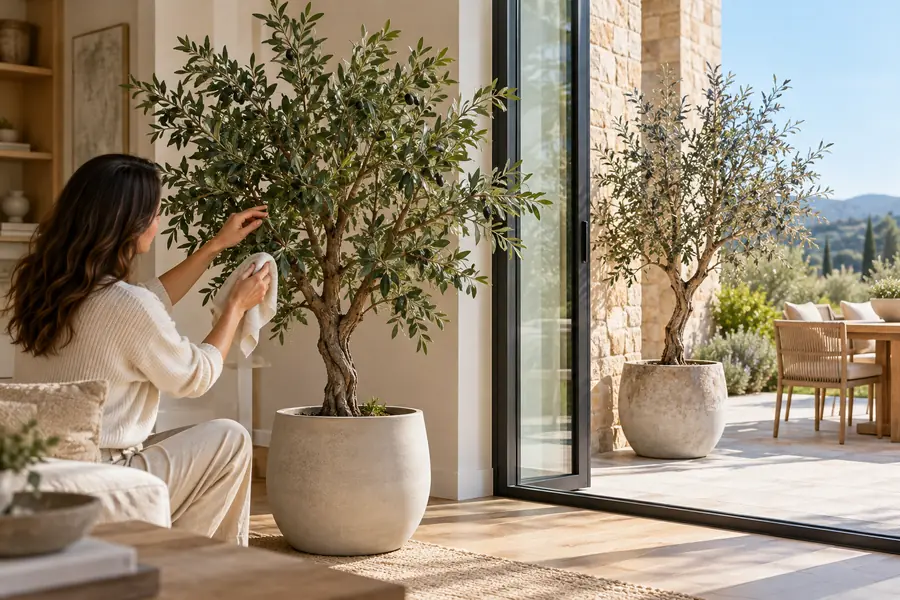
Imagine a seven-year-old artificial olive tree.
The trunk is still solid.
The branches still stand upright.
But the leaves have turned noticeably blue-gray, several stems have lost foliage, and the outer surfaces have become shiny and brittle.
The tree still exists.
But its decorative lifespan may be over.
For artificial greenery, I therefore distinguish between:
structural lifespan — how long the object physically survives;
and
aesthetic lifespan — how long it continues to look good enough for the intended space.
A tree in a hotel lobby may be replaced sooner than the same tree in a rarely used guest bedroom because the visual standard is different.
How Long Do Outdoor Artificial Trees Last?
Outdoor trees are much less predictable.
Outdoor faux trees may last only 1–2 seasons in intense direct sun or several years in shaded, protected conditions. Products specifically manufactured or treated for UV exposure generally last longer, but UV-resistant does not mean permanently fade-proof.
Afloral’s current guidance gives a particularly useful exposure-based range:
| Outdoor exposure | Estimated lifespan |
|---|---|
| Minimal sun / covered location | 3–6 seasons |
| Moderate sun | 2–4 seasons |
| Maximum sun | 1–2 seasons |
The company also recommends limiting outdoor display time for some products and notes that fading varies with sunlight intensity.
Sunlight Is Usually the Biggest Enemy
Ultraviolet radiation can gradually alter synthetic foliage.
Visible effects may include:
color fading,
yellowing,
brittleness,
cracking,
and loss of flexibility.
Nearly Natural likewise warns that unprotected artificial palms can fade and experience material weakening under UV exposure.
That is why an indoor faux tree should not automatically be moved onto a sunny patio.
Plastic does not automatically mean outdoor-safe.
UV-Treated Trees Can Last Longer
Artificial greenery designed for exterior use may use:
UV stabilizers incorporated into polymers,
surface treatments,
UV-resistant pigments,
or additional protective coatings.
Afloral says properly UV-treated artificial plants can last several years and potentially longer depending on sunlight intensity, while its more conservative current product guidance still warns that stronger sun causes faster fading.
I would use the conservative product-specific guidance rather than interpreting “UV resistant” as a guarantee of ten years outdoors.
Covered Outdoor Is Very Different From Full Sun
A tree beneath a covered porch may receive:
bright indirect light,
limited rain,
and relatively little midday UV.
The same product beside a swimming pool in full Arizona or Florida sun experiences a completely different environment.
Location can therefore affect lifespan as much as price.
How Long Does an Artificial Christmas Tree Last?
Artificial Christmas trees are generally built for repeated seasonal use rather than permanent year-round display.
A quality artificial Christmas tree commonly lasts around 10 years, and a well-made model can potentially remain usable for 10–15 years or longer when it is carefully assembled, cleaned, disassembled, and stored in a cool, dry location.
Balsam Hill says its consumer research indicates U.S. customers expect an artificial tree to last approximately 10 years. Treetime gives a general range of 10–15 years or longer for well-made realistic trees.
Nearly Natural also says artificial Christmas trees are commonly used for about 10 years and emphasizes cleaning as part of maintaining them.
Storage Often Determines Christmas Tree Lifespan
A Christmas tree may spend only four to six weeks on display.
The remaining ten or eleven months are spent in storage.
That means storage conditions can matter more than display conditions.
Nearly Natural recommends:
cleaning the branches,
protecting built-in lights,
avoiding sharp bends,
using an appropriately sized storage container,
and keeping the tree somewhere cool and dry.
Architectural Digest similarly cites artificial-tree manufacturer guidance recommending gentle cleaning and indoor storage in a sturdy bag away from excessive humidity.
Hot Attics Can Shorten Life
Heat can affect:
plastic foliage,
adhesives,
branch shape,
electrical insulation,
and specialty finishes.
Humidity can contribute to:
odor,
discoloration,
corrosion,
and material deterioration.
For long-term storage, I would prefer:
a climate-controlled closet,
dry utility room,
or protected indoor storage area
over an extremely hot attic or damp basement.
Flocked Trees May Age Differently
The underlying tree may remain structurally healthy even while artificial snow begins to yellow, crack, shed, or abrade.
Balsam Hill says frosted artificial trees can last around 10 years or more with proper care, while also noting that the cosmetic coating can deteriorate faster than the underlying structure if exposed to heat, humidity, sunlight, or rough storage.
This is another example of:
cosmetic lifespan ≠ structural lifespan.
What Materials Make a Fake Tree Last Longer?
There is no single material that guarantees longevity.
Artificial-tree lifespan depends on the whole construction: foliage polymer, pigments, UV stabilization, internal wire, branch connections, trunk, adhesives, base, and sometimes electrical components. A well-designed mixed-material tree can outlast a poorly made tree advertised with a premium material name.
Common artificial-tree materials include:
PE,
PVC,
polyester,
PU or soft-touch polymers,
steel wire,
iron,
natural wood trunks,
plastic trunks,
adhesives,
cement,
and foam.
PE Foliage
Polyethylene is frequently molded into three-dimensional foliage.
It can create:
defined leaf shapes,
dimensional needles,
and strong structural detail.
For artificial Christmas trees, molded PE is widely used in premium realistic branches.
But PE alone does not tell you:
pigment quality,
UV resistance,
branch strength,
or construction quality.
Polyester Leaves
Polyester is common in broad-leaf faux trees.
It can produce attractive color and lightweight foliage.
Indoors, it can remain visually effective for years.
Outdoors, however, untreated fabric-based foliage may fade or weather faster.
Internal Wire
Many artificial branches depend on wire to retain their shape.
Repeated aggressive bending can cause:
metal fatigue,
loosening,
or eventual breakage.
The tree should therefore be reshaped gently instead of being sharply folded every time the room changes.
Natural Wood Trunks
Some premium artificial trees use real wood trunks.
This can improve realism dramatically.
But it also introduces a natural component that should be protected from persistent moisture and extreme storage conditions.
Does Direct Sunlight Shorten the Life of a Fake Tree?
Yes.
Sun exposure is one of the most important predictors of artificial-tree lifespan. Even an indoor tree positioned against a bright south- or west-facing window may fade faster than the same product placed farther from direct sunlight.
UV-resistant artificial greenery is specifically engineered to slow this process.
Nearly Natural differentiates products designed for covered outdoor use from products labeled UV resistant for greater sun exposure and recommends periodic UV-protective treatment for exposed products.
Afloral gives similar warnings that greater sunlight exposure produces faster color fading even on many outdoor-oriented products.
Indoor Sun Still Counts
People sometimes assume UV exposure matters only outdoors.
A faux tree beside a strongly sunlit window can still experience gradual color changes.
If the tree is expensive and intended for long-term use, I would:
avoid hours of intense direct sun where practical,
rotate it occasionally if one side receives much more light,
and monitor the outer foliage for color change.
Does Dust Reduce an Artificial Tree’s Lifespan?
Dust mostly affects appearance, but neglect can shorten the useful decorative life.
Regular dusting helps an artificial tree retain its original color, surface texture, and visual realism. Heavy dust buildup can make leaves look dull or gray and can become increasingly difficult to remove from complicated foliage.
Nearly Natural recommends regular dusting with a feather duster or microfiber cloth for faux trees.
For Christmas trees, the same company recommends cleaning branches before storage.
I consider cleaning part of lifespan management.
A premium tree covered in dust may appear ready for replacement years before its materials actually fail.
Use Gentle Cleaning Methods
Avoid automatically using:
strong household chemicals,
solvents,
bleach,
or abrasive brushes.
These can potentially affect:
pigments,
coatings,
adhesives,
or soft-touch surfaces.
Follow the specific manufacturer’s instructions where available.
How Can You Make a Fake Tree Last Longer?
Most lifespan improvements are simple.
Keep artificial trees away from unnecessary UV exposure, clean them regularly, reshape branches gently, use an appropriately sized planter, avoid crushing foliage, keep indoor-only trees out of permanent exterior conditions, and store seasonal trees in cool, dry spaces.
The most useful habits are:
-
Choose the correct product for the environment.
Use outdoor-rated or UV-resistant trees outside. -
Limit direct sun when possible.
Even resistant products fade faster under intense exposure. -
Dust regularly.
This keeps the original color and texture visible. -
Bend branches gently.
Repeated sharp folding stresses internal wire. -
Keep the base stable.
Frequent tipping can damage trunks and branch joints. -
Protect seasonal trees in storage.
Avoid crushing, heat, moisture, and heavy objects. -
Inspect electrical systems separately.
A pre-lit tree’s lights may require repair even when the foliage remains good.
Do Not Store Trees Too Tightly
This is particularly important for Christmas trees.
Once branches have been fluffed, forcing everything back into the smallest possible box may:
flatten tips,
bend hinges,
stress light wiring,
and damage coatings.
Nearly Natural recommends storage bags or containers with enough room to protect branches rather than sharply compressing them.
Do Expensive Artificial Trees Last Longer?
Sometimes, but price is not a guarantee.
Higher-priced artificial trees may use better foliage, reinforced branches, stronger bases, more realistic trunks, or better electrical systems, but longevity depends on construction and use rather than retail price alone. A moderately priced indoor tree can outlast an expensive tree left permanently in harsh sunlight.
When buying for longevity, I would inspect:
branch attachment,
trunk construction,
wire thickness,
leaf attachment,
UV rating,
manufacturer care instructions,
replacement parts,
warranty,
and intended application.
For Christmas trees, I would also check whether:
individual lights can be replaced,
whole light sections can be serviced,
and hinges or stands have available replacement parts.
Repairability can extend practical life considerably.
When Should You Replace a Fake Tree?
Age alone is a poor replacement rule.
Replace an artificial tree when fading, brittleness, structural damage, shedding, unstable bases, exposed wires, damaged electrical components, or permanent deformation prevents it from looking or functioning safely as intended. A ten-year-old tree in excellent condition does not need replacement simply because it reached a round-number age.
Common replacement signs include:
- Significant fading
- Yellowing
- Cracking leaves
- Brittle foliage
- Repeated branch breakage
- Loose trunks
- Unstable stands
- Detached foliage that cannot be restored
- Exposed internal wire
- Failing or damaged electrical cords
- Flocked finishes that are extensively degraded
Electrical Damage Changes the Decision
For a pre-lit Christmas tree, failing lights do not necessarily mean the artificial foliage has reached the end of its life.
Some trees can be repaired.
But exposed wires, overheating, damaged plugs, or recurring electrical faults should be taken seriously.
The decorative lifespan and the electrical lifespan may be different.
Is It Better to Keep an Old Fake Tree or Replace It?
If it still works and looks good, keeping it is usually the practical choice.
A functioning artificial tree already represents materials, manufacturing, packaging, and transportation that have occurred. Extending its useful life avoids replacing it unnecessarily simply because a newer style is available.
This is especially relevant to artificial Christmas trees.
Balsam Hill connects longer reuse with lowering the per-year environmental burden of its trees and encourages storage practices intended to extend service life.
I would not replace a healthy artificial tree merely because:
a new model has more realistic leaves,
a different tree shape is trending,
or the current tree is several years old.
If the old tree no longer suits the room, another option is to:
move it to a secondary room,
reuse it in an office,
restyle the planter,
or donate it if it remains in good condition.
My insights: How Many Years Does a Fake Tree Last
After comparing current manufacturer guidance for indoor artificial trees, outdoor faux greenery, and Christmas trees, I think one fixed lifespan number creates more confusion than clarity.
How Many Years Does a Fake Tree Last? A useful planning range is around 5–10 years for quality indoor decorative trees and roughly 10 years or more for good artificial Christmas trees. Outdoor trees can have much shorter lives—sometimes only 1–2 seasons in maximum sun—unless they are specifically designed for UV exposure and used in more protected conditions.
My First Insight: Exposure Matters More Than Calendar Age
Two identical artificial trees can age completely differently.
Tree A sits:
inside,
six feet from a window,
in a climate-controlled living room.
Tree B sits:
outside,
in direct afternoon sun,
through rain and summer heat.
After three years, Tree A may look almost new.
Tree B may be badly faded.
That means the question:
“How old is the tree?”
is less useful than:
“What has the tree been exposed to?”
My Second Insight: Indoor Fake Trees Often Become Outdated Before They Wear Out
A quality indoor artificial tree may remain physically intact for many years.
Sometimes owners replace it because:
the planter looks dated,
the tree no longer fits the room,
or a more realistic design becomes available.
Before replacing it, I would try changing:
the pot,
branch shape,
location,
or surrounding styling.
A planter upgrade can make an older faux tree feel completely different.
My Third Insight: Outdoor Lifespan Should Be Measured in Exposure Seasons
For outdoor artificial trees, “five years old” can be misleading.
A tree displayed outside three months per year is not experiencing the same exposure as one left outside 365 days annually.
Afloral’s current guidance explicitly measures durability in seasons and connects lifespan to sun intensity.
I think that is a better model for outdoor faux greenery.
My Fourth Insight: UV-Resistant Does Not Mean UV-Proof
This distinction matters.
UV resistance slows deterioration.
It does not stop time.
Nearly Natural and Afloral both recommend additional protection or acknowledge continuing fading under stronger exposure.
So I would never promise:
“This outdoor tree will never fade.”
A more realistic promise is:
“This tree is designed to fade more slowly under the intended conditions.”
My Fifth Insight: Christmas Trees Live or Die in Storage
Artificial Christmas trees are unusual because most of their lifespan happens while they are not visible.
Rough storage can damage:
branches,
hinges,
lighting,
flocking,
and overall shape.
Both Nearly Natural and Balsam Hill emphasize dry, protected storage as central to long-term tree condition.
Therefore, a good storage bag is not merely an accessory.
It is part of the tree’s longevity strategy.
My Sixth Insight: Pre-Lit Trees Have Two Lifespans
A pre-lit tree is both:
an artificial tree
and
an electrical product.
The foliage could remain attractive for 12 years while part of the lighting fails in year eight.
That does not necessarily mean the entire tree has failed.
When buying a premium pre-lit model, I would ask whether:
lights are replaceable,
sections are serviceable,
and replacement components remain available.
Repairability may matter more than an extra thousand branch tips.
My Seventh Insight: Appearance Is the Real Replacement Standard
Most people do not care whether a faux tree is technically capable of surviving another decade.
They care whether it still looks convincing.
I would replace or refurbish the tree when:
fading is obvious,
branches cannot hold their shape,
leaf loss creates unnatural gaps,
or material degradation is visible.
That could happen in year three outdoors or year fifteen indoors.
My Eighth Insight: 5–10 Years Is a Planning Range, Not an Expiration Date
Nearly Natural’s 5–10-year estimate for artificial palms is useful because it creates realistic expectations.
But there is no mechanism that makes a fake tree suddenly expire on its tenth birthday.
A carefully maintained indoor tree can exceed the range.
A poor-quality tree in difficult conditions may fall short.
My Ninth Insight: Better Maintenance Can Be More Valuable Than Buying the Most Expensive Tree
Longevity comes from both product quality and ownership behavior.
A high-quality tree that is:
crushed,
left in direct sun,
stored in humidity,
and rarely cleaned
may age badly.
A moderately priced tree that is:
properly placed,
kept clean,
gently reshaped,
and stored correctly
can perform surprisingly well.
My Practical Lifespan Guide
| Fake tree type | Practical expectation |
|---|---|
| Indoor decorative faux tree | About 5–10+ years |
| Premium indoor/commercial tree | Often 10+ years with good care |
| Artificial Christmas tree | Around 10 years; good models may reach 10–15+ |
| Covered outdoor UV-resistant tree | Often several seasons |
| Moderate outdoor sun | Roughly 2–4 seasons for products with similar guidance |
| Maximum outdoor sun | Sometimes only 1–2 seasons |
| Indoor tree used permanently outdoors | Potentially much shorter and highly unpredictable |
These are planning ranges rather than universal guarantees. Product-specific material and care instructions should always take priority.
My Final View
So, how many years does a fake tree last?
For a quality indoor decorative tree, I would plan on roughly:
5–10 years or longer.
For a good artificial Christmas tree:
around 10 years, with 10–15 years or more possible for well-made products.
For an outdoor artificial tree:
anywhere from one or two seasons in harsh full sun to several years in protected conditions.
The most important variables are:
UV exposure, materials, construction, cleaning, storage, branch handling, and whether the tree is actually designed for its environment.
A fake tree should therefore not be replaced because a calendar says it is old.
It should be replaced when it no longer meets the visual, structural, or safety standard required for the space.
Conclusion
A good fake tree can last 5–10 years or longer indoors, while Christmas trees often reach around a decade. Outdoor lifespan depends heavily on UV exposure and weather.