


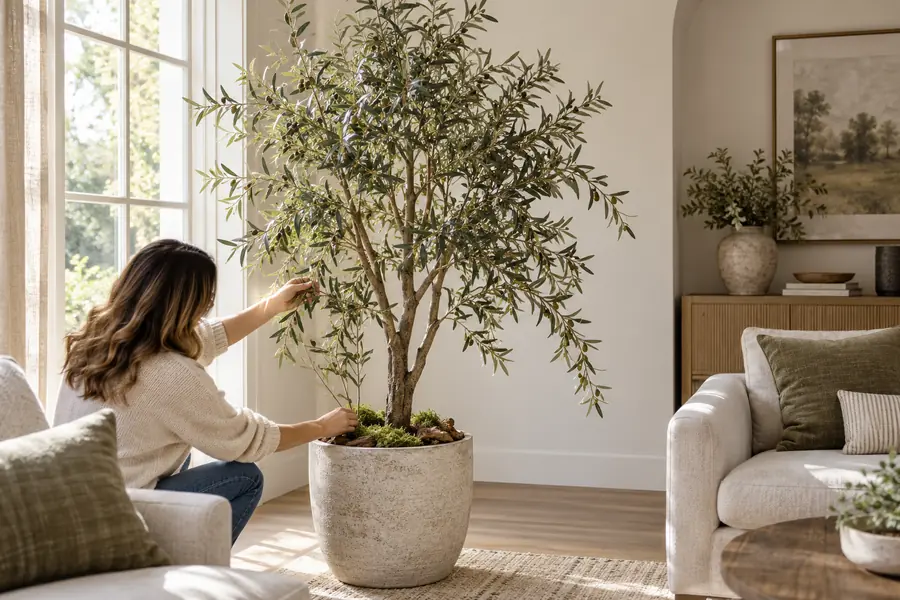
A good artificial tree can add height and greenery without watering or special light. Yet even an expensive faux tree can look artificial if it remains perfectly symmetrical and sits in a tiny factory pot.
To make a fake tree look more realistic, reshape the branches, create natural asymmetry, vary leaf directions, expose parts of the trunk, replace or conceal the factory pot, use moss or bark around the base, remove dust, and position the tree where a living plant would logically grow. The goal is controlled imperfection—not perfect symmetry.
Realistic faux trees depend on styling, not just manufacturing. Vary branches, create asymmetry, upgrade planters, and shape foliage naturally to make artificial trees look convincing.
Why Does a Fake Tree Still Look Fake After You Buy a Good One?
The problem is often not the price.
Artificial trees usually look fake because they are too symmetrical, too dense, poorly shaped after shipping, planted in undersized pots, or positioned without considering how a real tree grows. Glossy foliage, identical leaf angles, visible foam, and perfectly repeated branches can also reveal artificial construction.
House Beautiful’s 2026 styling advice emphasizes that nature does not produce perfect symmetry. Real branches bend, stems grow to different lengths, and leaves do not all face the same direction.
That is why I rarely judge a faux tree immediately after opening the box.
Shipping requires manufacturers to compress branches.
A tree that eventually looks natural may arrive looking:
- Narrow
- Upright
- Repetitive
- Dense around the trunk
- Completely symmetrical
It needs to be styled.
1. Reshape Every Major Branch
This is the most important step.
Never leave a fake tree in its shipping shape. Open the canopy by bending major branches outward, forward, backward, and slightly downward. Different branch angles create depth and prevent the plant from looking like a manufactured cone.
Architectural Digest specifically highlights artificial plants with adjustable branches because they allow owners to shape the foliage more naturally.
Start From the Trunk
I begin with the lowest main branches.
I pull some outward.
Then I move upward through the tree.
The goal is not to make every branch extend equally.
Instead, I might create:
- One fuller side
- One slightly open side
- Several lower branches
- A few higher branches
- Visible gaps around the trunk
That creates an organic silhouette.
Step Back Frequently
Do not style the entire tree from six inches away.
After adjusting a few branches, I step back several feet.
That is the distance from which most people will actually see it.
A branch that looks awkward up close may make the overall tree much more convincing from across the room.
2. Stop Trying to Make the Tree Perfectly Symmetrical
Symmetry is one of the clearest signals of artificial manufacturing.
Real trees are balanced but irregular. One side may grow farther toward light, some branches may droop, and certain areas may contain fewer leaves. Introducing controlled asymmetry makes faux trees look much more botanical.
House Beautiful’s 2026 guide specifically identifies perfect symmetry as one of the biggest giveaways that greenery is artificial.
Create Unequal Branch Lengths
If every branch ends at the same imaginary outer line, the tree can look like a Christmas tree.
Instead:
make one branch longer,
push another inward,
lower one,
and rotate another toward the wall.
The silhouette should have subtle variation.
Leave Negative Space
Do not try to eliminate every gap.
A real tree usually has visible spaces between branches.
House Beautiful’s 2026 faux olive tree coverage notes that sparse silhouettes can actually look more realistic because living olive trees naturally contain open space rather than forming perfect dense balls of foliage.
This is especially important for:
- Olive trees
- Ficus trees
- Citrus-style trees
- Eucalyptus trees
More leaves are not always more realistic.
3. Change the Direction of Individual Leaves
Once the main branches look good, I work on the smaller foliage.
Leaves should face multiple directions rather than presenting every surface directly toward the viewer. Rotate individual stems, tilt some leaves downward, and allow a few to face sideways or inward.
Think about what happens on a real plant.
Some leaves face the light.
Some overlap.
Some point toward the wall.
Some hang slightly downward.
When every artificial leaf faces outward, the plant begins to look like a display product rather than a growing tree.
Avoid the “Flat Front” Effect
Artificial trees are sometimes styled as if they have a front.
Every attractive leaf is rotated toward one direction.
That works in product photography.
It often looks fake in a real room.
I want the tree to look believable from several angles.
4. Expose Some of the Trunk
A realistic tree should not be an uninterrupted green mass.
Allow parts of the trunk and major branches to remain visible. This creates depth, shows the tree’s structure, and makes the canopy look grown rather than assembled.
This works particularly well with faux olive trees.
A real olive tree often has:
a twisting trunk,
open branches,
and an airy canopy.
House Beautiful’s current faux olive tree recommendations favor models that reproduce that restrained, sparse character.
Do Not Hide a Good Trunk
If the tree has a realistic trunk, use it.
Open the lower branches enough that parts of the trunk remain visible.
If the trunk is less convincing, place the weakest side toward:
a wall,
a curtain,
or a piece of furniture.
Then allow the stronger branching to face the room.
5. Upgrade the Factory Pot
The original container is often the easiest part of the plant to identify as artificial.
Place the small factory pot inside a larger planter that is visually proportionate to the tree. Ceramic, terracotta, stone-effect, plaster, wood, and woven baskets can all make an artificial tree feel more integrated into the room.
Architectural Digest specifically recommends ceramic planters as an easy aesthetic upgrade for artificial plants.
Match the Pot to the Tree’s Scale
A seven-foot tree should not appear to grow from a nine-inch shipping pot.
The proportions simply do not make visual sense.
I typically want the planter to feel substantial enough to support the tree visually.
It does not need to be enormous.
It just needs to look believable.
Match the Planter to the Interior
For a warm modern room:
- Textured ceramic
- Travertine-look planter
- Plaster
For a Mediterranean interior:
- Terracotta
- Aged ceramic
For a relaxed natural room:
- Woven basket
For a contemporary room:
- Simple stone-effect pot
- Dark ceramic
The planter should look like intentional furniture rather than packaging.
6. Hide the Artificial Base
Once the tree is in a better planter, conceal the original base.
Visible foam, cement, plastic, or a miniature factory pot can instantly expose a faux tree. Cover the surface with preserved moss, bark, coconut fiber, or decorative material appropriate to the species and planter.
House Beautiful’s current styling advice recommends concealing artificial bases with moss because this removes one of the strongest visual clues that the plant is fake.
Keep the Base Simple
I do not build an elaborate miniature landscape.
I usually use one material:
moss,
bark,
or neutral gravel.
Too much decorative material can make the base attract more attention than the tree.
7. Use the Right Height and Scale for the Room
A realistic tree can still look wrong if its scale does not match the architecture.
Choose a faux tree tall enough to relate to the ceiling and furniture without crowding the room. A substantial statement tree often looks more convincing than several undersized artificial plants scattered across different surfaces.
Architectural Digest’s current guide includes larger palms, fiddle leaf figs, and olive trees specifically as statement greenery for corners and seating areas.
For Standard Ceilings
In many rooms with standard ceiling heights, a tree around:
5 to 7 feet
can provide useful visual height without overwhelming the space.
This is not a rule.
Furniture scale matters too.
A large sectional in a spacious living room may need a taller tree than a small reading chair in an apartment.
Do Not Choose a Tree Only by Price
A cheap four-foot tree may technically fit the empty corner.
But if the architecture clearly calls for six feet of vertical height, the smaller plant may make the room feel under-scaled.
Correct proportions contribute heavily to realism.
8. Place the Tree Where a Real Tree Could Plausibly Grow
Fake trees do not need sunlight, but visual logic still matters.
Artificial trees often look more believable near windows, glass doors, bright corners, or transitional indoor-outdoor spaces because those are locations where people naturally expect living plants.
This does not mean faux trees cannot solve difficult low-light areas.
In fact, Architectural Digest has highlighted artificial trees precisely because they work in rooms where living trees would be difficult to maintain.
The point is to use the room’s visual cues intelligently.
Good Locations
I often like faux trees:
- Beside large windows
- Near patio doors
- Behind a sofa
- Beside a console
- In a bright corner
- At the transition between living and dining spaces
More Difficult Locations
A giant tropical tree in:
a narrow dark hallway
may immediately feel less plausible.
It can still work.
But the tree’s realism needs to be stronger because the placement itself creates suspicion.
9. Clean the Leaves Regularly
Dust destroys realism.
A layer of dust changes leaf color, texture, and light reflection. Clean artificial trees regularly using a soft cloth, brush, or another method recommended by the manufacturer.
Large artificial leaves can make dust particularly obvious.
This affects:
- Fiddle leaf figs
- Rubber trees
- Monstera
- Bird-of-paradise-style faux trees
A clean leaf catches light much more like a living leaf.
A dusty leaf looks decorative.
Do Not Overuse Gloss Products
I generally avoid products designed to make every leaf extremely shiny.
Different species naturally have different surface finishes.
An olive tree should not shine like polished vinyl.
Clean is realistic.
Glossy is not always realistic.
10. Add Natural Materials Around the Tree
One of the easiest ways to make synthetic greenery feel more convincing is to surround it with authentic materials.
Pair faux trees with wood, stone, linen, ceramic, wool, rattan, or other natural textures. These materials introduce real irregularity around the plant and prevent the artificial greenery from carrying the entire burden of making the room feel organic.
For example:
| Faux tree | Good material pairing |
|---|---|
| Olive tree | Stone planter + linen curtains |
| Fiddle leaf fig | Ceramic pot + oak furniture |
| Palm | Woven basket + natural textiles |
| Ficus | Terracotta + wood |
| Rubber tree | Dark ceramic + warm timber |
This changes how the plant is perceived.
The tree becomes one natural-looking layer within a broader material palette.
11. Use Lighting to Help the Tree Look Dimensional
Lighting affects artificial greenery just as much as it affects real plants.
Side lighting and natural window light create shadows between branches, helping an artificial tree appear deeper and less flat. Harsh direct overhead light can reveal repetitive surfaces, plastic shine, and identical leaf patterns.
I particularly like trees placed near:
sheer curtains,
floor lamps,
or directional natural light.
The shadows create depth.
Avoid Spotlighting Weak Details
If a faux tree has less convincing leaves, I do not position a bright spotlight directly above it.
That may exaggerate:
plastic sheen,
seams,
and molded texture.
Soft ambient light is more forgiving.
12. Mix Faux Trees With Real Botanical Elements
Everything around an artificial tree does not have to be artificial.
Combining a faux tree with real branches, fresh flowers, natural wood, or even a few living houseplants can make the room feel less staged. Mixing real and artificial botanical elements prevents the greenery from becoming visually repetitive.
This can be very subtle.
For example:
one faux olive tree in a dark corner,
a real pothos beside the window,
and a vase of seasonal branches on the dining table.
The room feels botanical without demanding that every plant survive in every location.
Which Fake Trees Are Easiest to Make Look Realistic?
Some species are naturally more forgiving.
Olive trees, ficus, palms, fiddle leaf figs, rubber trees, and certain citrus-style artificial trees can look highly realistic when they have convincing trunks, natural color variation, and adjustable branches. Olive trees are particularly forgiving because their real counterparts naturally have irregular, sparse canopies.
House Beautiful’s 2026 faux olive tree guide identifies olive trees as a designer favorite and specifically values examples with realistic sparse silhouettes.
Architectural Digest’s current artificial-plant guide also highlights palms, fiddle leaf figs, olive trees, monstera, and other large faux plants as convincing options when their proportions and styling are strong.
My Easiest Categories to Style
1. Olive tree
Airy structure naturally supports asymmetry.
2. Palm
Many separate fronds make irregular shaping easy.
3. Ficus
Small leaves create layered depth.
4. Rubber tree
Naturally substantial leaves work well with molded materials.
5. Fiddle leaf fig
Excellent statement shape, though leaf quality needs to be high.
What Are the Biggest Mistakes When Styling a Fake Tree?
Most problems are avoidable.
The biggest mistakes are keeping the factory shape, making the canopy perfectly symmetrical, leaving the shipping pot visible, using the wrong planter scale, placing every leaf forward, overcrowding the tree, neglecting dust, and choosing an implausible location.
Quick Before-and-After Checklist
| Fake-looking problem | Realistic solution |
|---|---|
| Narrow shipping shape | Spread branches |
| Perfect symmetry | Create uneven growth |
| Every leaf faces forward | Rotate foliage |
| Canopy is too dense | Add negative space |
| Trunk completely hidden | Expose some structure |
| Tiny plastic pot | Upgrade the planter |
| Foam visible | Cover with moss or bark |
| Dusty leaves | Clean regularly |
| Tree too small | Improve room-scale proportion |
| Harsh lighting | Use softer side light |
My insights: How to Make a Fake Tree Look More Realistic
After comparing current 2026 faux-plant styling guidance with designer recommendations, I think the biggest misunderstanding is that realism comes mainly from buying the most expensive tree.
It does not.
How to Make a Fake Tree Look More Realistic? Start by removing evidence of manufacturing. Break the symmetry, open the branches, expose some trunk, vary the foliage angles, upgrade the planter, hide the factory base, clean the leaves, and place the tree within a believable interior context. The final 20% of styling often creates most of the realism.
My First Insight: Imperfection Is the Most Important Styling Tool
House Beautiful’s current advice makes this particularly clear: perfect symmetry is a major artificial giveaway.
I agree.
I do not try to damage the plant.
I simply stop trying to make it perfect.
One branch can sit lower.
One side can be slightly fuller.
Several leaves can point away.
That creates a believable visual rhythm.
My Second Insight: Negative Space Is Valuable
Many people buy artificial trees according to leaf count.
I think silhouette matters more.
Especially with an olive tree, open spaces allow me to see:
the trunk,
branch junctions,
and depth inside the canopy.
That can look much more natural than a thick wall of identical leaves.
House Beautiful’s 2026 olive tree guide reinforces this by favoring intentionally airy examples over overly dense ones.
My Third Insight: The Planter Is Half the Illusion
A convincing tree with a bad pot still looks artificial.
I treat the planter as part of the tree.
It creates the visual transition between:
floor
and
trunk.
If that transition looks believable, the entire tree becomes more convincing.
Architectural Digest similarly recommends upgrading faux plants with good ceramic planters rather than accepting the original container.
My Fourth Insight: Correct Placement Can Compensate for Moderate Quality
A mid-range faux tree in the right location can look more believable than an expensive tree placed awkwardly.
Near a window, the tree makes visual sense.
Beside natural materials, it feels integrated.
Under soft side lighting, it develops depth.
Context matters.
My Fifth Insight: Viewing Distance Should Determine Quality
If a tree sits in a living-room corner eight feet from the main seating area, the viewer mainly sees:
silhouette,
trunk,
scale,
and color.
If the tree sits beside a reading chair, the viewer sees individual leaves.
Therefore:
the closer the viewing distance, the more important leaf-level realism becomes.
This can help control budget.
My Sixth Insight: Do Not Overdecorate Around the Tree
Once I have a convincing statement tree, I usually give it space.
I do not surround it with:
five more tiny faux plants,
botanical prints,
leaf sculptures,
and artificial vines.
The tree becomes more believable when it behaves like one design element rather than part of an artificial-plant theme.
My 60-Second Fake Tree Makeover
If I had only one minute to improve an artificial tree, I would:
0–10 seconds: Pull the main branches outward.
10–20 seconds: Lower two or three branches.
20–30 seconds: Rotate leaves in different directions.
30–40 seconds: Create visible gaps around the trunk.
40–50 seconds: Hide the factory base.
50–60 seconds: Step back and make one side slightly less symmetrical.
Those small adjustments can make a surprising difference.
My Final View
The best fake trees are not the ones that look perfect.
They are the ones that imitate the controlled irregularity of real growth.
Current design guidance supports exactly that approach. House Beautiful recommends uneven stems, drooping, concealed bases, and natural asymmetry, while Architectural Digest highlights realistic artificial plants with adjustable foliage and better containers.
So when I style a faux tree, I focus on seven things:
shape, asymmetry, trunk, foliage direction, planter, placement, and cleanliness.
I do not need every leaf to fool someone from three inches away.
I need the tree to look convincing at the normal viewing distance of the room.
That is a much more practical standard—and usually much easier to achieve.
FAQ
How can I make a cheap fake tree look expensive?
Reshape the branches, create asymmetry, place the tree in a larger decorative planter, conceal the factory base with moss or bark, clean the leaves, and position it where the scale feels intentional.
Should a fake tree be perfectly symmetrical?
No. Real trees grow irregularly. Current House Beautiful styling advice specifically recommends varying stem lengths and introducing natural asymmetry.
What can I put around the base of a fake tree?
Preserved moss, bark, coconut fiber, or decorative gravel can conceal the factory base. Choose one material that looks natural with the planter and tree species.
How do you make a faux olive tree look real?
Open the canopy, leave visible gaps, expose some trunk, bend branches unevenly, use a substantial planter, and avoid making the tree overly full. Real olive trees naturally have relatively airy silhouettes.
Should fake trees be placed near windows?
They do not need sunlight, but placing them near windows or bright architectural areas often makes them visually more believable because those are places where people expect living plants.
Why does my fake tree look too plastic?
Common causes include excessive leaf shine, flat color, identical foliage, poor branch shaping, and harsh lighting. A matte or species-appropriate finish and more varied branch positioning usually look more natural.
How often should I dust a fake tree?
There is no universal schedule. Clean it whenever visible dust begins affecting the color or surface. High-traffic areas may need more frequent attention.
Is a large fake tree more realistic than several small plants?
Often, yes. One substantial, well-styled statement tree can look more intentional and natural than many small artificial plants scattered across shelves and tables.
Conclusion
To make a fake tree look realistic, remove signs of manufacturing: reshape branches, embrace asymmetry, expose the trunk, upgrade the planter, hide the base, and style with natural imperfection.

