

Artificial flowers do not wilt in storage, but pressure, dust, moisture, heat, and poor handling can leave premium inventory bent, faded, or unsellable.
To store artificial flowers without crushing them, clean and dry every piece, separate products by shape and material, use rigid containers, support flower heads with acid-free tissue, and avoid overfilling. Long stems need horizontal racks or upright compartments, while bouquets, wreaths, garlands, and arch modules need dedicated containers that protect their finished shapes.
For retailers and event planners, storage is part of product quality. A flower is not truly reusable when the team needs hours to repair it before every sale, rental, or installation.
What Is the Best Way to Store Artificial Flowers?
Placing every stem inside one large box may save time after an event. It usually creates more work later because flower heads become compressed, stems become tangled, and labels disappear under the inventory.
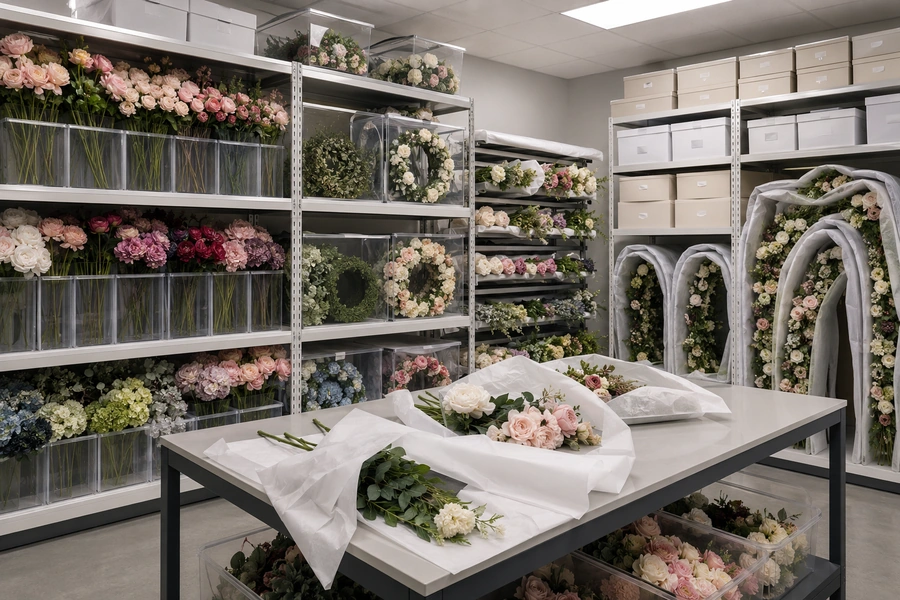
The best storage system keeps artificial flowers clean, completely dry, supported, separated, labeled, and protected from direct sunlight. Use rigid boxes or purpose-built floral containers, leave enough room around delicate blooms, and store inventory in a cool, dry area where boxes will not be crushed by heavier products.
Artificial-flower care guidance recommends cleaning and fully drying flowers before packing them, using a sturdy storage box, and keeping the box in a cool, dry place away from direct sunlight. These steps help limit dust, moisture damage, fading, and physical crushing.
Storage Should Match the Product Form
Loose rose stems do not need the same storage system as a finished bridal bouquet. A six-foot garland should not be folded into the same bin used for small flower heads.
I divide inventory into six basic groups:
| Inventory Group | Best Starting Storage Format |
|---|---|
| Loose short stems | Compartmented rigid bins |
| Long stems and branches | Horizontal racks or tall divided containers |
| Premium flower heads | Shallow trays with soft separators |
| Finished bouquets | Upright bouquet boxes or supported totes |
| Wreaths and garlands | Dedicated bags, flat boxes, or hanging racks |
| Arch and installation modules | Labeled rigid crates or rolling carts |
This classification reduces unnecessary handling. Staff can retrieve one product category without lifting, bending, or unpacking unrelated flowers.
Prevent Three Types of Storage Damage
Most storage failures fall into three groups.
Compression damage occurs when cartons, lids, dividers, or other flowers press against petals and leaves.
Environmental damage includes fading, trapped moisture, odor, dust, heat-related warping, and adhesive changes.
Operational damage occurs when staff cannot identify stock, drag stems from overcrowded bins, or repeatedly unpack the wrong products.
A good system controls all three. Protective tissue cannot solve a poor inventory label, and a barcode cannot protect a hydrangea from a heavy carton placed above it.
Method 1: Clean Every Flower Before Storage
Dust becomes harder to remove when it remains on petals for an entire season. Outdoor arrangements may also carry dirt, pollen, grease, moisture, or small debris into the storage area.
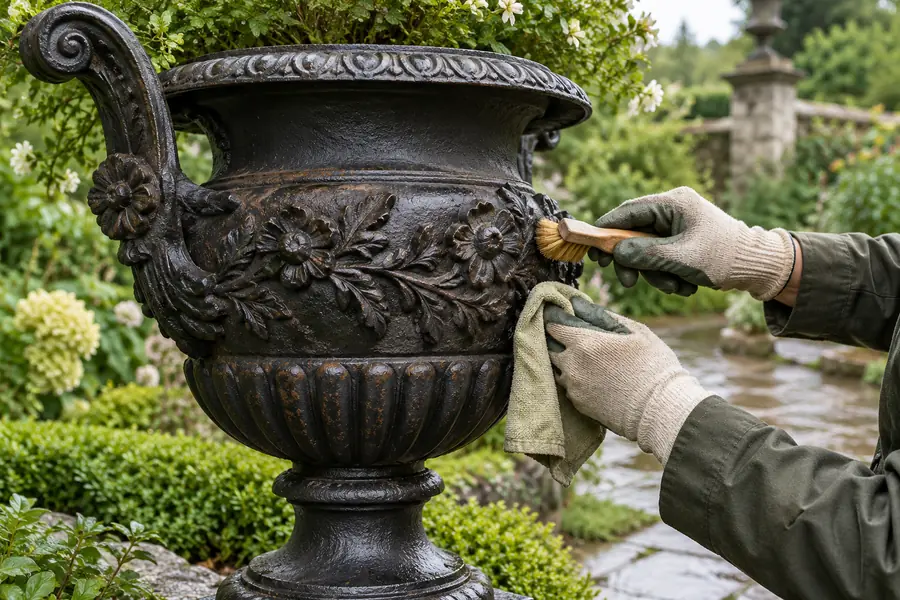
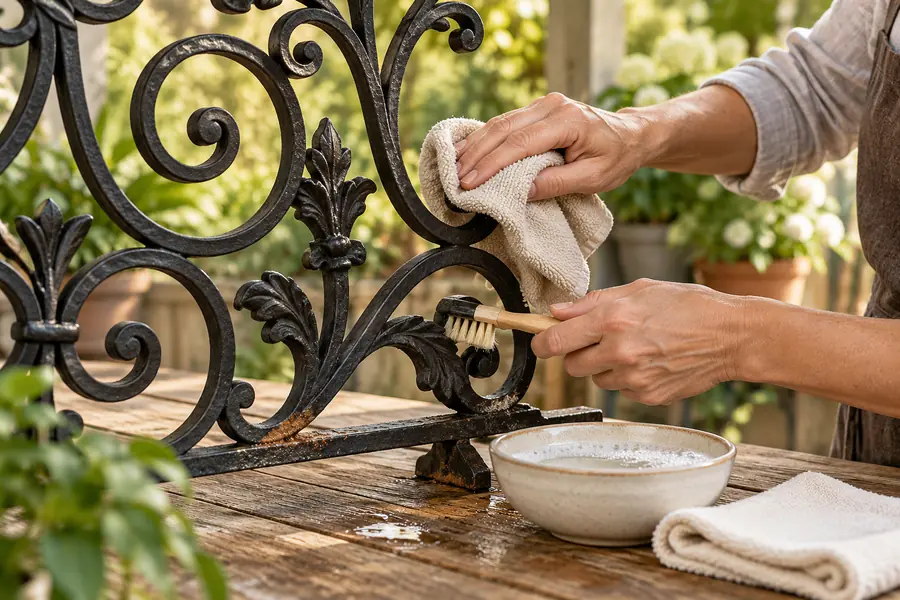
Clean artificial flowers before packing them by using a microfiber cloth, soft brush, or cool low-pressure air. Spot-clean only with a method approved for the material, and allow every petal, stem, adhesive joint, and container to dry completely before storage.
I begin with a visual inspection under good lighting. I look inside flower centers, under leaves, around wired stems, and between layered petals.
The cleaning method depends on the material:
| Material | Safer Starting Method |
|---|---|
| Polyester petals | Soft dry brush or cool air |
| PE leaves | Microfiber cloth |
| PVC stems | Dry or slightly damp cloth |
| PU real-touch petals | Gentle dry cleaning unless care instructions allow moisture |
| Flocked flowers | Soft brush only |
| Glittered flowers | Very light air or brushing |
| Foam flowers | Dry cleaning with minimal pressure |
Balsam Hill advises making sure artificial flowers are clean and completely dry before placing them in storage.
I do not seal damp flowers inside a plastic tote. A closed container can hold that moisture around porous fabric petals, paper-wrapped stems, adhesives, or metal components.
For event businesses, I add a return-cleaning station near the warehouse entrance. Used florals do not go directly back onto the main shelving. They first move through inspection, cleaning, repair, drying, and recounting.
Method 2: Inspect, Repair, and Grade Inventory
A loose petal that survives the storage process may still fall during the next event. Storage preparation is the best time to identify weak inventory.
Inspect artificial flowers for detached heads, bent wire, cracked stems, exposed metal, loose leaves, glue marks, fading, stains, and odor. Repair usable products before packing, then separate sale-ready, rental-ready, repairable, and unsellable stock so damaged items do not return to active inventory.
I use four condition grades:
- Grade A: Suitable for close-up retail, bouquets, and table arrangements
- Grade B: Suitable for arches, flower walls, and distant installations
- Repair: Requires cleaning, reattachment, reshaping, or stem work
- Retire: Faded, permanently crushed, unsafe, or uneconomical to repair
This grading protects premium inventory. A flower with a small rear glue mark may remain useful in an elevated arch, but it should not be mixed into a bridal-bouquet bin.
I also record missing pieces before storage. A centerpiece set described as complete should not contain nine arrangements when the label says ten.
For finished rental designs, I photograph the item before disassembly. The photograph shows the approved flower placement and makes rebuilding faster.
Method 3: Separate Flowers by Material, Color, and Shape
Mixed storage may create pressure, color transfer, tangles, and surface damage. A hard plastic branch can scratch a soft real-touch petal, while dark foliage can rub against pale fabric flowers.
Separate artificial flowers according to material, color family, stem length, flower-head size, and intended use. Keep pale products away from dark or glittered items, place rigid branches away from delicate petals, and avoid mixing strongly scented or recently coated products with absorbent fabric flowers.
My minimum separation categories are:
- White and ivory flowers
- Light pastels
- Strong or dark colors
- Glittered and flocked products
- Real-touch flowers
- Molded plastic greenery
- Long wired branches
- Small fillers
- Finished arrangements
- Outdoor-used products awaiting inspection
Color separation is especially important for white wedding flowers. Friction between a pale petal and a dark printed stem, berry coating, ribbon, or dusty carton can leave visible marks.
I also separate flower types that tangle. Fine baby’s breath, trailing vines, grasses, and berry sprays can wrap around roses and hydrangeas. Small reusable ties around each product bundle reduce this problem.
The tie should hold the stems together without compressing the flower heads. I attach the label to the stems or container, not through a delicate petal.
Method 4: Use Rigid, Correctly Sized Containers
A thin bag keeps dust away but provides almost no protection against stacking pressure. A large box can also be harmful when its contents move and collide.
Use rigid plastic totes, strong corrugated boxes, shallow trays, or purpose-built floral containers sized for the products inside. The container should protect the blooms from external weight while limiting internal movement without pressing directly against petals.
General UPS packaging guidance recommends rigid boxes, adequate cushioning, and containers with sufficient strength for their contents. Although warehouse storage is different from parcel shipping, the same mechanical principle applies: the outer container should carry external loads instead of transferring them to the product.
Choose the Container by Risk
| Container | Best Use | Limitation |
|---|---|---|
| Clear lidded tote | Regularly accessed rental inventory | Can trap moisture if items are packed damp |
| Strong cardboard carton | Dry warehouse and bulk stock | Sensitive to water and heavy stacking |
| Shallow rigid tray | Premium flower heads | Uses more shelf area |
| Tall divided bin | Upright sturdy stems | Can bend tall flowers if too short |
| Bouquet box | Finished bouquets | Must prevent sideways movement |
| Rolling crate | Installation modules | Requires clear weight limits |
I do not use one oversized tote for every product. Empty space allows stems to slide and flower heads to strike the sides. Excessive filler wastes space and complicates retrieval.
The correct container leaves controlled clearance around the product. It does not force the lid against the highest petals.
Method 5: Support Delicate Blooms With Acid-Free Tissue
Thin polyester petals can crease where they touch a divider, another flower, or the side of a box. Soft support spreads pressure across a wider area.
Place loosely shaped, unbuffered acid-free tissue around delicate flower heads and between storage layers. Use the tissue to support the natural curve of petals rather than wrapping the bloom tightly. Replace dirty, crushed, wet, or deteriorated tissue before the next storage cycle.
Smithsonian conservation guidance recommends neutral-pH, unbuffered acid-free tissue for general textile storage. It notes that lighter tissue can be used for stuffing and interleaving to maintain three-dimensional shapes and reduce abrasion.
Artificial flowers are not museum textiles, but the same support principle is useful for delicate polyester petals: soft, chemically stable tissue can reduce direct rubbing and help a bloom hold its shape.
The National Archives also recommends using shaped acid-free tissue to soften folds and lightly support three-dimensional textile objects.
How I Support a Flower Head
I do not wrap a rose like a parcel. Instead, I:
- Place a loose tissue ring under the outer petals.
- Add a small tissue support beside the flower if it can roll.
- Keep tissue away from sticky coatings or uncured adhesive.
- Ensure the bloom does not carry the weight of the layer above.
- Mark the box as “top load only” when the contents remain delicate.
Regular colored tissue may transfer dye, and ordinary paper can become acidic over long periods. For high-value stock, neutral, unbuffered archival tissue is the more controlled choice.
Method 6: Store Loose Stems in Shallow, Single-Direction Layers
Alternating flowers randomly inside a deep bin creates tangled leaves and uneven pressure. Deep vertical piles also place the full weight on the lowest flower heads.
Lay loose stems in shallow layers with all flower heads facing the same end of the container. Offset the heads so they do not sit directly above one another, add soft separators between layers, and keep the total depth low enough that lower blooms remain uncompressed.
I place the strongest stems at the bottom and the most delicate products near the top. I never put heavy molded tropical branches above soft fabric peonies.
A single-direction arrangement also makes inventory counting faster. Staff can lift one complete bundle instead of pulling stems through a tangled pile.
Layering Pattern
| Layer | Recommended Contents |
|---|---|
| Bottom | Strong greenery or securely molded stems |
| Middle | Medium roses, tulips, or structured flowers |
| Upper | Peonies, hydrangeas, orchids, and soft petals |
| Top | Lightweight filler or empty clearance space |
If a container needs many layers, I use rigid internal trays or dividers rather than allowing the flowers themselves to support the weight.
For large wholesale quantities, several shallow cartons are safer than one very deep carton. This may use more shelf positions, but it reduces recovery labor and damaged inventory.
Method 7: Store Long Stems Horizontally or in Divided Upright Racks
Long artificial stems are often damaged by being forced into a container that is slightly too short. The stem develops a permanent curve, or the flower head presses against the lid.
Store long roses, delphiniums, blossom branches, eucalyptus, and greenery horizontally on supported racks when possible. Upright storage can work for strong stems when the container is tall enough and includes dividers that prevent leaning, tangling, and pressure on flower heads.
Horizontal storage works best when the shelf supports the full stem length. I use low front barriers so products cannot roll onto the floor.
I separate long stems by type and height. A six-foot branch should not rest on top of a bundle of 24-inch roses.
Upright racks work well for active design studios because staff can see and select stems quickly. However, the base must hold the stems without squeezing them, and the tallest flower must remain below any shelf, ceiling, or cover.
Choose Horizontal Storage When:
- Flower heads are heavy
- Stems are soft or highly flexible
- Products will remain stored for months
- Branches have wide side growth
- The rack can support the full length
Choose Upright Storage When:
- Inventory is accessed daily
- Stems are strong and wired
- The container has enough height
- Each category has a separate compartment
- The flowers will not lean under their own weight
I avoid storing wired stems in a bent position simply because the shelf is too short. Repeated rebending weakens the structure and makes the product harder to arrange accurately.
Method 8: Keep Finished Bouquets Upright and Individually Supported
A completed bouquet has a designed shape that loose-stem storage can destroy. Laying several bouquets on top of one another transfers weight directly to the outer blooms.
Store finished artificial bouquets upright in divided bouquet boxes, rigid totes, or custom supports that hold the handles without pressing on the flowers. Cover the arrangement against dust, keep neighboring bouquets from touching, and leave enough overhead clearance for the tallest bloom.
Care guidance for finished artificial arrangements recommends upright storage and avoiding pressure on the petals.
I use a base insert with openings sized for the bouquet handles. The insert prevents the arrangement from falling sideways during handling.
Each bouquet receives:
- Product or event code
- Color palette
- Intended use
- Stem count
- Photograph
- Condition grade
- Storage date
- Required repair note
Bridal bouquets, bridesmaid bouquets, and toss bouquets should not be packed without identification. Similar-looking blush arrangements can contain different flower recipes and handle finishes.
For long-term keepsake storage, I use a clean rigid box with soft support around—but not on top of—the flower heads. I do not seal a bouquet until every component is dry.
Method 9: Store Centerpieces as Complete Modules
Repeatedly disassembling finished centerpieces saves space but increases labor and creates variation when the design must be rebuilt.
Store durable centerpieces as complete modules when shelf space permits. Secure each arrangement inside a rigid container, support the vase or base separately from the blooms, and prevent the design from touching the lid or neighboring arrangements. Remove heavy or fragile vessels when they could damage the flowers.
I decide whether to store a centerpiece assembled by comparing:
- Reconstruction labor
- Storage volume
- Material fragility
- Number of future uses
- Container cost
- Transport method
- Design consistency requirements
A standard rental centerpiece used every month usually deserves a custom storage position. A one-time design made from easy loose stems may be better disassembled.
Heavy ceramic, glass, or metal containers should not move freely beside artificial flowers. For transport and long storage, I often separate the vessel and floral insert.
The arrangement then consists of two labeled parts:
- A: Floral module
- B: Vessel or base
This prevents a vase from breaking or crushing petals while still allowing fast reassembly.
Method 10: Hang Garlands and Trailing Florals Without Sharp Folds
A garland can develop permanent flat areas when tightly folded into a small carton. Trailing flowers may also become tangled around their own stems.
Hang long garlands, vines, and trailing florals on wide padded supports when space allows. For boxed storage, coil them loosely in large curves, secure several points with soft reusable ties, and place tissue or dividers between layers so flowers do not hook into one another.
I never tie a long garland only at its midpoint. The unsupported ends pull downward and can distort the central frame.
A better hanging system supports several sections along the garland. The cover should protect against dust without pushing the leaves inward.
For boxed garlands, I avoid sharp U-shaped folds. A broad coil places less stress on the wired frame.
Garland labels should include:
- Finished length
- Main flower types
- Color palette
- Number of matching pieces
- Required joining clips
- Condition
- Intended venue or collection
Garlands used around candles, food, or heavily trafficked tables need an extra inspection before storage. Dirt and wax-like residue should be removed with a material-compatible method before the product is enclosed.
Method 11: Use Dedicated Wreath and Arch-Module Storage
Wreaths, swags, aisle markers, and wedding-arch modules have irregular shapes. A general-purpose bin may press on their highest flowers while leaving unused space elsewhere.
Store wreaths flat in rigid wreath boxes or hang them from strong frames without resting weight on the floral surface. Store arch modules in individual labeled crates, carts, or wall-rack positions that support the mechanical base rather than the flowers.
Specialist wreath bags can help protect artificial wreaths and garlands from dust during storage. A soft bag alone does not protect against stacking, so I use rigid outer protection when other items may be placed nearby.
Wreath Storage Rules
- Support the wreath frame, not the flower heads.
- Do not stack heavy wreaths directly on one another.
- Keep hanging points wide enough to prevent frame distortion.
- Cover the product without compressing its front.
- Store detachable accessories in a labeled inner pouch.
Arch-Module Storage Rules
Arch modules should be removed from the structural frame where the design allows it. Each module needs at least two strong handling points.
I label modules by position:
- Lower left
- Upper left
- Lower right
- Upper right
- Center connector
- Ground meadow 1–6
A reference photograph shows how the pieces connect. This prevents installers from bending the modules repeatedly while trying to identify the correct orientation.
Method 12: Control Light, Heat, Moisture, Dust, and Odor
A perfect container cannot protect inventory when the storage room leaks, overheats, or receives direct sunlight every afternoon.
Store artificial flowers in a stable, cool, dry, clean environment away from windows, heating equipment, roof leaks, and strong odors. Keep cartons off the floor, allow inspection space around walls, and do not use basements, attics, vehicles, or exterior sheds unless their conditions are properly controlled.
Balsam Hill recommends a cool, dry location away from direct sunlight. Smithsonian textile-storage guidance also shows why stable conditions matter: enclosure helps protect materials from light, abrasion, soiling, and rapid changes in temperature and relative humidity.
Retailers do not need to turn a warehouse into a museum. The practical lesson is to avoid major fluctuations and known risk areas.
Storage Locations I Avoid
| Location | Main Risk |
|---|---|
| Uninsulated attic | High heat and temperature swings |
| Damp basement | Moisture, odor, and possible leaks |
| Exterior shed | Heat, cold, pests, and dust |
| Delivery vehicle | Heat buildup and shifting loads |
| Floor beside a wall | Water exposure and difficult inspection |
| Directly under pipes | Leakage or condensation |
| Sunny window area | Uneven fading and heat |
| Near fragrances or chemicals | Odor transfer and surface reaction |
Boxes should sit on shelving or pallets rather than directly on the floor. This supports cleaning, airflow, inspection, and protection from minor water events.
I also keep artificial flowers away from scented cleaners, smoke, fuel, paints, and strongly perfumed materials. Fabric petals can retain unwanted odors.
Method 13: Label, Photograph, Map, and Rotate the Inventory
A no-crush system fails when staff must open and move six bins to find one product. Every unnecessary handling step adds compression and breakage risk.
Give every container a visible location code, product list, quantity, color, condition, and photograph. Maintain a digital inventory that matches the physical labels, assign permanent shelf locations, and rotate older or previously used stock so it is inspected before newer inventory is opened.
Wedding-planning organization guidance recommends placing an inventory list in or directly on each décor bin, including the item, its purpose, and quantity.
For professional operations, I use three identification layers.
Layer 1: External Container Label
The label shows:
- Bin or carton number
- Product category
- Main color
- Quantity
- Condition
- “Top load only” or other handling rule
- Shelf location
Layer 2: Internal Packing List
The list identifies every product inside, including spare parts and accessories.
Layer 3: Digital Record
The digital record contains:
- Product code
- Photograph
- Quantity available
- Quantity reserved
- Rental or sales status
- Storage location
- Last inspection
- Replacement cost
- Event allocation
I also add a warehouse map. New or temporary staff should be able to locate a champagne rose without opening every pink-flower tote.
Use Status Zones
I separate the warehouse into:
- Clean and available
- Reserved for an event or order
- Returned and awaiting inspection
- Repair required
- Quarantine or claim stock
- Retired or clearance inventory
This prevents used, wet, damaged, or uncounted items from being returned to ready stock.
Can You Store Artificial Flowers in Plastic Bags?
Plastic bags are inexpensive and useful against dust, but they should not be treated as structural packaging.
Plastic bags can provide a dust barrier for clean, dry artificial flowers, particularly when products are hanging or already supported by a rigid rack. They should not be tightly packed, vacuum-sealed, or stacked without external protection because the bag cannot stop petals from being crushed.
A care guide for bridal artificial flowers recommends airtight containers, plastic bags, or garment bags to reduce dust before an event. The correct choice depends on whether the flowers also need protection from pressure.
Bags Work Best For:
- Hanging garlands
- Covered bouquet racks
- Individual large branches
- Short preparation periods
- Dust protection inside a clean room
- Products supported by a rigid frame
Bags Work Poorly For:
- Stacked warehouse stock
- Heavy flower heads
- Damp returns
- Long-term compression
- Products with sticky or uncured coatings
- Sharp wired branches
- Mixed loose stems
I use unscented, clean bags. A fragranced household bag can transfer odor to fabric petals.
I also avoid pulling a tight bag across the face of an arrangement. The cover should fall around the product without flattening it.
Should Artificial Flowers Be Stored Airtight?
An airtight box keeps dust outside, but it also traps anything already inside, including moisture, odor, or chemical residue.
A sealed container is useful only when the artificial flowers and the container are completely clean and dry. For long-term storage, the main priorities are stable environmental conditions, dust protection, and no compression. Do not seal flowers immediately after outdoor use, wet cleaning, steaming, coating, or exposure to rain.
Rigid lidded totes work well for many retail and event inventories because they protect against dust and accidental handling. The lid should close without contacting the flowers.
I inspect sealed bins periodically, especially after the first few weeks. I check for:
- Condensation
- Musty odor
- Sticky surfaces
- Color transfer
- Rust around exposed wire
- Pest evidence
- Pressure marks
Desiccant packets may be appropriate in some controlled containers, but they are not a substitute for drying wet products or fixing a humid storage room. They also need monitoring and replacement according to their instructions.
How Should Retailers Organize Bulk Artificial Flower Stock?
Retail inventory needs density, visibility, fast picking, and reliable quantities. Storing everything as finished arrangements is rarely efficient.
Retailers should store core loose stems by product code, color, length, and selling unit. Use shallow cartons or divided bins for delicate flowers, horizontal racks for long stems, and a separate forward-pick area for frequently sold items. Keep reserve cartons sealed until the active stock needs replenishment.
I divide wholesale stock into two levels.
Forward-Pick Stock
This is the inventory staff access every day. It should be easy to see, count, and retrieve.
Reserve Stock
This remains in approved original cartons or controlled warehouse packaging until needed. Reserve cartons should not be repeatedly opened for single-stem orders.
| Inventory Type | Recommended Position |
|---|---|
| Fast-selling roses and greenery | Waist-to-shoulder-height pick area |
| Delicate premium blooms | Protected shallow shelving |
| Heavy containers and bases | Lower shelves |
| Long branches | Horizontal rack |
| Slow seasonal inventory | Upper or rear controlled shelves |
| Damaged or returned stock | Separate quarantine zone |
I do not place delicate flowers beneath heavy vases, metal stands, or event hardware. Warehouse shelf failure is not the only concern; staff may accidentally drag heavy equipment across a floral carton.
How Should Event Planners Store Artificial Wedding Flowers?
Wedding inventory must stay photo-ready and easy to deploy. Color families, complete recipes, and event allocations matter more than general product categories alone.
Event planners should store wedding flowers by collection and function: bridal bouquets, bridesmaid bouquets, centerpieces, aisle flowers, arch modules, garlands, and spare stems. Give every collection a photograph, component list, setup map, and return checklist so pieces are not mixed into general stock after an event.
A complete wedding collection may include 20 different product codes but should remain connected operationally.
I use one master collection number for:
- Bouquets
- Boutonnieres
- Centerpieces
- Ceremony pieces
- Welcome-sign flowers
- Cake-table pieces
- Arch modules
- Spare flowers
- Repair supplies
Each individual container carries the same master number plus a component code.
After the event, staff count the collection before leaving the venue. Missing pieces are easier to trace immediately than several days later.
The returned flowers then move to the inspection zone. They do not go directly into long-term storage while still dusty, damp, or compressed from transport.
How Often Should Stored Artificial Flowers Be Checked?
Artificial flowers do not expire like fresh flowers, but storage conditions and packaging can change.
Inspect frequently used inventory whenever it is returned and before every new order or event. Check long-term or seasonal stock at planned intervals for compression, moisture, fading, odor, pests, carton weakness, and inaccurate quantities. Record the inspection so recurring problems can be traced to a shelf, container, product, or packing method.
A practical inspection may include:
- Opening representative containers
- Comparing color with the approved sample
- Checking lower layers for pressure
- Testing flexible stems
- Smelling fabric products
- Reviewing labels
- Counting high-value items
- Inspecting shelves and walls
- Replacing damaged tissue
- Cleaning the storage area
Artificial-flower storage guidance recommends checking stored products periodically and correcting storage problems before damage becomes severe.
I inspect seasonal Christmas, spring, and wedding collections well before their selling or event periods. Discovering flattened flowers one day before installation removes the main advantage of reusable décor.
My Insights: How Should Retailers and Planners Store Artificial Flowers Without Crushing Them
The most effective storage system does not maximize the number of stems inside each carton. It minimizes the total cost of damage, reshaping, recounting, searching, and replacement.
Retailers and planners should store artificial flowers through a 13-part no-crush system: clean, inspect, separate, contain, support, layer, rack, hold bouquets upright, protect modules, hang long décor, control the environment, label inventory, and inspect it regularly. The correct system preserves both the product’s shape and the team’s working time.
My main insight is that storage density and storage efficiency are not the same thing.
The 13 No-Crush Methods at a Glance
| No. | Storage Method | Main Problem Prevented |
|---|---|---|
| 1 | Clean and dry before packing | Dust, stains, and trapped moisture |
| 2 | Inspect, repair, and grade | Damaged stock returning to use |
| 3 | Separate by material and color | Abrasion, tangles, and color transfer |
| 4 | Use rigid fitted containers | External crushing and movement |
| 5 | Add acid-free tissue support | Petal creases and friction |
| 6 | Use shallow single-direction layers | Weight on lower blooms |
| 7 | Rack long stems correctly | Bent stems and pressed heads |
| 8 | Keep bouquets upright | Loss of designed shape |
| 9 | Store centerpieces as modules | Rebuilding time and inconsistency |
| 10 | Hang or loosely coil garlands | Sharp folds and tangles |
| 11 | Protect wreaths and arch modules | Irregular-shape compression |
| 12 | Control the storage environment | Fading, heat, moisture, and odor |
| 13 | Label and map all inventory | Unnecessary handling and lost stock |
Protect the Flower Head First
The flower head is usually the most visible and difficult part to repair. A bent wired stem can often be reshaped. A permanently creased real-touch petal or stained ivory hydrangea may need replacement.
I design the container around the flower head, then organize the stems around that protected space.
Store by Retrieval Pattern
A product used every week should not sit behind seasonal stock. Frequently accessed inventory needs easy picking and strong dust control because its container is opened often.
Long-term reserve inventory needs stronger environmental protection and less internal pressure.
This operational distinction reduces unnecessary handling.
Measure Storage Damage
Retailers and rental businesses should record:
- Crushed units
- Stained units
- Missing pieces
- Repair time
- Reshaping time
- Replacement cost
- Event preparation delays
- Customer returns
- Damage by container type
A storage change becomes easier to justify when the business knows that one overcrowded bin creates several hours of monthly repair work.
Standardize the Return Process
My preferred return workflow is:
- Count at the venue.
- Photograph major damage.
- Transport in the correct containers.
- Place all returns in the inspection zone.
- Remove dirt and debris.
- Repair loose components.
- Dry completely.
- Grade the condition.
- Update quantities.
- Repack in the assigned location.
This process stops small problems from becoming permanent damage.
Use Original Packaging Selectively
Original manufacturer cartons can be useful when they already protect each flower properly. They also preserve product codes and packing quantities.
I replace the original packing when:
- Flower heads were heavily compressed
- The carton is weak or damp
- The product needs frequent access
- The inner packaging creates scratches
- The box cannot be safely restacked
- The original label no longer matches the inventory status
The goal is not to keep every original box. The goal is to retain packaging that still supports the product.
My Final Storage Rule
No lid, shelf, carton, divider, or neighboring flower should press against the visible surface of a premium bloom.
The storage system should support the stem, frame, base, or empty space around the flower. It should not ask the petals to carry weight.
When that rule is combined with cleaning, environmental control, clear labels, and disciplined return handling, artificial flowers remain ready for retail displays and events with far less reshaping.
Conclusion
Clean and dry every flower, protect blooms with rigid space and soft support, store each format correctly, and label every container. No-crush storage preserves both inventory value and preparation time.