
Fake wedding flowers once carried a budget reputation. Today, better materials, rental services, destination weddings, DIY planning, and reusable installations have made them a normal option.
Yes, using fake flowers for a wedding is increasingly common and socially accepted, although there is no reliable evidence that most weddings use them. Couples choose artificial flowers for bouquets, arches, centerpieces, aisle décor, and backdrops because they can be prepared early, reused, rented, transported easily, and kept after the wedding.
Artificial wedding flowers are increasingly accepted, with rental options expanding and stigma fading. The key is choosing realistic faux, fresh, or hybrid designs for weddings.
Are Fake Flowers Cheaper Than Real Flowers for Weddings?
Artificial flowers can save money, especially when they replace large installations or can be rented and reused, but premium faux flowers are not automatically cheaper than fresh flowers.
Fake wedding flowers can be cheaper, but the comparison depends on quality, design, labor, rental versus purchase, and reuse. Budget polyester flowers may cost less initially, while premium real-touch flowers can approach or exceed fresh-flower prices. Faux flowers become particularly cost-effective for large installations, rentals, destination weddings, and designs reused after the ceremony.
Why the “Fake Is Always Cheaper” Rule Does Not Work
A wedding florist’s quote contains more than flower stems.
Fresh-flower pricing can include:
- Flower sourcing
- Conditioning
- Refrigerated storage
- Design labor
- Delivery
- Installation
- Water mechanics
- Breakdown
- Waste
Artificial arrangements may avoid some of those requirements, but they introduce others:
- Higher-quality faux stems
- Wire cutting
- Reshaping
- Storage
- Packaging
- Shipping
- Assembly
- Rental handling
- Cleaning
Zola notes that artificial wedding arrangements can range widely in price depending on size and material, and it specifically warns that the most realistic faux flowers can cost as much as or more than fresh flowers.
Fresh Wedding Flowers Are Also a Significant Budget Category
The Knot’s May 2026 wedding-flower cost guide is based on nearly 11,000 couples and confirms that floral décor remains a substantial line in wedding budgets. The exact amount varies widely with location, flower selection, scale, season, and design complexity.
This is why couples should compare equivalent designs.
Do not compare:
One basic artificial bouquet
with:
A full-service florist package containing bouquets, centerpieces, ceremony flowers, setup, and breakdown.
Instead compare the same shopping list.
Compare Like With Like
| Wedding Element | Fresh Option | Faux Option |
|---|---|---|
| Bridal bouquet | Florist-designed fresh bouquet | Premium silk/real-touch bouquet |
| Ceremony arch | Fresh floral installation | Faux or rented floral modules |
| Bridesmaid bouquets | Fresh bouquets | Artificial bouquets |
| Centerpieces | Fresh table flowers | Artificial arrangements |
| Aisle flowers | Fresh arrangements | Faux aisle modules |
| Photo backdrop | Fresh installation | Reusable artificial wall |
Only after those elements match should price decide the winner.
Where Faux Flowers Can Protect the Budget
Artificial flowers become especially practical for:
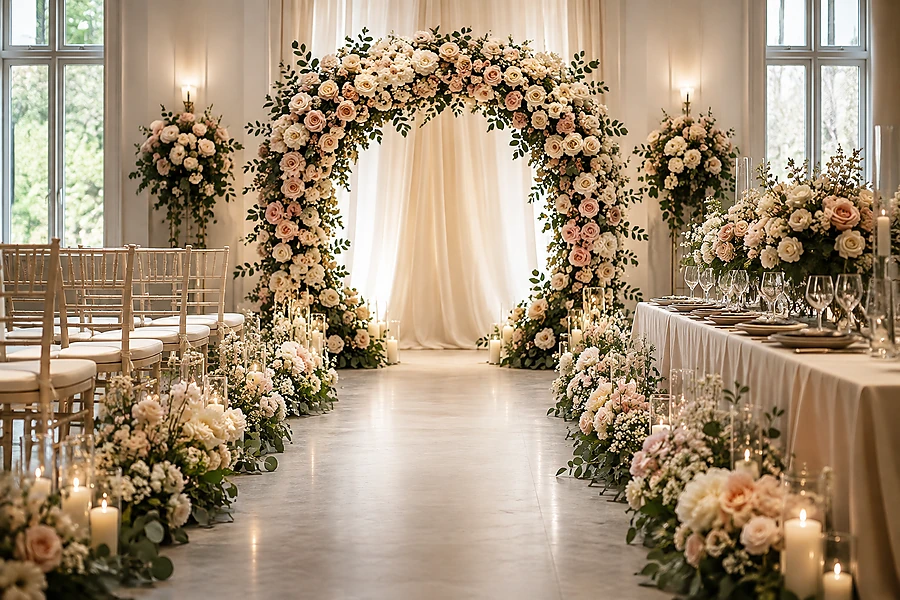
Ceremony Arches
A floral arch requires significant volume.
Artificial flowers can be:
- Installed earlier
- Built in reusable modules
- Rented
- Moved to the reception
- Used again for another event
The Knot’s flower-rental guide identifies artificial flower rentals as an increasingly available wedding option.
Flower Walls
A dense fresh-flower wall can require a very large amount of material.
Artificial flowers make the structure reusable and easier to prepare before the wedding.
Ceiling Installations
Flowers above normal viewing distance often do not need the same close-up realism as a bridal bouquet.
This makes them a strong location for high-quality faux materials.
Destination Weddings
Artificial flowers can be assembled before travel and do not require hydration during the journey.
WeddingWire discussions also show couples choosing rented silk flowers specifically because destination-wedding logistics made fresh-flower care difficult.
Rental Changes the Calculation Again
Buying artificial flowers is only one model.
Couples can also rent:
- Bouquets
- Garlands
- Centerpieces
- Aisle markers
- Ceremony flowers
The Knot reports that wedding flower rental companies are now available in both local and wider service models, with these businesses using high-quality artificial flowers rather than fresh flowers.
Rental removes another problem:
What do I do with 30 artificial centerpieces after the wedding?
My Cost Rule
Use faux flowers when they reduce total project cost, not simply when their stem price is lower.
Calculate:
Total flower cost = materials + design + delivery + setup + breakdown + storage + replacement + disposal − reuse value
That gives a much fairer comparison.
Do Artificial Wedding Flowers Look Real in Photos?
High-quality artificial flowers can photograph convincingly, especially in large arrangements and at normal viewing distances, but low-quality glossy flowers are easier to identify in close-ups.
Artificial wedding flowers can look realistic in photographs when they have matte or botanically appropriate petals, detailed centers, varied bloom sizes, natural color transitions, and irregular positioning. Close-up bridal portraits reveal quality most easily, while arches, aisle flowers, hanging installations, and reception arrangements are generally more forgiving because cameras view them from farther away.
Photography Distance Changes Everything
A wedding contains several viewing distances.
Very close
- Bridal bouquet
- Boutonniere
- Corsage
- Cake flowers
Medium
- Centerpieces
- Sweetheart table
- Welcome sign
Farther away
- Ceremony arch
- Hanging installation
- Stage flowers
- Flower wall
Zola specifically suggests that artificial flowers can work particularly well in larger or more distant applications while recommending more caution in areas photographed very closely.
What Makes Artificial Wedding Flowers Look Cheap?
The most common problems are:
- Shiny petals
- Identical flower heads
- Flat color
- Visible glue
- Thick plastic stems
- Frayed edges
- Perfect symmetry
- Too many flowers facing forward
- No buds
- No natural foliage variation
A flower does not need to fool someone examining it from five centimeters away.
It needs to look believable at the viewing distance where guests and cameras experience it.
Use Several Bloom Stages
A realistic bouquet should not contain twelve flowers that look as though they opened at exactly the same second.
Mix:
- Open blooms
- Semi-open flowers
- Buds
- Small supporting flowers
- Foliage
That creates natural depth.
Test Flowers Under Wedding Lighting
Do not approve artificial flowers only under warehouse lighting.
Photograph them:
- In daylight
- Under warm indoor lighting
- Under venue lighting
- With camera flash
- From portrait distance
Recent 2026 wedding guidance similarly recommends testing artificial flowers under several lighting conditions because inexpensive glossy surfaces may become more obvious in photographs.
The Bridal Bouquet Deserves the Highest Quality
The bouquet appears in:
- Bridal portraits
- Detail photographs
- Ceremony images
- Table photographs
- Close-up video
If the budget allows only one premium artificial item, I would prioritize the bridal bouquet.
Another effective strategy is hybrid.
Use:
Fresh
- Bridal bouquet
- Boutonniere
- Corsage
Artificial
- Ceremony arch
- Aisle
- Large reception installation
- Hanging greenery
That concentrates natural detail where cameras get closest.
Good Faux Flowers Need Reshaping
Artificial flowers are often compressed during shipping.
Before the wedding:
- Separate every bloom.
- Open compressed petals.
- Bend wired stems.
- Turn leaves in several directions.
- Lower several flower heads.
- Create gaps.
- Remove visibly poor components.
A premium flower still looks inexpensive when every stem remains shipping-straight.
Photograph the Sample Before Buying in Bulk
For a 100-person wedding, do not order hundreds of artificial stems before checking five or ten physically.
Build one sample centerpiece.
Then photograph it from:
- Guest seating distance
- Standing distance
- Camera close-up
- Top view
- Venue lighting
The sample tells you more than catalog images.
Can You Mix Real and Fake Flowers for a Wedding?
Yes. Mixing fresh and artificial flowers is one of the most practical ways to combine close-up authenticity with predictable cost, scale, and logistics.
Real and fake wedding flowers can be mixed successfully. A common hybrid strategy uses fresh flowers for bridal bouquets and other close-view personal flowers, while premium faux flowers cover arches, aisle décor, hanging installations, large centerpieces, and backdrops. Keep colors, flower scale, foliage, and bloom stages consistent so both materials read as one design.
Why Hybrid Weddings Work
Real and faux flowers have different strengths.
Real flowers provide:
- Natural variation
- Fragrance
- Fresh texture
- Organic movement
Artificial flowers provide:
- Advance preparation
- Repeatability
- Reuse
- Stable color
- Easy transport
- No wilting
There is no rule requiring the wedding to choose only one.
Hybrid Formula 1: Fresh Personal Flowers + Faux Décor
Use fresh:
- Bridal bouquet
- Bridesmaid bouquets
- Boutonnieres
- Corsages
Use faux:
- Arch
- Aisle
- Backdrop
- Reception installation
This is one of the easiest mixes because the two materials rarely appear side by side in close-up.
Hybrid Formula 2: Fresh Focal Flowers + Faux Structural Greenery
Create the arrangement structure with artificial:
- Eucalyptus
- Fern
- Olive foliage
- Branches
Then add fresh:
- Roses
- Peonies
- Dahlias
- Ranunculus
The fresh flowers become the close-view focal points.
Hybrid Formula 3: Faux Ceremony + Fresh Reception
Artificial ceremony décor can be installed early.
Fresh table flowers provide natural detail where guests spend several hours.
This works well when the ceremony setup window is difficult.
Hybrid Formula 4: Fresh Centerpiece Tops + Faux Base
Large arrangements can use artificial structural foliage beneath fresh focal flowers.
Keep the water mechanics separated from artificial components that are not designed for moisture.
Match Color Undertones Carefully
White is not one color.
You may have:
- Bright white
- Warm white
- Ivory
- Cream
- Champagne
Place the fresh and artificial flowers beside each other before approval.
A cool-white fake rose beside a warm ivory fresh rose may make the artificial product more obvious.
Match Scale
A huge artificial rose beside a smaller natural rose can also expose the difference.
Keep flower-head proportions believable.
Keep the Best Faux Flowers Closest to Guests
Use the highest-quality artificial flowers in:
- Centerpieces
- Welcome arrangements
- Sweetheart tables
Use more economical products in:
- Overhead installations
- Distant arches
- Background greenery
This allocates the budget according to viewing distance.
Do Not Hide That Faux Flowers Exist
Vogue’s June 2026 coverage suggests the cultural stigma around high-quality faux florals is weakening, with designers increasingly treating them as intentional decorative objects rather than embarrassing substitutes.
That approach works well for weddings too.
A beautifully constructed silk flower wall does not need an apology.
What Are the Pros and Cons of Artificial Wedding Flowers?
Artificial flowers provide flexibility, durability, early preparation, and reuse, but they lose the scent and natural variation of fresh flowers and can look inexpensive when quality is poor.
The main advantages of artificial wedding flowers are advance preparation, year-round availability, durability, predictable color, DIY flexibility, allergy considerations, rental potential, and reuse. Their disadvantages include variable realism, lack of natural scent, bulky storage, possible crushing, visible repetition, environmental concerns with mixed synthetic materials, and the potentially high cost of premium real-touch flowers.
Main Advantages
1. They Can Be Prepared Early
Fresh wedding flowers require a tight preparation window.
Artificial bouquets can be assembled:
- Weeks earlier
- Months earlier
- Before destination travel
This reduces wedding-week pressure.
2. They Do Not Wilt
Heat is a major concern for:
- Summer weddings
- Outdoor ceremonies
- Destination weddings
Artificial flowers do not biologically wilt.
They may still be affected by:
- Heat
- UV
- Crushing
- Coating damage
but they do not depend on hydration.
3. Flower Season Matters Less
A couple can create a peony-inspired look outside natural peony season without importing fresh peonies.
The Knot identifies year-round flower availability as a major benefit of artificial wedding flowers.
4. They Are DIY-Friendly
Artificial flowers allow repeated practice.
A couple can build a bouquet, decide they dislike it, and take it apart.
Zola specifically highlights this flexibility.
5. They Can Be Reused
After the wedding, artificial arrangements can become:
- Home décor
- Rental inventory
- Anniversary décor
- Another event
- Resold items
Fresh flowers require preservation if the couple wants to keep them.
6. They Can Be Rented
This has become an established wedding option.
The Knot notes that artificial wedding-flower rental companies have expanded significantly in recent years.
Main Disadvantages
1. Low Quality Is Obvious
A cheap artificial flower may reveal:
- Plastic texture
- Glue
- Fraying
- Repeated molding
The savings are less attractive if the product visibly lowers the quality of the design.
2. Premium Faux Can Be Expensive
Zola notes that the most realistic varieties can cost as much as or more than fresh flowers.
Do not assume “fake” means “cheap.”
3. There Is No Fresh-Flower Scent
For some couples, fragrance is part of the wedding experience.
Artificial flowers cannot reproduce genuine floral scent.
Adding artificial fragrance may also be undesirable for guests sensitive to scent.
4. They Need Storage
If you buy rather than rent 20 centerpieces, you need somewhere to keep them:
- Before the wedding
- During transport
- After the wedding
Large arches and flower walls require even more space.
5. They Can Be Crushed
Artificial flowers do not wilt, but fabric petals can still crease.
Premium real-touch flowers may be especially vulnerable to:
- Tight cartons
- Heat
- Abrasion
- Pressure
Storage and packaging still matter.
6. Synthetic Materials Complicate End-of-Life Decisions
Artificial flowers may combine:
- Polyester
- Plastic
- Wire
- Foam
- Adhesive
That can make recycling difficult.
Their strongest material-use case is often reuse, not one-day purchase followed by disposal.
Quick Decision Table
| Priority | Better Starting Choice |
|---|---|
| Natural fragrance | Fresh |
| Perfect close-up authenticity | Fresh |
| Advance DIY | Faux |
| Destination logistics | Faux |
| Rental/reuse | Faux |
| Large backdrop | Faux |
| Seasonal authenticity | Fresh |
| Exact color consistency | Faux |
| Summer heat resilience | Faux |
| Keepsake bouquet | Faux |
| Mixed priorities | Hybrid |
My Insights: Is It Common to Use Fake Flowers for a Wedding
Artificial flowers are no longer an unusual wedding workaround. They are an established option used for complete weddings, selected décor zones, DIY projects, and increasingly through rental services.
Yes, it is common enough to use fake flowers for a wedding that major wedding-planning platforms now publish dedicated artificial-flower and rental guidance. However, no strong current dataset shows that faux flowers are used by the majority of couples. The more accurate conclusion is that they have become a mainstream alternative rather than a niche exception.
The Biggest Change Is Social Acceptance
A decade ago, artificial wedding flowers were frequently treated primarily as a budget substitute.
In 2026, the conversation is broader.
Couples use them because of:
- Design control
- Heat
- Travel
- Timing
- Reuse
- Rental
- Keepsake value
Vogue’s 2026 examination of permanent florals reflects a wider shift in design culture: high-quality faux flowers are increasingly being judged by their craftsmanship rather than automatically dismissed because they are artificial.
The Best Weddings Do Not Need to Choose One Side
The real-versus-faux debate creates an unnecessary binary.
A wedding can use:
- Fresh bouquet
- Fresh boutonnieres
- Faux ceremony arch
- Faux aisle flowers
- Hybrid reception arrangements
That often makes more sense than forcing one material into every application.
The Best Faux Applications Are Usually Large
Artificial flowers become particularly attractive when the design requires:
- Large volume
- Early installation
- Difficult access
- Reuse
That includes:
- Ceremony arches
- Flower walls
- Hanging flowers
- Staircases
- Stage arrangements
- Large aisle installations
These elements also tend to be viewed from farther away.
The Bridal Bouquet Needs a Separate Decision
Do not decide the bouquet simply because the arch is faux.
Ask:
- Do I want fragrance?
- Will I keep the bouquet?
- Is it photographed closely?
- Does my preferred flower exist in season?
- Will heat or travel be a problem?
A couple can choose a fresh bouquet and artificial venue décor without creating visual conflict.
Rental May Be the Strongest Middle Ground
Rental artificial flowers remove two major objections:
Objection 1: Premium artificial flowers cost too much to buy.
Objection 2: I do not need 15 centerpieces after my wedding.
Rental allows the couple to pay for use rather than permanent ownership.
The Knot’s coverage confirms that artificial wedding-flower rental has developed into an established vendor category.
Quality Matters More Than the Label
Guests rarely care whether the product description says:
- Silk
- Polyester
- Real-touch
- Latex
- Foam
They experience:
- Color
- Texture
- Scale
- Design
- Photography
- Overall atmosphere
An excellent artificial arrangement is stronger than a poorly conditioned fresh arrangement.
A beautiful fresh bouquet is stronger than an obviously plastic artificial bouquet.
The material alone does not determine the quality of the wedding.
My Preferred Hybrid Formula
For a wedding that wants natural close-up detail and predictable large-scale décor:
Fresh
- Bridal bouquet
- Boutonnieres
- Corsages
Premium faux
- Ceremony arch
- Aisle décor
- Welcome sign
- Hanging installation
Fresh, faux, or hybrid
- Reception centerpieces
This allocates each material according to its strengths.
My Buying Rule
Before purchasing artificial wedding flowers, order samples.
Evaluate them:
- From 30 centimeters
- From one meter
- From table distance
- Under daylight
- Under venue lighting
- With flash
- On video
Do not rely on heavily edited supplier photographs.
My Budget Rule
Do not assume fake flowers automatically save money.
Compare:
- Fresh florist quote
- DIY fresh flowers
- Purchased faux flowers
- Rented faux flowers
- Hybrid design
The cheapest option can change with the size and structure of the wedding.
My Realism Rule
Spend the most where the camera gets closest.
Prioritize:
- Bridal bouquet
- Boutonniere
- Corsage
- Sweetheart table
- Guest centerpiece
You can often use less-expensive artificial material farther away.
My Sustainability Rule
If artificial flowers are purchased, plan for reuse before ordering them.
Possible second lives include:
- Home decoration
- Rental
- Resale
- Donation
- Anniversary party
- Another family wedding
The environmental logic of a durable artificial product becomes much weaker when it is treated as disposable one-day décor.
My Final Answer
Using fake flowers for a wedding is now a normal choice.
The better question is not:
“Will people think using fake flowers is strange?”
It is:
“Which wedding flowers need real-flower authenticity, and which areas benefit more from the durability, preparation time, scale, and reuse of artificial flowers?”
For many weddings, the answer will be a combination of both.
Conclusion
Yes, fake wedding flowers are a mainstream option. Use premium faux flowers where durability, scale, advance preparation, or reuse matters, and fresh flowers where fragrance and close-up authenticity matter most.