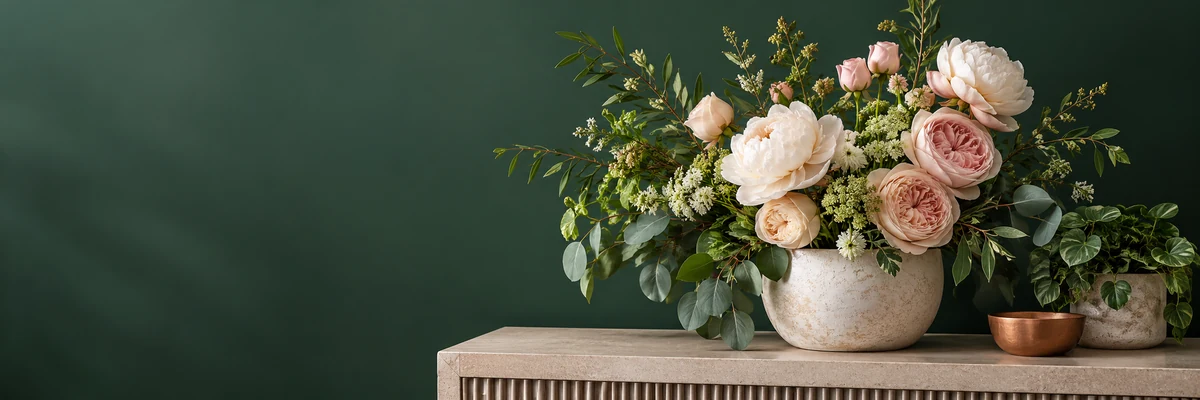

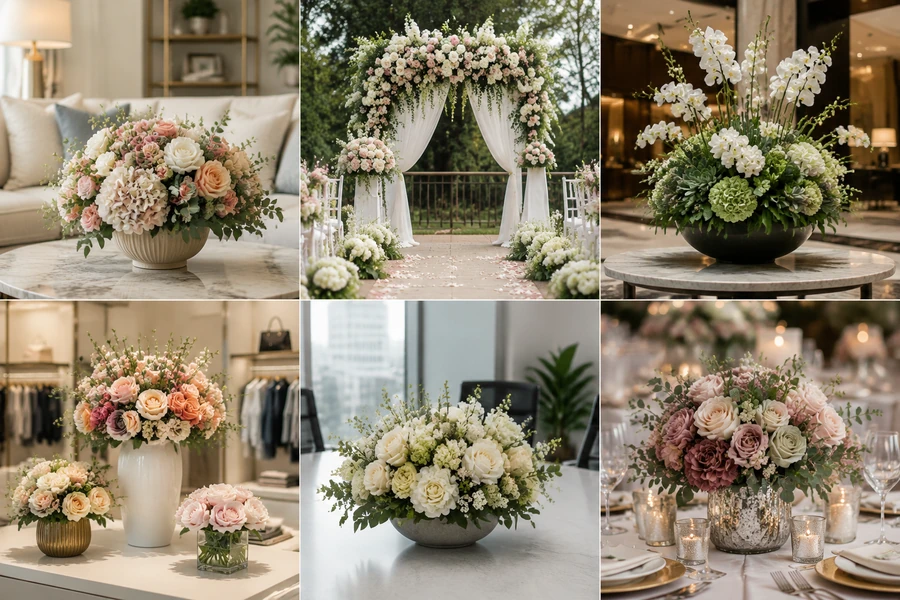
Artificial flower arrangements are no longer limited to inexpensive home decorations. They now compete for spending across weddings, hospitality, retail, offices, events, gifting, and premium interior styling.
Yes, there is a substantial market for artificial flower arrangements. Current industry reports place the broader global artificial flowers market in the billions of dollars and forecast continued growth. Demand comes from residential décor, weddings, commercial interiors, hospitality, retail displays, gifts, and reusable event installations, with realism and convenience becoming major buying factors.
The strongest opportunity is not simply “selling fake flowers.” Buyers increasingly want finished arrangements that solve a specific problem: a realistic centerpiece that needs no watering, a reusable wedding installation, a hotel arrangement that stays consistent, or a seasonal display that can be stored and installed again.
How Big Is the Artificial Flowers Market?
Current research clearly indicates an established global market, although published estimates vary because research firms use different definitions, samples, geographic coverage, and segmentation methods.
Fortune Business Insights values the global artificial flowers market at about $1.86 billion in 2026 and projects $2.91 billion by 2034. Grand View Research uses a broader estimate of about $3.2 billion for 2026 and forecasts roughly $4.49 billion by 2030. The exact number varies, but both indicate continued market growth.
The Market Is Already Commercially Significant
Grand View Research reports that commercial applications represented more than 58% of artificial-flower sales in 2024. Its commercial-market data estimates commercial artificial-flower revenue at approximately $1.89 billion in 2025, with continued growth projected through 2033.
That commercial category matters for arrangement sellers because it includes spaces and projects such as:
- Hotels
- Restaurants
- Cafés
- Offices
- Retail stores
- Event venues
- Salons
- Hospitality spaces
- Visual merchandising
These buyers may need more than individual stems.
They may purchase:
- Finished vase arrangements
- Reception arrangements
- Floor urns
- Centerpieces
- Hanging installations
- Flower walls
- Artificial wedding arrangements
- Seasonal floral modules
- Custom commercial displays
Market Reports Do Not Agree on One Exact Number
This is important when evaluating the opportunity.
Current 2026 reports provide substantially different global estimates.
| Research Source | Reported 2025/2026 Market | Forecast |
|---|---|---|
| Fortune Business Insights | $1.86B in 2026 | $2.91B by 2034 |
| Grand View Research | Approx. $3.2B in 2026 | $4.49B by 2030 |
| 360iResearch | $3.28B in 2026 | $4.56B by 2032 |
| Straits Research | $3.80B in 2026 | $6.31B by 2034 |
| Market Glass | $2.6B in 2025 | $4.0B by 2032 |
These reports are not necessarily measuring identical market boundaries.
The useful conclusion is therefore not:
“The market is exactly X billion dollars.”
The stronger conclusion is:
Multiple independent market-research firms identify artificial flowers as a billion-dollar global category with positive projected growth.
That is enough to confirm that a market exists.
Finished Arrangements Are Only One Part of the Opportunity
The total artificial-flower market includes:
- Loose stems
- Bouquets
- Bushes
- Wreaths
- Plants
- Trees
- Finished arrangements
- Event installations
- Commercial décor
A seller focusing only on finished arrangements is therefore entering a subsegment of the larger artificial-floral market.
That can actually be an advantage.
Individual stems are easier to compare on price.
Finished arrangements create more room for differentiation through:
- Design
- Vase selection
- Color palette
- Size
- Packaging
- Styling
- Customization
- Occasion
- Installation service
Wholesale Activity Also Shows Product Depth
Faire’s current wholesale artificial-flower category reports more than 900 brands and over 33,000 products across stems, sprays, bouquets, bushes, picks, and other artificial floral formats. This does not measure final consumer demand directly, but it demonstrates a broad active wholesale ecosystem serving retailers.
The category is clearly larger than a small craft niche.
Why Are Artificial Flowers Becoming More Popular?
Artificial flowers solve several practical problems that fresh flowers cannot solve as easily, especially when buyers need décor to remain consistent for weeks or months.
Artificial flowers are gaining demand because they combine long display life, low routine maintenance, year-round availability, reusable styling, easier advance preparation, and increasing realism. Improvements in materials and manufacturing have also reduced the old perception that faux flowers must look shiny, stiff, or obviously artificial.
Realism Has Changed the Category
One of the largest barriers to artificial flowers has historically been appearance.
Older inexpensive products often showed:
- Flat colors
- Plastic shine
- Visible seams
- Identical petals
- Unnatural stems
- Obvious glue
- Perfect symmetry
Current premium products increasingly use:
- Polyester textiles
- Real-touch coatings
- PU-based materials
- Printed petals
- Wired stems
- Multiple leaf sizes
- More detailed flower centers
- Layered color treatments
Grand View Research specifically identifies improved manufacturing and real-touch technologies as drivers of market growth.
That change creates an important opportunity for finished arrangements.
A customer may not know how to transform individual artificial stems into a convincing arrangement.
The arrangement seller adds value by:
- Selecting realistic stems.
- Combining several bloom stages.
- Reshaping flowers.
- Cutting or bending stems.
- Choosing a suitable vase.
- Hiding artificial mechanics.
- Creating natural asymmetry.
- Packaging the finished design.
The product becomes more than the sum of its stems.
Convenience Creates a Clear Use Case
A fresh arrangement may require:
- Water
- Vase cleaning
- Stem cutting
- Dead-flower removal
- Replacement
- Temperature management
Artificial arrangements still need:
- Dusting
- Reshaping
- Occasional repairs
- Proper storage
But they do not require daily hydration or botanical care.
That makes them attractive for locations such as:
- Vacation properties
- Offices
- Reception areas
- High shelves
- Windowless rooms
- Short-term rentals
- Shops
- Restaurants
- Event venues
Reusability Changes Wedding Economics
Wedding and event projects create another strong use case.
Artificial flowers can often be:
- Designed in advance
- Transported before the event
- Reused
- Rented
- Resold
- Reconfigured
- Stored
A fresh floral installation has a much narrower preparation and use window.
Current artificial-flower sellers describe weddings and event planners as core buyer categories, and broader market research identifies weddings and events as major applications.
Online Retail Makes the Category Easier to Sell
Artificial flower arrangements are highly visual.
Customers can evaluate:
- Color
- Style
- Vase
- Shape
- Dimensions
- Room placement
through photographs and video.
Grand View Research forecasts continued growth in online artificial-flower sales and identifies the expansion of e-commerce as one factor supporting broader market access.
This creates several online business models:
- Direct-to-consumer arrangements
- Etsy-style handmade arrangements
- Marketplace sales
- Shopify stores
- Social-commerce sales
- Wholesale B2B
- Made-to-order wedding designs
- Rental businesses
But Convenience Does Not Mean Every Product Will Sell
Artificial flowers still face common objections:
- Cheap appearance
- Dust
- Environmental concerns
- High initial price for premium products
- Bulky shipping
- Trends changing
- Color mismatch online
The opportunity therefore favors sellers who solve these problems instead of competing solely on unit price.
Who Buys Artificial Flower Arrangements?
The buyer base is wider than homeowners. Artificial flower arrangements can serve individual consumers, professional decorators, event companies, hospitality operators, retailers, and other commercial buyers.
Core customers include home decorators, wedding and event planners, florists, interior designers, hotels, restaurants, cafés, salons, offices, retailers, property managers, short-term rental hosts, photographers, and gift buyers. Each segment values a different combination of realism, price, durability, customization, packaging, and repeatability.
1. Home Décor Customers
Residential customers may buy arrangements for:
- Living rooms
- Entry tables
- Dining rooms
- Home offices
- Bedrooms
- Bathrooms
- Bookshelves
- Seasonal decoration
The strongest consumer products are often easy to understand immediately.
Examples:
- Neutral olive arrangement
- White orchid bowl
- Pink peony vase
- Eucalyptus centerpiece
- Seasonal hydrangea arrangement
The customer is buying a finished look rather than individual craft supplies.
2. Wedding and Event Planners
This market can purchase:
- Bridal bouquets
- Bridesmaid bouquets
- Corsages
- Boutonnieres
- Table centerpieces
- Ceremony flowers
- Arch flowers
- Welcome-sign arrangements
- Flower walls
- Hanging installations
The opportunity is especially attractive when arrangements are modular.
One reusable flower module can potentially move between:
- Wedding arch
- Welcome sign
- Sweetheart table
- Photo backdrop
That improves utilization for rental companies.
3. Hotels and Hospitality
Hotels can use artificial arrangements in areas where permanent visual consistency matters.
Examples include:
- Guest-room desks
- Reception desks
- Elevator lobbies
- Corridors
- Restaurants
- Spa reception
- High shelves
- Conference areas
Grand View Research identifies hospitality and other commercial applications as important demand areas for artificial flowers.
Hospitality buyers may care less about the lowest unit cost and more about:
- Consistent dimensions
- Replacement availability
- Dust resistance
- Fire documentation where relevant
- Vase stability
- Multi-location consistency
4. Retail Stores
Retailers can buy artificial arrangements either as:
Merchandise
or as:
Visual merchandising décor
Finished artificial arrangements are particularly suitable for:
- Gift shops
- Furniture stores
- Home décor stores
- Fashion boutiques
- Jewelry stores
- Beauty stores
- Department stores
Faire currently lists thousands of artificial floral products across hundreds of brands, illustrating the depth of retailer participation in the category.
5. Restaurants and Cafés
Suitable products include:
- Small table arrangements
- Host-stand displays
- Seasonal window flowers
- Hanging florals
- Wall arrangements
The important design requirement is cleaning.
A highly realistic but extremely difficult-to-clean flower may not be the best commercial product for a restaurant.
6. Interior Designers and Property Stylists
Design professionals may need:
- Project-specific color palettes
- Large trees
- Console arrangements
- Built-in shelf greenery
- Model-home arrangements
- Photography styling
They are often buying complete visual solutions rather than a flower species.
7. Short-Term Rental and Property Operators
Artificial arrangements can fit:
- Airbnb properties
- Serviced apartments
- Vacation homes
- Model homes
- Rental offices
The appeal comes from consistency between guest stays without relying on a plant-care routine.
8. Gift Buyers
Finished arrangements can compete in gifting categories because they arrive already styled.
Gift opportunities include:
- Birthdays
- Housewarming
- Mother’s Day
- Anniversaries
- Corporate gifts
- Sympathy arrangements
Artificial flowers also avoid the need for the recipient to keep the flowers alive or replace vase water.
B2B and B2C Buyers Need Different Products
| Buyer | Main Need | Useful Product Format |
|---|---|---|
| Homeowner | Easy decorating | Finished vase arrangement |
| Wedding planner | Reuse and coordination | Modular floral set |
| Hotel | Consistency | Standardized commercial arrangement |
| Retailer | Margin and shelf appeal | Boxed arrangement |
| Interior designer | Customization | Project-specific arrangement |
| Restaurant | Cleanability | Compact durable centerpiece |
| Rental company | Repeated use | Repairable modular installation |
| Gift buyer | Presentation | Ready-to-gift arrangement |
A supplier should not assume that one artificial arrangement can serve all eight.
What Factors Are Driving the Artificial Flowers Market?
Current market reports repeatedly point to low maintenance, long usable life, improved realism, commercial adoption, home décor demand, events, and wider online distribution as major growth factors.
Market growth is being driven by better realism, demand for low-maintenance décor, commercial use, home styling, weddings and events, e-commerce, reusable installations, and wider product variety. The best business opportunities are therefore likely to come from specific use cases rather than generic mixed bouquets that compete mostly on price.
Finished Arrangements Can Create More Value Than Loose Stems
Consider two business models.
Model A: Sell 12 loose artificial roses
Competition focuses on:
- Stem price
- Flower size
- Shipping
- Color
Model B: Sell one designed arrangement
Competition can include:
- Flower realism
- Color story
- Vase
- scale
- Styling
- Packaging
- Occasion
- Personalization
The arrangement creates additional differentiation.
Which Artificial Arrangements Have Strong Market Potential?
Several categories have a clear commercial logic.
Permanent Home Arrangements
Examples:
- White orchid bowl
- Olive branch vase
- Peony arrangement
- Neutral hydrangea arrangement
- Greenery centerpiece
These products work particularly well when the design is not tied to one short-lived trend.
Seasonal Arrangements
Examples:
- Spring tulip arrangement
- Summer hydrangea
- Autumn dahlia
- Winter magnolia
- Holiday centerpiece
The same vase and structural base can sometimes be reused across seasonal designs.
Wedding Arrangements
Potential products include:
- Ready-made centerpiece sets
- Coordinated bridal sets
- Ceremony flower modules
- Rental arch flowers
- Table runners
The value proposition is less about “fake versus real” and more about:
- Predictability
- Advance preparation
- Reuse
- Color control
- Logistics
Commercial Arrangements
Hotels, retailers, restaurants, and offices may need standardized designs rather than one-off handmade pieces.
This opens opportunities for:
- Size specifications
- Replacement modules
- Multi-site programs
- seasonal rotations
- private labeling
What Makes an Artificial Arrangement Easier to Sell?
I would evaluate five factors.
| Factor | Weak Product | Stronger Product |
|---|---|---|
| Realism | Flat shiny petals | Varied botanical detail |
| Purpose | Generic bouquet | Clear room/occasion |
| Scale | Dimensions unclear | Exact dimensions shown |
| Styling | Random flower mix | Deliberate palette |
| Logistics | Crush-prone | Packaged for recovery |
Product Photography Matters More Than Normal
The customer cannot smell or touch the arrangement online.
The listing therefore needs to communicate:
- Size
- Flower texture
- flower center
- vase scale
- room context
- back view
- close-up details
Show the arrangement beside familiar furniture.
A 45-centimeter bouquet photographed alone can appear either enormous or tiny.
Avoid the Lowest-Price Trap
Artificial arrangements are vulnerable to price competition when the products appear interchangeable.
A seller can reduce that pressure through:
- Distinctive palettes
- Better vessels
- realistic stems
- branded packaging
- custom sizes
- seasonal collections
- B2B customization
- replacement services
Test Before Scaling Inventory
Market existence does not guarantee that every SKU will sell.
A practical product test can use:
- 3 flower styles
- 2 sizes
- 2 color palettes
instead of launching 30 arrangements immediately.
Track:
- Click-through rate
- Conversion
- Returns
- Damage
- Customer questions
- repeat purchases
- gross margin
Then scale the strongest designs.
Wholesale Demand Is Also Visible
Current wholesale marketplaces demonstrate substantial assortment depth. Faire reports more than 900 brands and over 33,000 artificial-flower products within its current wholesale catalog, while trade-oriented suppliers identify wedding planners, retailers, wholesalers, florists, and decorators as repeat buyer groups.
That does not prove that every new supplier will succeed.
It does show a functioning distribution ecosystem.
My Insights: Is There a Market for Artificial Flower Arrangements
Yes. The evidence points to a real and growing market, but the strongest opportunity is not a generic “fake flower” business.
There is a market for artificial flower arrangements across residential décor, weddings, hospitality, retail, offices, gifting, and events. Multiple 2026 market reports forecast continued growth in the broader artificial-flower category, while commercial applications already represent a substantial share. The strongest sellers will compete through realism, design, convenience, specialization, and repeatable quality rather than price alone.
My First Insight: The Market Is Proven, but Its Exact Size Is Not
Current research firms disagree significantly on the global dollar value.
That is normal for a fragmented décor category with different definitions.
I would not build a business plan around one forecast number.
I would use the reports to establish one broader conclusion:
Artificial flowers are an established global category with continued projected growth.
Then I would validate the exact target niche separately.
My Second Insight: Commercial Demand Is Particularly Interesting
Grand View Research reports that commercial applications represented more than 58% of artificial flower sales in 2024.
That makes B2B arrangements worth serious attention.
A single commercial customer can potentially require:
- Multiple arrangements
- Replacement units
- Seasonal modules
- Repeat orders
- several locations
That is very different from winning one residential customer for one vase.
My Third Insight: Sell Solutions, Not Flowers
“Artificial roses” is a product category.
“Six matching hotel reception arrangements” is a solution.
“Reusable wedding arch flower kit” is a solution.
“Dust-friendly office centerpiece” is a solution.
The more clearly the product answers a use case, the less dependent it becomes on competing against every inexpensive artificial stem online.
My Fourth Insight: Realism Is Now a Minimum Requirement in Premium Segments
Improved materials are helping market acceptance, but that also raises buyer expectations.
Premium customers will inspect:
- Flower centers
- petal color
- leaf undersides
- stems
- glue
- planter
- overall silhouette
A beautiful product photograph cannot permanently hide weak construction.
My Fifth Insight: Arrangements Create a Stronger Margin Opportunity Than Commodity Stems
A finished arrangement can combine:
- Product
- design
- vessel
- labor
- packaging
- personalization
That creates more differentiation than selling the same loose rose available from dozens of suppliers.
The trade-off is that arrangements also require stronger control over:
- Labor
- inventory
- packing
- shipping volume
- damage
My Sixth Insight: Weddings Offer Both Sales and Rental Models
Artificial flowers do not have to be sold only once.
A durable premium arch or centerpiece can potentially become rental inventory.
That creates different economics:
Sale model: revenue once per arrangement
Rental model: revenue across repeated events
Rental products need stronger:
- mechanics
- cleaning
- storage
- repairability
- transport packaging
My Seventh Insight: Home Décor Should Focus on Evergreen Designs
Trend-led products can sell quickly and become obsolete quickly.
For repeatable inventory, I would build a core collection around:
- White orchids
- neutral hydrangeas
- olive branches
- eucalyptus
- cream roses
- restrained peonies
Then use smaller accent collections for seasonal colors.
This lowers the risk of holding large quantities of highly specific colors.
My Eighth Insight: B2B Buyers Need Replacement Consistency
A homeowner may buy one arrangement.
A hotel may buy twenty.
When one arrangement becomes damaged, the hotel needs the replacement to match.
That makes these capabilities valuable:
- Stable SKUs
- color control
- golden samples
- batch records
- replacement modules
The supplier with reliable repeatability can be more valuable than one producing endless new designs.
My Ninth Insight: E-Commerce Expands the Market but Raises the Photography Standard
Online channels continue to support artificial-flower distribution growth.
That means sellers can reach customers without physical stores.
But the arrangement needs:
- excellent photography
- dimensions
- styling images
- close-ups
- clear packaging expectations
Poor photography can make a premium $100 arrangement look like a $20 product.
My Tenth Insight: Validate a Niche Before Building a Large Catalog
I would begin with one buyer and one problem.
For example:
Home décor
- 3 premium vase arrangements
Weddings
- 3 reusable centerpiece sets
Hotels
- 3 standardized lobby/desk arrangements
Retail
- 3 seasonal display products
Then measure real demand.
A Practical Market-Entry Matrix
| Niche | Demand Logic | Repeat Potential | Complexity |
|---|---|---|---|
| Home décor | Convenience + styling | Medium | Low-medium |
| Wedding sales | Advance preparation | Medium | Medium |
| Wedding rentals | Reuse | High | High |
| Hotels | Stable décor | High | High |
| Restaurants | Low-maintenance tables | High | Medium |
| Retail displays | Seasonal merchandising | High | Medium |
| Gifts | Ready-made presentation | Medium | Low-medium |
| Interior designers | Project customization | High | High |
My Preferred Starting Strategy
I would use this sequence:
- Choose one customer segment.
- Identify three common floral problems.
- Create three arrangements that solve them.
- Buy production samples.
- Photograph them professionally.
- Test pricing.
- Test packaging.
- Record customer reactions.
- Remove weak designs.
- Scale the strongest arrangement.
- Add related sizes and colors.
- Build wholesale or repeat-order options.
This approach is safer than assuming the existence of a billion-dollar global market means every artificial arrangement deserves inventory.
The Final Answer
Yes, there is clearly a market for artificial flower arrangements.
The stronger question is:
Which customer needs a specific artificial arrangement badly enough to buy it repeatedly or pay a premium for it?
The current evidence points especially toward:
- Home décor
- Weddings
- Events
- Hospitality
- Commercial interiors
- Retail merchandising
- Gifting
The market already exists. The business opportunity comes from selecting the right segment, product style, price point, and distribution model within it.
Conclusion
Yes, artificial flower arrangements serve a growing global décor market. The strongest opportunities come from realistic, purpose-built products for homes, weddings, hospitality, retail, events, and repeat commercial use.