


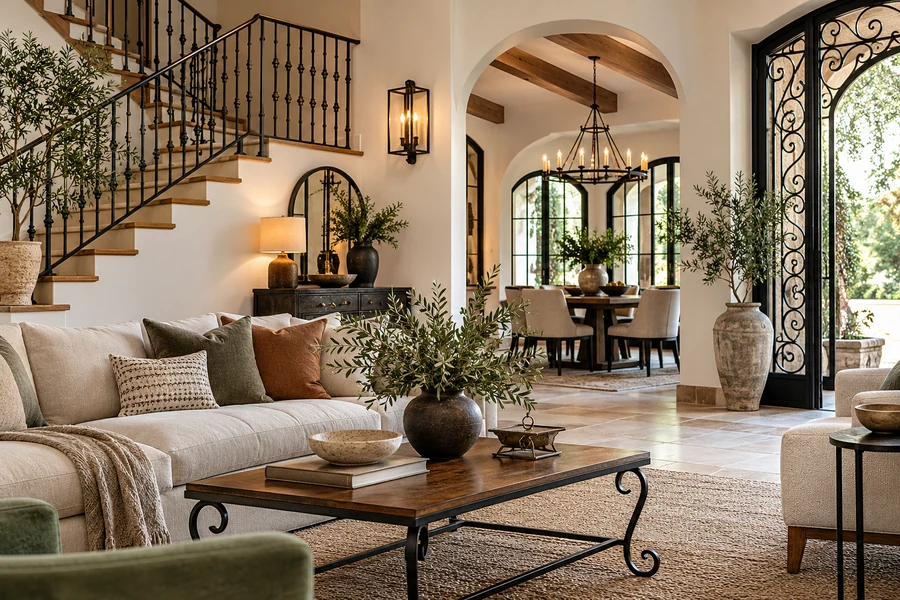
Wrought iron has moved far beyond heavy Tuscan scrollwork. In 2026, designers are using dark metal in cleaner, sculptural ways that feel warmer, lighter, and considerably more contemporary.
Wrought iron is unlikely to become the single “future” of interior décor, but iron is strongly positioned within several important 2026 design movements. Mixed metals, handcrafted furniture, sculptural lighting, warm minimalism, heritage details, and collected interiors all create room for iron. The future is less about ornate matching iron sets and more about selective, architectural metalwork.
That distinction matters. When I look at current design coverage, I do not see interiors returning wholesale to the heavy wrought-iron aesthetic associated with Mediterranean and Tuscan homes of previous decades. Instead, I see designers rediscovering iron’s line, texture, craftsmanship, patina, and contrast and combining it with stone, wood, linen, glass, plaster, and softer upholstery.
Is Wrought Iron Actually Coming Back in Interior Design?
Yes, but its return looks different from the wrought-iron décor many people remember.
Iron is becoming relevant again because 2026 interiors favor mixed metals, handcrafted objects, traditional details, vintage references, and sculptural furniture. ELLE Decor reports that designers are mixing pewter, aged brass, iron, and nickel in living rooms, while Architectural Digest’s 2026 Milan Design Week coverage identifies “soft industrialism” as a broader movement combining metal with organic forms and softer materials.
The New Iron Is Less Ornate
For years, wrought iron was closely associated with:
- Heavy scrollwork
- Large chandeliers
- Tuscan interiors
- Matching dining sets
- Elaborate wine racks
- Decorative wall grilles
- Dark Mediterranean color schemes
That combination can still work in the correct architecture, but I would not reproduce it automatically in a contemporary house.
The newer approach is more restrained.
I am seeing iron expressed through:
- Thin furniture frames
- Sculptural tables
- Architectural lighting
- Simple fireplace screens
- Mirrors
- Consoles
- Railings
- Shelving
- Occasional decorative objects
The material remains strong, but the visual language has become lighter.
Architectural Digest’s Spring 2026 High Point Market coverage even noted a new two-tier chandelier executed in classic wrought iron, showing that the material is appearing within current launches rather than surviving only as a historic reference.
Metal Is Part of a Bigger 2026 Shift
I would not isolate wrought iron from what is happening to metals generally.
ELLE Decor reports that mixed metals are actively returning to living spaces, with designers specifically identifying pewter, aged brass, iron, and nickel as combinations that create greater individuality.
Homes & Gardens also notes that designers are moving away from automatically defaulting to polished brass, encouraging more varied metal tones and naturally developing finishes.
That creates a good environment for iron.
Instead of asking:
“Should all my metal be black iron?”
I would ask:
“Where can iron provide the strongest contrast?”
That is a much more contemporary question.
Craftsmanship Is Helping Iron Return
Another important 2026 trend is renewed interest in visible craftsmanship.
ELLE Decor reports growing demand for artisan-made furniture where the hand of the maker remains noticeable, while Architectural Digest’s Milan coverage similarly identified a handcrafted revival as one of the year’s major design movements.
Iron fits naturally into that movement.
Hammer marks, forged curves, welded joints, patina, and small irregularities can make metal feel crafted rather than industrially generic.
That is where I think iron has its strongest future.
Where Does Wrought Iron Work Best in a Modern Interior?
I would use wrought iron where its structural character adds contrast rather than where it overwhelms the room.
The strongest contemporary applications are lighting, furniture frames, console and coffee tables, mirrors, fireplace screens, stair railings, shelving, and small sculptural accents. Iron works particularly well beside warm wood, natural stone, linen, wool, plaster, and glass because the hardness and darkness of metal create definition against softer materials.
1. Wrought-Iron Lighting
Lighting may be one of the easiest ways to introduce iron without making a room feel themed.
A thin black iron chandelier can create a strong outline over:
- A wood dining table
- A stone kitchen island
- A plaster ceiling
- A light-colored living room
The key is scale and shape.
I prefer fixtures that behave like sculpture instead of fixtures covered in unnecessary scrolls.
A 2026 Architectural Digest Paris apartment illustrates this direction especially well: its designers used a custom black wrought-iron pendant shaped almost like a tree branch, combining the metal with tapestry, wood, terra-cotta, brass, and other richly tactile materials.
That is an excellent example of modern wrought iron.
It is dark.
It is clearly metal.
But it is also organic and artistic.
2. Iron Coffee and Console Tables
Iron works extremely well as a framework.
A thin iron base under:
- Marble
- Travertine
- Glass
- Aged wood
- Limestone
creates visual tension without making the furniture feel bulky.
This approach also aligns with 2026’s warm-minimalist direction. Homes & Gardens describes warm minimalism as one of the major current movements toward uncluttered spaces softened by richer textures and warmer materials; its own coverage illustrates the aesthetic with a wrought-iron coffee table set against upholstered furniture and natural tones.
I think that pairing explains why iron feels relevant again.
Iron supplies the line.
Wood, stone, and fabric supply the warmth.
3. Mirrors and Wall Details
A slim iron mirror frame is one of the safest applications because it creates definition without requiring a large furniture commitment.
I would particularly consider iron around:
- Arched mirrors
- Full-length mirrors
- Fireplace mirrors
- Entry consoles
The current design movement toward curved architecture also helps.
ELLE Decor reports renewed interest in arches, rounded forms, and traditional architectural details in 2026.
A curved iron frame can therefore feel both historic and contemporary.
4. Railings and Architectural Metalwork
Iron becomes most powerful when it is integrated into the architecture.
Railings, balustrades, room dividers, and stair details can give a space permanent character.
However, I make an important distinction here.
Much of what is marketed today as wrought iron is actually fabricated mild steel shaped to resemble traditional wrought iron. Genuine historic wrought iron is a distinct low-carbon, slag-bearing material and is much rarer in modern fabrication. Contemporary fabricators commonly use steel for ornamental work.
For decorative shopping, that terminology may not matter much.
For architectural specifications, it does.
I would ask the fabricator exactly what material is being supplied.
5. Small Iron Accents
A room does not need a large iron installation.
Sometimes I prefer iron in:
- Candleholders
- Fireplace tools
- Picture frames
- Side tables
- Plant stands
- Lamps
- Sculptural objects
These pieces introduce the material without turning iron into the room’s theme.
That feels much closer to the mixed-metal approach designers are promoting in 2026.
How Do You Make Wrought Iron Look Modern Instead of Tuscan?
The difference usually comes down to form, finish, and what surrounds it.
To make wrought iron look modern, I choose simpler silhouettes, thinner profiles, restrained ornament, authentic or softly patinated finishes, and contrasting natural materials. I avoid matching iron furniture throughout the room and instead use iron as one element within a broader mix of wood, stone, textiles, glass, brass, nickel, or aged silver.
Use Less of It
This may be my most important styling rule.
A wrought-iron dining table can be beautiful.
A wrought-iron dining table combined with:
six iron chairs,
an iron chandelier,
iron candleholders,
an iron mirror,
and iron wall art
can quickly become thematic.
I prefer one or two strong applications.
Current designers are making a similar argument about metals in general: rooms increasingly feel more personal when finishes are not perfectly matched.
So I might pair:
iron table + brass lamp
or
iron railing + nickel hardware
instead of requiring one finish everywhere.
Pair Iron With Warm Materials
Iron can feel cold when surrounded by other hard surfaces.
I soften it with:
- Oak
- Walnut
- Linen
- Bouclé
- Wool
- Leather
- Travertine
- Plaster
- Terracotta
- Woven materials
This relates directly to the “soft industrialism” identified by Architectural Digest at Milan Design Week 2026, where designers were combining harder metallic materials with sculptural forms and plush or tactile surfaces.
That is a much more useful model than classic industrial décor.
It is not:
metal + brick + more metal.
It is:
metal + softness + craftsmanship.
Let the Finish Age Naturally
Perfect glossy black paint is not always the most sophisticated choice.
I often prefer:
- Blackened iron
- Waxed metal
- Aged iron
- Soft charcoal
- Natural forged textures
- Subtle patina
Homes & Gardens’ 2026 metal coverage reflects a broader preference for materials that develop authentic patina rather than artificial distressing.
A good iron piece should be allowed to feel like metal.
Use Curves Carefully
Wrought iron is naturally suited to bending and forging.
That does not mean every piece needs a scroll.
The current return of curved furniture and architecture gives iron an opportunity to use softer shapes in a cleaner way. ELLE Decor reports sculptural curves as one of the defining furniture directions of 2026.
I would therefore choose:
a simple arch,
a gentle loop,
a curved base,
or an organic forged line
rather than repetitive ornamental scrollwork.
Is Wrought Iron a Lasting Style or Just Another Trend?
I think wrought iron has a better chance of lasting when it is treated as a material rather than a decorating theme.
Wrought iron itself is not a temporary invention, and metalwork has appeared in architecture and furniture for centuries. What changes is the styling around it. Current 2026 trends—mixed metals, craftsmanship, heritage details, sculptural furniture, warm minimalism, and collected interiors—support renewed interest in iron, but heavily trend-driven iron décor could become dated again just as quickly.
Iron Works With the “Collected Home”
One of the strongest 2026 directions is toward interiors that look accumulated over time.
House Beautiful’s 2026 trend report emphasizes personality, nostalgia, and spaces that feel genuinely lived in rather than excessively curated.
Homes & Gardens describes a related movement as “found luxury”—interiors built around craftsmanship, history, character, and objects collected gradually rather than perfectly coordinated luxury. One example specifically features an antique wrought-iron and marble console table.
Iron fits this philosophy extremely well.
A forged console can look better after twenty years than after two.
A vintage iron chair can coexist with a modern sofa.
An old railing can remain relevant through several decorating cycles.
That is very different from a disposable trend object.
It Fits the Return of Heritage Details
Current interiors are also rediscovering:
- Crown molding
- Picture-frame molding
- Traditional trims
- Vintage furniture
- Classical proportions
- Older craft techniques
ELLE Decor describes this 2026 shift as a return to ideas that were pushed aside during the more stripped-back interiors of the previous decade.
Wrought iron belongs naturally within that conversation because it can bridge historical craft and contemporary form.
But Iron Is Not Replacing Wood, Stone, or Softer Materials
This is why I would not call wrought iron the future of interior décor.
At Milan Design Week 2026, Architectural Digest identified several simultaneous material movements:
stone,
wood,
woven structures,
metal,
glass,
and handcrafted surfaces.
The future is mixed.
Iron’s role is to create contrast and structure within that mixture.
My insights: Is Wrought Iron the Future of Interior Decor
After comparing current 2026 furniture, lighting, metal, and interior-design trends, I see strong evidence for renewed interest in iron—but not for a return to an all-wrought-iron decorating era.
Wrought iron is part of the future of interior décor because it aligns with several durable design priorities: craftsmanship, mixed materials, sculptural form, architectural detail, patina, and furniture that can age well. However, its strongest future is selective. Modern interiors use iron as structure, contrast, or sculpture rather than repeating ornate iron across every piece in a room.
My First Insight: Iron Is Returning Through Craft, Not Nostalgia Alone
The most interesting current iron pieces do not simply copy a Tuscan villa.
They reinterpret forging.
A black iron pendant may resemble a branch.
A console may combine hand-worked iron with stone.
A chair may use a thin forged frame under soft upholstery.
That approach connects directly with the current appetite for handmade and artisan-crafted furniture reported by both ELLE Decor and Architectural Digest.
This gives iron a stronger foundation than a superficial revival.
My Second Insight: Mixed Metals Make Iron More Useful
For a long time, homeowners were told to select one metal finish and repeat it.
That rule is weakening.
Designers quoted by ELLE Decor are explicitly mixing iron with pewter, aged brass, nickel, and other finishes in 2026 living rooms.
That means iron no longer needs to dominate.
It can provide the dark anchor while another finish adds warmth or reflectivity.
This makes wrought-iron styling much more flexible.
My Third Insight: The Best Wrought Iron Is Becoming More Sculptural
I think the future of iron depends on line.
Metal can become extremely visually light because a strong material does not require bulky dimensions.
A thin forged frame can hold:
stone,
glass,
wood,
or upholstery.
That gives designers a way to create furniture with substantial physical strength but relatively little visual mass.
This works particularly well with 2026’s interest in sculptural and organic furniture.
My Fourth Insight: Iron Benefits From the Move Away From Perfect Interiors
Patina and irregularity used to be treated as defects in many mass-market interiors.
Now they can be part of the appeal.
Current interiors increasingly value:
handmade surfaces,
old furniture,
visible craft,
and character developed over time.
Forged iron naturally supports this.
A slight hammer mark can increase character.
An antique iron console does not need to appear factory-new.
That gives the material longevity.
My Fifth Insight: “Wrought Iron” Should Be Specified Carefully
For decorative inspiration, the term wrought iron is convenient.
For professional specification, I would be precise.
Much modern ornamental ironwork is fabricated from mild steel rather than genuine traditional wrought iron.
That matters when specifying:
- Railings
- Gates
- Balustrades
- Structural screens
- Custom furniture
- Architectural installations
I would confirm:
the metal,
fabrication process,
finish,
corrosion protection,
welding,
and installation method.
The aesthetic may be “wrought iron,” while the actual material is modern steel.
My Sixth Insight: The Future Is “Iron Plus Something”
If I had to reduce the current direction to one formula, it would be:
iron + natural material.
For example:
| Iron element | Material I would combine it with |
|---|---|
| Coffee table base | Travertine |
| Console | Aged oak |
| Dining table frame | Stone |
| Chandelier | Linen or glass |
| Lounge chair | Wool or leather |
| Mirror | Plaster wall |
| Shelving | Walnut |
| Fireplace screen | Limestone |
| Side table | Marble |
| Railing | Warm timber |
This prevents the room from becoming harsh.
It also aligns with the 2026 emphasis on mixed materials and tactile interiors.
My Final View
When someone asks me “Is wrought iron the future of interior decor?”, I would answer:
Wrought iron is likely to remain an increasingly relevant part of interior design, but it will not define the future by itself.
What feels current is not a complete return to ornate black-metal interiors.
It is a more sophisticated interpretation.
I see iron used as:
a thin architectural line,
a sculptural furniture frame,
a handmade lighting element,
an antique object,
or
a dark counterpoint to warm natural materials.
That approach fits several of the strongest themes visible in 2026 design coverage: mixed metals, craft, sculptural furniture, heritage references, warmer minimalism, and interiors that feel collected over time rather than purchased as a coordinated set.
So I would not fill a home with wrought iron simply because it is returning.
I would use it where its strongest properties matter:
strength, contrast, craftsmanship, slender structure, and the ability to develop character.
Done that way, iron does not need to be “the future” to stay relevant.
It becomes something more useful:
a durable material that can move between traditional and contemporary interiors without depending on one decorating era.
Conclusion
Wrought iron is not the entire future of interior décor, but its craftsmanship, sculptural potential, durability, and compatibility with mixed materials make it increasingly relevant in 2026.

