


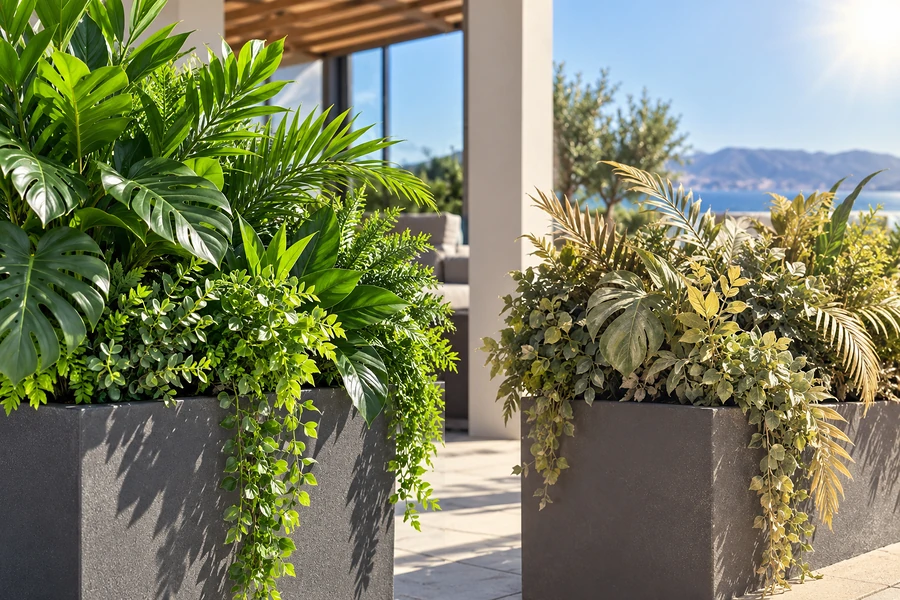
Outdoor artificial plants can look perfect when installed and noticeably faded one summer later. The difference often comes down to material formulation, UV stabilization, pigments, and weathering exposure.
For long-term outdoor artificial foliage, UV-stabilized polyethylene (PE) is usually my preferred choice over standard PVC because PE can combine flexibility, realistic molding, and effective light-stabilizer systems. However, PE is not naturally UV-proof, and properly formulated outdoor-grade PVC can also perform well. The formulation and verified weathering performance matter more than the polymer name alone.
That distinction is important. When a supplier says a plant is made from PE, I do not automatically assume it is suitable for full sun. Likewise, I do not reject PVC simply because it is PVC. I want to know what stabilizers, pigments, additives, test conditions, and outdoor-use claims apply to the finished foliage.
Is PE More UV Resistant Than PVC for Outdoor Artificial Plants?
For artificial greenery, UV-stabilized PE is commonly the stronger specification when long-term sun exposure, flexibility, and realistic leaf construction all matter.
UV-stabilized PE generally offers a better combination of UV durability and foliage realism than ordinary PVC artificial plants. PE can be injection-molded into flexible three-dimensional leaves and protected with HALS or other light stabilizers compounded into the resin. But unstabilized PE still degrades in sunlight, while specially formulated PVC can achieve excellent outdoor weatherability.
PE Is Not Naturally UV-Proof
This is the point I consider most important.
Polyethylene is a polyolefin, and prolonged ultraviolet exposure can initiate photo-oxidation.
BASF explains that UV radiation can produce free radicals that damage polyethylene’s molecular chains. Without suitable protection, PE products may lose flexibility, become brittle, and eventually deteriorate. Light stabilizers such as hindered amine light stabilizers, or HALS, are used to slow that process.
So when I see:
100% PE foliage
I still ask:
Is it UV-stabilized PE?
Those are different specifications.
HALS Are Particularly Important for PE
BASF describes HALS as especially effective light stabilizers for polyolefins. Rather than simply absorbing incoming UV radiation, HALS interrupt the free-radical reactions that contribute to polymer degradation.
That is highly relevant to artificial foliage because leaves are:
- Thin
- High-surface-area
- Continuously exposed to light
- Expected to retain flexibility
- Expected to retain color
A leaf can remain physically attached to an artificial tree and still fail aesthetically if it becomes faded, chalky, brittle, or curled.
For outdoor faux greenery, visual aging is often the first unacceptable failure.
PVC Can Also Be Highly Weatherable
I would not describe PVC as inherently unsuitable outdoors.
PVC is widely used in demanding exterior applications such as siding and window profiles.
A 2024 NIST study on vinyl siding confirms that outdoor durability depends heavily on the complete PVC formulation, including titanium dioxide, stabilizers, fillers, and other additives. The study evaluated color, gloss, chemical degradation, and mechanical performance after accelerated and natural weathering.
Research on exterior PVC also shows that titanium dioxide can substantially improve UV durability by screening or absorbing ultraviolet radiation and slowing photo-oxidative degradation.
So I do not use this oversimplified rule:
PE = outdoor, PVC = indoor.
My rule is:
UV-stabilized outdoor-grade PE is often preferable for exposed artificial foliage, while outdoor-formulated PVC can also perform well when its formulation and testing support the application.
Why PE Is Often Preferred for Artificial Foliage
For artificial plants specifically, PE has several practical advantages beyond UV resistance.
It can be injection-molded into realistic three-dimensional foliage.
That allows manufacturers to reproduce:
- Leaf thickness
- Rounded edges
- Veins
- Surface texture
- Curves
- Branch transitions
Current commercial artificial-plant guidance increasingly specifies UV-stabilized PE for exposed foliage because it offers a useful combination of realism, flexibility, and outdoor durability.
PVC can also be molded, but lower-cost artificial foliage frequently uses thinner, flatter, or stiffer PVC components.
That difference becomes visible at close viewing distances.
Why Do PE and PVC Artificial Plants Fade in Sunlight?
UV resistance is not simply about whether a leaf physically survives outdoors. Sunlight can alter its polymer, pigment, surface finish, and mechanical properties.
PE and PVC artificial plants fade because ultraviolet radiation drives chemical degradation in polymers and can also damage pigments and surface finishes. PE commonly undergoes photo-oxidative chain degradation, while PVC can discolor, lose gloss, crack, and undergo molecular changes during weathering. Stabilizers, pigments, heat, moisture, and exposure intensity determine how quickly these changes become visible.
PE Can Become Brittle Without Stabilization
BASF describes unstabilized polyethylene films exposed to intense sunlight as susceptible to loss of stretch properties, brittleness, and eventual breakdown.
For artificial leaves, I translate that into several possible visual failures:
- Leaf edges stiffening
- Fine cracking
- Curling
- Loss of flexibility
- Color fading
- Chalky-looking surfaces
A foliage panel does not need to completely disintegrate before I consider it failed.
If the leaves lose their realistic movement and color, the product has already stopped doing its job.
PVC Has a Different Degradation Mechanism
PVC experiences its own photochemical deterioration.
Research on exterior PVC shows that weathering can lead to discoloration, gloss loss, molecular chain changes, and progressive deterioration of the surface.
This does not mean PVC cannot last outdoors.
It means PVC needs the correct formulation.
Exterior building products demonstrate how much difference formulation can make.
They may include:
- UV absorbers
- Heat stabilizers
- Titanium dioxide
- Impact modifiers
- Durable pigments
Artificial plants sold primarily for indoor decoration may not contain comparable stabilization packages.
That is why I never assume a PVC artificial leaf has the same weatherability as exterior vinyl siding simply because both products use PVC.
Heat Accelerates the Problem
Outdoor artificial plants experience more than UV radiation.
Leaves can become extremely warm in direct sunlight, especially dark green foliage.
That creates combined:
UV + heat + oxygen
stress.
BASF’s current plastic-additive guidance specifically addresses protection against both sunlight and heat, including additives designed for PVC and polyolefin outdoor applications.
For artificial plants placed against:
- Dark walls
- Glass façades
- Rooftops
- South-facing patios
- Concrete plazas
surface temperatures can matter just as much as ambient air temperature.
Climate Changes the Result
A plant installed outdoors in Chicago does not experience the same environment as one installed in Phoenix, Miami, Dubai, or Singapore.
ASTM D1435 specifically warns that the relative outdoor durability of plastics can vary substantially according to:
- UV radiation
- Temperature
- Time of wetness
- Pollution
- Geographic location
ASTM therefore cautions against assuming that performance in one exposure location will accurately predict durability somewhere else.
That is why claims such as:
“Lasts five years outdoors”
need context.
Five years where?
In shade?
Full sun?
Desert heat?
High humidity?
Coastal conditions?
Those details matter.
What Makes an Artificial Plant Truly UV Resistant?
Material choice is only one part of the answer. The best outdoor foliage combines a suitable base polymer with the right additives, pigments, manufacturing method, and verified weathering performance.
A genuinely UV-resistant artificial plant should use an outdoor-grade formulation with appropriate light stabilizers, durable pigments, suitable leaf thickness, and weather-resistant construction. For PE, HALS are particularly effective. For PVC, stabilizers and pigments such as properly selected titanium dioxide can greatly affect performance. I prefer protection incorporated into the material rather than relying only on an unspecified topical spray.
UV Stabilizers Matter More Than the PE Label
Suppose I compare two PE artificial hedges.
Both are labeled polyethylene.
Product A contains an outdoor stabilizer package and weather-stable pigments.
Product B is inexpensive indoor-grade PE.
I would expect dramatically different outdoor performance even though the base polymer is technically the same.
Current BASF guidance identifies two major categories of light-protection chemistry:
UV absorbers (UVA) intercept harmful ultraviolet radiation.
HALS help stop the radical-driven degradation reactions inside the polymer.
Using appropriate stabilization can therefore matter more than choosing PE in name only.
Pigment Stability Matters Too
A leaf can remain mechanically flexible but still look terrible because the pigment fades.
The polymer and color system need to survive together.
NIST’s 2024 weathering research on PVC siding found that formulation—including titanium dioxide and other additives—significantly influenced weatherability and appearance retention.
For artificial plants, I therefore evaluate both:
mechanical durability
and
color retention.
Inherent Stabilization Is Different From a Surface Treatment
Some artificial foliage is marketed as UV-treated after manufacture.
Other products incorporate stabilizers into the plastic formulation.
I generally prefer the second approach for demanding outdoor installations because the protection is part of the material rather than only a surface finish.
Commercial artificial-foliage manufacturers use this approach by incorporating UV-protection chemistry into their raw materials and then weather-testing the finished foliage.
That does not mean every topical treatment is useless.
A coating can add protection.
But I want to know whether the product depends entirely on that coating and how long the manufacturer expects it to remain effective.
Outdoor Construction Extends Beyond the Leaves
Even excellent UV-stabilized PE leaves will not make a complete artificial tree outdoor-grade if everything else is inappropriate.
I also inspect:
- Stems
- Adhesives
- Branch joints
- Internal wire
- Trunk material
- Metal hardware
- Planter
- Anchoring
- Paint
- Surface coatings
Corrosion can destroy the supporting structure while the foliage still looks green.
A long-term commercial installation therefore needs weather-resistant construction as a system.
How Should Buyers Compare PE and PVC Outdoor Artificial Plants?
For professional sourcing, I would not approve an artificial plant using a specification sheet that says only “UV resistant.”
When comparing PE and PVC outdoor artificial plants, I ask for the resin type, stabilization method, test standard, exposure cycle, number of test hours, color-change data, mechanical-property changes, intended climate, warranty, and limitations. ASTM D4329 and G154 can be relevant for accelerated UV testing, while ASTM D1435 covers natural outdoor weathering of plastics. Test hours alone should never be translated automatically into an exact number of outdoor years.
ASTM D4329 Is Useful for Plastics
ASTM updated D4329 in March 2026.
The standard covers fluorescent ultraviolet lamp exposure of plastics and evaluates how materials respond to conditions involving UV radiation, moisture, and heat.
That makes it highly relevant when a supplier wants to substantiate outdoor-plastic performance.
However, the test does not magically tell me:
“This product will last exactly six years outdoors.”
Accelerated testing provides comparative information under specified conditions.
Real climates remain more complicated.
ASTM G154 Defines the UV Apparatus Framework
ASTM G154 covers operation of fluorescent UV exposure equipment and emphasizes that results need to be accompanied by the actual operating conditions used during testing.
So when someone tells me:
“Our artificial hedge passed 2,000 hours of UV testing,”
I ask:
- Which standard?
- Which lamp?
- Which cycle?
- What temperature?
- Was moisture included?
- What property was measured afterward?
- What was considered a pass?
Without those details, the number has limited value.
Natural Outdoor Weathering Is Still Important
ASTM D1435 deals with actual outdoor exposure.
It makes a particularly important warning: even natural exposure in one location does not automatically predict relative durability in another climate.
That is why the strongest commercial suppliers may combine accelerated testing with actual field experience.
My PE vs PVC Comparison
| Factor | UV-Stabilized PE | Outdoor-Grade PVC |
|---|---|---|
| UV resistance | Strong when properly stabilized | Can be strong with correct formulation |
| Unstabilized UV performance | Poorer than buyers often assume | Also vulnerable to weathering |
| Flexibility | Usually very good | Formulation-dependent |
| Realistic molded leaves | Excellent | Possible, but commonly less natural in budget foliage |
| HALS compatibility | Particularly effective for polyolefins | Different stabilization systems may be used |
| Pigment importance | Very high | Very high |
| Full-sun commercial use | Often my first choice | Requires stronger verification |
| Shaded outdoor use | Very suitable | Can be suitable |
| Cost | Often higher | Often economical |
| Final decision | Based on testing and formulation | Based on testing and formulation |
The key message is that this is UV-stabilized PE versus outdoor-formulated PVC, not simply PE versus PVC as chemical abbreviations.
My insights: PE vs PVC for Outdoor Artificial Plants: Which Material Is Better for UV Resistance
After comparing current polymer-stabilization guidance, NIST weathering research, ASTM standards, and artificial-foliage industry practices, I would normally specify UV-stabilized PE for exposed artificial leaves—but not because PE is inherently immune to sunlight.
For outdoor artificial plants, UV-stabilized PE is generally my preferred material because it combines effective polyolefin stabilization, flexibility, and realistic three-dimensional molding. However, high-quality outdoor PVC can also be durable. I consider UV additives, pigments, formulation, testing, climate, and warranty more important than simply seeing “PE” or “PVC” on a specification sheet.
My First Insight: PE Is Usually the Better Artificial-Foliage Choice, but Not Automatically the Better Polymer
This distinction matters.
For artificial plants, PE frequently wins because several useful characteristics occur together:
- Flexible foliage
- Three-dimensional molding
- Natural leaf edges
- Low-gloss finishes
- Effective HALS stabilization
- Good outdoor formulations
BASF specifically describes HALS as highly effective in polyolefins such as PE.
That makes PE a logical starting point for long-term artificial greenery.
But that does not prove that every PE product outperforms every PVC product.
My Second Insight: Good PVC Can Outperform Bad PE
Exterior PVC building products have demonstrated that properly formulated PVC can survive severe outdoor service.
NIST’s recent vinyl-siding research makes it clear that additives and formulation significantly influence weathering behavior.
So if I compare:
cheap unstabilized PE foliage
with
professionally formulated, tested outdoor PVC
I would not automatically choose the PE.
I choose the tested system.
My Third Insight: “UV Resistant” Without Test Details Is Not Enough
This is probably the biggest procurement problem.
A supplier may write:
UV resistant.
That could mean:
- UV stabilizers were compounded into the resin
- A surface spray was applied
- A pigment was selected for better colorfastness
- A short test was performed
- Or simply that the seller expects the product to tolerate some sunlight
Those are not equivalent claims.
I therefore ask for evidence.
My Fourth Insight: Test Hours Are Not Outdoor Years
If a supplier says:
2,000 hours of UV testing = five years outside
I become cautious.
ASTM D1435 explicitly explains that weathering varies by location and that short-term testing should not be used casually to predict absolute long-term performance.
ASTM G154 likewise emphasizes reporting the actual test conditions rather than treating the apparatus as a universal durability calculator.
So I use accelerated testing for comparison.
I do not convert test hours into calendar years without validated correlation data.
My Fifth Insight: Climate Should Influence Material Selection
For mild shade, PE and well-formulated PVC may both perform satisfactorily.
For intense full sun, I become much more selective.
My decision framework looks like this:
| Exposure | My preferred approach |
|---|---|
| Interior | PE or PVC |
| Bright interior near glass | UV-stabilized material preferred |
| Covered outdoor shade | Outdoor-rated PE or PVC |
| Partial sun | Verified UV-stabilized formulation |
| Full sun | UV-stabilized PE is usually my starting point |
| Desert/high-heat exposure | Strong testing and climate-specific evidence |
| Coastal exterior | UV plus corrosion-resistant structure |
| Permanent commercial façade | Documented weathering performance and warranty |
Material selection becomes stricter as exposure increases.
My Sixth Insight: Color Failure May Arrive Before Structural Failure
Artificial foliage is unusual because appearance is its primary function.
A structural plastic product might remain usable even after noticeable color change.
An artificial plant cannot.
If green leaves turn:
blue-gray, chalky, yellow, or noticeably pale,
the product has failed aesthetically even if it remains physically intact.
That is why I pay close attention to color-retention testing and pigment quality.
My Seventh Insight: I Would Specify the Finished Product, Not Just the Resin
My outdoor artificial-plant specification would include more than:
Material: PE
I would want something closer to:
UV-stabilized outdoor-grade PE foliage, weather-stable pigments, documented accelerated weathering test conditions, appropriate corrosion-resistant supporting components, defined warranty, and approved pre-production sample.
That specification tells the supplier what performance I actually need.
My Outdoor Artificial-Plant Buying Checklist
Before approving PE or PVC foliage, I ask:
| Question | Why it matters |
|---|---|
| Is the leaf PE, PVC, or a blend? | Establishes base construction |
| Is UV stabilization compounded into the material? | Indicates protection method |
| Which stabilizer system is used? | Helps assess formulation |
| Are pigments outdoor-grade? | Color can fail independently |
| Which weathering standard was used? | Makes testing meaningful |
| How many test hours? | Provides comparative exposure data |
| What UV cycle and lamp were used? | Test hours alone are insufficient |
| Was moisture included? | Outdoor weather is more than light |
| What changed after testing? | Color and strength results matter |
| Is there natural outdoor exposure data? | Useful field validation |
| What climate is the product intended for? | Performance varies geographically |
| What does the warranty cover? | Shows supplier confidence and limits |
| Are stems and hardware outdoor-grade too? | Leaves are only one component |
| Can replacement foliage be supplied? | Important for commercial projects |
My Final View
When someone asks me “PE vs PVC for outdoor artificial plants: which material is better for UV resistance?”, my practical answer is:
I usually choose UV-stabilized PE for the visible foliage of long-term outdoor artificial plants.
It generally gives me the strongest combination of:
realistic molding + flexibility + effective UV stabilization + commercial outdoor usability.
But I would never choose PE solely because the specification says PE.
Polyethylene can still suffer significant UV degradation without suitable stabilizers. BASF’s polymer guidance makes that clear.
PVC deserves the same nuance.
Ordinary low-cost PVC foliage may not be my first choice for long-term full-sun installations, but technically sophisticated PVC formulations can perform extremely well outdoors. NIST’s work on exterior vinyl demonstrates how strongly additives and formulation influence PVC weatherability.
So the real comparison is not:
PE versus PVC.
It is:
outdoor-engineered, UV-stabilized PE versus outdoor-engineered, weather-stabilized PVC.
For most visible commercial foliage exposed to strong sunlight, I would normally begin with the first.
Then I would ask for the evidence.
What additives are present?
How stable are the pigments?
Which ASTM or ISO method was used?
How did the color change?
Did the leaves become brittle?
What climate is covered?
What does the warranty actually promise?
Those answers tell me far more about outdoor durability than the resin abbreviation printed on a sales sheet.
Conclusion
UV-stabilized PE is usually the stronger choice for exposed artificial foliage, but formulation matters most. High-quality PVC can also perform outdoors when properly stabilized, pigmented, tested, and specified.

