


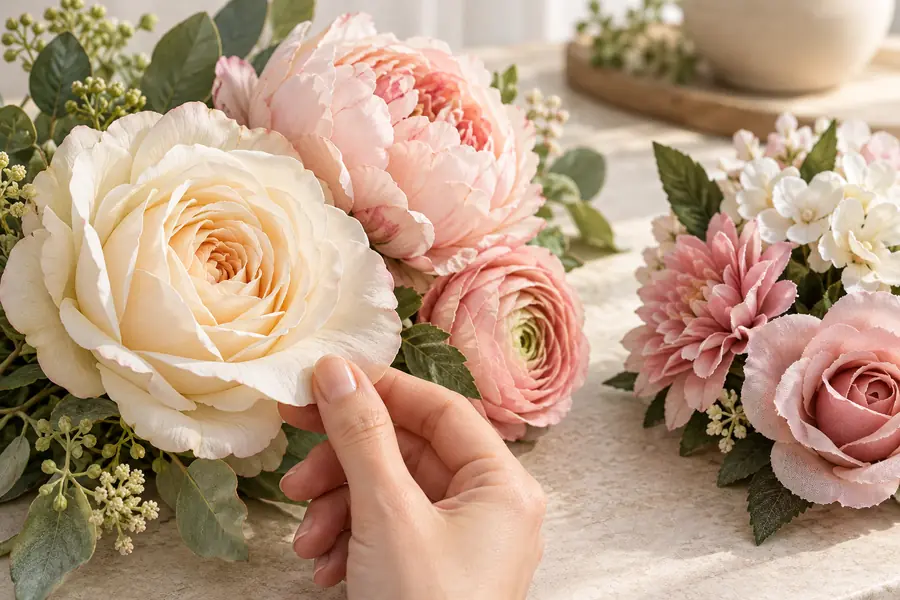
Real Touch vs Fake Flowers: What’s the Difference?
Artificial flowers can look almost identical in online photos, yet feel completely different once they arrive. The biggest difference is often hidden in their materials and construction.
Real Touch flowers are artificial flowers designed to reproduce both visual and tactile qualities of fresh petals, while ordinary fake flowers may focus mainly on appearance, affordability, or durability. Real Touch flowers commonly use polyurethane, latex-like polymers, silicone-like materials, coated fabrics, foam, or mixed constructions, while standard faux flowers often rely more heavily on polyester fabric and conventional plastic.
Real Touch describes a performance category, not standardized material. Modern silk flowers are usually synthetic too. Choose based on realism, texture, durability, application, and price.
What Is the Main Difference Between Real Touch and Regular Fake Flowers?
The biggest difference is usually tactile realism.
Real Touch flowers are engineered to feel more like natural petals when touched, while standard artificial flowers are generally designed primarily to reproduce the visual shape and color of flowers. Real Touch products often use soft polymer coatings or molded materials, whereas traditional silk-style faux flowers commonly use woven polyester or similar synthetic fabric.
A 2026 comparison of artificial-flower categories describes Real Touch flowers as using soft polymer finishes intended to imitate fresh-petal texture, while modern silk flowers are generally fabric-based and more likely to retain a textile feel.
Afloral similarly describes Real Touch flowers as premium stems with soft coatings intended to reproduce lifelike flexibility and surface feel.
Real Touch Focuses on Touch as Well as Appearance
Imagine picking up a fresh tulip.
Its petal does not feel like woven cloth.
It may feel:
soft,
slightly cool,
smooth,
or faintly waxy.
Real Touch manufacturing attempts to reproduce some of those qualities.
Depending on the flower, manufacturers may use:
- Polyurethane
- Latex or synthetic-rubber coatings
- Silicone-like polymers
- Polymer-coated polyester
- Foam
- PE components
- Wire-supported stems
Different flowers need different material behavior.
A peony petal may need softness and thickness.
An orchid may need a more sculptural molded surface.
A tulip may need smooth, slightly fleshy petals.
That is why I would never assume two flowers carrying the Real Touch label are chemically identical.
Regular Fake Flowers Cover a Much Wider Category
“Fake flowers” is an umbrella term.
It can describe:
a $2 polyester stem,
a molded plastic flower,
a premium silk-style peony,
a PE botanical,
or a luxury Real Touch rose.
Therefore:
all Real Touch flowers are artificial flowers, but not all artificial flowers are Real Touch.
That is the simplest distinction.
What Are Real Touch Flowers Actually Made Of?
This is where marketing terminology becomes confusing.
Real Touch flowers do not have one required formula. Their petals may use polyurethane, latex-like coatings, silicone-like materials, coated synthetic fabric, foam, polyester, or mixed polymers. Leaves and stems may use PE, PVC, polyester, plastic, adhesives, pigments, and internal metal wire.
Current product examples demonstrate how broad the category really is.
Afloral’s Real Touch blue poppy anemone is currently listed as 50% polyester, 20% PVC, 20% wire, and 10% plastic.
Its lavender Real Touch rose bundle uses fabric, polyethylene, wire, and polyfoam.
A Real Touch tulip bundle from the same retailer is described simply as foam and polyester.
Those three examples alone demonstrate why “Real Touch” should not be treated as a chemical name.
Polyurethane
PU can be useful for flowers that need:
softness,
petal thickness,
molded curves,
surface texture,
and three-dimensional structure.
Current Real Touch material descriptions frequently associate polyurethane with premium soft-touch petals.
Latex or Synthetic-Rubber Coatings
A thin synthetic textile can be coated with a flexible polymer.
This allows manufacturers to retain fabric structure while adding:
softness,
flexibility,
and a more petal-like surface.
Silicone-Like Polymers
Certain flower types benefit from detailed molding.
Silicone-like materials can help reproduce:
veins,
curved petals,
and smooth botanical surfaces.
Polyester
Polyester remains extremely common in modern artificial flowers.
It is:
lightweight,
easy to color,
flexible,
and relatively affordable.
Afloral’s conventional blush-peach artificial dahlia, for example, is currently listed as 75% polyester with plastic tube, wire, and glue.
That stem may still look highly realistic even though it is not primarily marketed around a soft polymer petal.
This is important:
Real Touch is not automatically realistic, and polyester is not automatically cheap-looking.
Construction quality matters.
Do Real Touch Flowers Look More Realistic Than Fake Flowers?
Often, especially from close range—but not automatically.
Real Touch flowers generally have an advantage when people will touch the petals or inspect them closely because the surface and flexibility are designed to feel more botanical. Standard premium faux flowers can still look extremely realistic from normal viewing distances, especially when color, petal shape, veining, flower centers, and stems are well executed.
The difference becomes most noticeable in:
bridal bouquets,
table centerpieces,
boutonnieres,
cake flowers,
retail displays,
and close-up photography.
Realism Is More Than Softness
A flower can feel soft and still look fake.
I evaluate at least six things:
| Feature | What I look for |
|---|---|
| Shape | Correct botanical proportions |
| Color | Gradients rather than flat color |
| Surface | Species-appropriate matte, waxy, or soft finish |
| Center | Realistic stamens, pistils, or flower structures |
| Stem | Flexible but believable |
| Irregularity | Slight variation rather than exact repetition |
A Real Touch label does not guarantee these qualities.
Current Real Touch market guidance explicitly warns that products sold under the same terminology can vary widely in material, realism, and construction.
Some Flowers Benefit More From Real Touch Than Others
I would pay more attention to tactile realism with:
roses,
tulips,
calla lilies,
peonies,
magnolias,
and other flowers with large exposed petals.
For:
hydrangeas,
lavender,
wildflowers,
or large filler blooms,
a well-made polyester construction can work beautifully because the viewer reads the complete bloom before touching individual petals.
Viewing Distance Matters
At 12 inches:
petal material matters greatly.
At six feet:
color, silhouette, and arrangement matter more.
At 15 feet:
the difference between Real Touch and premium fabric may be almost irrelevant.
This is why I do not recommend automatically using Real Touch for every stem in a large installation.
Are Real Touch Flowers Better for Weddings?
They can be, especially for flowers that will be handled and photographed closely.
Real Touch flowers are particularly useful for bridal bouquets, boutonnieres, corsages, sweetheart-table flowers, and other wedding pieces that receive close visual attention. Standard silk-style artificial flowers can be more economical for arches, aisle arrangements, flower walls, hanging installations, and large displays viewed from farther away.
A 2026 industry comparison similarly recommends Real Touch for close-up arrangements and photography while identifying premium fabric-based flowers as practical for larger-volume designs.
Bridal Bouquets
This is where Real Touch often earns its price.
A bridal bouquet appears in:
portrait photography,
ceremony photographs,
detail shots,
and guest interactions.
People also physically hold it.
For this application, I would prioritize:
natural petal feel,
matte or species-appropriate finish,
detailed flower centers,
subtle color gradients,
and clean stems.
Ceremony Arches
An arch is different.
Guests usually see it from several feet away.
The camera often captures the complete composition rather than one isolated petal.
For an arch, I care more about:
volume,
shape,
color harmony,
branch direction,
and flower density.
This is an ideal place to mix premium polyester flowers with selected Real Touch focal blooms.
Mixed-Material Wedding Designs
I often think the best value comes from mixing materials.
For example:
Real Touch roses + polyester hydrangeas + plastic or PE greenery.
The roses provide tactile realism.
Hydrangeas provide volume.
Greenery builds scale.
The arrangement does not need every flower to use the same manufacturing system.
Is Real Touch More Expensive Than Standard Fake Flowers?
Usually, but not always.
Real Touch flowers often cost more because soft-touch coatings, complex molding, hand-applied color, and more detailed construction can increase manufacturing cost. However, brand, flower type, stem size, craftsmanship, packaging, and retail positioning can affect price as much as the Real Touch label itself.
A premium polyester stem can cost more than a basic Real Touch flower.
Likewise, clearance pricing can completely reverse the comparison.
Therefore, price alone is not a reliable way to identify material quality.
Where I Would Spend More
I would invest more in:
- Bridal bouquets
- Dining-table flowers
- Reception desks
- Luxury retail displays
- Close-up photography
- Small arrangements people can touch
Where I Would Save
I would use less expensive flowers for:
- High shelves
- Ceiling installations
- Large flower walls
- Ceremony arches
- Distant displays
- Background arrangements
The best budget is based on viewing distance, not simply flower count.
Are Real Touch Flowers More Durable?
Not necessarily.
This is one of the biggest misconceptions.
Real Touch flowers are designed primarily for realism, not automatically for maximum durability. Some soft polymer surfaces can be more sensitive to heat, UV exposure, pressure, dirt, or long-term surface changes than simpler molded-plastic flowers. Durability depends on the exact material and intended use.
Standard plastic foliage may sometimes outperform a highly realistic soft-touch petal outdoors.
That does not make the plastic flower “better.”
It means the two products are optimized for different goals.
Indoor Durability
For normal indoor use, good Real Touch flowers can remain attractive for a long time when stored and cleaned properly.
Avoid:
crushing,
high heat,
prolonged intense sunlight,
and aggressive cleaning chemicals.
Storage
Soft petals can become compressed in storage.
Use containers large enough to avoid crushing the flower heads.
Wired stems should be reshaped after unpacking.
Cleaning
Cleaning recommendations depend on the specific material.
A dry or lightly damp soft cloth, gentle air, or soft brush may be appropriate for many artificial flowers, but the manufacturer’s instructions should take priority.
Do not assume a soft-coated Real Touch petal tolerates the same cleaning method as hard molded plastic.
Can Real Touch Flowers Be Used Outdoors?
Sometimes—but the label itself does not answer that question.
Real Touch does not automatically mean waterproof, UV-resistant, weatherproof, or outdoor-safe. Some products are specifically UV-treated for patios or covered outdoor use, while others are designed only for interiors or short-duration events. Always check the exact product specification before long-term exterior placement.
Current outdoor guidance for Real Touch flowers makes this distinction explicitly: realism and weather resistance are separate product characteristics.
Afloral currently sells a UV-treated Real Touch rose arrangement for indoor or covered outdoor use, while still warning that stronger sun exposure can accelerate fading.
That is a useful real-world example.
For Outdoor Weddings
Real Touch flowers can be excellent.
They do not biologically wilt in summer heat the way fresh flowers may.
And the display only needs to perform for:
several hours,
not several years.
For Permanent Outdoor Displays
My priorities change.
I first ask:
Is it UV treated?
Is it outdoor rated?
Can it tolerate moisture?
How are the pigments stabilized?
Are the adhesives weather resistant?
Will the internal wire corrode?
Only after those questions do I evaluate petal softness.
For permanent exterior décor:
weather performance comes before tactile realism.
Is “Silk Flower” the Same as “Fake Flower”?
Not exactly, although the terms are often used interchangeably.
“Fake flower” or “artificial flower” describes the full category. “Silk flower” historically referred to fabric flowers, but modern silk flowers are usually made from polyester or other synthetic fabrics rather than natural silk. Real Touch is another subcategory within artificial flowers, focused more strongly on tactile realism.
Afloral confirms that modern silk flowers are rarely made from authentic silk and instead commonly use synthetic materials including polyester and polymers.
A useful hierarchy is:
Artificial flowers / fake flowers / faux flowers
→ polyester or “silk” flowers
→ molded plastic flowers
→ foam flowers
→ PE flowers
→ Real Touch flowers
→ mixed-material artificial flowers
The categories overlap.
A Real Touch flower might contain polyester.
A silk-style flower might contain plastic.
A molded flower might use wire.
The labels are useful for shopping, but the actual material list tells you more.
How Can You Tell if Real Touch Flowers Are High Quality?
Do not judge the flower by softness alone.
High-quality Real Touch flowers combine realistic shape, subtle color variation, species-appropriate surface texture, natural movement, detailed centers, believable leaves and calyxes, flexible stems, clean joints, and minimal visible glue. The material should match the real flower rather than simply feel soft.
Check the Shape
Does the flower resemble its actual species?
A rose should not look like a generic round ball.
A peony should have layered petal depth.
A tulip should have a recognizable cup shape.
Check the Surface in Daylight
Artificial flowers often look different under showroom lighting.
Photograph the sample:
near a window,
from the side,
and in close-up.
Look for:
excessive shine,
mold seams,
patchy coatings,
and unrealistic transparency.
Touch the Petal
Ask:
Does it recover after gentle pressure?
Is it too sticky?
Too rubbery?
Too thick?
Too thin?
Realism depends on the flower species.
A calla lily should not feel identical to a hydrangea.
Check the Reverse Side
Lower-quality artificial flowers sometimes look excellent from the front but reveal:
unfinished fabric,
obvious glue,
poor paint,
or exposed plastic
on the reverse.
Professional installations are often visible from multiple angles.
Examine the Stem
The stem should be:
bendable,
cleanly assembled,
and proportionate to the flower head.
Visible wire or bulky connection points reduce realism.
Real Touch vs Fake Flowers: Quick Comparison
| Feature | Real Touch Flowers | Standard Fake Flowers |
|---|---|---|
| Main goal | Visual + tactile realism | Visual decoration |
| Common materials | PU, latex-like polymers, silicone-like polymers, coated fabric, foam, mixed plastics | Polyester, plastic, PE, foam, mixed synthetics |
| Feel | Softer, more petal-like | Often fabric-like or plastic |
| Close-up realism | Usually stronger | Highly variable |
| Long-distance realism | Excellent when well made | Can be equally effective |
| Price | Often higher | Wider price range |
| Weddings | Excellent for bouquets and close-up pieces | Excellent for large installations |
| Outdoor use | Only if specifically rated | Depends on product |
| Durability | Material-dependent | Material-dependent |
| Color range | Wide | Very wide |
| Best buying criterion | Botanical accuracy + touch | Appearance + application |
My insights: Real Touch vs Fake Flowers-What’s the Difference
After comparing current Real Touch material guidance, conventional silk-style flowers, product specifications, and current artificial-flower manufacturing descriptions, I think the biggest mistake is treating this comparison as premium versus cheap.
Real Touch vs Fake Flowers: What’s the Difference? Real Touch flowers are one type of fake flower engineered to emphasize tactile realism, while the broader artificial-flower category includes polyester, plastic, PE, foam, and mixed-material products designed for many different price points and applications. Real Touch is most valuable at close range; standard high-quality faux flowers can be equally effective when touch is less important.
My First Insight: Real Touch Is a Performance Goal, Not a Material
This is the point I would remember above everything else.
The words Real Touch tell me what the manufacturer wants the flower to achieve.
They do not automatically tell me whether it contains:
PU,
latex,
silicone,
polyester,
PE,
or foam.
Current product specifications make this clear: different Real Touch stems can contain very different combinations of materials.
So I do not buy by label alone.
My Second Insight: Softest Does Not Mean Most Realistic
Real petals vary enormously.
Some are:
thin and papery.
Some are:
thick and waxy.
Some are:
velvety.
Some are:
firm.
If every Real Touch flower has the same soft rubbery texture, something is wrong.
The material should imitate the specific botanical structure.
My Third Insight: Premium Polyester Is Still Relevant
Modern polyester flowers should not be dismissed as outdated.
Afloral currently sells highly detailed artificial flowers with polyester-dominant compositions, including dahlias and peonies designed for home décor and wedding arrangements.
Fabric offers advantages:
light weight,
large color range,
soft movement,
and economical volume.
That makes it excellent for large installations.
My Fourth Insight: I Would Mix Materials Instead of Choosing Sides
A professional arrangement does not need one material throughout.
For a wedding bouquet, I might choose:
Real Touch roses,
polyester hydrangeas,
molded greenery,
and wired filler stems.
Each material does a different job.
This usually creates better value than insisting every flower must be Real Touch.
My Fifth Insight: Viewing Distance Should Determine Spend
This is perhaps the most practical purchasing rule.
Under 2 feet: pay attention to texture and petal construction.
2–6 feet: color, shape, and centers matter more.
6+ feet: overall silhouette and arrangement dominate.
A Real Touch flower hidden 12 feet above a ballroom is rarely the smartest place to spend a premium budget.
My Sixth Insight: Photography Raises the Quality Standard
Cameras notice:
shine,
repetition,
flat color,
and poor flower centers.
They do not feel petals.
So Real Touch is useful for photography mainly when its material also creates better visual texture.
A badly colored Real Touch rose can photograph worse than an excellent polyester rose.
My Seventh Insight: Outdoor Performance Is a Separate Specification
One of the most important myths to avoid is:
Real Touch = outdoor-safe.
It does not.
Current outdoor product examples require separate UV treatments and still include limitations on sun exposure.
For patios, graves, outdoor weddings, storefronts, or garden displays, I always evaluate weather resistance independently.
My Eighth Insight: “Silk” Is Also Mostly a Marketing Category Today
Modern silk flowers rarely contain natural silk.
That means shoppers should not imagine a simple comparison:
Real Touch polymer vs genuine silk.
In reality, the comparison is often:
soft-touch polymer/mixed material vs polyester-based fabric/mixed material.
The terminology is historical.
The material list is current.
My Ninth Insight: Sample Evaluation Beats Online Labels
For large wedding, hospitality, retail, or wholesale orders, I would always request a sample first.
I would inspect it for:
shape,
color,
shine,
touch,
stem construction,
underside finish,
visible glue,
and packing recovery.
Then I would compare two or three stems from the same batch.
One perfect sample is not enough if production consistency matters.
My Quick Buying Rule
I would choose Real Touch when:
the flower will be touched,
photographed closely,
used in a bridal bouquet,
displayed on a dining table,
or sold as premium décor.
I would choose high-quality standard faux flowers when:
I need volume,
the arrangement is viewed from farther away,
the budget is tighter,
or the flower species looks convincing in fabric.
I would choose outdoor-rated artificial flowers when:
UV and weather exposure matter more than petal softness.
My Final View
Real Touch is not the opposite of fake.
It is a specialized type of fake flower.
That distinction makes the entire market easier to understand.
The question should never be:
“Do I want Real Touch or fake flowers?”
It should be:
“Where will these flowers be used, how closely will people see or touch them, what material behavior do I need, and what level of realism is worth paying for?”
For close-up luxury arrangements, Real Touch can be an excellent investment.
For large-scale decoration, premium fabric flowers may provide better value.
For permanent exterior use, UV and weather specifications may matter more than either category.
And for professional buyers, the most valuable piece of information is not the label on the catalog page.
It is the actual construction of the flower.
Conclusion
Real Touch flowers are premium artificial flowers focused on lifelike touch and appearance. Standard fake flowers offer broader materials and prices. Choose by application, distance, durability, and botanical realism.

