


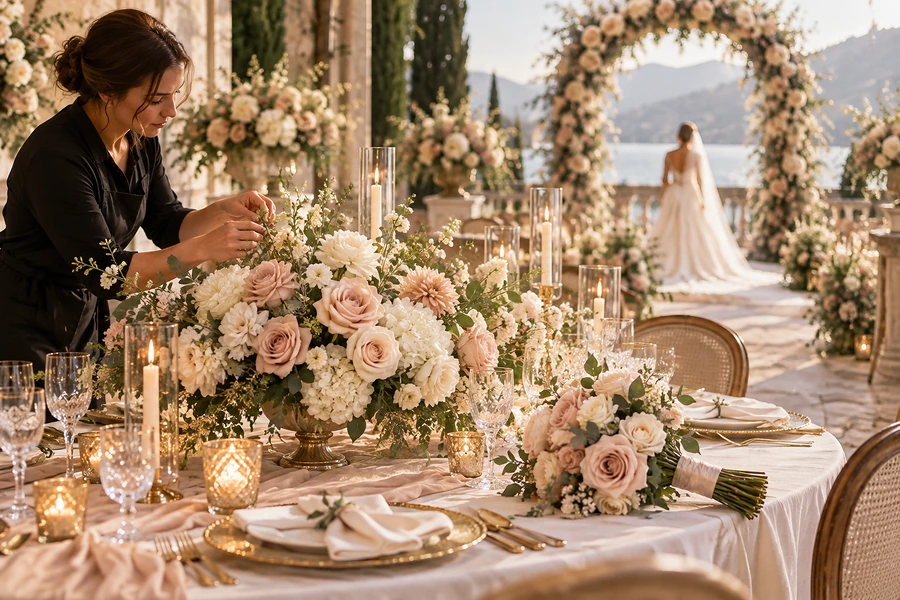
Wedding flowers can become beautiful focal points—or a surprisingly complicated expense. Fresh and artificial flowers now offer very different advantages, making the choice less obvious than it once was.
For a 2026 wedding, choose real flowers when natural fragrance, organic variation, and close-up botanical beauty matter most. Choose high-quality fake flowers when durability, exact colors, advance preparation, or predictable costs are more important. For many couples, combining fresh personal flowers with faux ceremony and reception décor offers the strongest balance.
The financial difference can also be substantial. The Knot’s 2026 wedding-flower report puts average U.S. flower spending at $2,800, with a median of $1,900. However, artificial flowers are not automatically inexpensive: premium Real Touch bouquets can cost hundreds of dollars, while rented faux flowers can create a very different cost structure.
Are Real or Fake Flowers Better for a Wedding?
Neither option is automatically better. They create different experiences and solve different problems.
Real wedding flowers are strongest when scent, natural movement, seasonal character, and close-up realism matter most. Artificial flowers are strongest when a wedding requires durability, precise colors, early preparation, easy transportation, or flowers that would otherwise be difficult to source. The decision should be based on application rather than assumptions about quality.
What Real Flowers Do Best
Fresh flowers still have one major advantage: they are naturally botanical.
A real garden rose has:
- Slightly different petals from the flower beside it
- Subtle color transitions
- Natural fragrance
- Irregular edges
- Changing bloom stages
- Organic movement
Those details matter most when people are close to the flowers.
That is why I often prefer fresh flowers for a bridal bouquet, boutonniere, small centerpiece, or another arrangement guests will see from only a few feet away.
Fresh flowers also make seasonality part of the wedding.
The Knot recommends considering flowers that are naturally in season because local and seasonal availability can improve selection and may sometimes help manage costs. It also notes that flowers outside their normal season can sometimes be imported, but doing so may increase the price.
A spring wedding can therefore feel genuinely different from an autumn wedding when fresh flowers are selected around what is naturally available.
What Fake Flowers Do Best
Artificial flowers win on control.
They do not depend on:
- Bloom stage
- Refrigeration
- Water
- Seasonal availability
- Wedding-day temperatures
A faux bouquet can be completed well before the wedding.
A ceremony arch can be assembled early.
A flower wall can sit through a long setup period without losing petals.
A bridal bouquet can survive several hours outdoors without needing hydration.
Zola’s guide to artificial wedding flowers highlights exactly these practical advantages: faux flowers can be prepared ahead, manipulated repeatedly, stored without water, and used without the same freshness concerns as real flowers.
That reliability becomes particularly useful for destination weddings, DIY weddings, and installations that need to be ready long before guests arrive.
The Real Question Is Where the Flowers Will Be Seen
I think viewing distance is one of the most overlooked factors.
If guests will hold or closely inspect a flower, realism becomes extremely important.
If flowers are ten feet above the dance floor, tactile realism matters much less.
That gives couples an opportunity to allocate quality strategically.
For example:
| Wedding element | What usually matters most |
|---|---|
| Bridal bouquet | Texture, botanical realism, photography |
| Boutonniere | Close-up detail |
| Low centerpiece | Natural appearance from nearby |
| Ceremony arch | Scale, color, silhouette |
| Hanging installation | Overall visual impact |
| Flower wall | Color and composition |
| Distant stage décor | Volume and shape |
This is why the best wedding does not always need one flower type everywhere.
What Are the Pros and Cons of Real Wedding Flowers?
Fresh flowers create an experience artificial flowers cannot completely reproduce, but they also create logistical demands.
The biggest advantages of real wedding flowers are natural fragrance, genuine texture, organic variation, and seasonal character. Their disadvantages are perishability, weather sensitivity, limited advance preparation, and potentially higher labor and sourcing costs—especially when the design requires imported flowers or complex installations.
Pros of Real Wedding Flowers
Natural Texture
A fresh petal behaves differently from fabric or polymer.
Its thickness varies.
Its edge curls naturally.
Light passes through it differently.
For close-up photographs, those details can matter.
Fragrance
Fresh flowers can contribute scent to the wedding environment.
Garden roses, sweet peas, jasmine, stock, lavender, and herbs can make floral design part of the sensory experience.
Artificial flowers may reproduce appearance, but they do not naturally produce that fragrance.
Seasonal Personality
Fresh flowers can make the date of the wedding visible.
The Knot’s seasonality guidance encourages couples to consider what is naturally blooming around their wedding month rather than designing only by color.
That could mean:
peonies in late spring,
garden roses in summer,
dahlias later in the year,
or branches and berries in colder months.
Florist Expertise
Professional fresh floristry involves much more than buying stems.
Florists may handle:
- Sourcing
- Conditioning
- Refrigeration
- Design
- Transportation
- Venue installation
- Breakdown
That expertise becomes especially important with large installations.
Cons of Real Wedding Flowers
They Are Perishable
Fresh flowers begin changing after harvest.
Some are more resilient than others.
Heat, wind, transportation, and dehydration can all affect their appearance.
This can make outdoor summer weddings particularly challenging.
Certain Flowers Can Cost More Out of Season
Although global sourcing means many flowers can be found beyond their traditional season, The Knot notes that importing out-of-season varieties can increase costs.
Couples who remain flexible about species often have more options.
Large Designs Can Require Significant Labor
The material itself is only part of a floral quote.
Installation can require:
mechanics,
containers,
staff,
delivery,
setup,
and removal.
That is why looking only at the wholesale cost of flowers does not accurately represent professional wedding-flower pricing.
What Are the Pros and Cons of Fake Wedding Flowers?
Artificial flowers have improved significantly, especially at the premium end of the market.
Fake wedding flowers offer predictable appearance, no wilting, year-round color choices, easier advance preparation, rental opportunities, and potential reuse. Their disadvantages include large quality differences, no natural fragrance, potentially bulky wired stems, and the fact that premium Real Touch products can cost as much as—or more than—some fresh alternatives.
Pros of Fake Wedding Flowers
No Wilting
This is the clearest advantage.
Artificial flowers can remain visually stable through:
- Outdoor ceremonies
- Long photography sessions
- Early venue setup
- Hot reception spaces
- Transportation
That reduces one major source of wedding-day uncertainty.
Advance Preparation
A faux bouquet can be finished weeks before the event.
For DIY couples, this changes the planning process dramatically.
Instead of arranging hundreds of fresh stems immediately before the wedding, artificial flowers can be prepared gradually.
Zola notes that artificial bouquets avoid much of the preparation and storage required for fresh flowers.
Exact Color Control
Fresh flowers naturally vary.
Usually that is beautiful.
But if a wedding needs an extremely precise shade, artificial flowers can provide more consistency.
This can be particularly helpful for:
- Dusty blue palettes
- Terracotta themes
- Specific mauves
- Unusual champagne shades
Out-of-Season Flowers
Artificial flowers allow a couple to create a particular botanical look regardless of season.
A winter wedding can use peony-style blooms.
A summer event can feature delicate flowers without worrying about heat.
Rental Options
Couples do not always need to purchase fake flowers.
The Knot’s rental guide reports average full wedding orders around $500 from Something Borrowed Blooms and $450 from Silk Stem Collective at the time of its latest guide update, with bridal bouquets around $55–$80 and centerpieces ranging approximately $28–$138. Rental services may also charge shipping, sample, damage, or setup-related fees.
These figures are useful examples rather than universal 2026 prices; current quotes should always be checked directly with the vendor.
Cons of Fake Wedding Flowers
Quality Varies Enormously
“Artificial flower” can describe everything from a basic fabric rose to a premium Real Touch bloom.
Low-quality products may show:
- Excessive shine
- Flat color
- Visible seams
- Cheap leaves
- Oversized stems
- Identical flowers
That is why I never evaluate fake flowers as one uniform category.
Premium Real Touch Can Be Expensive
Zola’s artificial-flower guide lists a basic silk bridal bouquet at roughly $20–$100, while premium Real Touch bridal bouquets can reach $300 or more. It also lists Real Touch bridesmaid bouquets at approximately $150+.
Those reference prices illustrate an important point:
fake does not automatically mean cheap.
Wired Stems Can Be Thick
Artificial flowers often contain wire.
That makes them easy to position, but large bouquets can develop thick or relatively heavy handles.
Zola also notes that faux stems may require wire cutters and can be less pliable than fresh stems.
They Lack Natural Scent
This cannot really be designed away.
A high-quality artificial flower can reproduce shape, color, and sometimes touch extremely well.
It still does not become a living flower.
How Much Should You Budget for Wedding Flowers in 2026?
Budget comparisons work best when couples compare complete floral plans rather than individual stems.
The Knot’s 2026 Real Weddings Study reports average U.S. wedding-flower spending of $2,800, with a $1,900 median. Couples in the lower-cost quartile spent about $900, while the upper-cost quartile averaged $4,800. Guest count, season, region, floral volume, and installation complexity all influence the final price.
2026 Fresh-Flower Spending Benchmarks
The Knot reports the following averages by guest count:
| Guest count | Average flower spending |
|---|---|
| 1–50 | $1,600 |
| 51–100 | $2,400 |
| 101+ | $3,300 |
These figures make sense because more guests normally mean:
more tables,
more centerpieces,
more ceremony seating,
and often a larger venue.
Season Also Affects Spending
The Knot’s current data reports approximate average flower spending of:
| Wedding season | Average spending |
|---|---|
| January–March | $2,900 |
| April–June | $2,900 |
| July–September | $2,800 |
| October–December | $2,700 |
These numbers do not mean winter flowers are always expensive or autumn flowers are always cheap.
They are national averages.
Flower choice and local availability still matter more for a particular wedding.
Artificial Flower Cost Is More Variable Than Many Couples Expect
Zola’s artificial-flower reference pricing illustrates the range:
| Artificial floral item | Reference price |
|---|---|
| Basic silk bridal bouquet | $20–$100 |
| Premium Real Touch bridal bouquet | $300+ |
| Silk bridesmaid bouquet | $10–$50 |
| Premium Real Touch bridesmaid bouquet | $150+ |
| Boutonniere | $3–$20 |
| Corsage | $5–$30 |
| Silk centerpiece | $20–$100 |
| Silk garland | $20–$50 |
| Silk aisle arrangement | $10–$20 |
The range explains why artificial wedding flowers can either save money or become a premium product.
It depends on quality and service model.
Rental Creates a Third Budget Category
Instead of comparing:
fresh vs purchased artificial,
I would compare three models:
- Fresh florist
- Purchased artificial flowers
- Rented artificial flowers
These are financially very different.
Rental flowers can be attractive because the couple pays for temporary use of an existing collection rather than purchasing every stem.
However, the design may also be less customizable.
The Knot notes that rental collections often involve predesigned options and may require couples to handle placement and returns themselves.
That labor should be part of the comparison.
Should You Mix Real and Fake Wedding Flowers?
For many couples, this is the option I would investigate first.
Mixing real and fake flowers can preserve fresh botanical detail in the most important close-up areas while using artificial flowers for large installations, distant décor, and weather-sensitive locations. Wedding professionals cited by The Knot report couples successfully using fresh flowers on tables or in bouquets while renting faux flowers for other parts of the event.
Where I Would Spend on Realism
I would normally prioritize the highest-quality flowers for:
Bridal bouquet
The bouquet is carried, touched, and photographed throughout the day.
Boutonnieres
These are often visible in close-up portraits.
Sweetheart table
The couple and flowers frequently appear together in photographs.
Low centerpieces
Guests sit near them for hours.
That does not necessarily mean all of these need to be fresh.
Premium Real Touch may also work.
The point is that these areas deserve the highest realism.
Where Faux Flowers Often Make More Sense
I would strongly consider artificial flowers for:
Ceremony arches
These require substantial volume and may sit outdoors before the ceremony.
Aisle markers
They can be installed early and potentially repurposed.
Flower walls
They are primarily visual backdrops.
Hanging installations
Artificial flowers eliminate hydration concerns overhead.
Distant stage flowers
Texture is less important when the arrangement is primarily viewed from across the room.
Example Hybrid Wedding Plan
| Floral element | Possible choice |
|---|---|
| Bridal bouquet | Fresh or premium Real Touch |
| Bridesmaid bouquets | Faux rental |
| Boutonnieres | Fresh or premium faux |
| Ceremony arch | Artificial |
| Aisle flowers | Artificial |
| Low centerpieces | Fresh |
| Large elevated centerpieces | Faux or mixed |
| Sweetheart table | Fresh |
| Flower wall | Artificial |
| Hanging installation | Artificial |
This can make the budget more intentional.
Instead of spending equally everywhere, money goes toward the places where guests can actually perceive the difference.
My insights: Real vs Fake Wedding Flowers: How to Choose (2026)
After comparing current 2026 wedding-flower spending with artificial-flower pricing, rentals, seasonality, and practical wedding logistics, I think the choice should be made by function, not ideology.
Real vs Fake Wedding Flowers: How to Choose (2026) comes down to where each material creates the most value. Fresh flowers are strongest when natural scent, texture, seasonality, and emotional experience matter. Artificial flowers are strongest when durability, scale, color control, advance preparation, or rental efficiency matter. A hybrid design often captures both advantages.
My First Insight: Do Not Compare Only the Price of Flowers
This is probably the biggest budgeting mistake.
A professional fresh-flower quote may include:
- Design
- Conditioning
- Delivery
- Installation
- Teardown
- Containers
- Mechanics
- Labor
A faux rental order may include flowers and return shipping but require the couple or planner to:
transport,
place,
collect,
repack,
and return everything.
The Knot specifically notes that many flower-rental companies do not include setup as a standard part of the service.
So a proper comparison is:
complete service vs complete service.
My Second Insight: Real Flowers Are Most Valuable Close to People
Fresh flowers deliver qualities artificial flowers struggle to reproduce perfectly:
fragrance,
delicate petal behavior,
small imperfections,
and natural movement.
Those advantages matter most at close range.
I would therefore protect the budget for flowers guests actually interact with rather than automatically making every installation fresh.
My Third Insight: Faux Flowers Are Most Valuable at Scale
Artificial flowers become especially effective when the design requires a lot of visual volume.
Consider a flower arch.
A guest primarily sees:
shape,
color,
density,
and composition.
They are unlikely to touch every bloom.
That allows premium-looking artificial flowers to perform extremely well.
The same logic works for:
flower walls,
high installations,
large urns,
and distant ceremony décor.
My Fourth Insight: Real Touch Should Be Used Strategically
Real Touch flowers can look and feel more botanical than inexpensive fabric flowers, but the premium is not always necessary.
I would spend more on Real Touch for:
- Bridal bouquets
- Handheld flowers
- Small arrangements
- Photography details
I may use good-quality silk or fabric flowers for:
- Large backdrop installations
- High hanging arrangements
- Distant arch filler
The question is not:
Is Real Touch better?
It is:
Will anyone be close enough for the extra realism to matter?
My Fifth Insight: Seasonality Still Matters for Fresh Flowers
If couples are flexible, fresh flowers become easier to budget.
The Knot’s current seasonality guidance encourages using flowers that are naturally available around the wedding date and location.
Instead of saying:
“I must have this exact imported flower,”
I would give the florist:
a color palette,
an overall mood,
and several acceptable flower references.
That gives the designer flexibility to choose what looks strongest at the time.
My Sixth Insight: Renting Can Be Better Than Buying Faux
Couples sometimes assume buying fake flowers is always the economical option.
That is not necessarily true.
High-quality artificial flowers can accumulate quickly when buying:
dozens of centerpieces,
multiple bouquets,
arches,
garlands,
and large installations.
The Knot’s flower-rental guide specifically quotes one rental provider saying DIY artificial arrangements can exceed the cost of fresh flowers when high-quality faux materials are purchased in sufficient quantity.
Rental avoids the additional question:
What do we do with 500 artificial flowers after the wedding?
My Seventh Insight: The Best Choice Depends on the Wedding’s Biggest Risk
I would identify the biggest practical risk.
If the wedding is outdoors in extreme heat:
durability becomes important.
If the event is highly fragrance-focused:
fresh flowers become important.
If the venue must be decorated the previous day:
artificial flowers become attractive.
If the couple wants rare seasonal flowers:
faux may offer easier availability.
If the bouquet is emotionally important:
fresh or exceptional Real Touch may deserve priority.
Different weddings produce different answers.
My 60-Second Decision Guide
Choose real flowers if most of these are true:
- Fragrance matters.
- Natural botanical detail is a priority.
- Guests will interact closely with the flowers.
- You want a seasonal floral experience.
- You are using a professional florist.
- The flowers can be installed near the event time.
Choose fake flowers if most of these are true:
- Setup must happen early.
- The wedding is very hot or weather-exposed.
- Exact color consistency matters.
- You want flowers that are normally out of season.
- You want to rent or reuse arrangements.
- The décor requires large quantities.
Choose hybrid flowers if:
- You want natural bouquets but lower-cost large installations.
- Some arrangements will be viewed closely and others from a distance.
- You want to prioritize spending on photography-important areas.
- Your venue has both indoor and outdoor floral requirements.
My Final View
When couples ask me “Real vs Fake Wedding Flowers: How to Choose (2026)”, I would not start by choosing a side.
I would divide the wedding into floral zones.
Zone 1: Close interaction
Bridal bouquet, boutonnieres, low centerpieces.
Here I prioritize botanical realism and sensory quality.
Zone 2: Medium-distance décor
Aisle flowers, elevated centerpieces, entrance arrangements.
Here I balance appearance and budget.
Zone 3: Large visual installations
Arches, flower walls, hanging florals, distant backdrops.
Here durability, volume, and composition often matter more than petal-level realism.
Then I compare quotes.
The Knot’s 2026 data places average U.S. wedding-flower spending at $2,800, but that number contains enormous variation: lower-cost weddings, luxury weddings, different guest counts, regions, seasons, and design ambitions all produce different totals.
Artificial flowers create another set of choices.
Basic silk can be inexpensive.
Premium Real Touch can be costly.
Rental can reduce ownership costs but introduce return logistics.
That is why the question should never simply be:
“Which is cheaper?”
The better question is:
“Where will fresh flowers create enough extra value to justify their cost, and where will high-quality artificial flowers perform just as effectively?”
For many 2026 weddings, the answer will not be all real or all fake.
It will be a thoughtful combination of both.
Conclusion
Choose fresh flowers for fragrance and close-up botanical beauty, faux flowers for durability and scale, and a hybrid approach when you want better control over both budget and experience.

