


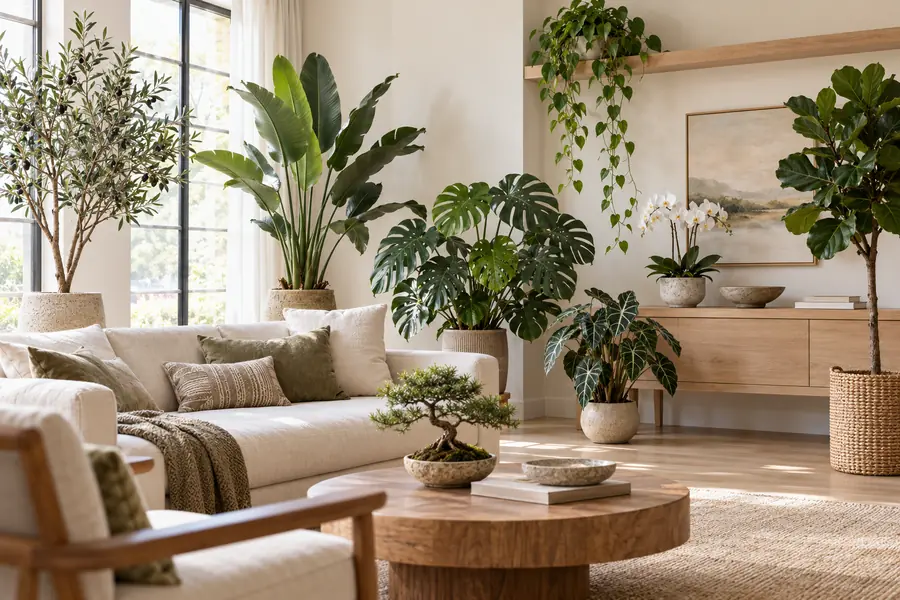
Real houseplants bring life into a room, but watering, sunlight, pruning, pests, and changing seasons can make them impractical. Good faux greenery provides another option.
The best fake plants look convincing from normal viewing distances, use varied foliage instead of repetitive glossy leaves, fit their intended space, and remain easy to reshape and clean. Standout categories include artificial alocasia, olive trees, monstera, orchids, fiddle leaf figs, bird of paradise, bonsai, pothos, hanging greenery, and realistic floor trees.
The Spruce tested 18 faux plants for realism and durability, showing that convincing artificial greenery depends on texture, color, scale, adjustability, planters, and viewing distance.
What Are the Best Fake Plants in 2026?
The published testing and current product research point to these 13 useful categories and products.
| Pick | Best for | Why it stands out |
|---|---|---|
| AllModern Faux Alocasia Zebrina | Best overall | Large realistic leaves and durable form |
| Kazeila Artificial Olive Tree | Best olive tree | Adjustable branches and vertical height |
| Der Rose Large Artificial Monstera | Best monstera | Varied leaves and bendable stems |
| IKEA FEJKA Artificial Orchid | Best budget orchid | Compact, affordable tabletop greenery |
| The Sill Artificial Fiddle Leaf Fig | Best statement fig | Six-foot scale and varied foliage |
| Berdkaba Artificial Bonsai Tree | Best bonsai | Compact sculptural shape |
| West Elm Faux Bird of Paradise | Best premium tropical | Strong silhouette and polished planter |
| The Sill Faux Pothos | Best premium trailing plant | Draping foliage for shelves |
| The Sill Faux Hanging Ric Rac Cactus | Best unusual hanging plant | Distinctive shape without plant care |
| The Sill Faux Tradescantia Zebrina | Best colorful foliage | Unusual striping and shelf presence |
| Threshold Trailing Pothos | Best budget trailing plant | Ceramic pot and natural drape |
| Afloral Artificial Hanging Ruscus | Best hanging greenery | Useful where floor space is limited |
| Nearly Natural 6-Foot Fiddle Leaf Tree | Best alternative floor tree | Large-scale greenery and easy maintenance |
The Spruce’s current roundup names the AllModern alocasia, Kazeila olive tree, Der Rose monstera, IKEA orchid, The Sill fiddle leaf fig, Berdkaba bonsai, and West Elm bird of paradise among its principal recommendations, while additional tested or vetted greenery appears later in the guide.
1. AllModern Faux Alocasia Zebrina — Best Overall
A convincing artificial plant does not always need dozens of leaves.
The AllModern Faux Alocasia Zebrina works because its large-scale leaves create visual impact without relying on excessive foliage. The tested plant was praised for its realistic leaves, durable two-leaf construction, useful medium size, and cemented faux soil, although its basic pot benefited from being placed inside a more decorative planter.
The Spruce’s tester kept the plant in her apartment for months and reported that it stayed stable and did not noticeably collect dust during that period. The publication particularly liked its ability to work either on a console or elevated plant stand.
I think this illustrates a broader buying rule:
large, well-shaped leaves can sometimes look more realistic than hundreds of inexpensive small leaves.
The fewer elements a manufacturer needs to reproduce, the easier it can be to focus attention on shape, color, and proportion.
Best for: Consoles, plant stands, television units, and medium-height decorative areas.
2. Kazeila Artificial Olive Tree — Best Faux Olive Tree
Olive trees remain one of the safest faux-tree styles because their natural structure is already irregular and relatively airy.
The Kazeila Artificial Olive Tree stands out for its vertical scale, veined foliage, artificial olives, and bendable branches. Its relatively sparse canopy can actually help realism because natural olive trees do not form perfectly dense cones of leaves.
During The Spruce’s testing, the foliage was described as thin without feeling excessively plastic, while the branches could be manipulated to increase fullness. The fruit and leaves also survived shipping and months of testing without significant loss.
That adjustability matters.
A fake olive tree usually looks better after the branches are opened unevenly and some negative space is left around the trunk.
I would avoid trying to make it perfectly symmetrical.
Best for: Empty living-room corners, dining rooms, bedrooms, and other spaces needing vertical greenery.
3. Der Rose Large Artificial Monstera — Best Faux Monstera
Monstera leaves can expose poor artificial construction quickly because their distinctive splits and veins are easy to recognize.
The Der Rose Artificial Monstera succeeds because it uses differently sized stems, varied leaves, and bendable wire construction. In The Spruce’s test, it was placed beside a living monstera and appeared surprisingly convincing by comparison.
The tradeoff is assembly.
Its leaves need to be attached and arranged manually, and some detached during testing. However, the wired stems allow the owner to control the final silhouette.
In this case, assembly is not entirely a disadvantage.
It gives you the opportunity to avoid the factory-perfect arrangement that makes many artificial plants look fake.
I would spread the leaves at different heights and rotate some sideways rather than aiming every surface toward the room.
Best for: Side tables, low furniture, consoles, and compact tropical displays.
4. IKEA FEJKA Artificial Orchid — Best Budget Orchid
Artificial orchids are challenging because the real flowers contain fine details that people tend to inspect closely.
The IKEA FEJKA works best as an affordable decorative orchid rather than an exact botanical replica. Its curved stem, support stake, roots, and compact proportions help it look convincing from normal room distance even though close inspection reveals its artificial construction.
The Spruce found the orchid attractive right out of the package and noted that it maintained its curved form without requiring extensive adjustment. The tester also considered it durable for the price.
That makes it useful when the goal is simply:
a little color,
a vertical floral shape,
and no watering schedule.
Current IKEA listings continue to offer FEJKA orchid variants in the artificial-plant collection.
Best for: Desks, bathroom counters, nightstands, coffee tables, and small office spaces.
5. The Sill Artificial Fiddle Leaf Fig Tree — Best Statement Fiddle Leaf Fig
Fiddle leaf figs are popular partly because their large leaves create an architectural silhouette.
The living version can also be demanding.
The Sill Artificial Fiddle Leaf Fig offers a six-foot statement form without the light and watering requirements of a living fig. Its varied leaves and optional planter system help it work as a substantial piece of interior décor rather than a small accessory.
The Sill’s current product page confirms that the tree measures six feet and recommends gently bending and arranging its foliage after arrival. It can also be paired with the brand’s floor planters.
This is exactly how a large artificial tree should be treated.
Do not leave it in shipping shape.
Open the branches, rotate the leaves, and create visible depth around the trunk.
Best for: Large living rooms, offices, beside armchairs, and television consoles.
6. Berdkaba Artificial Bonsai Tree — Best Compact Bonsai Look
Bonsai forms are particularly attractive in artificial plants because the sculptural trunk is as important as the foliage.
The Berdkaba Artificial Bonsai Tree is a useful choice when you want an architectural plant for a shelf or desk without the demanding pruning and cultivation associated with living bonsai. Its curved trunk and adjustable structure provide much of the visual character.
There is one important distinction in the source material: The Spruce says this particular option was not personally tested, even though it was included among the recommended plants. The publication liked its textured appearance, adjustable form, and compact size, while noting that the plastic pot was less convincing.
That transparency matters.
The planter would be the first thing I would upgrade.
Best for: Bookcases, desks, shelving, and small meditation or reading spaces.
7. West Elm Faux Potted Bird of Paradise — Best Premium Tropical Plant
Bird of paradise plants have large upright leaves, making them ideal for filling a tall corner.
West Elm’s Faux Potted Bird of Paradise is one of the strongest premium options when you want a clean tropical silhouette. The large leaves require relatively little fluffing, and the finished plant is available in substantial sizes suitable for living rooms and bedrooms.
The Spruce’s tester liked the plant straight from the box and specifically noted the waxy leaf texture, which resembles the feel of real bird-of-paradise foliage more closely than hard glossy plastic.
The current West Elm four-foot version is sold as a plastic faux botanical with a pot included. West Elm Faux Potted Bird of Paradise Plant
Its biggest drawback is price.
However, because the foliage is large and relatively simple, one tree can create more visual impact than several smaller inexpensive plants.
Best for: Premium living rooms, bedrooms, accent-chair corners, and modern interiors.
8. The Sill Faux Pothos — Best Premium Trailing Greenery
Trailing plants serve a different design purpose from trees.
Rather than filling vertical floor space, they soften:
shelves,
cabinets,
mantels,
and high surfaces.
A faux pothos works best when the vines fall unevenly and the leaves contain enough color variation to avoid looking like one molded green strand.
The Spruce’s 2026 guide includes The Sill’s faux pothos among its tester-approved artificial plants and notes that multicolored pothos-style foliage can help break up uniform greens.
I would place a trailing artificial plant slightly above eye level.
That provides two advantages.
First, the draping form is easier to appreciate.
Second, the viewer is less likely to inspect individual attachment points closely.
Best for: Floating shelves, bookcases, high cabinets, and windowsills.
9. The Sill Faux Hanging Ric Rac Cactus — Best Unusual Hanging Plant
Most faux-plant interiors rely on predictable olive trees and pothos.
That can become repetitive.
A faux ric rac cactus introduces a more unusual zigzagging form, making it useful for homeowners who want artificial greenery that feels sculptural rather than generic.
The Sill’s hanging ric rac cactus is included among the additional tester-approved products in The Spruce’s updated guide.
A plant like this also benefits from distance.
Hanging it higher allows the overall silhouette to matter more than tiny surface details.
I would use one distinctive plant like this rather than filling the same area with several small generic succulents.
Best for: Hanging planters, high shelves, home offices, and eclectic interiors.
10. The Sill Faux Tradescantia Zebrina — Best for Color Variation
Not every fake plant needs to be green.
Tradescantia zebrina is useful because its striped foliage naturally introduces more color.
The Sill Faux Tradescantia Zebrina can add purple and silver-green variation to shelves where ordinary green plants might feel repetitive. Its unusual form is visually interesting from a distance, although The Spruce noted that some parts felt plasticky and the overall shape could be somewhat unwieldy.
The publication’s writer says she continued displaying the plant on her own bookshelf despite those limitations because of the distinctive color it added.
That is a useful reminder that the best artificial plant is not always the one that passes the strictest close-up realism test.
Sometimes design value comes from:
color,
shape,
and placement.
Best for: Bookshelves and spaces needing something more colorful than standard green foliage.
11. Threshold Trailing Pothos — Best Budget Trailing Plant
Affordable artificial plants often fail because both the plant and pot look inexpensive.
Threshold’s current pothos avoids part of that problem.
The Threshold Trailing Pothos is a strong budget option because the foliage already comes in a ceramic container and the trailing form works naturally on tabletops and shelves. Its current product listing shows polyester foliage, a ceramic pot, and indoor-only use.
Target currently lists the plant at 10 inches high and describes it as a tabletop faux pothos in a ceramic container. Recent buyer feedback on the product page frequently mentions its natural appearance, though some buyers have reported damage during delivery.
The Spruce also highlights the Threshold option as a budget-friendly trailing plant.
One useful improvement is simple:
add a small amount of moss around the base if the internal foam is visible.
Best for: Bathrooms, desks, kitchen shelves, and compact spaces.
12. Afloral Artificial Hanging Ruscus Leaf Bush — Best for High Spaces
Hanging faux greenery is valuable where floors and tables are already crowded.
Afloral’s artificial hanging ruscus works best as an architectural trailing accent rather than a traditional potted plant. The hanging format keeps greenery away from children, pets, furniture, and limited floor space.
The Spruce specifically recommends hanging greenery when horizontal surfaces are already full and lists the Afloral ruscus among its additional picks.
I would use this type of artificial plant where the viewer primarily sees:
movement,
outline,
and drape.
That reduces the importance of close-up leaf realism.
Best for: High shelves, hanging baskets, cabinetry, and layered wall displays.
13. Nearly Natural 6-Foot Fiddle Leaf Tree — Best Alternative Large Floor Plant
Nearly Natural offers a large range of artificial trees, making it useful when size and shape choice matter.
A six-foot Nearly Natural fiddle leaf tree is a strong alternative for buyers who want substantial floor greenery without moving into the more expensive designer category. Its broad leaves and tall silhouette make it most effective when used as one major vertical accent.
The Spruce includes a Nearly Natural six-foot fiddle leaf tree among the additional fake plants it likes.
Current versions remain available from multiple retailers, including standard and Real Touch variations. Nearly Natural 6’ Artificial Fiddle Leaf Fig Tree
With a plant this large, I would plan on replacing or disguising the nursery container.
A larger planter can dramatically improve perceived quality.
Best for: Living-room corners, dining rooms, offices, and large bedrooms.
How Were the Fake Plants Evaluated?
Realism should be tested in a room, not just through online photography.
The Spruce says it incorporated 18 artificial plants into testers’ homes for several months and evaluated two main factors: realism and durability. Reviewers considered appearance, feel, dust accumulation, construction, and whether branches could be adjusted for a more natural shape.
I would expand that framework into six practical criteria:
| Criterion | What matters |
|---|---|
| Realism | Leaf shape, color, texture, trunk, stems |
| Silhouette | Natural irregularity and proportion |
| Adjustability | Wired or bendable branches |
| Container | Stable, correctly scaled, visually convincing |
| Durability | Secure leaves, stems, and base |
| Maintenance | Easy dust removal and reshaping |
For most homes, realism from six to ten feet away matters more than microscopic detail.
Guests generally experience the whole room before they inspect individual leaves.
What Should You Look for When Buying Fake Plants?
The biggest mistake is shopping only by price.
The best artificial plants use natural-looking color variation, species-appropriate surface texture, irregular stems, appropriate scale, and stable construction. Large trees should also have bendable branches or foliage so the shipping shape can be corrected after unpacking.
Leaf Color Should Not Be Completely Uniform
Real foliage changes with:
age,
light,
and position.
Artificial plants look more convincing when multiple related greens appear across the canopy.
Shine Should Match the Species
A rubber plant can naturally appear somewhat glossy.
An olive leaf should generally look more muted.
The goal is not:
matte everything.
It is:
botanically appropriate light reflection.
Look at the Stem and Trunk
Large artificial plants often reveal themselves through the trunk before the leaves.
I prefer:
texture,
color variation,
visible branching,
and natural tapering.
A smooth brown plastic pole is difficult to hide.
Buy the Correct Size
The Spruce emphasizes size as one of the key factors after realism. Large olive and fiddle leaf trees work well beside seating, while small bonsai-style plants belong on shelves or desks.
Scale can make an average plant look intentional.
Incorrect scale can make an excellent plant look cheap.
How Do You Make Fake Plants Look More Real?
Even the best artificial plant usually needs styling.
Reshape branches after unpacking, introduce asymmetry, rotate leaves in different directions, conceal visible foam, upgrade weak planters, remove dust, and position the plant where greenery makes visual sense.
House Beautiful’s September 2026 styling guidance similarly recommends varying artificial stems, bending some downward, and hiding artificial bases with moss to introduce more natural imperfection.
The simplest transformation is often:
better planter + better shaping.
Those two changes can make a moderately priced plant appear significantly more convincing.
Are Fake Plants Better Than Real Plants?
Not universally.
Artificial plants are better for spaces where consistent appearance and minimal care matter most. Real plants are better when natural growth, fragrance, biological change, and the experience of caring for living greenery are important. Many interiors can use both.
A fake plant has practical advantages.
It does not require:
watering,
fertilizing,
pruning,
or sunlight.
But it still requires cleaning.
The Spruce notes that none of its tested plants became significantly dusty during the testing period, but recommends gently wiping foliage with microfiber when necessary. Large-leaf plants are typically easier to clean than plants with dozens of intricate small leaves.
So I would call artificial plants:
low-maintenance
rather than:
maintenance-free.
My insights: The 13 Best Fake Plants We Tested for Beautiful Greenery Without the Fuss
After comparing the 2026 testing results with current product availability and current styling advice, I think the biggest lesson is that realism is contextual.
The 13 Best Fake Plants We Tested for Beautiful Greenery Without the Fuss are not simply the thirteen products with the most realistic leaves. The best choice depends on viewing distance, size, branch shape, planter quality, room placement, maintenance, and whether the plant’s natural species is easy to imitate convincingly.
My First Insight: Species Choice Matters
Some plants are easier to reproduce artificially than others.
I find these particularly forgiving:
olive trees,
snake plants,
pothos,
palms,
and ficus.
Their shapes translate well into synthetic materials.
Flowers such as orchids can be harder because people expect delicate petals and inspect them closely.
My Second Insight: Viewing Distance Changes the Buying Standard
A tabletop orchid seen from 18 inches needs better fine detail than a six-foot tree placed across the room.
That means quality should be allocated strategically.
For a large corner tree, I prioritize:
silhouette,
scale,
trunk,
and color.
For a desk plant, I care more about:
leaf texture,
attachment points,
and planter finish.
My Third Insight: Fewer Leaves Can Be More Convincing
Dense does not automatically mean realistic.
The AllModern alocasia is a good example.
Its large two-leaf structure was one of the strongest performers despite not being a huge mass of greenery.
Similarly, olive trees often benefit from open space.
Botanical accuracy matters more than maximum foliage count.
My Fourth Insight: Adjustability Adds Real Value
I strongly prefer trees with bendable branches.
Artificial plants are compressed for shipping.
If the structure cannot be changed after unpacking, the plant may permanently retain a narrow factory shape.
The Kazeila olive tree and Der Rose monstera both benefited from adjustable construction in testing.
My Fifth Insight: Planters Are Part of the Product
A fake plant does not end at the leaves.
The container contributes significantly to realism.
This is why the West Elm bird of paradise feels more finished, while several other tested options improved when their basic pots were hidden inside decorative containers.
I would budget for the planter before purchasing the plant.
My Sixth Insight: The Best Fake Plant Is Often the One You Stop Noticing
A successful artificial plant should support the room.
It should not constantly announce:
“Look how realistic I am.”
When the scale, placement, color, and planter all work together, greenery becomes part of the composition.
That is a better standard than demanding that every synthetic leaf survive close inspection.
My Final Ranking by Use Case
| Need | My strongest choice |
|---|---|
| Best overall | AllModern Faux Alocasia Zebrina |
| Best tall tree | Kazeila Artificial Olive Tree |
| Best tropical tabletop plant | Der Rose Monstera |
| Best budget floral plant | IKEA FEJKA Orchid |
| Best statement fig | The Sill Artificial Fiddle Leaf Fig |
| Best shelf plant | Berdkaba Bonsai |
| Best premium tropical | West Elm Bird of Paradise |
| Best premium trailing plant | The Sill Faux Pothos |
| Best unusual hanging plant | The Sill Ric Rac Cactus |
| Best colorful foliage | The Sill Tradescantia |
| Best budget trailing greenery | Threshold Pothos |
| Best hanging greenery | Afloral Ruscus |
| Best alternative floor tree | Nearly Natural Fiddle Leaf Tree |
No single plant wins every category.
That is exactly why I would shop by location and purpose, not simply by a generic “best artificial plant” label.
Conclusion
The best fake plants balance realism, proportion, durability, and styling flexibility. Choose the right species and scale, reshape it carefully, upgrade weak planters, and let the greenery support the room rather than dominate it.

