


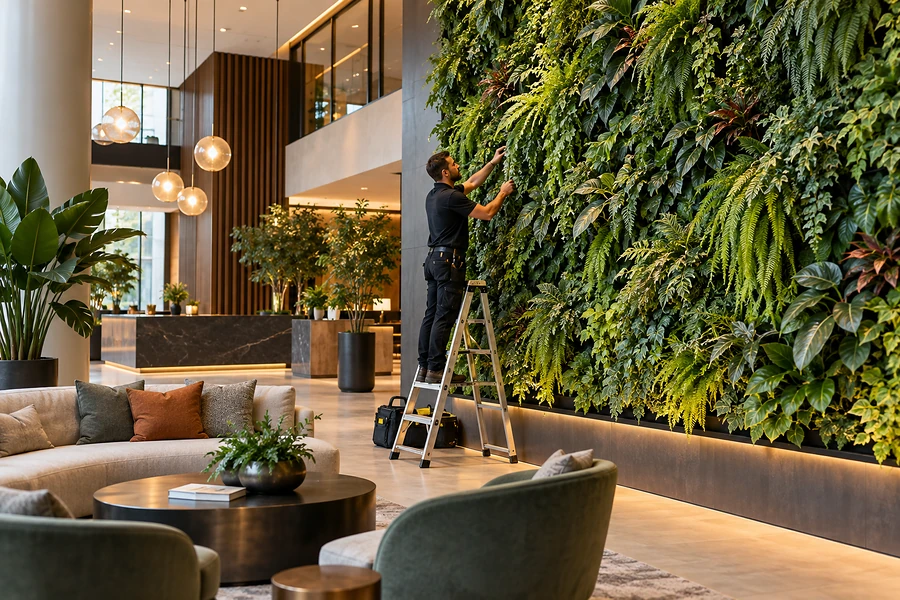
Faux plants can solve difficult design problems, but covering a wall with artificial greenery is not the same as placing one decorative plant on a shelf.
The hidden risks of faux plants, artificial greenery, and artificial plant walls include fire performance, smoke generation, dust accumulation, possible material emissions, inadequate wall anchoring, blocked exits or safety equipment, UV degradation, difficult cleaning, and end-of-life waste. Most of these risks can be controlled through correct product selection, testing documentation, installation, and maintenance.
Artificial greenery can be practical, but commercial installations require careful evaluation of materials, fire performance, mounting, electrical components, cleaning, exposure, and replacement needs before approval.
Are Faux Plants and Artificial Plant Walls a Fire Risk?
Fire performance is probably the most important issue to understand.
Artificial vegetation can be combustible, which is why building and fire codes may regulate its use. The International Fire Code requires applicable artificial decorative vegetation to satisfy specified flame-propagation criteria under NFPA 701 or, alternatively, meet heat-release requirements under NFPA 289. Decorative vegetation also must not obstruct required means of egress.
Risk 1: Assuming “Artificial” Means Fireproof
Many artificial leaves and stems contain polymeric materials.
Depending on the product, these may include:
- Polyethylene
- PVC
- Polyester fabric
- Polyurethane
- Adhesives
- Plastic coatings
- Internal wire
Synthetic does not mean noncombustible.
NIST’s fire research shows that synthetic polymers can contribute to fire growth, smoke, carbon monoxide, soot, and other combustion products depending on material composition and fire conditions.
That distinction becomes particularly important when hundreds or thousands of artificial leaves are assembled into a large wall.
A single faux plant in a corner represents one amount of combustible material.
A floor-to-ceiling artificial plant wall covering dozens of square feet represents a very different installation.
Risk 2: Confusing “Fire Retardant” With “Cannot Burn”
I would never interpret fire retardant as fireproof.
Fire-performance treatment is intended to alter ignition or flame-spread behavior under specified test conditions.
It does not make synthetic vegetation incapable of burning under every possible fire scenario.
NIST notes that even inherently fire-resistant polymer systems or polymers incorporating fire-retardant additives can burn when thermal exposure becomes sufficiently severe.
Therefore, I would ask a supplier for actual documentation rather than accepting wording such as:
fire safe
flameproof
or
commercial grade
without evidence.
Risk 3: Buying a Certificate Without Checking What It Covers
The 2025 California Fire Code, for example, requires artificial decorative vegetation subject to its provisions to meet applicable NFPA 701 flame-propagation criteria. The code also requires improved fire-performance documentation to be available in the applicable context.
For a professional project, I would verify:
- Product name
- Manufacturer
- Material tested
- Test standard
- Testing laboratory
- Test date
- Whether the tested product matches the supplied product
- Whether treatment is inherent or applied afterward
A certificate for one foliage collection should not automatically be assumed to apply to another.
Risk 4: Adding Unapproved Lighting
Plant walls are frequently combined with:
LED strips,
signage,
accent lighting,
or decorative electrical elements.
That creates another safety layer.
The IFC specifically prohibits unlisted electrical wiring and lighting on artificial decorative vegetation.
So an artificial green wall should not become an improvised electrical installation.
Lighting should be specified as part of the project rather than attached casually after installation.
Can Artificial Greenery Affect Indoor Air Quality?
This subject needs careful language because not every faux plant emits problematic quantities of chemicals.
Artificial plants should not automatically be described as toxic or harmful to indoor air. However, synthetic furnishings, coatings, glues, and adhesives can emit volatile or semi-volatile compounds, and EPA identifies building materials, furnishings, and adhesives as potential indoor VOC sources. Product-specific emissions therefore depend on the actual materials and manufacturing process.
Risk 5: Assuming All Synthetic Greenery Is Chemically Identical
Two artificial plants can look similar while using very different material systems.
One may consist largely of molded polyethylene.
Another might combine:
fabric,
polymer coating,
adhesives,
foam,
wire,
paint,
and a composite backing.
That means I would avoid making sweeping claims such as:
“Fake plants always off-gas.”
The evidence does not justify that statement for every artificial plant.
Instead, EPA guidance provides a more useful framework: materials and furnishings can be indoor pollutant sources, and emissions depend on the actual product.
For large commercial installations, I would therefore ask whether the manufacturer provides:
- Material declarations
- Emissions testing
- Low-emission documentation
- Information about adhesives
- Applicable third-party certifications
This becomes more relevant as the amount of installed material increases.
Risk 6: Assuming “Low VOC” Means Zero Risk
EPA cautions that VOC terminology can be misunderstood.
A product described as low VOC under one regulatory context is not necessarily free of every volatile chemical of possible indoor-air concern, and reducing total VOC concentration alone does not reveal the toxicity of each individual compound.
For me, the practical lesson is straightforward:
Ask for relevant emissions information rather than relying on one marketing phrase.
What About the “New Plastic Smell”?
A strong new-product odor does not by itself tell me exactly what chemical is present or whether its concentration is hazardous.
But for a very large indoor artificial installation, noticeable odor is a reasonable reason to investigate:
materials,
adhesives,
ventilation,
and manufacturer documentation.
EPA recommends ventilation as one approach for reducing exposure when materials or products emit VOCs.
I would be particularly cautious with unverified products installed in:
bedrooms,
healthcare environments,
schools,
or poorly ventilated commercial interiors.
Do Artificial Plants Really Need Maintenance?
Yes. They simply require a different type of maintenance from living plants.
Artificial plants do not need watering, pruning, fertilizer, or horticultural care, but they still collect dust and indoor debris. Dense artificial plant walls can contain hundreds of leaves and hidden surfaces, making routine cleaning more difficult than cleaning a simple wall or a single potted plant.
Risk 7: Dust Accumulation
This is one of the most underestimated problems.
A large artificial green wall creates enormous surface area.
Each leaf can collect:
- Dust
- Fibers
- Airborne particles
- Grease in food environments
- General indoor debris
EPA emphasizes that removing dust and allergens is an important part of maintaining healthy indoor conditions.
The plant itself is not necessarily creating the dust.
It is providing surfaces where dust can settle.
That distinction matters.
Artificial Green Walls Can Be Hard to Clean
A flat painted wall can be wiped quickly.
A dense faux plant wall contains:
front leaves,
rear leaves,
stems,
junctions,
and spaces between panels.
Maintenance becomes more difficult as the design becomes denser.
Before installation, I would ask:
Who will clean this?
How often?
Can the panels be removed?
Can maintenance staff reach the upper sections safely?
If nobody has an answer, the design is incomplete.
Restaurants Need Extra Attention
Artificial greenery near:
bars,
food preparation zones,
open kitchens,
or cooking areas
may encounter airborne grease in addition to normal dust.
That can create a surface that becomes more difficult to maintain over time.
For those environments, I prefer designs that allow access and cleaning rather than extremely dense greenery permanently fixed into inaccessible recesses.
Cleaning Products Can Introduce Their Own Issues
Maintenance should also follow manufacturer recommendations.
EPA notes that cleaning products themselves can contain chemicals associated with respiratory, skin, or eye irritation.
Using aggressive solvents on artificial foliage can also damage:
coatings,
color,
adhesives,
or surface finishes.
So I would not improvise a harsh cleaning method without checking material compatibility.
What Structural and Installation Risks Can Artificial Plant Walls Create?
A large plant wall is not simply a collection of leaves. It is a wall-mounted system.
Artificial plant walls may include backing grids, frames, planters, signs, lighting, metal supports, and thousands of foliage components. The installation therefore needs suitable anchors and substrates. Large permanent wall-mounted systems should be designed so they cannot detach, overturn, or create falling hazards.
Risk 8: Underestimating Total Weight
Individual artificial leaves feel light.
That can create a false sense that the entire system is lightweight.
But a complete wall may contain:
- Metal framing
- Timber panels
- Plastic grids
- Artificial foliage
- Decorative branches
- Planters
- Lighting
- Signage
The total load can become substantial.
FEMA guidance on nonstructural building components emphasizes that inadequately anchored components can slide, overturn, or fall during seismic shaking and create hazards for occupants.
The exact structural requirements depend on:
location,
building type,
wall construction,
system weight,
and jurisdiction.
But the principle applies broadly:
the support system matters as much as the leaves.
Drywall Is Not Automatically a Structural Support
I would not approve a large wall simply because someone says:
“We can screw it into the drywall.”
The installer needs to know:
- What is behind the finish?
- Where are the studs or structural supports?
- What load will the anchors carry?
- How is the frame distributed?
- Are overhead elements independently supported?
The larger the installation, the less appropriate it is to treat mounting as an afterthought.
Risk 9: Blocking Life-Safety Features
A green wall may also interfere with building functions if positioned carelessly.
Decorative foliage should not obstruct:
- Exit routes
- Exit signage
- Fire extinguishers
- Electrical panels
- Sprinkler coverage
- Emergency equipment
- Required doors
The IFC specifically states that decorative vegetation must not obstruct the required width of a means of egress.
I therefore consider artificial planting part of space planning—not just styling.
What Happens to Faux Plants Outdoors?
Outdoor use introduces an entirely different set of risks.
Artificial greenery used outdoors can be affected by UV radiation, temperature changes, wind, moisture, dirt, and mechanical wear. “Plastic” does not automatically mean permanently weatherproof. Outdoor projects should use products specifically designed for the exposure and should include realistic inspection and replacement plans.
Risk 10: UV Fading and Material Degradation
Artificial foliage often depends on color for realism.
Outdoor exposure can gradually affect:
- Pigments
- Surface coatings
- Flexibility
- Leaf strength
- Appearance
A faded artificial green wall can quickly look less convincing than an intentionally weathered natural material.
I would therefore distinguish carefully between:
indoor artificial greenery
UV-resistant artificial greenery
and
products specifically rated for exterior use.
Those are not interchangeable specifications.
Wind Loads Matter
Large exterior green walls can create another concern.
Individual leaves catch moving air.
Large installations can therefore experience forces that do not exist in a small indoor arrangement.
Exterior frames and attachments need to be appropriate for the site and building conditions.
Again, the leaves may look decorative, but the installation behaves like a building component.
Replacement Should Be Expected
I would be skeptical of claims suggesting that exposed artificial foliage will remain unchanged indefinitely.
The practical question is not:
“Will it last forever?”
It is:
“What appearance and structural condition should we expect after several seasons, and how are damaged sections replaced?”
Modular panels can make that process much easier.
Are Faux Plant Walls More Sustainable Than Living Walls?
Not automatically.
Artificial greenery can have sustainability advantages when it is durable and reused for many years, especially where a living wall would demand substantial replacement or operational resources. However, many faux plants contain mixed plastics, wire, textiles, coatings, and adhesives, which can complicate end-of-life recovery. Sustainability should be evaluated across the full product lifecycle rather than assumed from maintenance alone.
Risk 11: Ignoring End-of-Life Waste
Artificial greenery is often praised because it does not require:
water,
fertilizer,
or ongoing plant replacement.
Those are real operational differences.
But artificial plants are manufactured products.
EPA notes that plastics occur in durable goods and that mixed-material products can create different waste-management challenges depending on their polymer composition.
An artificial plant containing:
polymer leaves,
polyester fabric,
steel wire,
adhesive,
and a mixed-material backing
may not fit easily into a standard recycling stream.
Longevity Matters
UNEP’s lifecycle approach to plastic pollution emphasizes prolonged use and reuse rather than evaluating sustainability only at the disposal stage.
That principle is useful for artificial greenery.
A well-designed plant wall used for ten years is very different from a temporary installation discarded after six months.
So for sustainability, I ask:
- How long will it remain installed?
- Can damaged modules be replaced separately?
- Can foliage be reused elsewhere?
- Can the frame be reused?
- Can materials be separated at end of life?
“Maintenance-free” does not automatically mean environmentally preferable.
How Can You Reduce the Risks of Artificial Greenery?
Most problems can be addressed during specification.
A safer artificial-plant project starts with documented materials, applicable flame-performance testing, a properly designed mounting system, adequate clearance from exits and heat sources, listed electrical equipment, realistic cleaning access, and products suited to the intended indoor or outdoor environment.
My Specification Checklist
| Risk area | What I would verify |
|---|---|
| Fire | Applicable NFPA 701 or other required test documentation |
| Product identity | Certificate matches supplied foliage |
| Materials | Actual polymer, fabric, wire, coating and adhesive information |
| Indoor emissions | Relevant emissions documentation for large installations |
| Electrical | Listed lighting and wiring |
| Egress | No obstruction of exits or required pathways |
| Mounting | Correct anchors and substrate |
| Seismic conditions | Anchorage appropriate to project requirements |
| Cleaning | Accessible leaves and documented cleaning method |
| Outdoor use | UV/weather suitability |
| Maintenance | Replaceable modular sections |
| Sustainability | Expected service life and end-of-life plan |
Ask for Documentation Before Installation
For a small decorative plant at home, extensive technical documentation may not be necessary.
For a:
hotel lobby,
airport,
restaurant,
shopping center,
office,
healthcare project,
school,
or large hospitality installation,
I would ask much more.
At minimum, the designer should understand what has actually been specified.
Do Not Treat One Certificate as Universal Approval
Building-code requirements vary by jurisdiction and occupancy.
A test report does not automatically mean a product is approved for every installation everywhere.
The local code, occupancy classification, installation size, sprinkler conditions, and authority having jurisdiction may all matter.
The IFC itself contains occupancy-specific requirements and exceptions for artificial decorative vegetation.
Professional projects should therefore verify local requirements rather than relying only on supplier marketing.
My insights: The Hidden Risks of Faux Plants, Artificial Greenery and Artificial Plant Walls
After comparing current fire-code requirements, EPA indoor-air guidance, NIST fire research, FEMA anchorage guidance, and plastic lifecycle information, I think the biggest hidden risk is surprisingly simple:
Large artificial greenery installations should be treated as building systems, not simple decoration. Their risks can be managed through proper specification. Fire performance, emissions, dust, mounting, electrical components, UV exposure, maintenance access, and end-of-life planning all become more important as installations grow larger and remain in place longer over time.
My First Insight: Scale Changes Everything
One faux olive tree is a decorative object.
A 300-square-foot artificial green wall is a material installation.
Those two applications should not receive the same level of technical scrutiny.
As artificial greenery becomes larger, I become more interested in:
- Fire load
- Testing
- Anchoring
- Cleaning
- Electrical integration
- Material composition
Scale converts décor into infrastructure.
My Second Insight: Fire Documentation Should Come Before Aesthetics
For a large commercial wall, I would check flame-performance requirements before approving the final foliage.
The current IFC contains explicit requirements for artificial decorative vegetation, including NFPA 701 flame-propagation criteria in applicable situations.
That means fire performance is not an optional marketing feature.
It can be a code issue.
I would rather discover a compliance problem before:
design approval,
fabrication,
shipping,
and installation.
My Third Insight: “Fire Retardant” Does Not Finish the Conversation
I would ask:
Was the foliage itself tested?
Was a coating applied?
Does the certificate match this SKU?
Does cutting or modifying the panel affect the documented system?
Does cleaning affect the treatment?
What does the local authority require?
The 2025 California Fire Code also notes that fire-retardant coatings in existing buildings must be maintained so they retain effectiveness under service conditions.
This reinforces a broader point:
performance needs to survive actual use, not merely exist on paperwork.
My Fourth Insight: The Wall Behind the Plants Still Matters
Dense artificial foliage can visually hide almost everything behind it.
That includes:
anchors,
wiring,
wall damage,
and maintenance access.
I therefore prefer modular artificial-wall systems that can be opened or partially removed.
If a problem develops behind the wall, technicians should not have to destroy the entire installation to reach it.
My Fifth Insight: Maintenance-Free Is a Dangerous Specification
Artificial plants eliminate horticultural maintenance.
They do not eliminate facility maintenance.
A successful long-term installation still needs:
- Dust removal
- Inspection
- Reshaping
- Repair
- Lighting checks
- Attachment checks
- Replacement of damaged foliage
A large green wall that cannot be cleaned is eventually a poorly designed green wall.
EPA’s general indoor guidance emphasizes controlling dust and pollutants through appropriate cleaning and source management.
My Sixth Insight: Artificial Greenery Should Not Automatically Be Blamed for Every VOC Concern
This is an important counterpoint.
I would not label every plastic plant a serious indoor-air hazard.
EPA’s evidence supports the broader statement that materials, furnishings, adhesives, and other products can emit VOCs—not that every artificial plant necessarily emits dangerous concentrations.
So I would avoid fear-based claims.
For small household décor, the issue may be minor.
For a huge wall containing large amounts of synthetic material and adhesive, asking for emissions information becomes more reasonable.
Risk should be proportional to scale and evidence.
My Seventh Insight: Artificial Walls Need an Exit Strategy
Every installation eventually changes.
The company moves.
The restaurant renovates.
The foliage fades.
The wall design becomes outdated.
Parts are damaged.
What happens then?
EPA and UNEP both emphasize that plastics need to be considered across production, use, reuse, and end-of-life rather than only during their attractive useful phase.
That makes modular construction valuable.
Instead of discarding an entire wall, I would prefer to replace individual panels or foliage sections.
My Eighth Insight: The Safest Green Wall Is Designed as a System
I would divide the specification into five layers:
Layer 1: Foliage
Material, realism, flame performance, UV performance.
Layer 2: Backing
Grid, panel, mesh, frame.
Layer 3: Attachment
Anchors, fasteners, structural support.
Layer 4: Services
Lighting, signage, electrical wiring.
Layer 5: Operations
Cleaning, inspection, repair, replacement.
When each layer is considered independently, hidden risks become much easier to control.
My Final View
Faux plants are useful.
Artificial plant walls can transform:
offices,
hotels,
restaurants,
retail stores,
homes,
and commercial public spaces.
They can create greenery where natural light is inadequate.
They can maintain a consistent visual appearance.
They can eliminate irrigation.
They can produce enormous botanical impact without horticultural maintenance.
But those advantages should not hide the fact that artificial greenery is still physical material inside a building.
It can burn.
It can collect dust.
Its components may use plastics, fabrics, adhesives, coatings, and wire.
A large wall can become heavy.
Poor mounting can create falling hazards.
Electrical additions need appropriate listing and installation.
Exterior products can degrade.
And eventually, the materials must be repaired, reused, or discarded.
None of these points means artificial greenery should be rejected.
They mean it should be specified with the same seriousness given to other interior finishes and decorative systems.
My preferred approach is simple:
verify fire performance, understand the materials, design the mounting correctly, preserve life-safety access, provide cleaning access, specify for the actual environment, and plan for replacement.
Once those questions are answered, artificial greenery can do what it does best:
provide durable, controlled, visually convincing planting without creating avoidable hidden problems.
Conclusion
Faux greenery is not inherently dangerous, but large installations require more than good styling. Fire testing, secure mounting, suitable materials, cleaning access, and long-term maintenance make the difference.

