


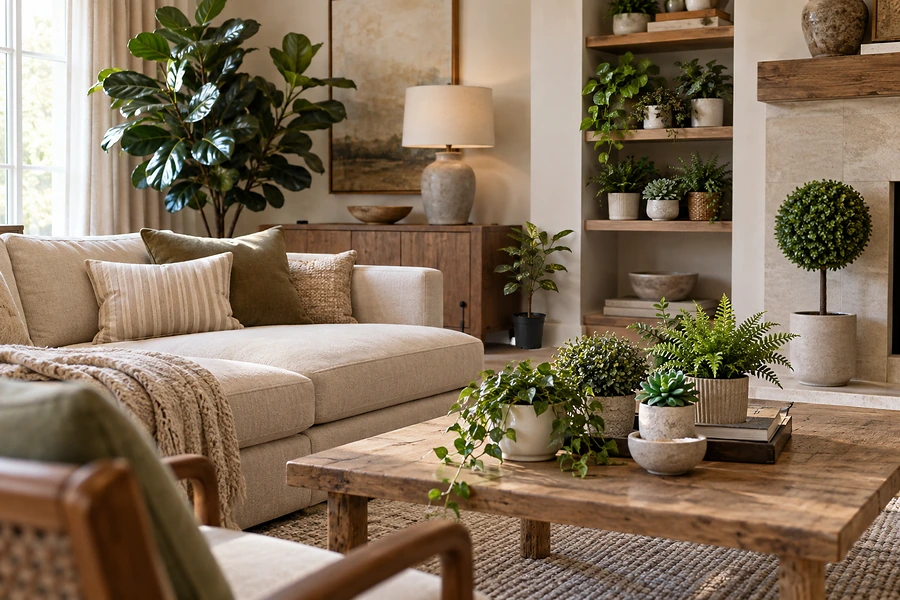
Faux plants can add greenery where living plants struggle, but poor scale, glossy leaves, perfect symmetry, dust, and weak styling can make them look obviously artificial.
The top mistakes when decorating with faux plants are choosing low-quality foliage, leaving plants perfectly symmetrical, using the wrong scale, keeping factory pots, placing greenery unrealistically, overcrowding rooms with small fake plants, forgetting to reshape and clean them, and using artificial plants where another material would create a more natural result.
For realistic faux greenery, vary stem lengths, allow natural drooping, hide bases, and choose lifelike proportions. Use plants sparingly to complement interiors without dominating them.
Why Can Faux Plants Look Cheap Even When They Are Expensive?
Price alone does not create realism.
A faux plant usually looks artificial because of its color, finish, proportion, symmetry, trunk, planter, placement, or styling—not simply because it was inexpensive. Even a premium artificial tree can look unconvincing if its branches remain compressed from shipping, its factory pot is visible, or its leaves are unnaturally glossy and perfectly arranged.
Architectural Digest notes that artificial plants vary significantly in quality, while current designer advice collected by Homes & Gardens warns that unnatural coloring, inexpensive-looking plastic leaves, and flimsy containers can quickly make faux greenery feel inauthentic.
That means I evaluate a faux plant as a complete object.
I look at:
- Leaf texture
- Leaf color
- Trunk realism
- Branching
- Overall silhouette
- Scale
- Container
- Placement
- Maintenance
A good plant can fail in any one of these areas.
Mistake 1: Choosing Plants With Glossy, Flat, or Repetitive Foliage
The first mistake happens before styling even begins.
Artificial foliage looks most convincing when its surface resembles the real species. Excessive shine, one-dimensional green coloring, identical leaves, obvious seams, and repetitive printing can immediately reveal a fake plant. The best faux greenery uses species-appropriate texture, subtle color variation, and irregular leaves rather than one uniform plastic finish.
Different Plants Need Different Surfaces
I would not expect every botanical species to have the same leaf finish.
For example:
| Plant | Natural-looking surface |
|---|---|
| Olive | Muted, soft gray-green |
| Fiddle leaf fig | Slight natural sheen |
| Rubber plant | Smoother, somewhat glossy |
| Palm | Mostly matte |
| Monstera | Soft natural sheen |
| Succulent | Matte or slightly powdery |
A highly glossy olive tree usually feels wrong because real olive foliage is comparatively muted.
A slight sheen on a rubber plant can be more believable because the living plant naturally has thicker, smoother leaves.
Look for Color Variation
Real plants rarely contain one identical green.
Older leaves may be darker.
New growth may be lighter.
Some leaves catch more light.
Others sit in shadow.
So when I inspect a faux plant, I prefer several closely related tones over one completely uniform color.
Architectural Digest’s artificial-plant coverage emphasizes lifelike appearance as the central quality separating stronger faux plants from weaker ones.
Inspect the Underside
Product photographs usually show the most flattering angle.
I also look underneath leaves.
A plant can have a convincing upper surface but reveal:
bright plastic,
poor molding,
or obvious attachment points
when viewed from the side.
This matters especially for large trees whose leaves sit around eye level.
Mistake 2: Leaving Every Branch Perfectly Symmetrical
Perfect symmetry is one of the fastest ways to make faux greenery look manufactured.
Real plants grow unevenly. Some stems extend farther, leaves face different directions, and branches naturally droop or leave gaps. Artificial plants become more realistic when branches are reshaped asymmetrically rather than left in a neat, evenly spaced factory arrangement.
House Beautiful’s September 2026 styling advice specifically recommends varying stem lengths, bending some stems downward, and introducing natural-looking imperfection rather than leaving faux greenery uniformly arranged.
Nature Creates Negative Space
A real tree is not an uninterrupted mass of green.
There are spaces between branches.
You can often see:
the trunk,
inner stems,
and parts of the room behind the foliage.
Many inexpensive faux trees are made unnaturally dense because manufacturers assume more leaves = more value.
But excessive density can make them less believable.
I often remove visual bulk simply by spreading the branches outward and creating gaps.
Avoid the Umbrella Shape
This is particularly important with faux palms and large trees.
If every branch forms a perfect dome around the central stem, the plant starts to look like a manufactured umbrella.
Instead, I create:
- One slightly higher side
- Several lower branches
- Some forward growth
- Some backward growth
- Open gaps around the trunk
The plant should feel balanced without appearing mathematically balanced.
Think Like a Living Plant
I ask:
Where would the light be?
Where would the plant naturally spread?
Would every leaf point directly into the room?
Usually not.
A little irregularity creates much more realism than perfect arrangement.
Mistake 3: Choosing the Wrong Plant Scale
Scale is one of the biggest decorating mistakes generally, and faux plants are no exception.
A fake plant that is too small for the room can feel like clutter, while a tree that is too large can overwhelm furniture and circulation. Larger rooms usually need fewer, more substantial plants rather than collections of undersized greenery. The planter should also be proportionate to the height and width of the plant.
Current 2026 design advice continues to emphasize proportion and scale as fundamental interior principles; House Beautiful’s designer roundup identifies these as among the details professionals notice immediately when a room feels wrong.
Tiny Plants Can Create Visual Clutter
A common approach is to place:
one little plant on the coffee table,
another on a shelf,
another beside the television,
another on a console,
and another in the bathroom.
Individually, each one may look fine.
Together, they can create a scattered artificial-greenery effect.
I would often rather use:
one convincing six-foot tree
than
six small generic fake plants.
Match the Plant to the Architecture
A tall ceiling can handle:
- Olive trees
- Ficus trees
- Palms
- Fiddle leaf figs
A small console may need only:
- One branch arrangement
- A compact orchid
- A trailing stem
Scale should respond to the room.
The Pot Must Match the Plant
A six-foot tree in a tiny plastic nursery container looks unstable even if the tree itself is excellent.
The eye recognizes that something is wrong.
I generally increase planter size as plant size increases.
That helps the entire composition feel physically believable.
Mistake 4: Keeping the Cheap Factory Pot Visible
Even premium faux trees often arrive in containers designed for shipping rather than interior design.
Leaving an artificial plant in a small black plastic factory pot is one of the easiest ways to make it look inexpensive. Place the original weighted base inside a larger ceramic, stone-effect, terracotta, plaster, wood, or woven planter, then conceal the top with moss, bark, gravel, or another appropriate material.
Architectural Digest recommends upgrading the container when styling artificial greenery, while House Beautiful’s recent guide specifically suggests concealing artificial bases with moss so the plant reads more naturally.
Treat the Planter as Furniture
A planter occupies visual space just like:
a side table,
lamp,
or chair.
Its:
color,
texture,
shape,
and scale
should relate to the room.
For warm minimalist interiors, I might choose:
- Textured plaster
- Limestone-effect ceramic
- Terracotta
For more traditional interiors:
- Aged ceramic
- Woven basket
- Decorative urn
For contemporary spaces:
- Simple oversized ceramic
- Dark stone-effect pot
Hide the Artificial Base
Visible foam is another immediate giveaway.
I can conceal it with:
- Preserved moss
- Bark
- Coconut fiber
- Decorative stones
The covering should look plausible for the species and room.
I would avoid creating an overly elaborate fake “soil” scene that attracts more attention than the plant itself.
Mistake 5: Putting Faux Plants Where a Real Plant Could Never Logically Grow
Artificial plants give us placement freedom—but that freedom can become a realism problem.
Faux plants often look more convincing when placed where living greenery could plausibly exist. A giant tropical tree in a completely dark interior niche may solve a practical problem, but placing every fake plant in obviously impossible locations can make the artificial nature of the décor more noticeable.
Designer Shea McGee has defended faux plants specifically for locations where living plants are impractical, such as basements and vacation homes. Her reasoning highlights the real advantage of artificial greenery: it can bring visual plant life into spaces that cannot reliably support living specimens.
That does not mean I ignore placement logic entirely.
Put Statement Plants Near Architectural Light
Even though the plant does not need sunlight, placing a faux olive tree:
near a window,
beside French doors,
or in a bright living-room corner
helps the eye accept it.
People naturally expect plants there.
Use Faux Where There Is a Practical Reason
I find artificial greenery most convincing in difficult places such as:
- Dark hallways
- Vacation homes
- High shelves
- Guest rooms
- Windowless meeting rooms
- Commercial interiors
In these locations, faux plants solve an actual maintenance or light problem rather than being used indiscriminately.
Be Careful Outdoors
Outdoor artificial greenery presents another challenge.
Homes & Gardens’ exterior-design coverage warns that plastic greenery can fade and deteriorate in sun exposure, making inexpensive outdoor faux plants particularly noticeable over time.
If I use artificial plants outside, I choose products specifically designed for outdoor and UV exposure rather than moving an indoor decorative plant onto the porch.
Mistake 6: Using Too Many Small Faux Plants Everywhere
More greenery does not automatically make a room feel more natural.
Scattering numerous artificial plants across every shelf, table, counter, and corner can make a room feel overdecorated. A stronger approach is to create a few deliberate botanical moments using plants of different scales while allowing furniture, artwork, lighting, and other materials to remain visually important.
Homes & Gardens’ 2026 guidance on overdecorating warns against filling every surface and over-coordinating accessories, recommending stronger balance and more intentional editing.
This principle applies particularly well to faux greenery.
Avoid the “Green Dot” Effect
Imagine looking around a room and seeing:
small green object,
small green object,
small green object,
small green object.
Eventually, the plants stop providing contrast.
They become visual noise.
Instead, I might use:
one floor tree
plus
one trailing plant
plus
one branch arrangement.
Three different botanical scales create much more depth.
Do Not Turn Faux Greenery Into a Theme
I would not automatically coordinate:
faux tree,
leaf-print cushions,
botanical wallpaper,
green ceramics,
artificial vines,
and plant artwork
unless a very botanical room is intentional.
Greenery usually works best as one layer of the design.
Mix Materials Instead
Rather than filling another empty surface with a faux plant, I may choose:
- Stone
- Wood
- Ceramic
- Books
- Sculpture
- Natural branches
A 2026 Homes & Gardens article quoting interior designer Lexie Saine argues that sculptural objects, branches, stone, wood, and ceramic can provide organic interest where homeowners do not want living plants.
I think that is useful advice even for people who like faux greenery.
Not every empty corner requires leaves.
Mistake 7: Forgetting to Reshape and Clean Faux Plants
Artificial plants are low-maintenance, not maintenance-free.
Two things quickly reveal fake plants: shipping-compressed branches and accumulated dust. Reshape artificial greenery immediately after unpacking, then clean it regularly. Bend stems, rotate leaves, create gaps, and introduce subtle drooping so the plant looks grown rather than assembled.
House Beautiful’s current guide strongly emphasizes reshaping as the easiest route to realism, particularly trimming or varying stems and bending some downward rather than preserving perfect symmetry.
Never Style a Tree Straight From the Box
Large artificial plants are compressed during transportation.
When unpacked, branches may point vertically or sit close to the trunk.
I usually spend several minutes—or longer for a large tree—opening it up.
My process is simple:
- Separate the main branches.
- Bend some outward.
- Lower several branches.
- Rotate individual stems.
- Create open gaps.
- Stand back and reassess.
This can transform the appearance dramatically.
Dust Is Especially Visible on Dark Leaves
Dust changes:
color,
surface finish,
and reflected light.
A matte olive leaf covered in dust can become gray and lifeless.
A large glossy leaf may show every particle.
One designer quoted in Homes & Gardens’ 2026 trends coverage specifically criticized neglected faux plants for collecting dust and fading over time.
That is a maintenance problem, not an inherent flaw in the concept.
Clean According to the Material
I start gently.
Depending on manufacturer instructions, that might mean:
- Microfiber cloth
- Soft brush
- Gentle air
- Slightly damp cloth
I avoid soaking unknown Real Touch coatings or using aggressive chemicals unless the manufacturer says they are compatible.
Mistake 8: Expecting Faux Plants to Replace Everything Living or Organic
Artificial plants work best when they are used for what they do well—not when they are expected to replace every connection to nature.
Faux greenery provides stable visual color and botanical form, but it does not grow, change, produce natural fragrance, or create the same sensory interaction as living plants. Successful interiors can combine fake plants with real plants, fresh branches, wood, stone, natural fibers, and other organic materials rather than asking artificial greenery to carry the entire biophilic effect.
Homes & Gardens has highlighted Joanna Gaines’ use of mixed real and faux floral stems, showing that the two categories do not need to compete.
Mix Real and Faux When Conditions Allow
I might use:
real pothos near a bright window
and
a faux olive tree in a darker corner.
This allows each type to perform where it works best.
Use Natural Branches
Branches are particularly useful because they provide organic irregularity without requiring long-term plant care.
A large vase with:
- Bare winter branches
- Flowering branches
- Dried stems
can sometimes provide stronger visual interest than another artificial potted plant.
Let Natural Materials Support the Greenery
A faux tree becomes more believable beside:
- Wood
- Stone
- Linen
- Rattan
- Handmade ceramic
because these materials add authentic variation around it.
Artificial greenery then becomes part of a larger material palette rather than a standalone imitation of nature.
How Can You Make Faux Plants Look More Real?
Most improvements are surprisingly simple.
To make faux plants look more realistic, choose high-quality foliage, reshape every branch, introduce asymmetry, conceal the factory pot, use a properly scaled planter, remove dust, place plants thoughtfully, and combine them with authentic natural materials. Small styling corrections can often improve a moderately priced plant more than simply buying a more expensive one.
House Beautiful’s 2026 advice reinforces this point: realism can be improved through uneven stems, gentle drooping, concealed bases, and other inexpensive styling adjustments rather than relying solely on premium price tags.
My Quick Realism Checklist
Before I decide a faux plant is finished, I ask:
| Question | What I want to see |
|---|---|
| Are the leaves too shiny? | Species-appropriate finish |
| Is every leaf identical? | Variation |
| Is the plant perfectly symmetrical? | Natural irregularity |
| Can I see the shipping pot? | Upgraded planter |
| Is foam visible? | Concealed base |
| Is the plant too small? | Correct scale |
| Are the branches compressed? | Reshaped silhouette |
| Is there dust? | Clean foliage |
| Does the location make sense? | Plausible placement |
| Are there too many fake plants? | Edited botanical moments |
This takes only a minute once I know what to look for.
My insights: The Top 8 Mistakes People Make When Decorating With Faux Plants
After comparing current 2026 designer advice with recent artificial-plant styling guidance, I think the biggest mistake is not actually using fake plants.
It is expecting them to work without design.
The Top 8 Mistakes People Make When Decorating With Faux Plants are choosing unrealistic materials, preserving factory symmetry, ignoring scale, exposing cheap pots, using implausible placement, overcrowding rooms with small greenery, neglecting reshaping and cleaning, and expecting artificial plants to replace every form of natural texture. Good faux styling depends more on editing and context than quantity.
My First Insight: Faux Plants Should Be Treated Like Furniture
I do not buy a sofa simply because it fills an empty space.
I consider:
scale,
color,
material,
position,
and relationship to the room.
I think fake plants deserve the same process.
A six-foot olive tree is a substantial design object.
It changes:
height,
balance,
silhouette,
and circulation.
Treating it as an afterthought usually produces an afterthought-looking result.
My Second Insight: Irregularity Is More Important Than Perfection
Manufacturers naturally like consistency.
Nature does not produce much of it.
That creates the central challenge of artificial plants.
House Beautiful’s 2026 guidance recommends introducing unevenness, drooping stems, and other imperfections precisely because those details imitate natural growth.
I therefore see the final reshaping process as essential.
The manufacturer supplies the components.
The homeowner creates the silhouette.
My Third Insight: Scale Can Hide or Reveal Artificiality
A larger faux plant can sometimes look more convincing because people experience the complete silhouette from several feet away.
A tiny fake plant placed directly beside someone’s hand invites much closer inspection.
That does not mean small faux plants cannot work.
It means detail quality becomes increasingly important as viewing distance decreases.
My rule is:
the closer the plant will be viewed, the better its material detail needs to be.
My Fourth Insight: The Planter Can Improve a Plant More Than Another 200 Leaves
People often focus on foliage density.
I focus on the whole composition.
A moderately priced faux tree in a substantial ceramic planter can feel much more convincing than a more expensive tree left inside a tiny shipping container.
The planter makes the tree feel physically rooted in the room.
That is why both Architectural Digest and House Beautiful’s current artificial-plant guidance emphasize container and base styling.
My Fifth Insight: Use Faux Plants Where They Solve a Problem
Shea McGee’s argument for faux greenery is practical: certain spaces, such as basements or vacation homes, simply may not support living plants reliably.
I think this is the strongest way to use artificial plants.
I choose them when I need:
- Greenery without sufficient light
- Stable size
- Minimal maintenance
- Decoration in inaccessible locations
- Consistent appearance
That gives the material a reason to be there.
My Sixth Insight: One Excellent Plant Can Replace Several Average Ones
Current interior design is moving away from rooms that feel excessively filled or coordinated.
Homes & Gardens’ 2026 discussion of overdecorating specifically warns against filling every surface and creating an overdone composition.
I apply that idea directly to faux plants.
Instead of five small pieces, I may use one substantial tree.
Instead of decorating every shelf with greenery, I allow books, art, and objects to create variety.
The room becomes calmer.
The plant becomes more important.
My Seventh Insight: Dust Is a Design Problem
I do not treat cleaning as separate from styling.
A dusty plant has:
different color,
different texture,
and different light reflection
from a clean one.
In other words, maintenance changes the design itself.
A faux plant that looked convincing when purchased can look inexpensive a year later simply because nobody cleaned it.
My Eighth Insight: Faux Does Not Need to Pretend to Be Real at Every Distance
This is perhaps my most useful conclusion.
I do not need every artificial leaf to fool someone holding it six inches from their face.
I need the plant to work at the normal viewing distance of the room.
For:
a tall corner tree,
the overall silhouette may matter most.
For:
a coffee-table succulent,
fine surface detail matters much more.
For:
a high trailing plant,
movement and color are more important than perfect leaf texture.
That helps allocate budget intelligently.
My Top 8 Mistakes at a Glance
| Mistake | Better approach |
|---|---|
| 1. Glossy, repetitive foliage | Choose varied, species-appropriate leaves |
| 2. Perfect symmetry | Bend and reshape branches |
| 3. Wrong scale | Match plant size to room and furniture |
| 4. Visible factory pot | Upgrade the planter and hide the base |
| 5. Implausible placement | Use greenery where it visually makes sense |
| 6. Too many small plants | Use fewer, stronger botanical moments |
| 7. No reshaping or cleaning | Style after unpacking and maintain regularly |
| 8. Using faux for everything | Mix with real greenery and natural materials |
My Final View
When people say fake plants look tacky, I think they are often reacting to specific styling mistakes rather than the entire category.
Design opinions remain divided. Some designers quoted in 2026 coverage strongly prefer real plants and consider faux greenery static or visually cheap when neglected, while others—including Shea McGee—argue that high-quality artificial plants are useful and stylish in places where living greenery is impractical.
I think both perspectives reveal the same underlying rule:
quality and context matter.
A glossy artificial tree,
still compressed from shipping,
inside a tiny plastic pot,
covered in dust,
and surrounded by ten other fake plants
will probably look artificial.
But a well-made olive tree,
reshaped asymmetrically,
placed in a substantial ceramic planter,
with its base concealed,
and used as the room’s only major botanical element
can work very differently.
The goal should not be to hide the fact that a plant is artificial at all costs.
The goal is to create a room that feels balanced, intentional, and visually natural.
Choose fewer plants.
Choose better materials.
Style them.
Give them believable scale.
Maintain them.
And remember that faux greenery usually looks strongest when it is one part of a layered interior—not the entire design strategy.
Conclusion
The best faux-plant interiors avoid glossy foliage, perfect symmetry, poor scale, cheap pots, clutter, and neglect. Use fewer, better plants and style them with deliberate imperfection.

