


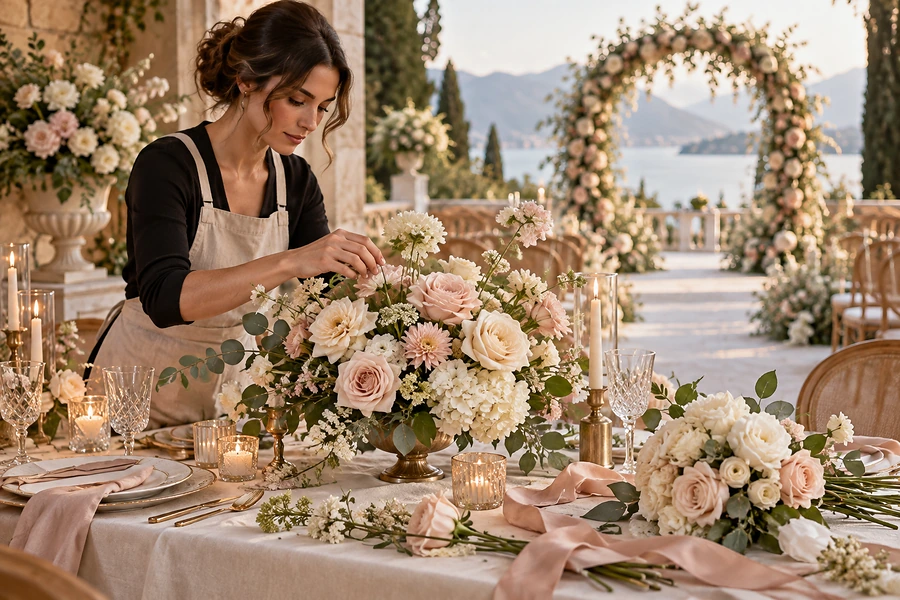
Wedding flowers can transform a venue, but fresh and artificial arrangements solve very different problems. Choosing well means balancing realism, fragrance, durability, logistics, and the actual 2026 budget.
For 2026 weddings, real flowers remain the strongest choice for natural fragrance, botanical variation, and close-up authenticity, while high-quality fake flowers offer predictable colors, no wilting, advance preparation, and rental savings. The Knot reports average U.S. wedding-flower spending of $2,800, while major faux-flower rental services report average full orders around $450–$500.
I would not treat this as a simple question of real = beautiful and fake = cheap. Premium Real Touch flowers can be expensive, while thoughtfully selected seasonal fresh flowers can sometimes be relatively economical. The best choice depends on where the flowers will be used, how closely guests will see them, and how much labor and customization the couple expects.
Are Real or Fake Flowers Better for a Wedding?
There is no universal winner because fresh and artificial flowers create different experiences.
Real wedding flowers are usually better when fragrance, natural variation, delicate texture, and close-up botanical detail matter most. Fake flowers are often better when durability, exact color matching, advance preparation, out-of-season availability, or predictable appearance matters more. For many weddings, the strongest solution is a hybrid combination rather than choosing only one category.
Why Real Flowers Still Feel Special
Fresh flowers offer natural qualities that artificial products are designed to imitate.
A fresh rose, peony, ranunculus, tulip, or sweet pea has subtle differences in:
- Petal thickness
- Color gradients
- Shape
- Scent
- Movement
- Stage of opening
No two blooms are exactly identical.
That irregularity often looks particularly beautiful in bridal bouquets and low centerpieces because guests can see the flowers closely.
Fresh flowers also contribute fragrance.
That sensory element can matter when couples want the wedding to feel like:
a garden,
a conservatory,
a spring meadow,
or a romantic floral environment.
Artificial flowers cannot fully reproduce that experience.
Why Fake Flowers Are More Practical
Artificial flowers offer something fresh flowers cannot: stability.
They do not wilt.
They do not need water.
They can be arranged weeks in advance.
They are not dependent on local flowering season.
And the bouquet generally looks the same at the end of the reception as it did when photographs began.
Zola identifies advance preparation, broader flower availability, and durability among the main advantages of artificial wedding flowers.
This makes faux florals especially useful for:
- Hot-weather weddings
- Long outdoor ceremonies
- Destination events
- Large installations
- DIY weddings
- Early venue setup
- Ceremony-to-reception repurposing
Modern Faux Flowers Can Photograph Well
Quality matters enormously.
The Knot reports wedding planners being impressed by how natural modern rental silk flowers can appear and, importantly, how well they photograph.
For close-up arrangements, I look for:
- Matte petals
- Natural color gradients
- Realistic flower centers
- Botanical proportions
- Flexible wired stems
- Detailed leaves
- Minimal visible glue
- Slight variation between blooms
A glossy, perfectly symmetrical artificial rose may still look fake.
A premium Real Touch peony or high-quality silk flower can perform very differently.
Fresh Flowers Are More Vulnerable
Fresh flowers are time-sensitive.
They may need:
- Refrigeration
- Hydration
- Conditioning
- Careful transportation
- Last-minute installation
Heat and sun can accelerate wilting.
Delicate petals can bruise.
Some blooms may open faster or slower than expected.
Professional florists manage these risks, but that expertise is part of what couples are paying for.
Artificial flowers remove much of this uncertainty.
What Are the Pros and Cons of Real vs. Fake Wedding Flowers?
The best choice becomes clearer when I compare both categories directly.
Real flowers provide unmatched natural detail, scent, movement, and seasonal character, but require careful timing and professional handling. Artificial flowers provide durability, predictable appearance, flexible scheduling, and rental possibilities, but premium faux varieties can be expensive and lower-quality products may look artificial at close range.
Real Wedding Flowers: Pros
Natural appearance
Fresh flowers do not need to imitate botanical irregularity.
It already exists.
Petals curl differently.
Leaves point in different directions.
Colors vary from bloom to bloom.
Fragrance
Certain flowers add scent to the wedding experience.
Garden roses, stock, jasmine, lilies, and herbs can create an atmosphere that visual décor alone cannot reproduce.
Seasonal character
Fresh flowers can strongly communicate time and place.
Tulips and flowering branches can feel unmistakably spring-like.
Dahlias can create a late-summer or autumn mood.
Professional artistry
A skilled florist can work with fresh stems dynamically, selecting bloom stages and adjusting arrangements on site.
Real Wedding Flowers: Cons
They are perishable
Fresh flowers change throughout the wedding day.
They require careful logistics
Storage, hydration, transport, setup, and breakdown may all be necessary.
Seasonality can affect availability and pricing
The Knot identifies seasonality, flower volume, logistics, and the ratio of flowers to greenery as major cost factors.
Large floral installations can become expensive
Fresh flowers require not only blooms but also labor, mechanics, transport, and installation.
Fake Wedding Flowers: Pros
No wilting
This is particularly valuable in heat.
Advance preparation
Bouquets and arrangements can be completed long before wedding week.
Predictable colors
If a design requires a very specific dusty blue, terracotta, champagne, or mauve palette, artificial flowers can offer more consistency.
Year-round flower choice
A couple can create a peony-heavy look even when fresh peonies are difficult to source locally.
Rental is possible
This is one of the biggest practical changes in the wedding-flower market.
The Knot reports that faux floral rental companies now provide bouquets, boutonnieres, centerpieces, ceremony pieces, garlands, and other décor.
Fake Wedding Flowers: Cons
Quality varies dramatically
A low-cost artificial flower may show:
- Frayed fabric
- Excessive shine
- Crude plastic centers
- Thick stems
- Visible seams
Premium faux flowers are not automatically cheap
Zola lists inexpensive silk bridal bouquets around $20–$100, but premium Real Touch bridal bouquets can cost $300 or more. Premium Real Touch bridesmaid bouquets may start around $150.
Rental restricts customization
Rental companies usually work from existing collections rather than creating completely bespoke flowers.
The Knot notes that couples generally choose from predetermined designs and must manage delivery, returns, possible damage charges, and often their own setup.
They lack natural fragrance
For some weddings, that is a meaningful trade-off.
Real vs. Fake at a Glance
| Factor | Real flowers | Fake flowers |
|---|---|---|
| Natural appearance | Excellent | Excellent at premium quality |
| Fragrance | Yes | No natural floral scent |
| Wilting | Possible | No |
| Seasonal limits | Yes | Minimal |
| Advance preparation | Limited | Excellent |
| Exact color control | Variable | Strong |
| Rental availability | No practical fresh-flower rental model | Yes |
| Keepsake potential | Requires preservation | Easy if purchased |
| Close-up realism | Naturally strong | Quality-dependent |
| Large installations | Beautiful but labor-intensive | Durable and easier to pre-build |
| Customization | Very high with florist | High if purchased/custom; lower if rented |
| DIY convenience | Time-sensitive | Easier to prepare ahead |
How Much Should You Budget for Wedding Flowers in 2026?
Current wedding data provides a much better starting point than assuming flowers should consume a fixed percentage of the wedding budget.
According to The Knot’s 2026 Real Weddings Study, U.S. couples spent an average of $2,800 on wedding flowers. The median was $1,900, while the upper-cost quartile averaged $4,800. Faux-flower rentals can be much lower: average full orders are about $500 at Something Borrowed Blooms and $450 at Silk Stem Collective.
The Knot’s data comes from 10,474 U.S. couples married in 2025, so it is one of the strongest current national benchmarks available for 2026 budgeting.
Fresh-Flower Budget Benchmarks
The Knot reports average flower spending by guest count of:
| Wedding size | Average flower spending |
|---|---|
| 1–50 guests | $1,600 |
| 51–100 guests | $2,400 |
| 101+ guests | $3,300 |
These are not quotes for a specific wedding.
They are planning benchmarks.
A 50-person wedding with an elaborate flower ceiling can cost more than a 150-person wedding using minimal greenery and candles.
Location Also Changes the Budget
The same 2026 data reports regional averages ranging from approximately $2,400 in the West to $3,600 in the Mid-Atlantic.
That is why I would not assume a national average is the correct budget for every couple.
Local labor, flower sourcing, venue access, and setup requirements matter.
Artificial Flower Purchase Costs
Zola provides useful approximate ranges for purchased artificial wedding flowers:
| Artificial floral item | Approximate range |
|---|---|
| Basic silk bridal bouquet | $20–$100 |
| Premium Real Touch bridal bouquet | $300+ |
| Silk bridesmaid bouquet | $10–$50 |
| Premium Real Touch bridesmaid bouquet | $150+ |
| Boutonniere | $3–$20 |
| Corsage | $5–$30 |
| Silk centerpiece | $20–$100 |
| Silk garland | $20–$50 |
| Silk aisle arrangement | $10–$20 |
These prices show why the statement “fake flowers are cheaper” is incomplete.
Basic faux flowers can be dramatically cheaper.
Premium artificial flowers used throughout an entire wedding may not be.
Faux Flower Rental Budgets
Rental can produce a much stronger price difference.
The Knot reports:
- Average full order at Something Borrowed Blooms: about $500
- Average full order at Silk Stem Collective: about $450
- Bridal bouquets: roughly $55–$80
- Centerpieces: about $28–$138
- Arch flowers: typically under $300
However, couples should also budget for possible:
shipping,
sample fees,
damage charges,
and setup.
Most rental companies do not automatically include installation.
Should You Choose Fresh, Fake, or a Combination?
For many weddings, I think a hybrid plan gives the best balance of quality and budget.
A fresh-and-faux combination lets couples use real flowers where natural texture and fragrance matter most, while using artificial flowers where durability, volume, or cost matters more. Current wedding professionals report couples successfully using fresh bouquets with silk décor or fresh table flowers with faux ceremony installations.
Where I Would Prioritize Fresh Flowers
I would consider fresh flowers first for:
The bridal bouquet
It appears in many close-up photographs and is held throughout the day.
Boutonnieres
These are worn close to the body and photographed at short distances.
Small fragrant arrangements
Fresh fragrance can add something artificial flowers cannot.
Low table arrangements
Guests may spend hours sitting close to them.
Where I Would Consider Faux Flowers
Artificial flowers can be particularly useful for:
Ceremony arches
They can be built early and remain stable.
Aisle arrangements
These can often be moved to the reception.
Flower walls
Guests primarily experience them as large visual compositions.
Hanging installations
Faux flowers eliminate hydration problems overhead.
Distant stage décor
Close-up tactile realism matters less.
A Practical Hybrid Plan
| Wedding element | Possible choice |
|---|---|
| Bridal bouquet | Fresh or premium Real Touch |
| Bridesmaid bouquets | Faux rental |
| Boutonnieres | Fresh or premium faux |
| Ceremony arch | Faux |
| Aisle arrangements | Faux |
| Guest tables | Fresh, faux, or mixed |
| Sweetheart table | Fresh |
| Flower wall | Faux |
| Hanging installation | Faux |
| Cake flowers | Fresh or premium faux |
This approach also lets the couple prioritize the budget.
Rather than using expensive flowers everywhere, they can spend where guests and cameras get closest.
My insights: Wedding Flowers: Real vs. Fake – Pros, Cons, and Budgeting for 2026
After comparing current 2026 wedding-spending data with artificial-flower pricing and rental information, I think the most important change is that fake wedding flowers are no longer one single budget category.
Wedding Flowers: Real vs. Fake – Pros, Cons, and Budgeting for 2026 comes down to service level as much as flower material. Fresh professional floristry averages $2,800 nationally, while standardized faux rentals can average about $450–$500. Yet premium purchased Real Touch flowers and custom artificial installations can still cost thousands. Couples should compare complete packages, not simply the price of individual stems.
My First Insight: The Fresh-vs.-Fake Cost Gap Is Largest With Rentals
This is where faux flowers have their clearest financial advantage.
A rental company can use the same floral inventory repeatedly.
The couple pays for temporary use rather than ownership.
That helps explain how average rental orders can remain around $450–$500 while national average flower spending is $2,800.
But this is not an identical service comparison.
A traditional florist may be providing:
- Custom design
- Fresh sourcing
- Conditioning
- Delivery
- Setup
- Installation
- Teardown
A rental order may arrive in boxes and require the couple, planner, or venue to place every arrangement.
The service level matters.
My Second Insight: Premium Faux Flowers Should Be Treated as a Design Material, Not a Cheap Substitute
Real Touch flowers can make sense even when saving money is not the main objective.
I might choose them because:
- The wedding is outdoors in summer.
- The installation must be completed a day early.
- The desired flower is out of season.
- An exact color is essential.
- The couple wants to keep the bouquet.
- A large installation must remain stable for many hours.
Those are performance reasons.
They are different from simply trying to spend less.
My Third Insight: Viewing Distance Should Control the Budget
I would spend most heavily where people see and touch flowers closely.
My basic hierarchy is:
| Viewing situation | Quality priority |
|---|---|
| Bridal bouquet | Very high |
| Boutonniere | Very high |
| Low centerpiece | High |
| Cake flowers | High |
| Ceremony arch | Medium to high |
| Aisle décor | Medium |
| Hanging flowers | Medium |
| Distant backdrop | Lower tactile priority |
This lets a couple use premium Real Touch or fresh flowers selectively instead of paying premium prices for every stem in the room.
My Fourth Insight: Fresh Flowers Win on Experience
Even the best faux flowers cannot completely reproduce:
natural fragrance,
organic variation,
the delicacy of real petals,
or the feeling of fresh flowers changing through the day.
If those qualities matter emotionally, I would not remove fresh flowers simply to optimize the budget.
I would reduce quantity instead.
One excellent fresh bridal bouquet may matter more than twenty additional arrangements nobody remembers.
My Fifth Insight: Faux Flowers Win on Predictability
Artificial flowers give couples unusual control.
The flowers can be approved in advance.
Colors remain consistent.
The arrangement does not depend on whether a shipment opens at exactly the right stage.
Weather becomes less threatening.
That predictability can have real planning value.
The Knot also notes that rental couples appreciate being able to see exactly what their floral designs will look like before the wedding.
My Sixth Insight: A Hybrid Budget Is Often the Smartest
If I were designing a 2026 wedding with a moderate flower budget, I would seriously consider:
fresh flowers for the bridal bouquet and a few high-impact close-up areas, then rented or purchased faux flowers for ceremony architecture and larger décor.
Wedding professionals cited by The Knot already report couples using exactly this strategy.
It reduces the need to choose between two extremes.
My 2026 Budgeting Framework
Instead of asking, “How much should wedding flowers cost?” I would build the budget in this order:
1. Personal flowers
Bridal bouquet, bridesmaid bouquets, boutonnieres, corsages.
2. Ceremony focal point
Arch, altar, chuppah, or floral columns.
3. Reception tables
Determine the number of tables before estimating floral needs.
4. High-impact installations
Flower walls, hanging florals, staircases, bars, entrances.
5. Logistics
Delivery, setup, teardown, shipping, rental return, and possible damage fees.
Then I would compare three complete versions:
all fresh
all faux
hybrid fresh + faux
That creates a much more accurate financial picture than comparing the cost of one fresh rose with one artificial rose.
My Final View
For 2026, I would choose fresh flowers when natural detail, scent, and botanical authenticity are central to the wedding experience.
I would choose fake flowers when durability, advance preparation, exact color, rental savings, or installation scale are more important.
And for many weddings, I would choose both.
Current data makes the budget difference clear. The Knot’s latest Real Weddings Study places average U.S. wedding-flower spending at $2,800, based on 10,474 couples who married in 2025. Its rental guide reports average faux-flower orders of about $450–$500 at two major rental companies.
But those numbers should guide—not dictate—the decision.
A wedding with $500 of rented flowers can look intentional.
A wedding with $5,000 of fresh flowers can look intentional.
A wedding using a fresh bridal bouquet and artificial ceremony arch can also look completely cohesive.
The strongest budgeting decision is therefore not simply:
real or fake?
It is:
Where will floral quality matter most, and which material delivers that result most efficiently in each part of the wedding?
Conclusion
Fresh flowers offer fragrance and natural detail; fake flowers offer durability and control. In 2026, compare complete packages—and consider a hybrid strategy to balance beauty, logistics, and budget.

