
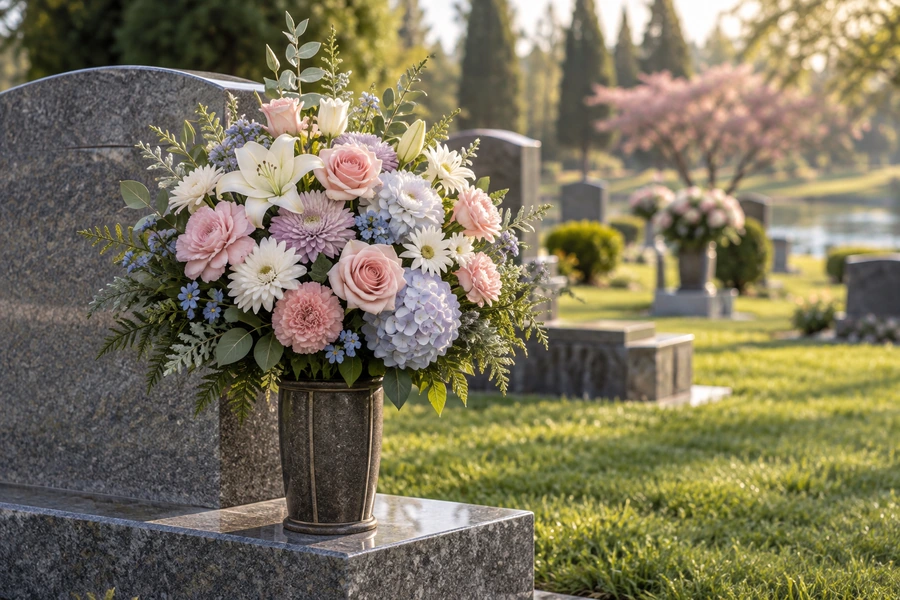
Choosing grave flowers is personal, but outdoor conditions add practical questions about fading, wind, rain, cemetery rules, and how often someone can return to maintain the arrangement.
The best artificial flowers for a grave are usually UV-treated roses, carnations, chrysanthemums, lilies, daisies, forget-me-nots, poppies, hydrangeas, and other structured memorial blooms. Choose meaningful flowers with secure stems, outdoor-suitable materials, restrained colors, and a size that fits the approved cemetery vase without interfering with maintenance.
Choose meaningful memorial flowers, but also consider UV resistance, strong stems, secure vase fit, wind exposure, cemetery rules, and easy cleaning for lasting outdoor respect.
What Are the Best Flowers to Put on a Grave?
There is no single flower that is correct for every grave. Meaning, climate, cemetery rules, personal memories, color, and outdoor durability all matter.
Roses, lilies, carnations, chrysanthemums, daisies, forget-me-nots, poppies, hydrangeas, and seasonal flowers are strong artificial grave-flower choices. Roses communicate love, lilies are traditionally associated with sympathy and peace, carnations with remembrance and care, and chrysanthemums have strong memorial associations in many cultures. Personal significance should come before rigid symbolism.
1. Artificial Roses
Roses are one of the safest all-purpose memorial choices.
They can represent:
- Love
- Respect
- Remembrance
- Affection
- Devotion
Red roses are often associated with deep love.
White roses can create a quieter memorial look.
Pink roses work well when the family wants a softer arrangement.
For outdoor artificial use, I would favor roses with:
- Structured petals
- Matte surfaces
- Strong wired stems
- Medium flower heads
- Outdoor-rated or UV-treated materials
Avoid highly glossy roses because direct sunlight can make plastic-looking surfaces more obvious.
2. Artificial Carnations
Carnations are especially practical for cemetery bouquets.
Dignity Memorial identifies carnations among common funeral flowers and associates them broadly with love, loyalty, esteem, and care.
Artificial carnations also have a useful shape for outdoor arrangements.
Their dense petals create visual fullness without requiring one enormous flower head.
They work well in:
- Cemetery cone vases
- Small memorial bouquets
- Mixed arrangements
- Patriotic arrangements
- Seasonal displays
Good colors include:
- White
- Soft pink
- Red
- Cream
3. Artificial Chrysanthemums
Chrysanthemums are among the most traditional memorial flowers.
Dignity Memorial notes that chrysanthemums have particularly strong associations with grief and sympathy in some cultures.
Artificial mums also work well visually because their compact, layered shape creates volume.
They pair well with:
- Roses
- Carnations
- Greenery
- Daisies
For a simple grave vase, several chrysanthemums can provide enough visual fullness without needing a complicated arrangement.
4. Artificial Lilies
Lilies create a more formal memorial appearance.
They are commonly used in funeral and sympathy arrangements and work especially well in white or ivory.
Use lilies when the arrangement needs:
- Height
- Graceful shape
- A traditional sympathy look
- Fewer but larger flowers
Artificial lilies need more quality control than carnations.
Look carefully at:
- Stamens
- Flower centers
- Petal printing
- Stem connections
Cheap artificial pollen details can make a lily look unrealistic very quickly.
For exposed gravesites, secure tall lily stems carefully because their larger flower heads can catch more wind.
5. Artificial Daisies
Daisies are appropriate for a lighter, simpler memorial arrangement.
Dignity Memorial describes daisies as a straightforward farewell flower.
They work especially well for:
- Spring displays
- Informal memorials
- Children’s graves
- Meadow-inspired bouquets
- White-and-yellow arrangements
Artificial daisies can also be combined with sturdier chrysanthemums or carnations so the arrangement does not depend entirely on delicate small stems.
6. Artificial Forget-Me-Nots
Few flower names communicate remembrance more directly.
Forget-me-nots are particularly suitable when the message of the arrangement is:
You are still remembered.
Their weakness is practical rather than symbolic.
Small artificial flowers contain many tiny parts, so they may:
- Collect dust
- Tangle
- Lose small flower heads
- Move more in strong wind
I would use forget-me-nots as supporting flowers rather than the entire arrangement in exposed locations.
7. Artificial Poppies
Poppies have a particularly strong connection with remembrance of military service and fallen service members.
They are an excellent option for:
- Veteran memorials
- Remembrance observances
- Patriotic grave arrangements
Before adding flags, stakes, wreaths, or other memorial accessories, check the cemetery rules separately.
For example, Texas State Veterans Cemeteries allow fresh and artificial flowers year-round but impose specific rules on other decorations.
8. Artificial Hydrangeas
Hydrangeas create a full arrangement with relatively few stems.
They work well when you want:
- A soft memorial look
- Large floral volume
- White, blue, pink, or green palettes
Current outdoor artificial-flower collections also include UV-protected hydrangeas, showing that this flower type is available in outdoor-oriented construction.
However, hydrangeas have many small petals.
That means they can collect:
- Dust
- Pollen
- Fine debris
more easily than simpler flowers.
For a grave visited infrequently, use hydrangeas with larger supporting flowers rather than creating an extremely dense arrangement.
9. Artificial Seasonal Flowers
Changing flowers seasonally can make the grave look intentionally maintained.
Examples include:
Spring
- Tulips
- Daffodils
- Daisies
Summer
- Roses
- Hydrangeas
- Sunflowers
Autumn
- Chrysanthemums
- Dahlias
- Warm foliage
Winter
- Poinsettias
- Holly-inspired arrangements
- Evergreen floral designs
Cemetery rules may also change seasonally, so never assume that a flower arrangement permitted in December will automatically be permitted in June.
Choose Personal Meaning Over Flower Etiquette
The best grave flower may simply be:
- Their favorite flower
- Their wedding flower
- A flower from their garden
- Their favorite color
- A flower connected with their culture
- A flower associated with a shared memory
Symbolism is useful.
Personal memory is often stronger.
Best Artificial Grave Flowers at a Glance
| Flower | Strongest Reason to Choose It | Outdoor Design Note |
|---|---|---|
| Rose | Love and remembrance | Choose matte, structured blooms |
| Carnation | Care and tribute | Compact and easy to arrange |
| Chrysanthemum | Traditional memorial meaning | Dense and visually full |
| Lily | Peace and sympathy | Secure tall stems |
| Daisy | Simplicity and farewell | Best mixed with stronger blooms |
| Forget-me-not | Remembrance | Use as an accent |
| Poppy | Military remembrance | Check cemetery accessory rules |
| Hydrangea | Fullness | Needs more dust maintenance |
| Seasonal blooms | Changing memorial displays | Match cemetery calendar |
Are Artificial Flowers Allowed in Cemeteries?
Artificial flowers are allowed in many cemeteries, but there is no universal cemetery rule. Some permit them throughout the year, some restrict them seasonally, and others prohibit them.
Always check the cemetery’s current decoration policy before purchasing artificial grave flowers. Confirm whether faux flowers are allowed, which containers can be used, how tall arrangements may be, whether flowers can touch or attach to the headstone, and when cemetery staff remove decorations for mowing, cleanup, or seasonal maintenance.
Cemetery Rules Can Be Completely Different
Consider three current examples.
At Andrew Johnson National Cemetery, artificial flowers and potted plants are allowed only from November 1 through April 1 under the 2026 superintendent’s rules. Artificial floral items are prohibited there from April 2 through October 31.
Texas State Veterans Cemeteries allow fresh-cut and artificial flowers throughout the year, although flowers may be removed when they become unsightly or interfere with maintenance.
Bellefontaine Cemetery generally does not permit artificial flowers except under limited circumstances specified by its rules.
That is why a product listing that says:
Suitable for cemetery use
does not mean:
Permitted at every cemetery.
Ask These Questions Before Buying
Call or check the cemetery website and confirm:
- Are artificial flowers permitted?
- Are they allowed year-round?
- Which vase type is allowed?
- Are ground stakes permitted?
- Can flowers be attached to the monument?
- Is there a maximum height?
- Are wreaths permitted?
- When does seasonal cleanup occur?
- Will faded flowers be removed?
- Are glass or ceramic containers prohibited?
Do Not Attach Flowers to a Headstone Without Permission
Federal cemetery regulations provide a useful example of why this matters.
36 CFR §12.10 allows fresh-cut or artificial flowers in designated non-breakable containers at times determined by the superintendent but prohibits securing objects directly to headstones, markers, or commemorative monuments.
Private and municipal cemeteries have their own rules.
Never assume:
- Tape
- Glue
- Wire
- Clips
- Saddles
are permitted directly on a monument.
Breakable Containers Are Frequently Restricted
Many cemeteries prohibit:
- Glass
- Ceramic
- Fragile decorations
because broken pieces can create hazards for visitors, maintenance crews, animals, and mowing equipment.
Hanford Cemetery District specifically identifies glass and ceramic as prohibited breakable materials.
Use the cemetery’s approved:
- Marker vase
- Metal container
- Plastic container
- Integrated memorial vase
instead.
Maintenance Access Matters
Cemeteries need to:
- Mow
- Trim
- Clean
- Maintain markers
- Move equipment
An arrangement that spreads across the grass can interfere with those operations.
Hanford Cemetery District states that flowers may be removed when they interfere with maintenance, become damaged, or are blown out of their vases.
So the best artificial grave arrangement is usually:
compact, upright, secure, and contained within the approved vase area.
What Flowers Last the Longest at a Cemetery?
For artificial cemetery flowers, longevity depends more on materials and exposure than on whether the product is shaped like a rose, lily, or chrysanthemum.
Choose artificial flowers specifically suitable for outdoor exposure, with UV-treated or UV-resistant materials, secure flower-head connections, strong stems, and colors that remain acceptable as they weather. Structured roses, carnations, chrysanthemums, and similar blooms are practical choices, but no artificial flower should be treated as permanently fade-proof outdoors.
Look for Outdoor-Safe Construction First
Do not choose solely by flower name.
A premium indoor rose may deteriorate outdoors faster than a less expensive flower made specifically for external use.
Look for:
- Outdoor-safe labeling
- UV treatment
- Weather-resistant construction
- Strong wired stems
- Secure flower heads
- Stable color
- Suitable care instructions
Balsam Hill’s outdoor artificial floral guidance, for example, specifically distinguishes UV-treated outdoor-safe products and recommends limited annual outdoor exposure for its own collections rather than promising indefinite outdoor life.
“UV Resistant” Does Not Mean “Never Fades”
This is an important buying rule.
ISO 4892-3:2024 provides laboratory methods for exposing plastic specimens to fluorescent UV radiation, heat, and water to evaluate weathering-related changes.
A supplier can therefore test material weathering.
But laboratory exposure should not automatically be converted into:
Guaranteed to look new outdoors for five years.
Actual cemetery exposure depends on:
- Latitude
- Sun direction
- Temperature
- Rain
- Wind
- Pollution
- Dust
- Color
- Material
- Maintenance
Structured Blooms Can Be Easier to Maintain
For exposed graves, I generally prefer flowers with visually stronger shapes.
Examples:
- Roses
- Carnations
- Chrysanthemums
- Dahlias
These tend to look intentional even when arranged in relatively small numbers.
Very delicate flowers can still work, but arrangements containing hundreds of tiny artificial petals can collect more debris.
Avoid Extremely Dark Dye Against Pale Stone Without Testing
Artificial flower color should stay on the flower.
Before placing deeply colored artificial stems directly against light stone, damp-test a hidden flower or inspect manufacturer care guidance.
If color releases onto a white cloth, do not allow the flower to rest against the memorial.
More importantly, many cemetery rules prohibit attaching objects directly to memorial stones anyway.
Choose Colors That Age Gracefully
Popular memorial palettes include:
Traditional
- White
- Ivory
- Soft green
Romantic
- Pink
- Cream
- Burgundy
Bright remembrance
- Yellow
- Blue
- Lavender
Military
- Red
- White
- Blue where culturally appropriate
Very saturated colors may show fading more obviously when one exposed side becomes lighter than the protected side.
Rotate Arrangements Rather Than Waiting for Failure
Artificial flowers are reusable, but outdoor displays still need inspection.
Check for:
- Fading
- Cracked stems
- Loose flower heads
- Frayed petals
- Dirt
- Bird debris
- Mold-like surface growth
- Missing flowers
- Wind displacement
Some cemeteries specifically remove artificial flowers once they become faded or unsightly. Hanford’s current rules are one example.
Keep a Replacement Schedule
A respectful artificial arrangement should not stay merely because it has not physically disappeared.
Replace it when:
- Color is badly faded
- Stems lean
- Petals tear
- The arrangement looks dirty
- Pieces are missing
- It no longer fits the season
A Simple Buying Checklist
| Feature | Recommended |
|---|---|
| Outdoor suitability | Confirmed |
| UV treatment | Preferred for exposed sites |
| Strong stem | Yes |
| Secure head attachment | Yes |
| Matte finish | Usually more realistic |
| Approved vase fit | Essential |
| Excessive height | Avoid |
| Loose glitter | Avoid |
| Fragile tiny parts | Limit outdoors |
| Easy cleaning | Preferred |
How Do I Keep Artificial Flowers From Blowing Away in Wind?
Artificial grave flowers need to be secured through the approved cemetery vase or container rather than attached to monuments or spread loosely around the grave.
To keep artificial cemetery flowers from blowing away, use the cemetery-approved vase, keep the bouquet compact, shorten excessively tall stems, group stems firmly inside the vase, and use an approved internal insert or fitted support when permitted. Do not use unauthorized stakes, wire, weights, glue, or attachments that could interfere with mowing or damage the memorial.
Start With the Correct Vase
Many cemetery memorials already include:
- Recessed vases
- Invertible vases
- Bronze vases
- Approved temporary containers
Use them.
Austin’s cemetery rules, for example, allow fresh and artificial flowers in an invertible vase or other approved non-breakable container.
Keep the Arrangement Low Enough
A tall flower acts like a lever.
Wind pushes the upper flower head while the narrow stem transfers force downward.
Shorter arrangements usually create:
- Less wind load
- Less bending
- Better visual proportion
- Lower risk of being pulled from the vase
Do not automatically use the longest stems you can buy.
Cut or bend approved artificial stems so the bouquet suits the vase.
Use More Than One Stem Contact Point
If the vase is deep enough, avoid having stems touch the container only at the bottom.
A fitted insert can help control movement farther up the stem.
Possible internal supports—only where cemetery policy allows—include:
- Fitted dry floral foam
- Purpose-made vase inserts
- Reusable stem grids
The support should fit securely without creating an object that can become loose during grounds maintenance.
Avoid Huge Top-Heavy Flowers
One enormous artificial hydrangea on a narrow long stem may catch more wind than several compact carnations.
For windy sites, build a lower arrangement with:
- Roses
- Carnations
- Chrysanthemums
- Compact foliage
and use tall lilies or branches more sparingly.
Keep the Bouquet Narrow
A wide horizontal arrangement catches more wind and may spread into maintenance areas.
A cemetery bouquet usually works better with:
vertical emphasis + compact width + secure base
rather than a sprawling wedding-style arrangement.
Avoid Loose Decorative Pieces
Do not add:
- Loose ribbon
- Lightweight plastic ornaments
- Unsecured picks
- Large bows
unless rules clearly permit them.
They can:
- Blow away
- Become litter
- Interfere with mowing
Inspect After Severe Weather
After strong wind or storms, check the arrangement when possible.
Current cemetery policies may authorize staff to remove flowers that have become dislodged. Hanford Cemetery District specifically lists blown-out or displaced arrangements among reasons for removal.
Never Sacrifice Cemetery Safety for Stronger Anchoring
A heavier anchor is not automatically better.
Do not add unauthorized:
- Concrete
- Metal rods
- Wire stakes
- Rocks
- Permanent adhesive
because cemetery rules may prohibit them.
The objective is:
secure within the approved cemetery system
not:
impossible for anyone to move.
My Insights: What Are the Best Artificial Flowers to Put on a Grave
The best artificial grave flowers combine emotional meaning with outdoor practicality. A beautiful flower that violates cemetery rules or becomes faded and loose quickly is not the strongest memorial choice.
For most graves, UV-treated artificial roses, carnations, chrysanthemums, lilies, or mixed memorial bouquets are the strongest starting choices. Select the deceased person’s favorite flower when possible, then check cemetery rules, outdoor suitability, vase dimensions, wind exposure, color stability, and maintenance needs before buying. Meaning should guide the flower; site conditions should guide its construction.
My First Rule: Check the Cemetery Before Buying Flowers
This is more important than choosing roses versus lilies.
Cemetery regulations vary substantially.
Current official rules demonstrate that artificial flowers may be:
- Allowed year-round
- Allowed seasonally
- Restricted to approved containers
- Prohibited in some cemeteries
A five-minute check can prevent the arrangement from being removed immediately.
My Second Rule: Personal Meaning Beats Generic Symbolism
Traditional symbolism can help.
But if the deceased loved sunflowers, an artificial sunflower arrangement may be more meaningful than traditional white lilies.
Think about:
- Favorite flower
- Favorite color
- Garden memories
- Wedding flowers
- Cultural traditions
- Military service
- Favorite season
The tribute should represent the person.
My Third Rule: Roses Are the Safest All-Round Choice
If there is no strong personal flower preference, artificial roses are probably the easiest default.
They work for:
- Parents
- Partners
- Grandparents
- Friends
- Anniversaries
- Birthdays
- General remembrance
They also mix easily with carnations, chrysanthemums, or greenery.
My Fourth Rule: Carnations and Chrysanthemums Are Excellent Practical Choices
Both flowers have strong memorial associations and create good visual density.
Dignity Memorial lists both among common funeral flowers.
For an exposed cemetery vase, a compact arrangement of:
- Carnations
- Mums
- A few roses
- Restrained foliage
can be easier to secure than a bouquet built entirely from large lilies.
My Fifth Rule: Use Lilies Where Their Meaning Matters
White artificial lilies can create a particularly peaceful, traditional tribute.
Because the flower heads are larger, however:
- Keep stems shorter
- Use fewer flowers
- Secure them carefully
A memorial arrangement should not become top-heavy simply to look larger.
My Sixth Rule: Buy Outdoor Construction, Not Just Pretty Flowers
The package should tell you more than:
silk cemetery rose.
Look for information about:
- Outdoor use
- UV protection
- Materials
- Care
- Stem construction
ISO 4892-3:2024 provides a recognized framework for laboratory UV weathering evaluation of plastic specimens, but even tested materials should not be marketed as permanently fade-proof.
My Seventh Rule: Do Not Overfill the Vase
More flowers do not automatically show more respect.
An overfilled arrangement may:
- Catch more wind
- Lean
- Hide the memorial inscription
- Interfere with maintenance
- Look untidy after weather exposure
Use enough stems to create a finished shape.
Then stop.
My Eighth Rule: Keep the Silhouette Compact
My preferred shape for an exposed grave vase is:
slightly taller center + medium side flowers + low supporting foliage
rather than:
very tall stems + wide horizontal flowers + loose trailing pieces.
The compact shape usually handles outdoor conditions better and remains visually respectful.
My Ninth Rule: Plan Seasonal Rotation
One arrangement does not need to stay outdoors indefinitely.
A useful rotation might be:
Spring
- Tulips
- Daisies
- Soft pink roses
Summer
- Roses
- Hydrangeas
- Sunflowers
Autumn
- Chrysanthemums
- Dahlias
- Warm foliage
Winter
- White roses
- Poinsettias
- Evergreen memorial designs
Check cemetery seasonal rules before each change.
My Tenth Rule: Replace the Arrangement Before It Looks Neglected
Artificial flowers are chosen because they last longer.
That should not become a reason to leave visibly damaged flowers indefinitely.
Replace or refurbish them when you see:
- Significant fading
- Torn petals
- Missing heads
- Dirt that cannot be cleaned
- Broken stems
- Unstable positioning
Many cemetery rules specifically allow removal of decorations that become unsightly.
Best Artificial Grave Flowers by Purpose
| Purpose | Strong Choice |
|---|---|
| General remembrance | Roses |
| Traditional memorial | Lilies |
| Long-lasting visual fullness | Carnations |
| Cultural remembrance | Chrysanthemums |
| Simple tribute | Daisies |
| “Never forgotten” message | Forget-me-nots |
| Veteran memorial | Poppies |
| Full premium arrangement | Hydrangeas + roses |
| Seasonal tribute | Seasonal flower mix |
| Personal remembrance | Loved one’s favorite flower |
My Preferred All-Purpose Grave Arrangement
For a typical approved cemetery vase, I would start with:
- 3–5 artificial roses
- 3–5 carnations or chrysanthemums
- A small amount of foliage
- One or two meaningful accent flowers
I would keep the arrangement:
- Compact
- Matte
- Outdoor-suitable
- Easy to clean
- Firmly secured
- Within cemetery dimensions
This gives enough color without turning the memorial into an oversized decorative installation.
My Final Answer
The best artificial flowers to put on a grave are not simply the flowers advertised as “cemetery flowers.”
The strongest choice combines four things:
meaning + cemetery rules + outdoor durability + secure placement
Roses, carnations, chrysanthemums, and lilies are reliable starting choices because they have established memorial associations and work well in structured arrangements. Daisies, poppies, forget-me-nots, hydrangeas, and seasonal flowers can make the tribute more personal.
But the person’s favorite flower may still be the best choice of all.
Conclusion
Choose meaningful, outdoor-suitable artificial flowers that fit the cemetery’s rules and vase. Roses, carnations, chrysanthemums, and lilies are dependable choices when durability, symbolism, and respectful appearance all matter.