


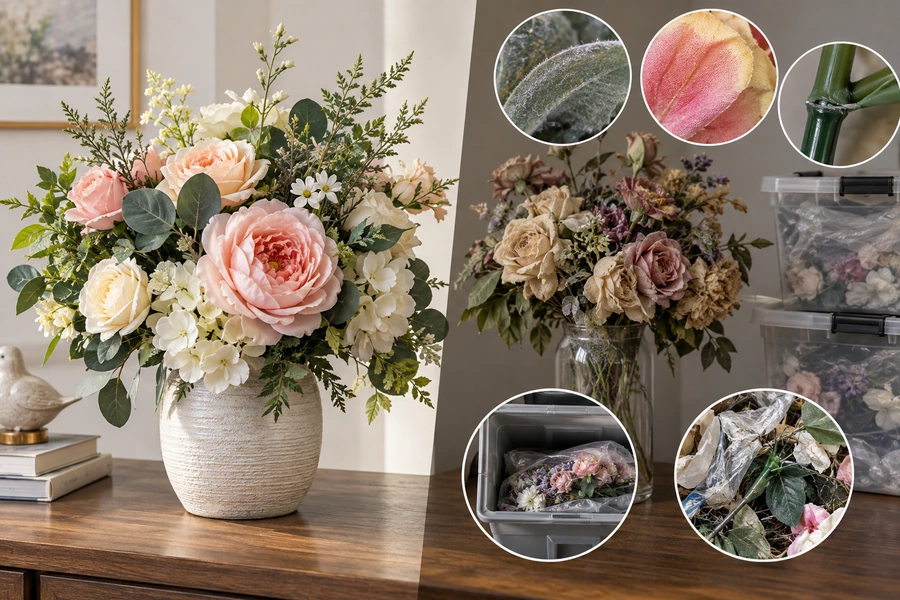
Artificial flowers avoid wilting and daily flower care, but poor realism, dust, fading, synthetic materials, storage problems, and premium prices can reduce their long-term appeal.
The main disadvantages of artificial flowers are that low-quality versions can look fake, they lack natural fragrance, collect dust, may fade or distort in sunlight, require storage, and can be difficult to recycle because they often combine plastics, polyester, adhesives, and wire. Premium Real Touch flowers can also cost as much as—or more than—fresh flowers.
Artificial flowers are still extremely useful for weddings, hotels, retail displays, dark interiors, allergy-sensitive environments, and reusable event décor. The key is understanding where their convenience creates trade-offs.
Are Artificial Flowers Tacky?
Artificial flowers can look tacky, but the problem is usually product quality, styling, and maintenance rather than the fact that the flowers are artificial.
Artificial flowers tend to look cheap when petals are glossy, colors are unnaturally uniform, blooms are perfectly identical, stems are visibly plastic, glue seams are exposed, or arrangements accumulate dust. High-quality faux flowers reduce these problems through softer materials, color variation, irregular shapes, realistic stems, and botanically accurate proportions.
Low-Cost Flowers Can Reveal Their Construction
Cheap artificial flowers often make the manufacturing process too visible.
Common giveaways include:
- Bright plastic shine
- One flat color across every petal
- Identical flower heads
- Thick artificial stems
- Visible fabric edges
- Exposed glue
- Perfect symmetry
Zola notes that quality varies significantly among artificial wedding flowers. Polyester “silk” petals can fray, while inexpensive foam flowers can look repetitive because each bloom may be nearly identical.
That means buying artificial flowers is not simply a choice between fresh and fake.
It is also a choice between different levels of artificial quality.
Premium Realism Can Become Expensive
Better manufacturing solves many realism problems, but it introduces another disadvantage: cost.
Zola’s comparison says high-end wax-coated flowers can cost significantly more than basic silk alternatives, while Real Touch or fresh-touch flowers sit toward the expensive end of the artificial-flower market.
Therefore, this assumption is unreliable:
Artificial flowers are always cheaper than fresh flowers.
A basic polyester bouquet may save money.
A premium Real Touch bridal bouquet may not.
For weddings and events, compare the complete inventory rather than just one stem.
Artificial Flowers Do Not Have Natural Fragrance
Fresh flowers provide something faux flowers cannot fully reproduce:
natural scent.
Zola specifically lists the lack of fresh-flower smell among the disadvantages of artificial wedding flowers.
This can matter with naturally fragrant species such as:
- Roses
- Gardenias
- Lilies
- Jasmine
- Lavender
- Sweet peas
Artificial fragrance sprays exist, but they are not the same experience and may not suit every guest or venue.
Touch Can Reveal the Difference
A faux bloom can photograph beautifully and still feel obviously synthetic.
Basic polyester petals may feel like:
- Fabric
- Cloth
- Plastic-backed textile
Real Touch improves tactile realism, but that usually raises the price.
This is why I would spend more on flowers placed:
close to people
and less on flowers placed:
high, far away, or in background installations.
Wired Stems Can Be Thick and Heavy
Artificial flowers often contain internal wire so the stems can be shaped repeatedly.
That is useful for arranging.
It also means bouquets can become:
- Thick
- Heavy
- Harder to cut
Zola notes that artificial wedding-flower stems can contain steel wire wrapped in plastic, creating bulkier bouquets and requiring wire cutters rather than ordinary floral scissors.
For a large bridal bouquet, this can become a genuine comfort issue.
Realism Problems at a Glance
| Weak Feature | Possible Disadvantage |
|---|---|
| Glossy petals | Obvious plastic appearance |
| Flat color | Less botanical realism |
| Identical blooms | Manufactured look |
| Fabric edges | May fray |
| Thick wired stems | Heavy bouquet |
| Visible glue | Lower perceived quality |
| Cheap container | Makes whole arrangement look artificial |
| Premium Real Touch | Higher purchase price |
The main aesthetic disadvantage is therefore not simply that faux flowers are artificial.
It is that convincing artificial flowers require more careful selection.
Do Artificial Flowers Collect Dust?
Yes. Artificial flowers require less care than fresh flowers, but they are not maintenance-free because petals, leaves, stems, and flower centers gradually collect dust and airborne dirt.
Artificial flowers collect dust and need occasional cleaning to stay realistic. Dust dulls colors, highlights synthetic surfaces, and accumulates inside layered petals where it can become difficult to remove. Current care guidance recommends routine gentle dusting with a microfiber cloth, soft duster, or other material-appropriate dry method rather than waiting for heavy buildup.
“No Maintenance” Is an Exaggeration
Faux flowers eliminate:
- Water changes
- Stem trimming
- Flower food
- Wilting
- Petal drop from natural aging
But they add another maintenance task:
cleaning.
Balsam Hill currently recommends weekly or biweekly dusting as a general care approach, although actual frequency depends on placement.
Afloral similarly recommends occasional dusting and checking arrangements for bent petals, loose leaves, or other physical damage.
Layered Flowers Can Be Difficult to Clean
A simple artificial tulip is relatively easy.
A large artificial peony may contain dozens of overlapping petals.
Dust can settle:
- Between petals
- Around flower centers
- Behind leaves
- Around stem joints
This is especially noticeable on:
dark artificial flowers
because pale dust creates strong contrast.
Commercial Displays Need More Cleaning
Flowers in a quiet bedroom may stay clean for months.
Flowers in a:
- Restaurant
- Hotel
- Retail store
- Reception area
- Kitchen
may collect dirt faster because of higher traffic, HVAC airflow, cooking residue, and handling.
In commercial projects, artificial flowers should therefore be included in the housekeeping plan.
Cleaning Can Damage Delicate Materials
Another disadvantage is that there is no one cleaning method that is safe for every artificial flower.
Fabric, foam, Real Touch, latex-style, and molded plastic flowers respond differently to:
- Water
- Cleaning products
- Pressure
- Heat
Current care guidance recommends gentle dry methods first because aggressive cleaning can distort or damage petals.
That means artificial flowers may be easier to maintain than fresh flowers, but they still require material-aware care.
Storage Adds Another Task
Seasonal artificial flowers need somewhere to go when they are not displayed.
Good storage requires enough space to prevent:
- Crushed petals
- Bent flower heads
- Flattened leaves
- Dust buildup
- Heat distortion
Afloral advises using containers that give blooms sufficient room and avoiding hot environments such as attics because temperature extremes can contribute to warping or discoloration.
This can become a meaningful disadvantage for someone owning:
multiple large seasonal arrangements.
Do Artificial Flowers Fade in Sunlight?
Yes. Artificial flowers do not need sunlight, and prolonged UV exposure can gradually fade pigments, distort color, and degrade synthetic materials.
Artificial flowers can fade when exposed to prolonged direct sunlight. Indoor faux flowers should not automatically be used in sunny windows or outdoor displays. UV-treated products generally perform better, but UV resistance does not mean permanent fade-proof color. Shade, limited exposure, and choosing specifically outdoor-rated flowers remain important.
Sunlight Provides No Benefit to Faux Flowers
Fresh plants need light.
Artificial flowers do not photosynthesize.
So direct sunlight provides them with:
no biological advantage
while still creating material exposure.
Afloral specifically recommends keeping artificial flowers away from prolonged direct sunlight unless they have suitable UV protection because exposure can cause color distortion and material degradation.
Window Placement Can Be a Problem
An arrangement can technically be indoors but still receive intense sunlight.
Examples include:
- South-facing windows
- Conservatories
- Skylights
- Glass shopfronts
- Bright hotel entrances
Over time, one side of an arrangement may fade faster than the other.
This creates uneven coloration that is difficult to correct.
Fading Cannot Be Cleaned Away
Dust can be removed.
UV pigment damage cannot simply be wiped off.
Once a red artificial rose becomes:
- Pale red
- Pink
- Unevenly bleached
cleaning cannot restore the original pigment.
Replacement may become the only practical option.
Outdoor Use Requires a Different Product
One common mistake is buying an attractive indoor flower and assuming it can remain permanently:
- On a patio
- At a gravesite
- In an outdoor planter
- Outside a storefront
Balsam Hill advises checking whether flowers are marked Outdoor Safe and recommends reducing exposure to direct sun and extreme weather even with outdoor products.
Afloral also distinguishes UV-treated outdoor florals from ordinary indoor artificial flowers.
UV Resistant Does Not Mean Permanent
Marketing terms such as:
UV resistant
should not be interpreted as:
will never fade.
Actual performance depends on:
- Sun intensity
- Hours of exposure
- Climate
- Pigment
- Material
- Orientation
- Rain and heat
Outdoor flowers in Arizona and shaded flowers on a covered porch are not experiencing the same environment.
Physical Shape Can Also Change
Artificial flowers do not only lose color.
Poor storage or environmental exposure can also produce:
- Bent stems
- Crushed petals
- Warping
- Distortion
Afloral explicitly notes that artificial flowers can fade and distort over time.
So their long life does not equal an unchanged appearance forever.
Are Artificial Flowers Bad for the Environment?
Artificial flowers can create environmental disadvantages because many combine synthetic polymers, fabric, adhesives, coatings, and metal components that are difficult to separate at the end of their useful life.
Many artificial flowers contain polyethylene, polypropylene, PET polyester fabric, adhesives, and metal wire. Mixed-material construction can complicate recycling, while manufacturing and eventual disposal add environmental impacts. Their sustainability improves when durable flowers are reused for years, rented, repurposed, or resold rather than purchased for one event and immediately discarded.
Artificial Flowers Are Often Multi-Material Products
A peer-reviewed study analyzed 203 components from 175 decorative plastic plants.
Researchers found that molded components were commonly made from:
- Polyethylene
- Polypropylene
while many leaves and colorful petals consisted of PET-based fabric attached to molded components.
An artificial flower can therefore combine:
polymer petal + fabric + plastic stem + wire + adhesive
in a single object.
Recycling Can Be Difficult
A plastic bottle is relatively simple compared with a faux floral stem.
To recycle a mixed artificial flower properly, components may need to be separated.
That can involve removing:
- Wire
- Fabric
- Plastic
- Adhesive
- Foam
and local recycling systems may not accept all those materials.
The academic study specifically investigated decorative artificial plants because material composition and additives can complicate sustainable disposal and recycling.
One-Time Event Use Is the Weakest Scenario
Artificial flowers become harder to justify environmentally when they are treated as disposable décor.
For example:
buy → wedding → trash
uses the longevity advantage only once.
A stronger lifecycle is:
buy → wedding → home décor → lend → resell → reuse
or:
rent → return → reuse at another event.
Artificial flowers are durable enough that reuse should be treated as part of the buying plan.
Fresh Flowers Also Have Environmental Inputs
This issue should not be oversimplified into:
Fresh is environmentally perfect and artificial is environmentally bad.
Fresh flowers can also involve:
- Heated greenhouse production
- Irrigation
- Fertilizer
- Refrigeration
- Air freight
- Packaging
- Short useful life
The environmental comparison depends on sourcing, transportation, materials, and how many times an artificial arrangement is reused.
Without a specific lifecycle analysis of two comparable products, claiming that one category is always greener would be too simplistic.
Durability Is the Environmental Advantage of Faux Flowers
The strongest environmental argument for artificial flowers is their potential longevity.
A high-quality bouquet that is reused for:
five weddings
is a different product lifecycle from one used once.
The same applies to:
- Hotel arrangements
- Retail displays
- Seasonal home décor
- Event rental inventory
Buy fewer.
Use them longer.
Replace individual stems rather than entire arrangements where practical.
My Insights: What Are the Disadvantages of Artificial Flowers
The biggest disadvantage of artificial flowers is that their convenience shifts the problems rather than eliminating them. You trade wilting and daily fresh-flower care for realism, cleaning, storage, material, fading, and end-of-life concerns.
The disadvantages of artificial flowers include possible fake-looking surfaces, lack of natural fragrance, dust accumulation, sunlight fading, storage requirements, thick wired stems, difficult recycling, and higher costs for premium Real Touch quality. They make the most sense when their durability is actually used through long-term display, rotation, rental, or reuse.
My First Insight: Quality Solves One Disadvantage by Creating Another
Low-cost faux flowers may look artificial.
Premium products solve that through:
- Better materials
- Better color
- Realistic texture
- Better construction
But then the price rises.
Zola specifically notes that the best-looking artificial options may cost as much as or more than fresh flowers.
So buyers often choose between:
lower cost + weaker realism
and
strong realism + higher cost.
My Second Insight: Faux Flowers Need Housekeeping, Not Floristry
Fresh flowers need:
- Water
- Trimming
- Refrigeration
- Replacement
Artificial flowers need:
- Dusting
- Reshaping
- Storage
- Occasional replacement
That is much less horticultural work, but it is not zero work.
My Third Insight: Viewing Distance Should Control Your Budget
Artificial flowers become harder to fake at close range.
For a:
bridal bouquet
I would prioritize premium Real Touch or high-quality faux stems.
For a:
ceremony arch several meters away
high-quality polyester may be perfectly adequate.
Zola similarly recommends being more cautious about artificial flowers in heavily photographed, close-view wedding locations while using them more freely in distant installations.
My Fourth Insight: Sunlight Is a Replacement-Cost Problem
A cheap artificial flower placed in harsh sunlight may need frequent replacement.
That means the low purchase price can become misleading.
Afloral and Balsam Hill both recommend protecting ordinary artificial flowers from direct sunlight and using products specifically designed for outdoor exposure where necessary.
For exterior projects, ask about UV specification before ordering.
My Fifth Insight: Storage Should Be Planned Before Buying
A 100-stem wedding arrangement can take significant space after the event.
Before choosing faux flowers, decide whether you will:
- Keep them.
- Rent them.
- Resell them.
- Donate them.
- Reuse them for another event.
If none of those options works, their long lifespan is not creating much value.
My Sixth Insight: Material Selection Matters
“Artificial flower” includes very different products.
Zola’s current guide distinguishes among polyester silk, foam, wax-coated, latex, Real Touch/polymer, and paper flowers, each with different disadvantages.
For example, polyester may fray.
Foam may look repetitive.
Real Touch may be expensive and vulnerable to crushing.
The category is too broad for one material judgment.
My Seventh Insight: Flowers That Look Perfect Can Look More Fake
Living flowers have irregularity.
They include:
- Different opening stages
- Slightly bent petals
- Color variation
- Uneven stems
Current 2026 realism guidance repeatedly identifies excessive uniformity as a major reason faux flowers look artificial.
When styling, I would mix:
open blooms + smaller blooms + buds
rather than 20 identical flowers.
My Eighth Insight: Dust Is More Than a Cleaning Problem
Dust is also an aesthetic signal.
A fresh flower is replaced before it sits in the same vase for two years.
Artificial flowers can remain long enough to develop a very visible dust layer.
That immediately tells the viewer:
permanent artificial décor.
Regular cleaning therefore protects realism as much as hygiene.
My Ninth Insight: Reuse Is the Best Way to Offset Several Downsides
Reuse improves:
- Cost per event
- Storage value
- Material efficiency
- Waste reduction
Artificial flowers become much more compelling when used repeatedly.
This is especially true for:
- Wedding rental businesses
- Hotels
- Restaurants
- Retail stores
- Seasonal décor
My Tenth Insight: Hybrid Floral Design Often Gives the Best Compromise
You do not always need to choose:
100% fresh
or
100% artificial.
A hybrid design can use premium fresh or Real Touch flowers where people look closely and less expensive faux flowers in high-volume locations.
For example:
| Location | Practical Choice |
|---|---|
| Bridal bouquet | Fresh or premium Real Touch |
| Boutonniere | Fresh or premium faux |
| Sweetheart table | Fresh / premium hybrid |
| Ceremony arch | Faux / rental |
| High floral installation | Faux |
| Distant backdrop | Faux |
| Fragrant entrance feature | Fresh |
| Reusable hotel arrangement | Premium faux |
This addresses many artificial-flower disadvantages without giving up their strongest advantages.
My Practical Disadvantages Checklist
Before buying artificial flowers, I would ask whether I am comfortable with these trade-offs:
| Issue | Why It Matters |
|---|---|
| No natural fragrance | Different sensory experience |
| Quality varies | Cheap products may look obvious |
| Premium price | Real Touch can be expensive |
| Dust | Requires cleaning |
| UV fading | Limits sunny/outdoor placement |
| Crushing | Requires careful storage |
| Wired stems | Can add weight and bulk |
| Fabric fraying | Material-dependent |
| Mixed materials | Recycling can be difficult |
| No natural aging | Flowers remain visually static |
| Storage | Requires physical space |
| Disposal | Long-lived synthetic waste if not reused |
My Final Answer
So, what are the disadvantages of artificial flowers?
The biggest are realism, maintenance, sunlight, material waste, storage, and premium cost.
Artificial flowers may:
- Look cheap when quality is poor
- Lack the fragrance and natural variation of fresh flowers
- Accumulate dust
- Fade in direct sunlight
- Become crushed during storage
- Use thick wired stems
- Be difficult to recycle
- Cost surprisingly much when premium Real Touch quality is required
However, these disadvantages become much easier to justify when faux flowers are used repeatedly.
For most homes, weddings, hotels, and commercial spaces, I would therefore judge artificial flowers by three questions:
How closely will people see them?
How long will they be used?
How many times can they be reused?
If the answers are from a distance, for years, and many times, artificial flowers can deliver strong value despite their disadvantages.
If the flowers are needed only once, will be viewed extremely closely, and natural scent is an important part of the experience, fresh flowers may be the better choice.
Conclusion
Artificial flowers can look fake, collect dust, fade, require storage, and create mixed-material waste. Their strongest value comes from choosing quality carefully and reusing them for years.

