


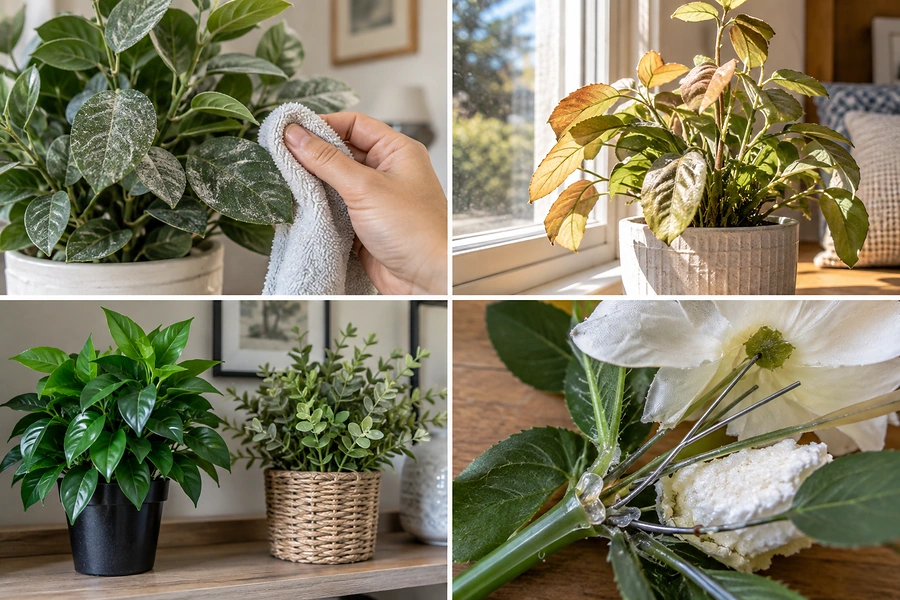
Artificial plants solve problems with watering, light, and plant care, but their convenience comes with disadvantages involving realism, dust, fading, materials, recycling, and long-term appearance.
The main downsides of artificial plants are that they do not grow or change naturally, can collect visible dust, may fade or become brittle in strong sunlight, can look cheap when quality is poor, and are often made from mixed plastics, fabrics, wire, foam, and adhesives that can make recycling difficult. Premium faux plants can also be expensive.
Artificial plants can still be excellent for dark rooms, hotels, offices, retail displays, vacation homes, and difficult-to-maintain locations. The important point is not that faux plants are bad, but that they solve a different set of problems from living greenery.
Are Artificial Plants Bad for the Environment?
Artificial plants are not environmentally neutral. Many are manufactured from plastic, polyester, metal wire, foam, adhesives, and coatings, and these mixed materials can make end-of-life recycling difficult.
The environmental disadvantage of artificial plants comes mainly from material production, manufacturing, transportation, and disposal. Many faux plants combine several materials that cannot easily be separated for recycling. Their environmental case becomes stronger when buyers choose durable products, maintain them well, and reuse them for many years instead of treating them as short-lived seasonal decorations.
1. Many Artificial Plants Contain Plastic
A scientific study examining 175 decorative plastic plants found that molded components commonly contained:
- Polyethylene
- Polypropylene
while many leaves and colorful petals were made from PET-based fabric attached to molded components with adhesives or coatings.
That means the typical faux plant is often more complicated than one simple recyclable plastic object.
It may contain:
- Plastic leaves
- Polyester fabric
- Metal wire
- Foam
- Glue
- Paint or pigment
- Polymer coatings
2. Mixed Materials Make Recycling Difficult
Consider one artificial tree.
Its leaves may be polyester.
Its branches may be polyethylene.
Its internal structure may contain steel wire.
Its pot may contain plastic.
Its base may contain foam or cement-like filler.
Separating all those components at the end of the product’s life may be impractical.
Current 2026 sustainability guidance on artificial plants makes the same point: because many models combine plastic, metal, fabric, and foam, they are not always easy to recycle.
3. Manufacturing Has an Environmental Cost
Artificial plants need:
- Raw materials
- Manufacturing energy
- Packaging
- Transportation
Many are also produced internationally and shipped significant distances before reaching the final buyer.
This does not mean a living plant automatically has zero environmental impact.
Living plants may also involve:
- Greenhouse heating
- Plastic nursery pots
- Growing media
- Fertilizer
- Irrigation
- Transportation
- Replacement
The comparison needs to consider the whole lifecycle.
4. Longevity Changes the Calculation
Imagine two buyers.
Buyer A
buys cheap faux greenery every year because trends change.
Buyer B
buys one high-quality artificial olive tree and uses it for ten years.
Buyer B gets much more use from the manufactured materials.
That is why one of the strongest sustainability strategies for artificial plants is:
buy fewer, better plants and keep them longer.
5. Artificial Plants Do Not Support Living Ecosystems
A faux plant is décor.
It does not:
- Grow
- Produce flowers
- Provide nectar
- Develop roots
- Support soil organisms
- Participate in a living garden ecosystem
This distinction matters particularly outdoors.
A plastic hedge may provide visual privacy, but it should not be treated as the ecological equivalent of a living hedge.
6. Artificial Plants Cannot Regenerate
A real plant can sometimes replace a damaged leaf with new growth.
An artificial plant cannot.
Once a faux leaf becomes:
- Torn
- Permanently faded
- Brittle
- Cracked
the affected component must be repaired or replaced.
Practical Environmental Comparison
| Factor | Artificial Plant |
|---|---|
| Plastic content | Often present |
| Metal components | Often present |
| Fabric | Common |
| Recycling | Can be difficult |
| Transportation | Often significant |
| Watering after purchase | None |
| Fertilizer after purchase | None |
| Replacement | Quality-dependent |
| Ecological function | Decorative only |
| Best sustainability strategy | Long-term reuse |
The environmental question should therefore not simply be:
Is an artificial plant sustainable?
A better question is:
How long will I actually use this artificial plant?
Do Artificial Plants Collect Dust?
Yes. Dust is one of the most practical disadvantages of artificial plants because broad leaves, textured stems, flower petals, and branch joints can gradually collect visible debris.
Artificial plants collect dust and still require routine cleaning even though they do not need watering, fertilizer, pruning, or repotting. Dust can dull leaf color, make surfaces look gray, and exaggerate plastic-looking textures. Regular dry dusting and material-appropriate gentle cleaning are therefore necessary if faux greenery is meant to remain realistic.
“Maintenance-Free” Is Misleading
Artificial plants eliminate horticultural maintenance.
They do not eliminate housekeeping.
You no longer need to:
- Water
- Fertilize
- Prune
- Repot
- Monitor roots
But you still need to:
- Dust
- Wipe leaves
- Clean planters
- Reshape stems
- Inspect loose components
Current 2026 artificial-plant care guidance specifically says faux plants are not completely maintenance-free and recommends regular dusting and gentle cleaning.
Where Dust Accumulates
Pay particular attention to:
- Horizontal leaves
- Leaf veins
- Branch joints
- Artificial moss
- Flower centers
- Textured trunks
- Planter rims
A large artificial tree can contain hundreds of individual dust-catching surfaces.
Dust Can Make Fake Plants Look Cheaper
This is more than a hygiene issue.
Dust changes the visual effect.
A dusty matte leaf can become:
- Gray
- Flat
- Dull
Dust can also settle in molded details and make manufacturing lines more obvious.
That means a premium artificial plant can eventually look worse than a cheaper clean one.
Large Faux Plants Take Time to Clean
A 6-foot artificial fiddle-leaf fig may be easy because it has relatively large leaves.
A large artificial fern can be much more difficult.
Compare:
Fiddle-leaf fig
- Large broad leaves
- Easy to wipe
Fern
- Hundreds of small leaflets
- More time-consuming
Maintenance should therefore influence species selection.
Best Choices for Easy Cleaning
For low-maintenance commercial interiors, I would favor:
- Rubber plant
- Snake plant
- Monstera
- Bird of paradise
- Large-leaf ficus
over extremely fine:
- Ferns
- Fine grasses
- Delicate trailing greenery
when cleaning access is limited.
A Simple Cleaning Routine
Current care guidance recommends starting with dry dust removal and using a slightly damp cloth and mild cleaning method only where appropriate for the specific material.
A practical sequence is:
- Dust from top to bottom.
- Use microfiber on broad leaves.
- Use a soft brush around details.
- Wipe heavier dirt only if the material allows.
- Let the plant dry completely.
- Reshape the branches.
Commercial Spaces Need More Frequent Cleaning
Faux plants in:
- Restaurants
- Hotels
- Offices
- Stores
may collect more:
- Dust
- Airborne grease
- Fibers
- Handling marks
than plants in quiet residential rooms.
Include them in the normal cleaning schedule rather than waiting until they visibly look dirty.
Do Artificial Plants Fade in Sunlight?
Yes. Prolonged sunlight can fade artificial foliage, change pigments, and eventually make some synthetic materials harder or more brittle.
Artificial plants can fade in strong direct sunlight because UV exposure degrades pigments and materials over time. Ordinary indoor faux plants should not be assumed suitable for sunny windows or outdoor locations. UV-resistant products may perform better, but they are not permanently fade-proof. Placement and exposure remain important even when a product is marketed for outdoor use.
Faux Plants Do Not Benefit From Sunlight
This creates an interesting difference from living greenery.
Real plants require usable light for photosynthesis.
Artificial plants do not.
For faux greenery, strong sunlight is therefore all risk and no biological benefit.
What UV Exposure Can Do
Current 2026 artificial-plant guidance notes that prolonged direct sunlight can cause:
- Color loss
- Yellowing or flattening of green tones
- Material hardening
- Brittleness
and that once UV fading has occurred, cleaning cannot restore the original pigment.
Window Glass Does Not Make Placement Risk-Free
A plant can be indoors and still receive significant direct sunlight.
Watch:
- South-facing windows
- Conservatories
- Skylights
- Bay windows
- Glass entrance areas
A faux tree beside a bright window can receive more UV exposure than one in the center of the room.
Dark Colors Can Show Fading Differently
Artificial greenery commonly uses several green pigments.
As exposure continues, one component may fade faster than another.
Leaves can become:
- Yellow-green
- Gray-green
- Unevenly colored
The side facing the window may also age more quickly than the protected side.
Outdoor Faux Plants Need a Different Specification
If you need artificial greenery for:
- Patio
- Balcony
- Storefront
- Restaurant terrace
- Outdoor entrance
select a product designed for outdoor exposure.
Do not buy a premium indoor fiddle-leaf fig simply because it looks realistic and assume it can tolerate:
- Rain
- Full sun
- Heat
- Wind
UV-Resistant Is Not UV-Proof
Marketing language can be misleading.
“UV resistant” should generally be understood as:
designed to resist UV-related deterioration better than an untreated alternative.
It should not be interpreted as:
will never fade.
Actual outdoor performance depends on:
- Geography
- Sun intensity
- Exposure hours
- Temperature
- Color
- Material
- Orientation
Best Placement Strategy
| Location | Faux Plant Risk |
|---|---|
| Interior shaded room | Low |
| Bright indirect light | Low to moderate |
| Direct sunny window | Higher |
| Conservatory | High |
| Covered balcony | Product-dependent |
| Full outdoor sun | Outdoor-rated product needed |
Heat Matters Too
Sunlight can also increase surface temperature.
Long-term heat may affect:
- Adhesives
- Polymer flexibility
- Branch connections
so avoid placing artificial plants directly beside:
- Radiators
- Fireplaces
- Strong heaters
unless the manufacturer confirms suitability.
Do Artificial Plants Look Tacky?
They can. Poor-quality artificial plants are one of the biggest aesthetic disadvantages because glossy leaves, repeated shapes, visible plastic stems, and cheap planters can make an otherwise sophisticated room feel less convincing.
Artificial plants look tacky when their synthetic construction becomes obvious. Common problems include excessive shine, one flat green color, identical leaves, perfect symmetry, visible foam or plastic bases, unrealistic trunks, tiny pots, and accumulated dust. High-quality faux greenery can avoid many of these problems, but convincing realism usually costs more.
Style Opinion Is Not Universal
Designers disagree about fake plants.
Some use high-quality faux greenery when real plants are impractical.
Others strongly prefer living or dried botanicals.
That disagreement is especially visible in current 2026 design coverage. Real Simple recently reported designers identifying faux plants as a decorating choice they would replace with more natural alternatives.
So there is no objective rule that:
fake plants always look bad.
But there is a genuine style risk.
Cheap Shine Is the Biggest Giveaway
Real leaves can have:
- Matte surfaces
- Satin surfaces
- Waxy sheen
depending on species.
Artificial leaves often fail when everything has the same strong plastic shine.
The finish needs to match the plant.
A faux rubber plant can tolerate more sheen.
A faux olive tree generally looks better with muted leaves.
Repetition Reveals Manufacturing
Factories rely on molds.
That means several leaves may have identical:
- Size
- Shape
- Veins
- Angles
If every leaf faces forward, the repetition becomes obvious.
Reshaping helps.
After unpacking:
- Bend branches
- Rotate leaves
- Open gaps
- Create irregular height
The Starter Pot Can Ruin the Plant
An expensive artificial tree inside a tiny black transport pot can still look cheap.
Transfer it visually into:
- Terracotta
- Stoneware
- Woven basket
- Textured ceramic
- Concrete-look planter
Then hide the internal base with appropriate top dressing.
Some Faux Plants Cost More Than Living Plants
High realism requires better:
- Molds
- Pigments
- Materials
- Trunks
- Assembly
As quality improves, price rises.
A premium artificial olive or ficus tree may cost significantly more up front than a young living equivalent.
Its economic advantage comes mainly from:
- Lower horticultural maintenance
- No watering
- No replacement due to poor growing conditions
not necessarily from a lower purchase price.
Artificial Plants Never Grow Into the Space
This is an overlooked disadvantage.
A living plant can gradually become:
- Taller
- Fuller
- More characterful
A faux plant remains essentially the same size.
If you buy a plant that looks undersized on day one, it will still look undersized years later.
They Cannot Provide the Experience of Plant Care
For people who enjoy gardening, faux greenery removes:
- New leaf growth
- Propagation
- Repotting
- Flowering
- Seasonal change
That experience may be more important than convenience.
What Makes Faux Plants Look Better?
| Weak Faux Plant | Better Faux Plant |
|---|---|
| Shiny leaves | Species-appropriate finish |
| Flat green | Color variation |
| Perfect symmetry | Irregular branching |
| Tiny pot | Substantial planter |
| Visible foam | Covered base |
| Identical leaves | Mixed leaf sizes |
| Dusty | Regularly cleaned |
| Random placement | Intentional placement |
My Insights: What Are the Downsides of Artificial Plants
The main disadvantage of artificial plants is not simply that they are fake. It is that their benefits come from removing biology—and that removes some of the qualities people value about plants.
Artificial plants trade biological authenticity for convenience. Their main downsides are synthetic materials, difficult recycling, dust accumulation, possible UV fading, lack of growth, no ecological function, potential style problems, and higher upfront prices for premium realism. They work best when those disadvantages matter less than consistent appearance, difficult placement, and low horticultural maintenance.
My First Insight: “No Maintenance” Is the Wrong Selling Point
Artificial plants require much less maintenance.
But they still need:
- Dusting
- Cleaning
- Reshaping
- Damage inspection
Current care guidance recommends roughly monthly dusting as a reasonable starting point, with more frequent cleaning in dusty or high-use spaces.
A better description is:
no horticultural maintenance
rather than:
no maintenance.
My Second Insight: Sustainability Depends Heavily on Useful Life
The materials are one obvious weakness.
Research on decorative plastic plants found multiple polymers, fabrics, coatings, and adhesives in the products examined, illustrating why disposal and recycling can be complicated.
Therefore, the worst approach is:
cheap faux + short trend cycle + frequent replacement
A better approach is:
high-quality faux + long-term use + repair + reuse
My Third Insight: Sunlight Is a Hidden Cost
An artificial tree may seem permanent.
Place it in direct sun for years and the color may change permanently.
Current 2026 guidance notes that UV fading generally cannot simply be cleaned away.
That means location affects replacement cost.
My Fourth Insight: Natural Plants Still Win on Change
A living plant can produce:
- New leaves
- New stems
- Flowers
- Natural asymmetry
Those changes create authenticity automatically.
An artificial plant has to imitate them.
This makes living plants strongest when the user actually wants the experience of nature rather than simply the visual color green.
My Fifth Insight: Do Not Justify Real Plants With Exaggerated Air-Purification Claims
Artificial plants do not photosynthesize.
But it is also inaccurate to claim that a few living houseplants substantially clean normal indoor air.
EPA currently states there is no evidence that a reasonable number of houseplants removes significant quantities of pollutants in typical homes and offices.
So the strongest case for real plants is:
- Authentic growth
- Horticultural experience
- Biological character
not replacing ventilation.
My Sixth Insight: Premium Faux Has a High Upfront Cost
Cheap fake plants create aesthetic problems.
Premium fake plants solve many of those problems by improving:
- Leaf texture
- Color
- Trunks
- Branching
But that creates a different disadvantage:
price.
The more closely people will inspect the plant, the more useful premium quality becomes.
My Seventh Insight: Viewing Distance Should Determine Quality
Spend more on a faux plant:
- Beside a sofa
- On a desk
- At eye level
because people can inspect it closely.
You may be able to use less expensive greenery:
- High on shelving
- Across a hotel lobby
- Behind a reception desk
because silhouette matters more than petal or leaf texture.
My Eighth Insight: Artificial Plants Are Strongest in Difficult Zones
Despite their disadvantages, faux greenery solves genuine design problems.
Use it where living plants would be impractical:
- Windowless rooms
- Dark corridors
- High shelves
- Vacation properties
- Hard-to-access commercial spaces
In those situations, the lack of biological requirements is an advantage.
My Ninth Insight: Mixing Real and Fake Often Reduces the Downsides
A hybrid interior can use:
Real plants
- Near suitable windows
- At accessible heights
Artificial plants
- Dark corners
- High shelves
- Low-maintenance spaces
This keeps real growth where conditions support it while using faux greenery where practical constraints are strongest.
My Tenth Insight: Buy Fewer Artificial Plants
One excellent 6-foot olive tree can look more intentional than:
- Three fake succulents
- Two small vines
- Four tiny plastic plants
scattered throughout the same room.
Fewer plants also mean:
- Less plastic
- Less cleaning
- Less clutter
- Easier replacement
Downsides at a Glance
| Downside | Why It Matters |
|---|---|
| Plastic/material use | Manufacturing and disposal impact |
| Difficult recycling | Mixed construction |
| Dust | Requires regular cleaning |
| UV fading | Can permanently change color |
| Brittleness | Long-term sunlight/material aging |
| No growth | Appearance never develops naturally |
| No ecological role | Decorative only |
| Realism varies | Cheap products can look artificial |
| High premium cost | Better realism costs more |
| No regeneration | Damaged leaves cannot regrow |
| Storage/disposal | Large trees take space |
| Trend risk | Poor styling can date a room |
When I Would Avoid Artificial Plants
I would be less likely to use faux greenery when:
- Excellent natural light is available
- Someone enjoys caring for plants
- The purpose is gardening
- Real botanical growth is central to the design
- Outdoor biodiversity matters
- The plant will sit permanently in extreme direct sun
When I Would Still Choose Artificial Plants
I would strongly consider them for:
- Windowless office
- Hotel corridor
- High shelf
- Vacation home
- Retail display
- Difficult commercial installation
- Short-term event styling
In those locations, their consistency can outweigh their disadvantages.
My Final Answer
So, what are the downsides of artificial plants?
The biggest are:
- They do not grow or change naturally.
- They collect dust.
- They can fade in sunlight.
- Cheap versions can look obviously fake.
- High-quality versions can be expensive.
- Many use mixed plastics and fabrics that are difficult to recycle.
- Damaged leaves cannot regenerate.
- They provide visual greenery rather than living botanical function.
None of these disadvantages means artificial plants should be avoided completely.
The better decision is to use them where their strongest advantage matters:
consistent greenery in locations where living plants would be difficult to maintain successfully.
Conclusion
Artificial plants sacrifice growth, natural variation, and easy recyclability for convenience and consistency. Choose durable, realistic products, protect them from sunlight, clean them regularly, and use them selectively.

