
Natural and artificial plants can create similar visual greenery, but they behave very differently once light, watering, maintenance, cost, placement, and long-term appearance enter the picture.
The key difference is simple: natural plants are living organisms that grow, change, and require suitable light, water, and care, while artificial plants are decorative replicas that keep a consistent appearance without biological maintenance. Real plants provide authentic growth and natural variation; faux plants provide placement freedom, predictable shape, and much lower routine care.
The better choice is rarely “real plants good, fake plants bad” or the reverse. The right decision depends on what the plant needs to do, where it will be placed, and how much ongoing care the space can support.
Are Artificial Plants Better Than Real Plants?
Artificial plants are better for some locations, while natural plants are better when living growth and authentic botanical character matter most.
Artificial plants are often better for dark rooms, high shelves, vacation properties, commercial spaces, and locations where regular watering is impractical. Natural plants are usually better where suitable light, maintenance, and growing conditions are available and the owner values genuine growth, changing form, and the experience of caring for living greenery.
The Core Difference: Living Plant vs Decorative Object
A natural plant is alive.
It:
- Photosynthesizes
- Develops roots
- Grows new leaves
- Responds to light
- Uses water
- Changes over time
- May flower
- Can become unhealthy
- Can die
An artificial plant does none of these things.
It is manufactured to reproduce the visual characteristics of a plant using materials that may include:
- Plastic
- Polyester
- Fabric
- Metal wire
- Foam
- Latex-like materials
- PE or PVC
- Real-touch polymer coatings
The plant does not grow.
Its purpose is primarily decorative.
That difference affects almost every comparison that follows.
Natural Plants Need the Right Light
Light is one of the largest practical differences.
University of Illinois Extension describes light as essential for plant growth and one of the most limiting factors for houseplant success. Different plants tolerate different light levels, but every living plant ultimately depends on sufficient usable light for photosynthesis.
Iowa State University Extension makes the same point: indoor light is often the limiting factor for houseplants, and areas only a few feet from a bright window can already be too dark for many species.
Artificial plants do not have this biological requirement.
That makes them useful for:
- Windowless offices
- Interior corridors
- Hotel elevator areas
- Dark reception corners
- High shelving
- Basements
- Retail displays
- Deep rooms far from windows
“Low Light” Does Not Mean “No Light”
This is an important distinction.
A snake plant or ZZ plant may tolerate relatively low light.
It still needs light.
University of Maryland Extension recommends selecting indoor plants according to available natural light and using supplemental lighting when the natural environment cannot meet their needs.
An artificial snake plant can sit in complete darkness when the room is unused.
A living snake plant cannot.
Natural Plants Change Over Time
This is one of their strongest advantages.
A healthy living plant can:
- Produce new leaves
- Grow taller
- Become fuller
- Change orientation
- Develop new shoots
- Show natural imperfections
Those changes create biological variation that even premium artificial plants imitate rather than reproduce.
The appearance is therefore dynamic.
Artificial plants provide the opposite benefit.
A 150 cm artificial olive tree should remain approximately:
- 150 cm tall
- The same color
- The same canopy width
- The same branch structure
unless someone manually reshapes it or the materials deteriorate.
Consistency Can Be an Advantage
For commercial spaces, consistency may be more valuable than growth.
Consider a hotel ordering 50 plants for:
- Guest floors
- Elevator lobbies
- Meeting rooms
- Corridors
The hotel may want every plant to remain:
- The same height
- The same density
- The same green tone
- The same general shape
Artificial greenery makes that easier.
Living plants naturally vary.
Natural Plants Require Water
This sounds obvious, but it has design consequences.
Watering creates requirements for:
- Drainage
- Waterproof surfaces
- Access
- Saucers
- Staff time
- Overflow control
Too little water causes stress.
Too much water can also cause problems.
EPA specifically warns that overwatered houseplants can support microorganisms in damp soil, which may affect sensitive individuals.
Artificial plants eliminate the watering requirement.
Natural Plants Are Not Powerful Air Purifiers in Normal Rooms
This is one of the most exaggerated arguments in real-versus-faux discussions.
Laboratory experiments have shown that plants can interact with some pollutants under controlled conditions.
However, EPA states:
There is currently no evidence that a reasonable number of houseplants removes significant quantities of pollutants in homes and offices.
So the accurate comparison is:
Natural plants
- Perform biological processes
- Exchange gases
- Interact with moisture and their growing medium
Artificial plants
- Provide visual greenery only
But it is misleading to suggest that adding several houseplants should replace proper:
- Ventilation
- Source control
- HVAC
- Appropriate air cleaning
Quick Comparison
| Factor | Natural Plants | Artificial Plants |
|---|---|---|
| Living | Yes | No |
| Needs light | Yes | No biological light requirement |
| Needs water | Yes | No |
| Grows | Yes | No |
| Changes shape | Naturally | Only when manually adjusted |
| Can die | Yes | No biological death |
| Can fade | Leaves naturally change | Materials may fade |
| Needs fertilizer | Sometimes | No |
| Needs pruning | Sometimes | No |
| Needs dusting | Yes | Yes |
| Pest problems | Possible | No biological pest infestation |
| Placement freedom | Limited by plant needs | Very high |
| Natural variation | Highest | Manufactured |
| Appearance consistency | Variable | High |
Neither Option Wins Every Category
This is the most practical conclusion.
A living monstera beside a bright window may be ideal.
A living monstera in a completely dark hotel corridor may be an inappropriate specification.
A premium faux monstera could solve that second problem.
The right question is:
What does this location allow the plant to do successfully?
Do Artificial Plants Need Any Maintenance?
Artificial plants require much less biological maintenance than natural plants, but they are not completely maintenance-free.
Artificial plants do not need watering, fertilizer, pruning, repotting, or grow lights, but they still need dusting, cleaning, reshaping, attachment checks, and protection from unsuitable heat or strong UV exposure. Natural plants require ongoing horticultural care, while faux plants mainly require surface and appearance maintenance.
Natural Plant Maintenance
Depending on the species, living plants may require:
- Watering
- Light monitoring
- Rotation
- Fertilization
- Pruning
- Repotting
- Pest inspection
- Soil management
- Humidity management
- Temperature control
Iowa State Extension identifies light, soil, container, temperature, humidity, water, and fertilizer among the important environmental and care factors for houseplants.
Not every plant requires equal attention.
A pothos and a delicate calathea should not be treated as identical maintenance commitments.
Artificial Plant Maintenance
Artificial plants mainly require:
- Dust removal
- Occasional wiping
- Reshaping
- Cleaning the planter
- Checking loose leaves
- Checking stem connections
- Inspecting fading
- Replacing damaged components
A recent 2026 comparison similarly identifies occasional dusting as the main recurring faux-plant maintenance requirement.
Dust Is the Main Indoor Faux-Plant Problem
Artificial plants do not generate new leaves that replace dusty old ones.
Dust can remain on:
- Leaf surfaces
- Leaf veins
- Branch joints
- Artificial moss
- Trunks
- Planter rims
for months.
That can make an expensive artificial plant look cheap.
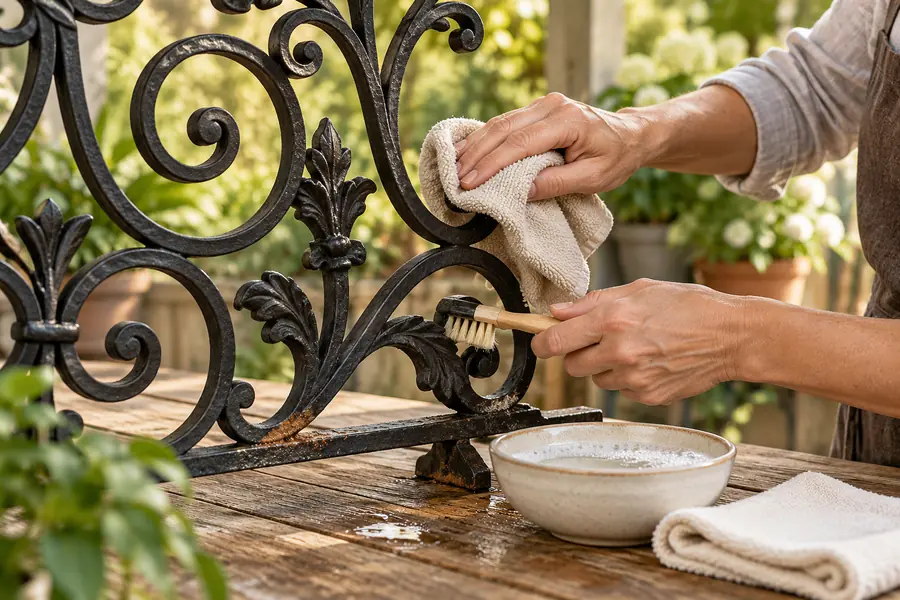
A simple routine works well:
- Inspect the plant.
- Support delicate leaves.
- Use microfiber on broad surfaces.
- Use a soft brush for small details.
- Use cool airflow where appropriate.
- Clean the planter.
- Reshape branches.
Natural Plants Also Collect Dust
Living leaves need cleaning too.
Dust can reduce their visual quality and may interfere with the amount of light reaching leaf surfaces.
So dusting is not an artificial-only task.
The difference is that living plants add horticultural maintenance on top of surface cleaning.
Maintenance Comparison
| Task | Natural | Artificial |
|---|---|---|
| Water | Yes | No |
| Fertilize | Sometimes | No |
| Prune | Often | No biological pruning |
| Repot | Periodically | Usually no |
| Pest inspection | Yes | Not for plant pests |
| Grow light | Sometimes | No |
| Dust | Yes | Yes |
| Reshape | Occasionally | Yes |
| Replace damaged leaves | Naturally/new growth or pruning | Component replacement |
| Soil care | Yes | No true growing soil required |
Artificial Plants Can Fade
No watering does not mean no environmental damage.
Artificial foliage may deteriorate from:
- Strong sunlight
- UV exposure
- Excessive heat
- Abrasion
- Chemical cleaners
Non-outdoor-rated faux plants placed near strong sun may fade more quickly. Current artificial-plant care guidance also recommends keeping unsuitable faux greenery out of harsh direct sunlight or choosing UV-resistant products for bright exposure.
Natural Plants Can Recover
This is one advantage artificial products do not have.
A living plant can sometimes replace:
- Damaged leaves
- Old foliage
- Pruned growth
through new biological growth.
An artificial leaf cannot heal.
Once it becomes:
- Torn
- Permanently faded
- Cracked
- Melted
- Detached beyond repair
it must be repaired or replaced.
Maintenance Cost Depends on Scale
For one plant at home, watering may take only seconds.
For 500 plants across a commercial property, maintenance becomes an operating system.
Living plant programs may require:
- Horticultural staff
- Plant service contracts
- Watering schedules
- Replacement stock
- Access equipment
Artificial commercial greenery replaces much of that horticultural maintenance with periodic cleaning and condition inspection.
This is one reason artificial plants can make more operational sense in:
- Hotels
- Malls
- Offices
- Restaurants
- Retail chains
But “Zero Maintenance” Is Still the Wrong Claim
A dusty, faded, leaning artificial plant is not performing successfully.
The more accurate description is:
low horticultural maintenance, not zero maintenance.
What Are the Disadvantages of Artificial Plants?
Artificial plants provide convenience, but they also have real limitations involving biological authenticity, material use, recycling, fading, dust, and close-view realism.
The main disadvantages of artificial plants are that they do not grow or change naturally, cannot reproduce the full experience of living greenery, may contain mixed plastics, fabrics, wire, foam, or coatings that are difficult to recycle, can fade or collect dust, and vary dramatically in realism. Premium faux plants can also have a higher upfront cost.
1. Artificial Plants Are Not Alive
This is their most fundamental limitation.
You do not get:
- New leaves
- New shoots
- Flowers developing naturally
- Seasonal change
- Growth
- The experience of plant care
For someone who enjoys horticulture, those qualities may matter more than convenience.
2. Artificial Plants Cannot Fully Copy Natural Variation
Premium artificial plants have improved considerably.
High-quality products may include:
- Matte leaves
- Several shades of green
- Printed veins
- Flexible branches
- Realistic trunks
- Irregular leaf sizes
Current 2026 comparisons note how much premium faux plants have improved in color variation, surface texture, and flexible construction.
But close inspection can still reveal:
- Mold repetition
- Seams
- Wire
- Printed surfaces
- Glue
- Repeated leaf shapes
Living plants remain the reference being copied.
3. Cheap Artificial Plants Can Look Very Artificial
Quality variation is enormous.
A poor faux plant may have:
- Bright plastic shine
- One flat green color
- Identical leaves
- Perfect symmetry
- Obvious molded stems
- Visible glue
A premium artificial tree can cost considerably more because producing convincing botanical detail requires better materials and more complex assembly.
4. Faux Plants Can Collect Visible Dust
A glossy leaf plus dust is particularly noticeable.
Dust can:
- Gray the color
- Highlight mold lines
- Make surfaces look plastic
- Accumulate in leaf joints
The plant must therefore be included in the cleaning schedule.
5. Artificial Plants Can Fade
Artificial plants may retain their overall shape, but color is not automatically permanent.
Direct sunlight and UV exposure can degrade some:
- Pigments
- Plastics
- Fabrics
- Coatings
Outdoor projects should therefore use products specifically designed for the intended exposure.
6. Artificial Plants Use Manufactured Materials
Many artificial plants combine materials such as:
- Plastic
- Polyester fabric
- Metal
- Foam
- Adhesive
- Polymer coatings
Mixed construction can complicate recycling.
A recent sustainability assessment similarly notes that artificial plants are not environmentally neutral and that mixed materials can make end-of-life recycling difficult.
Do Not Assume Real Is Automatically Sustainable Either
The environmental comparison is more complicated than:
Natural = sustainable
Artificial = unsustainable
Real plants may involve:
- Greenhouse heating
- Irrigation
- Fertilizer
- Plastic nursery pots
- Transport
- Replacement
- Growing media
Artificial plants involve manufactured materials but may remain in service for years.
The meaningful comparison therefore depends on the entire lifecycle.
For faux greenery, one of the strongest environmental strategies is simple:
buy fewer, better products and use them for a long time.
7. Premium Faux Plants Can Cost More Up Front
A small natural houseplant can be inexpensive.
A highly realistic artificial:
- Olive tree
- Ficus
- Bird of paradise
- Palm
may cost considerably more initially.
Current 2026 real-versus-artificial comparisons generally identify this same pattern: lower upfront cost is often possible with living plants, while premium faux products may involve a larger initial purchase.
8. Faux Plants Do Not Provide the Experience of Caring for Something Living
For many plant owners, watering is not simply maintenance.
They enjoy:
- Watching a new leaf unfold
- Propagating
- Repotting
- Seeing a plant grow
- Learning horticultural skills
Artificial plants cannot provide that experience.
Natural Plants Have Disadvantages Too
A balanced comparison should include both sides.
Real plants can:
- Die
- Wilt
- Drop leaves
- Outgrow their location
- Develop pests
- Require repotting
- Need supplemental light
- Need regular care
Indoor light is especially important. Iowa State notes that even bright indoor environments provide much less light than outdoors, and supplemental lighting may be necessary when suitable window conditions are unavailable.
Key Disadvantages Side by Side
| Natural Plants | Artificial Plants |
|---|---|
| Need suitable light | No living growth |
| Need water | Can look synthetic |
| Can die | Can fade |
| May get pests | Collect dust |
| Require ongoing care | Mixed materials |
| May outgrow space | Often difficult to recycle |
| Appearance changes | Cannot regenerate damage |
| Replacement may be needed | Premium quality can cost more initially |
Neither side is problem-free.
They simply have different problems.
Can You Mix Real and Artificial Plants?
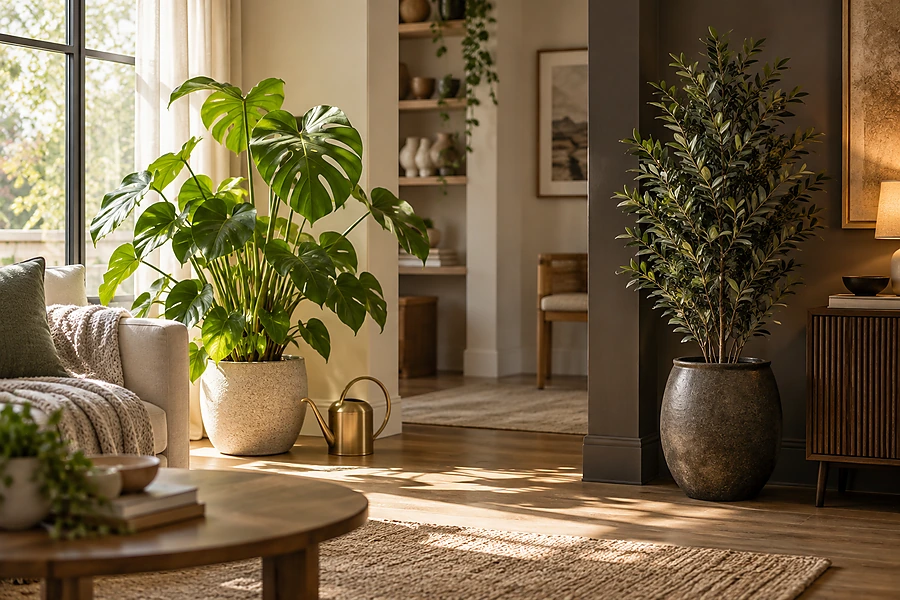
Real and faux greenery can work very well together because the living plants can occupy locations that support healthy growth while artificial plants fill difficult zones.
Yes, mixing natural and artificial plants is often the most practical strategy. Place real plants close to suitable light and where watering is easy, then use premium faux greenery in dark corners, high shelves, windowless rooms, or difficult commercial locations. Similar planters, plant scale, colors, and styling help both types read as one unified scheme.
A Hybrid Strategy Solves the Wrong-Plant-Wrong-Place Problem
Imagine a large room with:
- South-facing windows
- A dark hallway
- A high bookshelf
- A central coffee table
There is no reason every location needs the same solution.
Use:
Real plants
- Near suitable windows
- On accessible tables
- Where someone can inspect them
Artificial plants
- Deep hallway
- High shelf
- Dark corner
This approach follows the horticultural principle of matching living plants to appropriate conditions rather than forcing them into unsuitable places.
University of Florida Extension describes this as essentially “right plant, right place”, emphasizing that indoor plant selection should begin with the amount of available light.
Keep the Planters Consistent
A common reason mixed greenery looks disconnected is not the plants.
It is the containers.
For both real and faux, use related materials such as:
- Terracotta
- Stoneware
- Matte ceramic
- Textured composite
- Woven baskets
A premium faux olive tree in a large terracotta pot will integrate more naturally with real plants than the same tree left in a tiny black shipping pot.
Match the Plant Scale
Use believable proportions.
A large room may need:
- One 180 cm statement tree
- Two medium plants
- A few smaller botanical accents
Do not use twenty small faux plants just because they require little maintenance.
Mix Species That Make Sense Together
For example:
Real
- Pothos
- Snake plant
- ZZ plant
Faux
- Olive tree
- High-shelf trailing philodendron
The arrangement feels believable because all the plants belong naturally within an interior botanical language.
Use the Best Faux Quality in Close-View Locations
Viewing distance matters.
A fake plant placed:
- Beside a sofa
- On a desk
- At eye level
needs stronger realism than a tree:
- Across a hotel lobby
- Above shelving
- Behind a reception desk
Premium close-view greenery should have:
- Matte surfaces
- Color variation
- Irregular branching
- Detailed veins
- Realistic trunks
- Natural proportions
Commercial Hybrid Design
Mixing is especially useful for offices and hotels.
For example:
Hotel lobby
- Living large plants near daylight
- Artificial plants in dark corridors
Office
- Living plants beside windows
- Faux trees in internal meeting spaces
Restaurant
- Living greenery in protected bright zones
- Artificial hanging greenery in difficult overhead positions
This lets the designer use the strengths of each material.
A Simple Decision Matrix
| Location | Natural | Artificial | Hybrid |
|---|---|---|---|
| Bright living room | Excellent | Good | Excellent |
| Dark hallway | Poor | Excellent | Good |
| Windowless office | Difficult without grow lights | Excellent | Good |
| High shelf | Difficult | Excellent | Excellent |
| Sunroom | Excellent | Usually unnecessary | Good |
| Vacation home | Possible | Excellent | Excellent |
| Hotel lobby | Excellent if maintained | Excellent | Excellent |
| Elevator lobby | Difficult | Excellent | Excellent |
| Indoor garden | Excellent | Limited role | Good |
| Retail display | Possible | Excellent | Excellent |
Mixing Can Also Improve Realism
A room containing both living and faux plants naturally contains more variation in:
- Leaf direction
- Growth stage
- Color
- Height
- Shape
The artificial plants should not be designed to deceive guests intentionally.
They simply need to support the same visual language.
My Insights: What Are the Key Differences Between Natural and Artificial Plants
The most important difference is not appearance. It is function: natural plants are biological systems, while artificial plants are decorative products.
Natural plants grow, photosynthesize, need suitable light and water, change over time, and require horticultural care. Artificial plants remain visually consistent, need no water or grow lights, tolerate locations unsuitable for living plants, and mainly require cleaning. The best choice depends on authenticity, maintenance, placement, lifecycle cost, and the purpose of the space.
My First Insight: Light Creates the Biggest Placement Difference
Many people compare real and artificial plants based on appearance.
I would begin with light.
Illinois, Maryland, Iowa State, and Florida extension guidance all emphasize how important adequate light is to living indoor plants.
This makes the decision easy in some locations.
Bright window: real is practical.
Windowless corridor: faux is practical.
My Second Insight: Artificial Plants Replace Horticulture, Not Cleaning
The phrase “maintenance-free” is too strong.
Faux plants eliminate:
- Watering
- Fertilizing
- Repotting
- Grow lights
- Plant disease management
But they still need:
- Dusting
- Cleaning
- Reshaping
- Damage checks
Call them low-maintenance décor, not zero-maintenance objects.
My Third Insight: Real Plants Win on Biological Authenticity
No manufactured product can literally reproduce:
- Growth
- New leaves
- Natural movement
- Biological variation
If those qualities are important to the room, living plants remain the stronger choice.
My Fourth Insight: Artificial Plants Win on Predictability
A designer can specify:
20 artificial olive trees, each approximately 180 cm tall.
Those trees can remain almost the same height and visual density for the duration of the installation.
Twenty living trees will naturally develop differently.
That makes faux greenery useful for:
- Multi-site retail
- Hotels
- Franchises
- Events
- Model homes
My Fifth Insight: Do Not Buy Real Plants for Impossible Locations
A common design mistake is choosing a living plant because it looks beautiful in photographs and then placing it where it cannot receive enough light.
Iowa State notes that even places only several feet from bright windows may be too dark for successful houseplant growth.
The more sensible options are:
- Change the species
- Add proper grow lighting
- Move the plant
- Use faux greenery
My Sixth Insight: Do Not Buy Faux Plants Where Living Growth Is the Point
The opposite mistake also exists.
If the goal is:
- Gardening
- Propagation
- Plant collecting
- Watching growth
an artificial plant will never deliver that experience.
Convenience is not automatically better.
My Seventh Insight: Air-Purification Claims Need Restraint
This is one of the clearest areas where marketing language needs correction.
EPA says there is currently no evidence that a reasonable number of houseplants removes significant amounts of indoor pollutants in homes and offices.
So do not choose twenty natural plants expecting them to replace good ventilation.
Choose them because you want living plants.
My Eighth Insight: Compare Lifecycle Cost, Not Only Purchase Price
Natural plants can have lower initial prices.
Their longer-term costs can include:
- Replacement
- Fertilizer
- Soil
- Planters
- Grow lights
- Maintenance labor
Artificial plants may cost more initially but normally avoid most horticultural costs.
Current 2026 comparison guides reflect this difference between upfront cost and ongoing maintenance.
For commercial buyers, calculate:
Lifecycle cost = purchase + installation + maintenance + replacement + energy/water requirements + disposal
Do not compare two shelf prices alone.
My Ninth Insight: Environmental Impact Is Not a One-Word Answer
Artificial plants contain manufactured materials and may be difficult to recycle.
Living plants can also involve transport, plastic pots, growing media, water, and replacement.
The strongest faux-plant strategy is therefore:
- Choose durable quality
- Avoid short-lived trends
- Maintain the plant
- Reuse it for years
- Replace components instead of complete displays where possible
My Tenth Insight: Hybrid Is Often the Strongest Answer
The real-versus-fake debate makes people think they must choose one camp.
They do not.
I would use:
Real plants where biology can succeed.
Artificial plants where consistency and placement flexibility matter.
This produces a more practical interior than forcing one solution into every zone.
Natural vs Artificial Plants: Final Comparison
| Key Difference | Natural Plant | Artificial Plant |
|---|---|---|
| Nature | Living organism | Manufactured replica |
| Growth | Grows and changes | Fixed |
| Light | Required | Not required for survival |
| Water | Required | Not required |
| Soil | Usually required | Decorative filler only |
| Fertilizer | Sometimes | Never |
| Pruning | Often | No biological pruning |
| Dusting | Required | Required |
| Pests | Possible | No biological plant pests |
| Dark locations | Limited | Excellent |
| Authenticity | Highest | Quality-dependent |
| Consistency | Variable | High |
| Upfront cost | Often lower | Premium faux may cost more |
| Ongoing care | Higher | Lower |
| Regeneration | Can produce new growth | Cannot heal |
| Recycling | Depends on system | Mixed materials may be difficult |
| Commercial standardization | Harder | Easier |
| Best use | Suitable growing conditions | Difficult or low-maintenance zones |
My Practical Decision Rule
Ask these six questions:
- Is there enough appropriate light?
- Who will water and maintain the plant?
- Does the plant need to remain visually identical?
- How closely will people view it?
- How long will the installation remain in place?
- Is living growth part of the experience?
If suitable light and maintenance exist and natural growth matters, choose real.
If the zone is dark, difficult to access, or requires long-term visual consistency, premium artificial greenery is often the stronger practical choice.
If the building contains both situations, use both.
Conclusion
Natural plants offer genuine growth and biological character; artificial plants offer consistency, placement freedom, and lower horticultural maintenance. The best interiors match each option to the conditions rather than choosing one universally.