


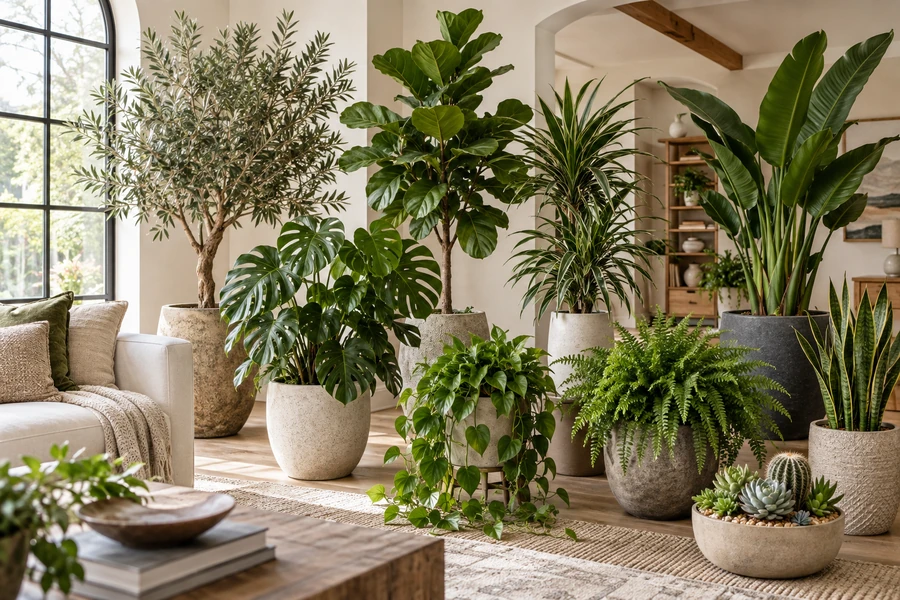
Some artificial plants look convincing across a room but immediately reveal shiny leaves, repeated shapes, cheap trunks, or visible foam when you move closer.
The most realistic artificial plants are usually olive trees, monstera, fiddle-leaf figs, dracaena, bird of paradise, snake plants, succulents, cacti, agave, pothos, and high-quality ferns. Look for matte multi-tone foliage, irregular branching, realistic trunks, molded PE or Real Touch leaves where appropriate, and substantial planters with natural-looking top dressing.
The best choice depends on the species. Thick tropical leaves are often most convincing in molded polymers, while thin ferns and trailing foliage can look more natural in fine polyester. Realism comes from matching the artificial material to the biology of the living plant.
Which Artificial Plants Look the Most Realistic?
Some plant species translate into artificial form better than others because their natural leaf shape, texture, or growth habit is easier to reproduce convincingly.
Artificial olive trees, monstera, fiddle-leaf figs, dracaena, snake plants, bird of paradise, succulents, cacti, agave, pothos, and premium ferns are among the strongest choices. Olive trees hide manufacturing repetition through small irregular leaves, while monstera, succulents, and tropical foliage benefit from detailed molded leaves that reproduce natural thickness and veining.
1. Artificial Olive Trees
Olive trees are one of my safest recommendations when someone wants a large faux tree that does not immediately look artificial.
Their natural appearance helps.
Real olive trees have:
- Small leaves
- Narrow foliage
- Silver-green color
- Irregular branching
- Characterful trunks
Because the leaves are relatively small, there is less large plastic surface area catching light.
Leaf’s current 2026 guide ranks artificial olive trees among its strongest realistic options, highlighting their two-tone silver-green foliage and naturally irregular appearance.
Architectural Digest also includes faux olive trees among its current lifelike artificial-plant recommendations.
For maximum realism, look for:
natural wood or highly detailed trunk + varied branch angles + muted foliage + irregular canopy.
Avoid an olive tree where every branch curves outward at exactly the same angle.
2. Artificial Monstera
Monstera is another excellent artificial species.
The real plant already has:
- Large sculptural leaves
- Deep veins
- Holes and splits
- Distinctive geometry
These features translate well into molded PE.
Current 2026 materials guidance explains that injection-molded polyethylene can reproduce three-dimensional vein structures, leaf curl, and shape more effectively than flat printed fabric.
Architectural Digest and The Spruce both include monstera among their realistic faux selections.
Check that the plant includes:
- Several leaf sizes
- Different fenestration patterns
- Some younger unsplit leaves
- Adjustable stems
A monstera containing 20 identical large leaves looks manufactured.
3. Fiddle-Leaf Fig
Fiddle-leaf figs are visually dramatic and difficult to keep happy as living houseplants, which makes them a popular faux choice.
Their leaves are:
- Large
- Thick
- Heavily veined
- Irregularly shaped
That makes good molded construction valuable.
Architectural Digest highlights faux fiddle-leaf figs with color variation as particularly convincing, while The Spruce’s tested selection also includes a six-foot artificial fiddle-leaf fig with varied foliage.
Look closely at the trunk.
A realistic canopy attached to a perfectly smooth brown plastic pole weakens the entire illusion.
4. Dracaena
Dracaena can be surprisingly convincing because its foliage naturally forms loose clusters rather than a perfect symmetrical canopy.
Real Simple’s September 2026 interior-design coverage specifically recommends realistic faux dracaena as a way to add greenery, with the styling advice to upgrade the planter and cover the artificial base with natural material such as dried Spanish moss.
For dracaena, prioritize:
- Uneven leaf lengths
- Natural droop
- Matte foliage
- Several green tones
- Textured stems
It works especially well in:
- Office corners
- Living rooms
- Bedrooms
- Reception areas
5. Snake Plants
Snake plants are naturally architectural.
Their leaves are:
- Thick
- Upright
- Relatively rigid
That shape works well with molded polymer materials.
A good artificial snake plant should include variation in:
- Height
- Lean
- Stripe pattern
- Leaf width
Do not choose one where every leaf resembles the same printed blade.
6. Succulents
Succulents are among the easiest plants to reproduce convincingly when the material quality is good.
Their real leaves already look:
- Thick
- Waxy
- Sculptural
TidyPlant’s 2026 realism guide identifies succulents as one of the botanical forms that translate particularly successfully into premium Real Touch materials because their geometry is clear and reproducible.
Good species include:
- Echeveria
- Aloe
- Sedum
- Haworthia
Small succulents are also useful because there is less plant for the eye to inspect.
7. Cacti and Agave
Cacti and agave can be extremely convincing because they do not require delicate fabric foliage.
Architectural Digest currently includes both a textured artificial cactus and a high-end faux agave among its lifelike recommendations.
These work particularly well in:
- Modern interiors
- Southwestern spaces
- Minimalist rooms
- Offices
Look for matte material rather than glossy green plastic.
8. Bird of Paradise
Bird of paradise is one of the strongest large-scale options.
Its real leaves are:
- Large
- Sculptural
- Upright
- Naturally imperfect
Architectural Digest and The Spruce both include artificial bird-of-paradise plants in their recommended selections.
The important detail is leaf damage.
Living bird-of-paradise leaves often develop:
- Small splits
- Irregular edges
- Different angles
A faux version that is absolutely perfect can paradoxically look less realistic.
9. Pothos
Trailing foliage is useful because natural drape hides some of the structure connecting artificial leaves.
Architectural Digest highlights faux pothos as a convincing option for higher shelves where the stems can cascade naturally.
Use pothos on:
- Floating shelves
- Bookcases
- Tall cabinets
- Bathroom shelving
Spread the vines irregularly instead of arranging them at identical lengths.
10. Ferns
Ferns are an interesting exception to the assumption that molded Real Touch is always best.
Real fern foliage is extremely:
- Thin
- Flexible
- Fine
Current 2026 material guides note that polyester fabric can actually be better suited to delicate foliage because it creates the thinness and drape that molded PE does not reproduce as naturally.
Architectural Digest also includes artificial Boston fern among its current recommendations.
Most Realistic Artificial Plants at a Glance
| Plant Type | Why It Works |
|---|---|
| Olive tree | Small leaves hide artificial texture |
| Monstera | Molded veins and splits reproduce well |
| Fiddle-leaf fig | Thick structured leaves |
| Dracaena | Naturally irregular foliage |
| Snake plant | Strong architectural shape |
| Succulent | Thick Real Touch leaves |
| Cactus | Sculptural form |
| Agave | Molded leaves work naturally |
| Bird of paradise | Large structured foliage |
| Pothos | Trailing habit hides construction |
| Fern | Fine fabric can mimic natural drape |
What Materials Make Artificial Plants Look Real?
Material matters because different manufacturing methods produce very different leaf thickness, reflection, texture, movement, and edge quality.
The most realistic artificial plants commonly use molded polyethylene for three-dimensional foliage, polyurethane Real Touch coatings for soft close-view surfaces, polyester fabric for thin and delicate leaves, and natural wood or high-quality molded trunks. No single material is best for every species; the material should reproduce how that particular living plant naturally looks and moves.
Molded Polyethylene
PE is one of the strongest materials for substantial foliage.
Current materials guidance describes it as being injection molded into three-dimensional foliage that can hold:
- Leaf veins
- Curvature
- Thickness
- Stem detail
better than flat cut material.
PE works particularly well for:
- Monstera
- Rubber plant
- Fiddle-leaf fig
- Succulents
- Tropical foliage
Real Touch / PU Coatings
“Real Touch” can refer to a soft polyurethane-style surface treatment applied to artificial foliage.
It creates a:
- Matte
- Slightly yielding
- Less obviously plastic
surface.
Current 2026 materials guides emphasize that Real Touch is generally most useful at eye level and within touching distance, where tactile realism can actually be noticed.
That means paying for Real Touch on every hidden leaf inside a seven-foot tree may not provide much additional visual value.
Polyester “Silk”
Modern artificial plants advertised as silk plants are usually made from polyester fabric rather than genuine silk.
Polyester has one big visual advantage:
movement.
It works well for:
- Ferns
- Blossom
- Thin leaves
- Grasses
- Trailing foliage
because lightweight fabric can fold and drape more naturally than thick molded plastic.
PVC
PVC remains common at lower price points.
Current materials comparisons generally describe it as flatter and more repetitive than molded PE, particularly when made from cut or pressed strips.
That does not mean every PVC plant looks terrible.
But for close-view premium greenery, I generally prefer better molded PE, PU, or thoughtfully used polyester.
Natural Wood Trunks
For artificial trees, the trunk may matter as much as the leaves.
Natural wood provides genuine:
- Bark
- Knots
- Irregularity
- Color variation
that factories otherwise have to imitate.
Current artificial-tree materials guides identify natural wood as one of the strongest options for close-view trunk realism.
Best Material by Plant
| Plant | Material to Look For |
|---|---|
| Monstera | Molded PE / Real Touch |
| Rubber plant | PE / PU |
| Snake plant | Molded polymer |
| Succulent | PU / Real Touch |
| Agave | Molded PE |
| Fiddle-leaf fig | Molded PE / mixed |
| Fern | Fine polyester |
| Pothos | Polyester or mixed |
| Olive tree | Mixed foliage + realistic trunk |
| Dracaena | PE/polyester hybrid |
| Large commercial tree | Mixed materials |
The best plants often mix materials rather than using one technology everywhere.
How Can You Tell if an Artificial Plant Is High Quality?
A high-quality artificial plant should remain believable not only in a product photo, but also under normal room lighting and at close viewing distance.
Check five things: matte or species-appropriate leaf finish, several natural color tones, irregular branching, realistic stems or trunks, and a believable base. Avoid perfectly identical leaves, excessive plastic shine, visible mold seams, exposed foam, and branches arranged in obvious repeated patterns. The best faux plants reproduce natural imperfection rather than perfect symmetry.
Check the Shine
Shine is one of the fastest ways to spot low-quality artificial foliage.
That does not mean every real leaf is matte.
A rubber plant naturally has some sheen.
An olive tree should not look like polished vinyl.
Good manufacturers match the surface to the actual species.
Look for Several Greens
One flat green across an entire plant is rarely convincing.
Current 2026 realism guides repeatedly emphasize natural color variation as an important quality signal.
Look for:
- Dark mature foliage
- Pale new growth
- Lighter undersides
- Brown or green stems
- Subtle variation between leaves
Look for Imperfection
Nature repeats patterns.
It does not copy and paste them perfectly.
A convincing artificial plant should have:
- Different leaf angles
- Different heights
- Uneven branch density
- Open spaces
- Asymmetry
The Spruce’s designer guidance similarly recommends faux plants with natural imperfections and varied shades rather than bright, overly glossy foliage.
Inspect Leaf Edges
Move close.
Look at the leaf edge.
Cheap artificial plants may show:
- Fabric threads
- Rough cutting
- Heavy molded seams
- Unnatural thickness
Premium molded foliage usually has a cleaner transition from top surface to edge.
Inspect the Trunk
For large trees, ask:
- Is it natural wood?
- Does the bark repeat?
- Is there a visible mold seam?
- Are branches connected convincingly?
- Does the trunk taper naturally?
A premium canopy cannot completely disguise an obviously synthetic trunk.
Check the Base
Current styling guidance consistently identifies exposed plastic pots or foam as realism killers.
A plant may arrive in a small weighted nursery pot for shipping.
That is fine.
It does not mean the shipping pot should be the final display.
Use the Three-Distance Test
I recommend inspecting artificial plants at:
30 cm
- Texture
- Seams
- Leaf edges
2 meters
- Color
- Branch structure
Across the room
- Silhouette
- Scale
A high-quality artificial plant should survive all three reasonably well.
Realistic vs Artificial-Looking
| More Realistic | More Artificial |
|---|---|
| Multi-tone foliage | One flat green |
| Natural matte finish | Uniform plastic shine |
| Several leaf sizes | Identical leaves |
| Irregular branching | Perfect symmetry |
| Detailed trunk | Plastic pole |
| Adjustable stems | Rigid repeated branches |
| Natural planter | Tiny transport pot |
| Hidden base | Visible foam |
How Do You Make Fake Plants Look More Realistic at Home?
Even a good faux plant can look artificial if it is left compressed from shipping or displayed in an undersized plastic nursery pot.
Make artificial plants look more realistic by reshaping every branch, varying leaf angles, placing the plant in a larger ceramic, terracotta, stone, or woven planter, and hiding the transport pot with moss, bark, pebbles, or another natural-looking top dressing. Choose a realistic scale and place the plant where that species could plausibly grow.
1. Reshape It After Unpacking
Artificial plants are compressed for transport.
Do not display them straight from the box.
Spread:
- Main branches
- Side stems
- Leaves
until the plant develops a natural silhouette.
Avoid radial perfection.
2. Upgrade the Planter
This may be the single easiest improvement.
Architectural Digest recommends ceramic pots as an aesthetic upgrade for faux plants, while current Real Simple and The Spruce styling advice also emphasizes better planters.
Try:
- Terracotta
- Handmade ceramic
- Stone-look pot
- Woven basket
- Textured neutral planter
The planter should visually support the size of the plant.
3. Hide the Artificial Base
Real Simple’s September 2026 designer advice specifically suggests adding dried Spanish moss around faux dracaena to improve authenticity.
Other options can include:
- Decorative moss
- Bark
- Pebbles
- Suitable faux soil
Do not expose a rectangular foam block beneath premium foliage.
4. Choose the Right Size
A four-foot plant in a huge double-height room may look like décor rather than vegetation.
A seven-foot tree squeezed onto a tiny bathroom shelf creates the opposite problem.
Scale the artificial plant to:
- Ceiling height
- Furniture
- Available floor area
5. Put It Somewhere Botanically Plausible
Artificial plants do not need light.
But if realism is your goal, placement should make sense.
An artificial tropical tree in a completely dark cupboard can visually signal that it is fake.
You can place faux greenery in low-light spaces, but allowing the room to suggest a believable plant location often strengthens the illusion.
6. Mix Faux With Real Plants
The Spruce’s designer advice recommends mixing artificial and living plants, particularly in locations where the grouping visually blends together.
A useful strategy is:
real plants
near suitable windows
plus
faux plants
in difficult corners or high shelves.
The viewer stops analyzing which is which.
7. Keep Them Clean
Dust creates an immediate giveaway.
It settles particularly visibly on:
- Dark broad leaves
- Horizontal surfaces
- Leaf veins
A plant that looked premium when purchased can look inexpensive after months of neglect.
8. Use Fewer, Better Plants
One convincing artificial olive tree often creates a stronger room than six cheap miniature plants distributed everywhere.
This also lets you spend more on:
- Trunk quality
- Material
- Planter
- Scale
where it matters.
My Insights: What Are the Most Realistic Artificial Plants
There is no universal single winner, but certain species consistently perform better because their natural geometry works well with modern artificial-plant manufacturing.
The most realistic artificial plants are olive trees, monstera, fiddle-leaf figs, dracaena, bird of paradise, snake plants, succulents, cacti, agave, pothos, and premium ferns. For close viewing, prioritize molded PE or Real Touch foliage; for delicate leaves, premium polyester can look more natural. Botanical accuracy, color variation, trunk quality, asymmetry, and styling matter more than the word “premium.”
My First Insight: Olive Is My Safest Large-Tree Choice
If someone wants one artificial floor tree without knowing where to start, I would investigate an olive tree first.
Why?
Its:
- Small leaves
- Muted color
- Naturally irregular shape
make synthetic construction harder to detect.
Current 2026 specialist guidance similarly ranks olive trees extremely highly for realism.
My Second Insight: Succulents Are My Safest Tabletop Choice
Their natural geometry suits molding extremely well.
A premium faux aloe or echeveria does not need delicate fabric movement.
It needs:
- Correct shape
- Matte texture
- Natural color variation
Those are achievable with high-quality molded materials.
My Third Insight: Monstera Is Excellent When the Molding Is Good
Large leaves are risky because people can see them clearly.
But they are also an opportunity.
A properly molded monstera can reproduce:
- Deep veins
- Curves
- Fenestrations
very effectively.
Cheap flat versions, however, become obvious quickly.
My Fourth Insight: Real Touch Is Most Valuable Within Arm’s Reach
Do not pay for tactile realism where nobody can touch the plant.
I would prioritize Real Touch for:
- Desks
- Coffee tables
- Reception counters
- Low shelving
Current materials guidance makes the same point: premium surface treatments create the most value near eye and hand level.
My Fifth Insight: “Silk” Can Sometimes Look More Real Than Plastic
This sounds counterintuitive.
But a real fern leaf is thin.
A thick molded plastic fern can therefore look wrong.
Premium polyester can provide the correct:
- Weight
- Drape
- Thinness
for fine foliage.
Material realism means choosing the correct material, not the most expensive one.
My Sixth Insight: The Trunk Can Ruin a $500 Tree
When evaluating a tall artificial tree, I would spend almost as much time inspecting the trunk as the foliage.
Look for:
- Natural irregularity
- Convincing bark
- Non-repetitive branching
- No obvious assembly points
The eye reads the entire tree, not just the leaves.
My Seventh Insight: The Planter Is Part of the Plant
Current decorating guidance repeatedly recommends replacing or disguising the original transport pot.
I agree.
For a premium result, think of the purchase as:
plant + planter + top dressing
not simply:
plant.
My Eighth Insight: Avoid Perfect Plants
Perfect symmetry makes manufacturing visible.
The most convincing arrangement has controlled imperfection.
After unpacking:
- Bend one branch outward.
- Leave another closer to the trunk.
- Tilt several leaves.
- Create empty spaces.
You are imitating growth, not arranging spokes on a wheel.
My Ninth Insight: Buy According to Viewing Distance
My buying priorities change dramatically by location.
| Location | Priority |
|---|---|
| Desk | Real Touch texture |
| Coffee table | Leaf detail |
| Living-room corner | Trunk + silhouette |
| Hotel lobby | Scale + canopy |
| High shelf | Shape + drape |
| Ceiling installation | Density + color |
| Outdoor entrance | UV specification |
The closer people are, the more surface quality matters.
My Tenth Insight: Current Design Opinion Is Not Unanimous
It is worth acknowledging that designers do not universally agree about faux greenery.
Real Simple published one September 2026 piece recommending realistic faux dracaena as an affordable styling tool, while another very recent piece quoted designers who prefer replacing faux plants with living or dried botanicals.
Architectural Digest has likewise published both highly realistic faux-plant recommendations and criticism from designers who feel many fake plants still look artificial.
My conclusion is not that artificial plants are always stylish.
It is that quality and restraint matter enormously.
My Top 10 Most Realistic Artificial Plant Types
If I had to create a shortlist, I would start here:
- Olive tree — safest large-tree option
- Monstera — excellent molded leaf detail
- Succulent — extremely convincing at small scale
- Agave or cactus — sculptural and easy to reproduce
- Dracaena — naturally irregular canopy
- Fiddle-leaf fig — strong statement foliage
- Snake plant — simple architectural leaves
- Bird of paradise — excellent large tropical form
- Pothos — natural trailing silhouette
- Premium fern — convincing when the fabric is fine enough
This is not a scientific ranking. It is a practical buying hierarchy based on current editorial recommendations, material characteristics, and how successfully each botanical form translates into faux construction.
My Buying Checklist
Before buying, inspect:
- Leaf material
- Surface shine
- Color variation
- Leaf-size variation
- Mold seams
- Branch adjustability
- Natural asymmetry
- Trunk quality
- Base construction
- Final planter
- Viewing distance
- Indoor or outdoor rating
If shopping online, zoom into:
- Leaf edges
- Stem joints
- Trunk
- Soil line
rather than judging only the styled room photograph.
My Recommended Formula
For the most realistic result indoors, I would use:
**one botanically convincing species
- premium molded or appropriately lightweight foliage
- natural color variation
- irregular branch shaping
- convincing trunk
- oversized decorative planter
- natural-looking top dressing
- regular dusting**
That combination is more reliable than buying a plant simply because the listing says:
ultra-realistic
or
Real Touch.
My Final Answer
So, what are the most realistic artificial plants?
My strongest options are:
olive trees, monstera, fiddle-leaf figs, dracaena, snake plants, bird of paradise, succulents, cacti, agave, pothos, and high-quality ferns.
For thick leaves, look for:
molded PE or premium Real Touch surfaces.
For thin or delicate foliage, look for:
high-quality polyester or intelligently mixed materials.
Then inspect the features that matter even more:
- Matte or botanically correct shine
- Multiple shades of green
- Natural asymmetry
- Realistic stems and trunks
- Several leaf sizes
- A substantial planter
- Hidden artificial base
The most convincing faux plant is not necessarily the most expensive one.
It is the one where material, species, scale, and styling all make botanical sense.
Conclusion
Olive trees, monstera, succulents, dracaena, fiddle-leaf figs, and other structurally distinctive plants often look most realistic when quality materials, natural variation, and thoughtful styling work together.

