


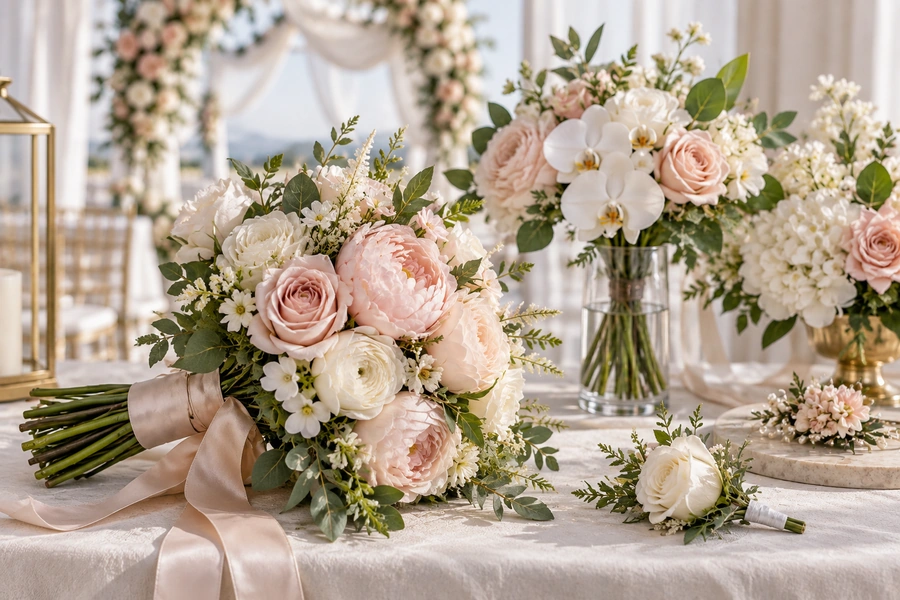
Artificial wedding flowers can save planning stress, but shiny petals, identical blooms, stiff shapes, and obvious fabric edges can quickly reveal that a bouquet is fake.
The most realistic artificial wedding flowers are premium Real Touch roses, peonies, ranunculus, tulips, orchids, dahlias, and anemones, combined with high-quality silk hydrangeas, wildflowers, and foliage. For bridal bouquets and close-up photography, prioritize matte petals, natural color gradients, irregular bloom stages, realistic centers, and flexible wired stems.
The best faux wedding designs rarely depend on one material. Current wedding-flower guidance favors premium Real Touch for close-view focal blooms and quality fabric flowers where thin petals, volume, or natural movement matter more than touch.
Which Artificial Flowers Look Most Realistic for a Wedding?
The most convincing artificial wedding flowers tend to be species whose petal shape, thickness, and natural structure can be reproduced effectively with modern polymers or high-quality fabrics.
Roses, peonies, ranunculus, tulips, orchids, dahlias, anemones, and calla lilies are among the strongest Real Touch choices for weddings. Premium silk hydrangeas, cosmos, poppies, sweet peas, wildflowers, and delicate fillers can also look highly realistic because their natural appearance depends more on thinness, movement, and variation than tactile weight.
Real Touch Roses
If I had to choose one safest artificial wedding flower, I would start with a premium rose.
Roses work well because good manufacturers can reproduce the flower’s most important details: overlapping petals, slightly curled edges, a gradual opening pattern, subtle color shifts, and natural irregularity.
Afloral currently sells Real Touch wedding roses made from mixed polyester, plastic, and wire, illustrating an important point: the term Real Touch does not necessarily identify one standardized material composition. What matters is the final surface and construction.
Look for roses with several bloom stages rather than 20 identical fully open heads. A convincing bouquet might combine tighter buds, medium blooms, and a few large focal roses.
Real Touch Peonies
Peonies are another excellent choice for bridal bouquets.
Their natural petals are:
soft, layered, slightly irregular, and densely arranged.
That complexity helps disguise the internal construction when the flower is made well.
A current Afloral Real Touch peony uses polyester petals with a latex coating plus wire and plastic components, demonstrating how manufacturers combine fabric structure with a softer surface treatment.
Peonies work especially well in:
romantic, garden-style, spring, blush, ivory, and luxury wedding designs.
The main risk is excessive perfection. A real peony does not look like a perfectly spherical ball.
Real Touch Ranunculus
Ranunculus may be one of the best artificial flowers for close-up bouquet work because its many layered petals create visual depth.
Current Real Touch ranunculus products use mixed constructions including polyester, PVC, wire, and soft-touch polyurethane foam depending on the design.
The best versions have:
a slightly darker center, multiple bloom sizes, fine petal edges, and an uneven outer silhouette.
Ranunculus is particularly strong for:
bridal bouquets, bridesmaid bouquets, bud vases, and sweetheart-table arrangements.
Real Touch Tulips
Tulips are difficult to fake cheaply because their petals are smooth and exposed.
That actually makes premium Real Touch especially valuable.
A high-quality tulip should have:
soft curved petals, subtle translucency or color variation, a believable closed-to-open shape, and stems that do not look excessively rigid.
Afloral’s current wedding bouquet recipes include Real Touch tulips alongside Real Touch English roses and eucalyptus, showing how premium faux designers mix tactile focal flowers with supporting foliage.
Orchids
Orchids can look extremely convincing because premium molded materials reproduce their sculptural form well.
Good artificial orchids need:
a realistic center, throat coloring, petal curvature, and natural stem spacing.
They are especially effective for:
modern weddings, tropical weddings, minimalist bouquets, luxury tablescapes, and cascading designs.
Because orchids are often photographed close up, I would avoid inexpensive versions with flat white petals and a printed-looking center.
Anemones
Anemones offer a useful visual contrast because of their strong dark centers.
Afloral currently sells a Real Touch-style white anemone using fabric, plastic, and wire construction, with textured centers designed for close-view arrangements.
They work well in:
black-and-white weddings, modern bouquets, garden-style arrangements, and winter weddings.
The center quality matters more than people expect. A beautiful petal surrounding an obvious plastic center can ruin the illusion.
Dahlias
Dahlias are useful for larger focal blooms.
Current Real Touch dahlia products can use polyurethane and plastic construction to create substantial petal texture and depth.
Because the flower contains many petals, minor differences between artificial and living material become less obvious than with extremely simple flowers.
Premium Silk Hydrangeas
Hydrangeas are a good example of a flower that does not necessarily need Real Touch material everywhere.
A hydrangea head contains dozens of small flowers.
At normal wedding viewing distance, what matters most is:
overall shape, color variation, petal softness, and volume.
High-quality polyester can therefore work extremely well, particularly in:
arches, centerpieces, floral meadows, staircase installations, and backdrops.
Wildflowers and Cosmos
For fine, airy wedding flowers, premium fabric can outperform thick polymer.
Current 2026 faux-wedding guidance notes that flowers such as cosmos, daisies, wildflowers, poppies, and other movement-driven varieties often suit premium silk because their realism comes from softness and drape rather than thick tactile petals.
That is why the most realistic artificial wedding bouquet may contain both Real Touch and silk, not one or the other exclusively.
| Flower Type | Best Starting Material | Best Wedding Use |
|---|---|---|
| Rose | Real Touch / latex-coated | Bridal bouquet |
| Peony | Real Touch | Bridal and bridesmaid bouquets |
| Ranunculus | Real Touch / soft touch | Close-up arrangements |
| Tulip | Real Touch | Modern bouquets |
| Orchid | Molded Real Touch | Luxury/tropical designs |
| Anemone | Real Touch / premium mixed material | Focal flower |
| Dahlia | PU / Real Touch | Large focal bloom |
| Hydrangea | Premium silk/polyester | Volume and installations |
| Cosmos | Premium silk | Airy garden designs |
| Wildflowers | Premium silk | Natural meadow style |
Are Real Touch Flowers Better Than Silk Flowers for Weddings?
Real Touch flowers usually win for close-up tactile realism, but premium silk flowers can be more convincing for delicate flowers, loose movement, and large-scale wedding installations.
Real Touch is generally better for bridal bouquets, boutonnieres, corsages, sweetheart tables, and flowers guests will inspect closely. Premium silk works especially well for hydrangeas, wildflowers, cosmos, poppies, fillers, arches, and large installations. The most realistic wedding florals often combine both rather than insisting every stem use the same material.
What Does “Silk Flower” Mean Today?
The term is misleading.
Modern silk flowers are commonly made from polyester or other synthetic fabrics rather than natural silk.
The Knot notes that artificial wedding flowers sold as silk are often made from another fabric such as polyester.
Fabric has several advantages.
It can be:
lightweight, thin, flexible, and available in an enormous number of botanical varieties.
Those qualities are ideal for large wedding installations.
What Does “Real Touch” Mean?
The term describes a realistic tactile effect rather than one universal manufacturing recipe.
The Knot categorizes polymer or Real Touch wedding flowers as the artificial option closest to genuine petals in appearance and feel. Zola similarly describes fresh-touch or Real Touch flowers as the premium end of faux wedding flowers.
However, current individual product specifications show very different material compositions.
For example, one Real Touch Afloral rose is primarily polyester plus plastic and wire, while a Real Touch peony combines polyester with latex coating, wire, and plastic.
So I would never buy simply because a listing says:
Real Touch.
I would inspect the flower itself.
Where Real Touch Is Worth Paying For
Spend your highest flower budget where the camera and guests will get closest.
That usually means:
bridal bouquet, groom boutonniere, bridesmaid bouquets, corsages, flat-lay detail flowers, sweetheart table, and small dining arrangements.
These flowers may appear in:
portraits, ring photographs, getting-ready photography, ceremony close-ups, and reception detail shots.
Texture matters there.
Where Silk Can Save Money Without Looking Cheap
A ceremony arch may contain hundreds of flowers.
Guests may see it from several meters away.
What matters there is primarily:
silhouette, color, volume, layering, and natural movement.
Premium silk can produce excellent results without paying Real Touch prices for every flower.
Zola notes that silk artificial flowers offer broad variety and can look realistic when slight variations are mixed together, although low-quality edges may fray and tactile realism is lower.
The Hybrid Formula
For many weddings, I prefer:
Real Touch focal flowers + premium silk secondary blooms + realistic foliage.
A romantic bouquet might use Real Touch roses, peonies, and ranunculus with fabric sweet peas and fine foliage.
A ceremony arch might reverse that balance, using mostly premium fabric hydrangeas and wildflowers with selected premium focal blooms at eye level.
That gives you realism where it matters most without overspending everywhere.
Do Artificial Wedding Flowers Look Real in Photos?
High-quality artificial wedding flowers can photograph convincingly, but cameras expose shine, poor edges, flat colors, and repetitive shapes more easily than distant guests do.
Yes, premium artificial wedding flowers can look real in professional photos when the petals are matte, colors have natural gradients, blooms vary in size and opening stage, and the arrangement has irregular movement. Real Touch is especially useful for bridal portraits, while quality silk flowers often photograph well in arches and larger arrangements viewed from farther away.
Cameras Reveal Shine
One of the biggest artificial-flower problems is unnatural reflection.
Cheap petals may become noticeably glossy under:
flash photography, direct sunlight, strong venue lighting, or video lights.
Real petals may have satin or waxy surfaces depending on the species, but they rarely look like polished plastic.
Choose finishes appropriate to the flower.
A rose should not have the same gloss as a waxy tropical leaf.
Cameras Reveal Edges
The outer edge of a petal is another danger zone.
Cheap fabric flowers can show:
fraying, visible cutting, thick fabric texture, or heat-sealed edges.
Zola specifically identifies fraying as one weakness of silk wedding flowers.
Inspect flowers from the angle where a photographer will see them—not only from directly above.
Color Matters More Than You Think
Fresh flowers rarely contain one perfectly uniform shade.
A realistic ivory rose may include:
cream centers, slightly darker outer petals, faint green near the base, and subtle tonal changes.
A fake rose made entirely from one flat RGB-like white can look artificial in photographs.
Look for:
color gradients, muted undertones, slightly different blooms, and realistic flower centers.
Professional Photos Can Still Look Excellent
Current reviews on The Knot’s Ling’s Moment marketplace repeatedly describe artificial arrangements as realistic in person and in professional wedding photographs. Those are customer experiences rather than controlled scientific comparisons, but they demonstrate that high-quality faux florals can work successfully in real weddings.
The key is not simply buying artificial flowers.
It is buying photography-friendly artificial flowers.
Avoid Perfect Bouquet Geometry
A living garden bouquet rarely forms a perfect ball.
Natural arrangements have:
different heights, occasional gaps, varied flower orientations, movement, and several stages of bloom.
Artificial flowers become much more convincing when designers deliberately recreate those imperfections.
A bouquet containing twelve identical roses at exactly the same height tells the camera immediately how it was manufactured.
Test Before the Wedding
Before committing to bulk faux flowers, photograph samples in:
daylight, warm indoor lighting, direct flash, and the approximate lighting conditions of your venue.
Look at the photographs enlarged.
Check:
shine, petal edges, flower centers, stem visibility, foliage, and overall shape.
A flower that looks wonderful in an online catalog may behave differently under your photographer’s flash.
How Do You Choose Artificial Wedding Flowers That Look Real?
The best purchasing method is to evaluate the entire flower rather than trusting labels such as premium, silk, Real Touch, or luxury.
Choose faux wedding flowers by inspecting petal texture, edge quality, color variation, flower centers, bloom sizes, stem construction, foliage, and overall botanical accuracy. Buy samples before placing a large order, photograph them under wedding lighting, and prioritize your best-quality stems for bouquets and other close-view areas. Realistic irregularity matters more than perfect uniformity.
Check the Petals First
For focal flowers, inspect:
surface sheen, thickness, flexibility, vein detail, edge quality, and color transition.
Avoid petals that look:
rubbery in the wrong way, excessively shiny, completely flat, or perfectly identical.
Inspect the Flower Center
People often focus on petals and overlook the center.
For:
anemones, orchids, lilies, poppies, daisies, and cosmos,
the center can determine whether the flower looks convincing.
A premium fabric petal surrounding a bright molded-plastic center still looks fake.
Examine the Back of the Flower
Turn it over.
Look at:
sepals, stem connection, glue, plastic joins, and the underside of petals.
Bridal bouquets are frequently photographed from different angles.
A flower that only looks realistic from the front is not ideal for close-use wedding work.
Check the Stem
Artificial wedding stems usually contain wire, which makes them adjustable but can also make bouquets bulky.
Zola notes that wired artificial stems can create thick, heavy bundles.
For bouquets, make sure the stems can be:
trimmed, wrapped, clustered, and held comfortably.
Buy Several Bloom Stages
A convincing bouquet should not contain only fully open flowers.
Combine:
buds + partially open flowers + full focal blooms.
This is one of the easiest ways to make faux florals imitate real botanical growth.
Order Samples
For a wedding, I would never approve a large faux-flower purchase from product photography alone when realism is a priority.
Order representative samples of the flowers that will appear closest to the camera.
Compare them against:
your dress fabric, venue lighting, table linen, and wedding color palette.
Compare the Actual Materials
A current Afloral Real Touch dahlia is polyurethane and plastic, while another Real Touch rose is mostly polyester. A peony uses polyester with latex coating.
That confirms why the buying question should be:
How realistic is this exact flower?
not:
Does the seller call it Real Touch?
My Buying Scorecard
| Quality Factor | What to Look For |
|---|---|
| Petal surface | Matte or botanically accurate |
| Color | Multiple subtle tones |
| Edges | Clean and soft |
| Centers | Detailed and natural |
| Bloom stages | Buds through full blooms |
| Shape | Slight irregularity |
| Stem | Flexible but not excessively bulky |
| Leaves | Realistic color and texture |
| Photography | Low unnatural shine |
| Touch | Soft where close handling matters |
My Insights: What Are the Most Realistic Artificial Wedding Flowers?
The most realistic artificial wedding flowers are not necessarily the ones made from the most expensive material. They are the flowers whose construction matches the natural species and their role in the wedding.
For close-up wedding florals, my strongest choices are premium Real Touch roses, peonies, ranunculus, tulips, orchids, anemones, and dahlias. For hydrangeas, cosmos, wildflowers, poppies, and other delicate flowers, premium silk can be equally convincing. The most realistic wedding designs usually combine materials and concentrate premium stems where guests and cameras are closest.
My First Insight: Roses Are the Safest Overall Choice
If you want one flower that is widely available, versatile, and convincing in good Real Touch quality, start with roses.
They work for:
classic, romantic, garden, modern, vintage, and minimalist weddings.
Current artificial wedding suppliers offer roses in a wide variety of Real Touch and premium mixed constructions, making it easier to find a quality level and color palette that works.
My Second Insight: Ranunculus May Be the Best Detail Flower
Ranunculus has many small overlapping petals, which naturally creates visual complexity.
That complexity is useful in faux design because the eye sees:
depth, shadow, layering, and variation.
A few premium ranunculus stems around roses or peonies can make an entire bouquet feel more botanical.
My Third Insight: Peonies Need Controlled Imperfection
Peonies are beautiful but dangerous in cheap artificial form.
Avoid perfect fabric balls.
Choose flowers with:
different opening stages, slightly irregular petals, varied centers, and a believable weight.
Premium latex-coated and Real Touch peonies are much stronger for close bridal work.
My Fourth Insight: Use Silk Where Nature Is Naturally Thin
Not every faux flower should be thick and rubbery.
Wildflowers, cosmos, poppies, sweet peas, and similar flowers naturally have:
fine petals, movement, and lightness.
Current 2026 specialist wedding-floral guidance similarly argues that premium silk often suits these varieties better than Real Touch because fabric creates the appropriate drape.
My Fifth Insight: Put the Highest Quality in the Bridal Bouquet
If the budget forces you to choose, spend on the bouquet first.
It appears in:
portraits, ceremony photographs, ring shots, getting-ready photos, and close video.
Use your best:
roses, peonies, ranunculus, tulips, orchids, or anemones there.
A ceremony arch 30 feet away does not need the same tactile specification.
My Sixth Insight: Mix Fresh and Faux When Necessary
You do not have to choose 100% artificial.
A hybrid wedding might use fresh fragrant flowers in the bridal bouquet and faux flowers for the arch.
Or it might use Real Touch focal flowers with fresh greenery.
Zola specifically notes that artificial flowers can be mixed with real blooms.
Hybrid design can improve realism while retaining much of the logistical advantage of faux florals.
My Seventh Insight: Do Not Chase Perfect Uniformity
For wholesale and DIY buyers, consistency often sounds desirable.
But floral realism needs controlled variation.
Use several:
sizes, shades, stem angles, opening stages, and foliage textures.
A tiny amount of imperfection can make an artificial arrangement look significantly more natural.
My Eighth Insight: White Flowers Need Extra Scrutiny
White and ivory are unforgiving.
Under wedding photography, inexpensive white polyester can reveal:
blue undertones, gray fabric texture, excessive brightness, and artificial shine.
If your wedding is mostly white florals, order samples before committing.
Compare the flowers next to the actual:
dress, table linen, and venue lighting.
My Ninth Insight: Material Labels Are Not Quality Guarantees
Current Afloral specifications make this especially clear.
Products marketed as Real Touch can contain very different proportions of:
polyester, polyurethane, latex coating, plastic, PVC, foam, and wire.
Therefore:
Real Touch is a useful buying signal, not proof of realism.
You still need to inspect the product.
My Tenth Insight: The Most Realistic Bouquet Is Usually Hybrid
My preferred premium faux bridal bouquet would not use one artificial-flower technology throughout.
I would combine:
Real Touch roses or peonies for large focal flowers, Real Touch ranunculus or tulips for close detail, premium fabric cosmos or sweet peas for movement, and high-quality foliage for irregular structure.
That variety of surfaces mimics a fresh arrangement better than dozens of identical polymer flowers.
My Top Artificial Wedding Flower Choices
- Real Touch rose — best all-around wedding flower
- Real Touch peony — best romantic focal flower
- Real Touch ranunculus — best layered detail flower
- Real Touch tulip — best minimalist spring flower
- Real Touch orchid — best luxury or tropical choice
- Real Touch anemone — best high-contrast focal bloom
- Real Touch dahlia — best large textured focal flower
- Premium silk hydrangea — best for volume
- Premium silk cosmos or wildflowers — best for airy movement
- High-quality mixed foliage — essential for breaking perfect symmetry
My Final Answer
So, what are the most realistic artificial wedding flowers?
For close-up work, I would choose Real Touch roses, peonies, ranunculus, tulips, orchids, anemones, and dahlias.
For airy flowers and large installations, I would use premium silk hydrangeas, cosmos, wildflowers, poppies, sweet peas, and delicate greenery.
The most convincing wedding arrangement does not need every stem to be Real Touch.
Instead, use:
Real Touch where people look closely, premium silk where softness and volume matter, and natural irregularity throughout the design.
Before buying in bulk, test the flowers under the same conditions in which they will actually be seen:
close up, under daylight, under indoor venue lighting, and through a camera.
If the petals remain convincing in all four situations, you have found a strong artificial wedding flower.
Conclusion
Premium Real Touch roses, peonies, ranunculus, tulips, and orchids excel close up, while quality silk flowers add natural movement and volume. Mixing both usually creates the most convincing wedding florals.

