


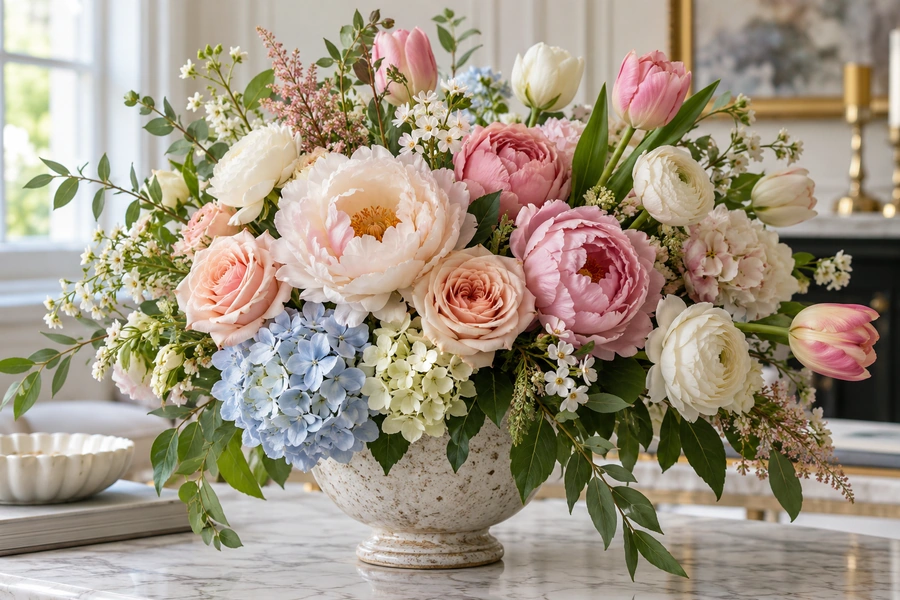
Some artificial flowers feel soft but still look obviously fake. Truly high-quality Real Touch flowers succeed because their materials, proportions, colors, stems, and botanical details work together.
Truly high-quality Real Touch artificial flowers are premium faux blooms designed to reproduce both the appearance and tactile qualities of fresh flowers. I look for botanically accurate shapes, soft PU or latex-type petals, subtle color gradients, matte surfaces, realistic flower centers, flexible wired stems, detailed leaves, clean assembly, and natural variation rather than perfect uniformity.
The term Real Touch is useful, but I do not treat it as a guarantee of quality. Flowers carrying the same label can differ dramatically in material formulation, petal thickness, coloring, construction, and durability. A premium flower needs to remain believable not just when I touch one petal, but when I examine the complete stem.
What Makes a Real Touch Artificial Flower Truly High Quality?
High quality begins with botanical credibility. Softness alone cannot compensate for an inaccurate rose, peony, tulip, or orchid.
A truly high-quality Real Touch flower should resemble the fresh flower it imitates in proportion, petal layering, color, surface texture, flower-center structure, leaf shape, and stem behavior. The best flowers also include controlled irregularity, such as slightly different petal angles, varied leaf positions, and natural-looking color transitions.
Botanical Accuracy Comes First
Before touching the flower, I look at its silhouette.
A rose should have believable petal layering.
A tulip should have the correct cup-shaped bloom.
A peony should show a realistic relationship between its outer petals and dense center.
An orchid should reproduce the characteristic shape of its petals and lip.
This matters because the human eye recognizes botanical structure surprisingly quickly.
A flower can use expensive polyurethane and still look artificial if the flower head is too large for the stem or the leaves are the wrong shape.
When I evaluate a sample, I compare:
| Feature | What I want to see |
|---|---|
| Flower-head size | Appropriate to the real species |
| Petal arrangement | Natural layering |
| Bloom stage | Variation between buds and open flowers |
| Flower center | Detailed rather than molded as one crude piece |
| Leaf shape | Botanically believable |
| Stem thickness | Proportional to the bloom |
| Calyx | Correct shape and color |
| Overall silhouette | Natural rather than perfectly symmetrical |
A realistic flower is a complete botanical object.
The Petals Should Feel Appropriate to the Species
Real Touch materials commonly include polyurethane, latex-type polymers, silicone-like materials, or polymer-coated synthetic fabrics. Premium products use these materials to imitate the compression, flexibility, thickness, and surface feel of living petals.
I do not expect every flower to feel identical.
A tulip has a different petal structure from a rose.
A calla lily feels different from a hydrangea.
A magnolia should not feel exactly like a peony.
That is why I do not use a simple rule such as:
softer = better.
The correct question is whether the material feels appropriate for the botanical flower.
Matte Surfaces Usually Look More Natural
Excessive shine is one of the fastest ways artificial flowers reveal themselves.
Natural petals may have subtle sheen, translucency, or waxiness, but they rarely reflect light like polished plastic.
Current Real Touch comparisons emphasize matte or naturally light-responsive polymer surfaces as one reason higher-quality faux flowers perform better during close-up photography.
I examine flowers in daylight whenever possible.
A stem can look convincing under soft store lighting and suddenly become glossy beside a window.
That is especially important for weddings, hotels, restaurants, and photography.
What Materials Are Used in Premium Real Touch Flowers?
Real Touch is not one standardized material. Different flowers require different construction methods.
Premium Real Touch artificial flowers commonly use polyurethane, latex or synthetic-rubber coatings, silicone-like polymers, coated polyester fabric, flexible plastics, adhesives, pigments, and internal metal wire. PU and latex-style materials are especially valuable for close-up petals because they can reproduce softness, elasticity, and three-dimensional botanical texture.
Polyurethane Can Create Soft Three-Dimensional Petals
PU is widely associated with Real Touch products because it can be molded into detailed shapes.
Manufacturers can reproduce:
petal veins, curved edges, varying thickness, wrinkles, and three-dimensional surfaces.
Current material comparisons describe PU Real Touch flowers as particularly effective for close-contact applications because the material can compress and recover rather than behaving like rigid plastic.
This makes PU useful for flowers such as:
roses, tulips, peonies, calla lilies, and other flowers where tactile realism matters.
I still inspect the actual bloom.
Poor molding, flat color, or an inaccurate shape can make even a PU flower look inexpensive.
Latex-Type Coatings Work Well for Thin Petals
Some Real Touch flowers use polymer-coated fabric rather than fully molded petals.
A textile core gives the petal thinness and flexibility.
The latex or synthetic-rubber-style coating changes the surface so it feels more like natural floral tissue and less like plain polyester fabric.
This can work particularly well when a flower naturally has delicate layered petals.
Premium artificial-flower comparisons in 2026 continue to identify latex and PU as major materials used for tactile realism.
Polyester Is Still Useful
Polyester should not automatically be viewed as low quality.
It is lightweight, easy to shape, and capable of accepting detailed color.
It can be particularly effective for:
hydrangeas, filler blooms, large-volume arrangements, and flowers viewed from farther away.
The limitation is tactile realism.
At very close range, woven texture may reveal that the flower is fabric-based.
That is why premium designs sometimes combine Real Touch focal flowers with high-quality polyester filler blooms.
Mixed-Material Construction Can Be Better
I actually consider mixed materials a sign of intelligent design when each material is used where it performs best.
A premium flower may combine:
| Component | Possible material |
|---|---|
| Main petals | PU or latex-coated fabric |
| Fine petals | Polyester with polymer coating |
| Leaves | PE, PVC, polyester, or coated fabric |
| Calyx | Molded plastic |
| Flower center | Molded polymer |
| Stem surface | Flexible plastic or rubber-like coating |
| Internal structure | Metal wire |
| Assembly | Adhesive |
The question is not whether every part uses the most expensive material.
The question is whether every component supports realism.
How Should High-Quality Real Touch Flowers Be Colored?
Color may reveal quality even faster than touch.
Premium Real Touch flowers use layered, botanical color rather than one flat shade. I look for subtle gradients, deeper tones near flower centers, lighter petal edges, realistic green variations, and small differences between individual blooms. Bright neon greens, perfectly identical petals, and uniform white or pink usually make faux flowers look manufactured.
Real Flowers Rarely Have Flat Color
A white rose may contain:
cream, ivory, pale green, and warmer tones toward the center.
A blush peony may become darker toward its center.
A tulip may shift in color close to the base.
A hydrangea may contain several related colors within one flower head.
High-quality artificial flowers try to recreate this complexity.
Current 2026 Real Touch product testing similarly highlights color variation, veining, and layered pigment as factors that separate more convincing flowers from basic artificial blooms.
I Pay Particular Attention to Green
Petals often receive all the attention.
Leaves can ruin the illusion.
Cheap artificial flowers frequently use one bright green across:
leaves, stems, flower centers, and calyxes.
Nature rarely behaves that way.
I prefer a combination of:
olive green, blue-green, yellow-green, dark green, and muted gray-green
where appropriate to the species.
Leaves should also contain believable veins and edges.
Color Should Work From Multiple Angles
I turn the flower over.
A premium petal should not look beautifully shaded on the front and unfinished on the back.
This matters with flowers placed in centerpieces or open arrangements where guests see them from every side.
Some higher-quality latex flowers now use double-sided printing or coloration specifically to maintain realism from multiple angles.
What Should the Stems and Leaves Look Like?
A beautiful flower head attached to a poor stem is not a high-quality Real Touch flower.
Premium stems should be strong, flexible, bendable, and visually consistent with the bloom. I look for internal wire that holds a natural curve, realistic stem color, discreet joints, botanically correct leaves, and clean transitions between the flower head, calyx, leaves, and stem. Exposed wire, visible glue, rigid plastic rods, and oversized connectors are quality red flags.
Flexibility Matters to Designers
Fresh flowers rarely stand perfectly straight.
Tulips lean.
Roses curve.
Orchids turn toward different directions.
A wired stem allows me to imitate those natural positions.
Current artificial-flower buying guides emphasize flexible internal wire as a major advantage because it lets designers create natural asymmetry rather than arranging every bloom vertically.
When I test a stem, I gently bend it.
Then I check whether it holds the position without kinking.
The Stem Should Not Be Too Thick
Some artificial flowers have large internal wires and heavy plastic coatings.
This can create an unrealistic stem-to-flower ratio.
It also makes bridal bouquets uncomfortable to hold because twenty artificial stems can create a very thick handle.
I therefore evaluate proportion as well as strength.
Leaves Deserve the Same Quality Standard as Petals
I inspect:
leaf veins, thickness, color, edge shape, surface finish, attachment point, and direction.
Leaves should not all sit at exactly the same angle.
Slight variation helps create the appearance of natural growth.
How Can I Test Whether Real Touch Flowers Are Truly Premium?
Marketing descriptions are useful, but I prefer physical samples whenever quality matters.
I test Real Touch flowers by examining them in daylight, touching and compressing the petals, bending the stems, inspecting the reverse side, photographing them close-up, checking seams and glue, comparing multiple stems from the same SKU, and evaluating how well compressed blooms recover after shipping. Professional buyers should approve actual samples rather than relying only on “Real Touch” marketing language.
I Use the Touch Test
I gently press the petal.
I want it to feel flexible.
I want it to recover.
I do not want:
permanent dents, excessive stickiness, cracking, or an unusually hard plastic surface.
Current Real Touch comparisons describe premium polymer petals as able to compress and recover rather than behaving like conventional fabric or rigid plastic.
I Use the Camera Test
This is one of my favorite tests.
I photograph the flower in:
window light, overhead indoor light, close-up mode, and normal room compositions.
The camera can reveal things I overlook in person.
Glossy petals become obvious.
Visible seams appear.
Flat colors lose depth.
This is especially important for weddings, retail displays, hotels, and social-media-driven interiors.
I Inspect the Back
The reverse side tells me how much attention the manufacturer paid to finishing.
I look for:
clean petal edges, believable calyxes, hidden glue, no exposed wire, and consistent color.
A flower designed only to look convincing from the front may work in a wall installation.
It is not my first choice for a bridal bouquet or table centerpiece.
I Compare More Than One Stem
One excellent sample does not prove consistent production.
For large orders, I compare multiple stems.
I check:
flower-head diameter, color, leaf count, petal arrangement, stem length, coating quality, and joint construction.
This matters especially in commercial and wedding projects where hundreds of flowers may need to look consistent without becoming mechanically identical.
Which Flowers Work Best as Real Touch Artificial Flowers?
Some flower types particularly benefit from Real Touch materials because people expect to see and handle them closely.
Real Touch construction is especially effective for roses, tulips, peonies, calla lilies, magnolias, orchids, hydrangeas, and other flowers where petal texture strongly influences realism. For large installations, I may mix premium Real Touch focal flowers with lighter fabric flowers to control weight and cost without sacrificing close-up quality.
Roses
Roses benefit from layered construction and thin petal edges.
I look for:
natural petal curling, deeper center color, realistic outer guard petals, and believable calyx detail.
Tulips
Tulips are ideal candidates for soft Real Touch materials.
Their natural petals have a slightly substantial, almost waxy feel.
They also curve naturally.
A flexible stem is especially important because perfectly upright artificial tulips can look unnatural.
Peonies
Peonies need volume without looking like one perfectly spherical ball.
I want:
different petal sizes, dense centers, looser outer petals, and slight irregularity.
Orchids
Orchids require precision.
The shape of the center is particularly important.
A beautifully colored orchid with a crude plastic center will still look fake.
Hydrangeas
Hydrangeas depend more on the cumulative effect of many small florets.
A good version needs variation in:
petal angle, tone, floret size, and flower-head shape.
Large hydrangeas can also become heavy, so mixed-material construction may be useful.
My insights: What Are Truly High-Quality Real Touch Artificial Flowers
After comparing current Real Touch material guidance and 2026 buying information, I think truly premium flowers should be judged as complete botanical reproductions rather than simply soft artificial petals.
Truly high-quality Real Touch artificial flowers combine appropriate materials with botanical accuracy, natural color variation, matte surfaces, realistic flower centers, detailed leaves, flexible stems, controlled irregularity, and clean construction. PU and latex-type materials can deliver excellent tactile realism, but premium quality ultimately depends on how successfully every part of the flower reproduces the real botanical reference.
My First Insight: Real Touch Is Not a Quality Grade
This is the most important distinction.
I do not treat:
Real Touch
as equivalent to:
high quality.
Real Touch describes a tactile category.
One flower may use beautifully molded PU with subtle coloring and detailed stems.
Another may use a thick rubber-like coating with poor proportions and visible seams.
Both may carry the same marketing label.
So I judge the physical product.
My Second Insight: Botanical Accuracy Is More Important Than Extreme Softness
I would rather choose a moderately soft rose with correct proportions than an extremely soft rose that does not resemble a real rose.
Softness is only one component of realism.
My order of priorities is roughly:
| Quality factor | Why it matters |
|---|---|
| Botanical shape | Determines whether the flower reads correctly |
| Color | Prevents flat artificial appearance |
| Surface finish | Controls shine and light response |
| Petal material | Affects tactile realism |
| Flower center | Critical in open blooms |
| Leaves | Frequently reveal cheaper construction |
| Stem flexibility | Allows natural arranging |
| Assembly | Prevents glue and seams from becoming visible |
| Variation | Reproduces natural irregularity |
The entire system matters.
My Third Insight: High Quality Includes Imperfection
Nature is not symmetrical.
That means premium artificial flowers should not look cloned.
I want small differences between blooms.
One flower may open more than another.
A leaf may bend downward.
A petal may curl slightly.
The color may shift subtly.
Current Real Touch product evaluations similarly praise hand-finished or irregular flowers because small variations create a more natural appearance.
My Fourth Insight: Different Projects Need Different Levels of Quality
A flower in a bridal bouquet may be photographed from ten inches away.
A flower in a ceiling installation may be viewed from twenty feet away.
Those are different design problems.
For close-up use, I prioritize:
petal feel, center detail, leaf quality, stems, and finishing.
For distant installations, I prioritize:
silhouette, color, volume, weight, and durability.
That means I do not automatically buy the most expensive Real Touch flower for every application.
I spend where people can see the difference.
My Fifth Insight: Sample Testing Is the Best Professional Quality Control
I would never specify a large quantity of premium Real Touch flowers based only on a product description.
I want a sample.
I touch it.
I bend it.
I photograph it.
I inspect the underside.
I place it beside fresh flowers.
I see how it looks in the intended lighting.
Then I compare several pieces.
For professional buyers, this process matters far more than words such as:
premium, luxury, silk, soft touch, or Real Touch.
My High-Quality Real Touch Checklist
| Test | What I consider high quality |
|---|---|
| Botanical accuracy | Correct shape and proportion |
| Petal texture | Soft and appropriate to species |
| Surface | Matte or naturally reflective |
| Color | Layered with subtle gradients |
| Flower center | Detailed and convincing |
| Leaves | Botanically accurate and varied |
| Stem | Flexible, strong, proportional |
| Wire | Hidden but shapeable |
| Joints | Clean and discreet |
| Glue | Not visible |
| Petal edges | Thin, clean, natural |
| Variation | Slight irregularity between blooms |
| Photography | Convincing in close-ups |
| Recovery | Reshapes after packaging |
| Batch consistency | Reliable enough for the project |
My Final View
When someone asks me “What are truly high-quality Real Touch artificial flowers?”, I would define them by performance rather than labels.
The best flowers should convince me at several levels.
From across the room, the silhouette should look botanical.
From a few feet away, the colors and proportions should feel natural.
From close range, I should see realistic flower centers, leaves, and petal surfaces.
When I touch the bloom, the material should flex in a way that makes sense for the real flower.
When I bend the stem, it should hold a believable position.
And when I turn the flower around, the illusion should not disappear.
Premium materials such as polyurethane and latex-style polymers can help create that realism. Current 2026 Real Touch comparisons continue to identify PU and latex-based materials as important for flowers intended for close contact and photography.
But material alone does not create quality.
The highest-quality Real Touch flowers succeed because material science, botanical observation, coloring, molding, hand finishing, and structural design all support the same goal: making an artificial flower behave visually and physically like the real flower it represents.
That is the standard I would use for weddings, luxury interiors, commercial displays, hospitality projects, and any arrangement where people are close enough to notice the details.
Conclusion
Truly high-quality Real Touch flowers combine lifelike materials, botanical accuracy, natural color, flexible stems, detailed foliage, and clean construction—not simply a soft petal or premium label.

