


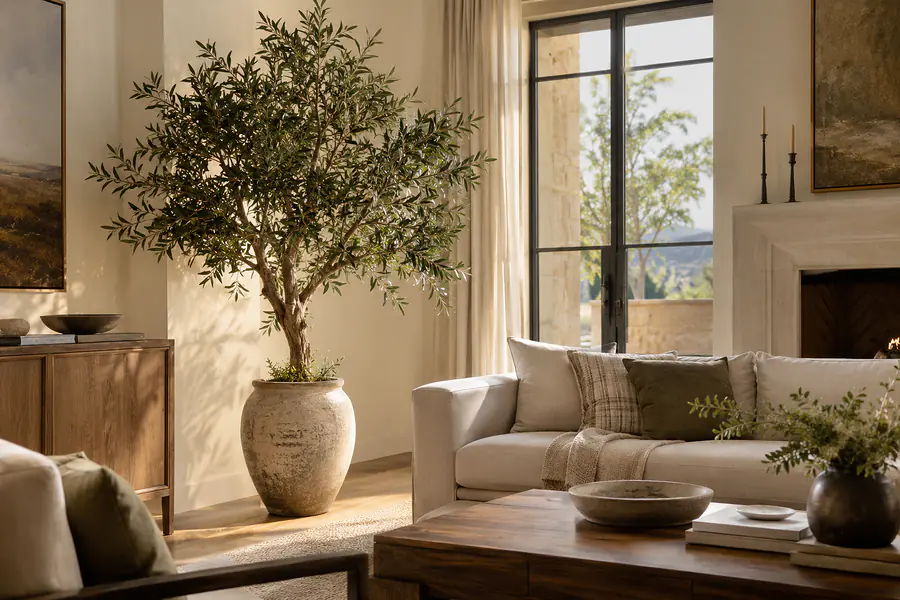
A fake tree can transform an empty corner, but glossy leaves, perfect symmetry, and an artificial-looking trunk can immediately reveal that it is not real.
For indoor decorating, a high-quality faux olive or fiddle leaf fig is usually among the most realistic fake trees. In 2026, House Beautiful particularly praised premium faux olive trees, while Architectural Digest continues to recommend realistic fiddle leaf figs and large artificial trees. The most convincing choice depends more on trunk, foliage, color, and silhouette than species alone.
In fact, current design advice increasingly suggests that large faux trees can look more believable than small artificial plants because their sculptural scale allows them to function as part of the room rather than as a small object guests inspect closely.
Which Fake Tree Looks the Most Realistic?
If I had to choose one general category for a home, I would start with a premium faux olive tree.
A high-quality artificial olive tree is one of the most realistic choices because its naturally sparse canopy, narrow leaves, irregular branching, and muted gray-green coloring are relatively forgiving. The best versions use twisting trunks, varied leaf positions, matte foliage, and intentionally imperfect silhouettes rather than dense, symmetrical greenery.
House Beautiful’s March 2026 review of faux olive trees found several models convincing enough for editors to test and recommend. The publication specifically noted that realistic faux olives often benefit from a slightly sparse structure because natural olive trees do not form perfectly dense indoor canopies.
That gives faux olive trees an advantage.
A few irregular leaves do not look like a manufacturing error.
They look botanical.
Premium Faux Olive Trees Can Be Extremely Convincing
Among current examples, House Beautiful singled out a West Elm faux olive tree with a sculptural planter as the most realistic option it spotted in its 2026 roundup. It also praised West Elm’s Black Olive Tree for thick, convincing foliage.
West Elm’s current Faux Potted Black Olive Tree stands 78 inches high and uses polyester, plastic, iron wire, foam, cement, and sand. Its wire-supported structure allows manufacturers to create the irregular branching needed for a more natural silhouette.
I would therefore place premium olive trees near the top when someone asks for the most realistic fake tree for a living room.
But olive is not my only answer.
Are Fiddle Leaf Fig Trees More Realistic Than Faux Olive Trees?
Fiddle leaf figs can look exceptionally convincing because their leaves are large, sculptural, and visually familiar in interior design.
A premium faux fiddle leaf fig can look as realistic as an olive tree, especially when it uses varied leaf sizes, visible veining, natural trunks, matte surfaces, and repositionable branches. However, its large leaves expose poor materials more easily, so inexpensive glossy versions usually look fake faster than a lower-cost olive tree.
House Beautiful’s guide to artificial fiddle leaf figs specifically emphasizes realistic trunks, variation in leaf size, and wired foliage that can be repositioned. It highlighted models from CB2, Joss & Main, and other retailers for those details.
Architectural Digest has also repeatedly featured faux fiddle leaf figs among the artificial plants capable of working successfully in polished interiors. Its current fake-plant recommendations include both West Elm and other fiddle leaf fig models.
Why the Leaves Matter So Much
A fiddle leaf fig has very large leaves.
That means I immediately notice:
- Veining
- Surface texture
- Edge shape
- Thickness
- Green variation
- Stem attachment
- Shine
A small imperfection on an olive leaf may disappear from six feet away.
The same problem on a twelve-inch fiddle leaf can become obvious.
That is why premium construction matters more with this species.
Natural Trunks Improve the Illusion
The trunk often determines whether I believe a faux fiddle leaf fig.
A smooth molded plastic pole rarely works.
I prefer:
- Irregular bark texture
- Several branching points
- Changes in trunk thickness
- Multiple stems when botanically appropriate
- Brown variation rather than one uniform color
A current Joss & Main artificial fiddle leaf fig specifically combines realistic leaves with a natural-looking trunk, and recent 2026 customer reviews repeatedly describe the finished tree as unusually realistic.
For close-range realism, that trunk quality is extremely important.
What Features Make a Fake Tree Look Real?
Species matters, but construction matters much more.
The most realistic fake trees have irregular trunks, matte foliage, several related shades of green, varied leaf sizes, asymmetrical branch placement, flexible wired stems, and a naturally shaped canopy. I avoid highly glossy leaves, perfect symmetry, identical branches, visible glue, exposed plastic bases, and undersized pots because these details immediately signal artificial construction.
1. Natural Imperfection
This is probably the most important quality.
Real trees are uneven.
One branch may extend farther.
Some leaves droop.
Others turn toward the light.
The canopy may be fuller on one side.
House Beautiful’s September 2026 styling advice specifically recommends introducing asymmetry and gentle drooping into faux greenery because perfectly upright, evenly positioned stems immediately appear artificial.
I use the same principle with trees.
After unpacking one, I never leave the branches exactly where the shipping box placed them.
I bend them.
Rotate them.
Separate them.
Create some negative space.
2. Matte or Naturally Reflective Leaves
Strong plastic shine is one of the easiest giveaways.
Designer guidance collected by House Beautiful recommends avoiding excessively glossy faux foliage and looking instead for realistic texture and color variation.
Different species naturally reflect light differently.
An olive leaf can have a subtle silvery character.
A fiddle leaf fig may have gentle sheen.
A rubber tree can be naturally glossier.
The goal is not making every leaf matte.
It is matching the natural plant.
3. Several Shades of Green
Real foliage is rarely manufactured-looking green.
I prefer trees containing subtle changes such as:
- Deep green
- Olive green
- Gray-green
- Yellow-green
- Slightly faded leaves
- Darker young growth
Color variation produces depth.
It also prevents the canopy from looking like one molded object.
Architectural Digest specifically notes that color variation contributes to the believable appearance of good artificial fiddle leaf figs.
4. A Convincing Trunk
I inspect the trunk before buying.
For me, this is often more important than the leaves.
I look for:
| Trunk detail | What looks more realistic |
|---|---|
| Shape | Slightly irregular |
| Color | Several brown or gray tones |
| Texture | Bark-like rather than smooth |
| Branch joints | Gradual transitions |
| Thickness | Tapers upward |
| Position | Not perfectly vertical |
A beautiful canopy attached to an obvious plastic pole will never completely convince me.
5. The Right Amount of Foliage
More leaves do not automatically create more realism.
A natural olive tree is relatively airy.
A ficus can be much fuller.
A palm has an entirely different distribution.
I prefer foliage density that matches the species.
That is one reason sparse faux olive trees can work so well. House Beautiful specifically notes that excessively full artificial olives can look less natural than intentionally open versions.
Which Types of Fake Trees Look Most Realistic Indoors?
Different species create different levels of difficulty for manufacturers.
My strongest categories for realistic artificial indoor trees are olive, fiddle leaf fig, ficus, rubber tree, palm, and loose branching maple-style trees. Olive trees are forgiving because of their small leaves and open structure; fiddle leaf figs and rubber trees can be exceptionally realistic at higher quality levels; ficus and palms work particularly well when viewed from normal room distance.
Faux Olive Tree
Best for: warm minimalism, Mediterranean interiors, organic modern rooms.
Why I like it:
- Small foliage hides minor manufacturing details
- Sparse growth looks natural
- Gray-green color reduces plastic appearance
- Twisting trunks create character
Current design publications continue to treat faux olive trees as one of the strongest artificial-tree categories.
Faux Fiddle Leaf Fig
Best for: contemporary living rooms and larger statement corners.
Why I like it:
- Large sculptural leaves
- Recognizable branching
- Strong vertical presence
- Can imitate a difficult-to-maintain real plant
House Beautiful continues to describe convincing faux fiddle leaf figs as realistic alternatives to notoriously demanding living versions.
Faux Ficus
Best for: traditional, transitional, office, and large living spaces.
Ficus creates a softer, fuller canopy.
I particularly like Ficus Alii-style forms because their narrower leaves reduce the visual heaviness of a dense canopy.
Living ficus varieties are also receiving renewed design attention in 2026, giving faux versions a current botanical reference rather than an obviously dated artificial-plant shape.
Faux Rubber Tree
Best for: modern and compact interiors.
Rubber-tree foliage is naturally substantial and slightly glossy, which can make molded artificial leaves easier to believe.
House Beautiful’s 2026 designer-shopping coverage includes a faux rubber tree that designer Galey Alix uses personally and describes as particularly realistic.
Faux Palm
Best for: relaxed, tropical, coastal, and sunroom interiors.
Palms work particularly well when the fronds have different angles and lengths.
Architectural Digest currently includes a Nearly Natural Golden Cane Palm among its recommended lifelike artificial plants.
Faux Maple or Branching Tree
Best for: rooms where I want something less predictable than an olive tree.
Architectural Digest has documented designers successfully using artificial maple trees in finished interiors and notes that full-size faux trees can function as genuine statement elements.
These trees are especially convincing when the branch structure remains visible.
How Do I Make a Fake Tree Look Even More Realistic?
A good artificial tree can still look fake if I style it poorly.
I make a fake tree look more realistic by reshaping every branch, introducing asymmetry, replacing the small nursery pot with a substantial planter, hiding the artificial base with moss or other natural-looking material, and placing the tree somewhere a living plant could plausibly grow. Proper styling can matter almost as much as the original purchase price.
Replace the Small Pot
Most artificial trees arrive in a small weighted container.
I consider that a shipping base, not a finished planter.
I place it inside:
- Terracotta
- Ceramic
- Woven basket
- Stone-effect planter
- Textured plaster container
The planter needs to feel proportional to the height of the tree.
A seven-foot tree in a tiny pot immediately looks artificial.
Hide the Artificial Base
House Beautiful’s current September 2026 styling advice identifies hiding the artificial base as one of the most effective realism tricks and recommends moss for disguising visible foam and plastic.
I may use:
- Preserved moss
- Bark
- Gravel
- Coconut fiber
- Decorative stone
The goal is to remove the visual evidence of manufacturing.
Place It Near Natural Light
A faux tree does not require sunlight.
But putting one near a window makes visual sense.
Natural daylight also creates convincing shadows across the leaves.
I often position artificial trees:
- Beside windows
- Near patio doors
- In bright corners
- Behind a reading chair
- Beside a console
The tree looks like it belongs there.
Use One Large Tree Instead of Many Small Fake Plants
Large faux plants can actually be easier to believe.
House Beautiful’s designer guidance says bigger artificial plants, particularly trees, tend to appear more convincing because they create a sculptural effect and are not examined as closely as tiny tabletop plants.
I agree.
One excellent six- or seven-foot tree usually looks more intentional than ten small generic faux plants scattered around the room.
My insights: What Is the Most Realistic Fake Tree
After comparing current 2026 design recommendations, product testing, and artificial-tree styling guidance, I would not define one species as automatically realistic in every price range.
For most homes, I consider a premium faux olive tree the safest answer to “What is the most realistic fake tree?” because its small leaves, muted colors, irregular branching, and naturally sparse silhouette hide artificial construction particularly well. A high-quality fiddle leaf fig can be equally convincing, but its large leaves demand better materials and finishing.
My First Insight: Olive Trees Are the Most Forgiving
The olive tree has several natural features that work in favor of artificial reproduction.
Its leaves are relatively small.
Its branches are irregular.
Its canopy can be sparse.
Its color is muted.
That means small imperfections disappear into the overall composition.
A fiddle leaf fig does not provide the same forgiveness.
One badly molded giant leaf can attract attention immediately.
So when I need the highest probability of realism without inspecting hundreds of products, I usually start with olive.
My Second Insight: Fiddle Leaf Fig Can Win at the Premium End
At the higher end of the market, I think fiddle leaf figs become serious competitors.
A manufacturer can reproduce:
- Large leaf veins
- Natural color variation
- Flexible wired leaves
- Branching trunks
- Different leaf sizes
House Beautiful’s guide specifically identifies models with realistic trunks and repositionable leaves, while current Joss & Main customer feedback shows that strong faux fiddle leaf figs can be difficult to distinguish from real plants at ordinary viewing distance.
So my answer depends partly on budget.
My Third Insight: The Tree Trunk Is More Important Than Most Buyers Realize
When I evaluate a tree quickly, I look at the trunk.
Then I look at the foliage.
Why?
Because leaves can often be reshaped.
A bad trunk is much harder to fix.
A smooth brown plastic pole remains a smooth brown plastic pole.
I therefore value natural-looking bark, taper, branching, and color variation.
My Fourth Insight: Realism Is About the Whole Silhouette
I do not judge a tree leaf by leaf.
I step back.
Does the canopy look natural?
Does one side extend farther?
Can I see some interior branches?
Is there believable negative space?
Does the trunk support the visual weight of the crown?
House Beautiful’s 2026 styling advice emphasizes exactly this kind of natural irregularity rather than perfect symmetry.
My Fifth Insight: Styling Can Move an Average Tree Into a Higher Realism Category
I have seen artificial trees that looked unimpressive directly from the box and much better after twenty minutes of shaping.
My realism formula is simple:
| Element | What I want |
|---|---|
| Species | Recognizable botanical form |
| Leaves | Varied color and natural texture |
| Shine | Controlled |
| Trunk | Irregular and believable |
| Branches | Asymmetrical |
| Canopy | Species-appropriate density |
| Planter | Large enough for the tree |
| Base | Completely concealed |
| Placement | Plausible for a living tree |
| Maintenance | Clean and dust-free |
If all ten work together, the tree becomes much more convincing.
My Final View
When someone asks me “What is the most realistic fake tree?”, my first recommendation is a high-quality faux olive tree.
Its natural characteristics make artificial reproduction easier to disguise.
A premium version with:
a textured twisting trunk, matte gray-green leaves, varied branch directions, an airy canopy, and a substantial planter
can look remarkably convincing from normal room distance.
Current 2026 House Beautiful testing supports that conclusion, with the publication highlighting several faux olives as unusually lifelike and identifying a premium West Elm example as the most realistic model in its roundup.
My close second is a premium fiddle leaf fig.
It has stronger visual presence and can look exceptionally realistic when its trunk and leaves are executed properly.
After that, I would consider:
ficus, rubber trees, palms, and loose branching maple-style trees.
But I would not buy any of them based on species alone.
I inspect the trunk.
I check the leaf shine.
I compare the greens.
I reshape the branches.
I upgrade the planter.
And I hide the base.
The most realistic fake tree is ultimately the one where botanical accuracy, material quality, irregularity, scale, and styling work together so effectively that I stop examining the tree and simply accept it as part of the room.
Conclusion
A premium faux olive tree is usually my most realistic choice, with high-quality fiddle leaf figs close behind. Natural trunks, matte foliage, irregular branching, and proper styling matter most.

