
Destination weddings sound romantic, but fresh flowers can become stressful fast. Heat, travel, timing, and local supply can turn simple floral plans into last-minute problems.
Artificial flowers are ideal for destination weddings because they travel well, stay fresh-looking in heat, can be prepared early, reduce local vendor pressure, and keep the wedding style consistent. They work well for bouquets, arches, aisle décor, corsages, boutonnières, centerpieces, and reception displays.
A destination wedding usually asks flowers to do more than look beautiful. They may need to survive flights, hotel storage, outdoor photos, beach wind, humid air, and a long ceremony day. Fresh flowers can still be lovely, but artificial flowers give couples more control before, during, and after the celebration.
Why Are Artificial Flowers Better for Destination Weddings?
A destination wedding adds distance to every decision. That distance can make fresh flowers harder to plan, source, transport, and protect.
Artificial flowers are better for destination weddings when couples need reliable floral décor that can be arranged before travel, packed safely, reused during the day, and matched to the full wedding theme without depending on local flower availability.
They Reduce Last-Minute Floral Stress
Fresh flowers often need careful timing. They must be ordered, delivered, conditioned, stored, and arranged close to the wedding date. This can be manageable for a local wedding. It becomes harder when the venue is in another city, island, country, mountain town, or beach resort.
Artificial flowers remove much of this pressure. The bouquet, corsages, boutonnières, aisle flowers, and small centerpieces can be completed before travel. Couples can review the style at home. They can check the color beside dresses, suits, linens, and ribbon. They can also make changes before the event week.
They Help When Local Options Are Limited
Destination venues do not always have the exact flowers a couple wants. A small island may have limited floral suppliers. A mountain venue may have fewer delivery options. A foreign destination may have seasonal or import limits. Artificial flowers give the couple more control over the design.
| Destination Challenge | Artificial Flower Advantage |
|---|---|
| Limited local florists | Flowers can be prepared before travel |
| Seasonal flower gaps | Desired colors and flower types stay available |
| Language barriers | Less need for complex floral instructions |
| Tight wedding timeline | Décor can be ready before arrival |
| Remote venue | Less dependence on same-day delivery |
They Keep the Visual Plan Consistent
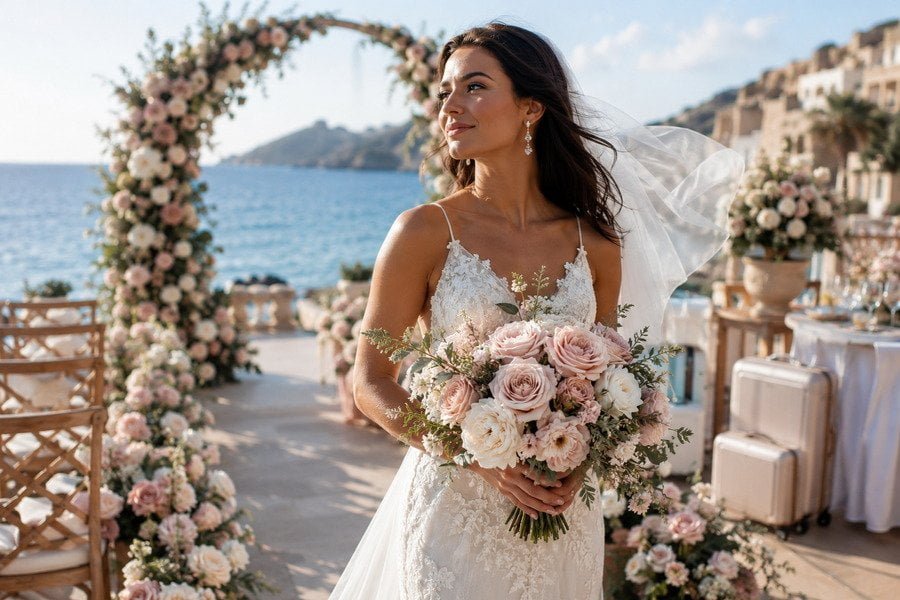
Destination weddings often rely on a strong visual story. The flowers need to match the location, the outfit, and the mood. Artificial flowers can be selected in exact shades and repeated across many pieces. A blush rose in the bouquet can match the arch. The same greenery can appear on aisle chairs, tables, and welcome signs.
This consistency is useful because destination weddings often have fewer setup hours. When the floral pieces are already coordinated, the installation process becomes simpler.
Can Artificial Wedding Flowers Travel Safely?
Travel is one of the biggest concerns for destination wedding flowers. Fresh flowers need moisture, cool temperatures, and gentle handling.
Artificial wedding flowers can travel safely when they are packed with enough space, supported with tissue or bubble wrap, and placed in sturdy boxes or carry-on luggage. Silk bouquets, corsages, boutonnières, and loose stems can usually handle movement better than fresh flowers.
They Are Easier to Pack and Carry
Artificial flowers do not need water tubes or refrigeration. They do not leak. They do not bruise as quickly as fresh petals. This makes them easier to pack for travel. Smaller pieces such as corsages and boutonnières can be placed in labeled boxes. Bouquets can be wrapped with tissue and held in a structured container.
For a wedding abroad, this can be a major benefit. Couples can bring key floral pieces with them instead of hoping every detail will be correct after arrival. A planner, family member, or bridal party member can also carry small floral items if needed.
Smart Packing Tips
| Floral Item | Packing Method | Extra Tip |
|---|---|---|
| Bridal bouquet | Upright box or carry-on space | Support the flower heads with tissue |
| Boutonnières | Small labeled boxes | Keep pins in a separate pouch |
| Corsages | Flat boxes with soft padding | Do not crush ribbons or wristbands |
| Loose stems | Long packing box | Bundle by color or flower type |
| Garland | Soft bag or wide box | Avoid tight folding |
| Arch flowers | Separate clusters | Label each cluster by placement |
They Can Be Refluffed After Travel
Even good packing can flatten petals or leaves. The advantage of artificial flowers is that they can be shaped again. Petals can be opened gently by hand. Stems can be bent back into position. Leaves can be spread out. This helps the flowers recover quickly after travel.
A simple travel kit can help. It may include floral wire, small zip ties, scissors, ribbon, glue dots, safety pins, and a handheld steamer if the material allows gentle steaming. This kit gives the couple or planner a way to fix small issues without calling a florist.
Do Artificial Flowers Handle Heat, Wind, and Humidity Better?
Many destination weddings happen in warm places. Beaches, gardens, resorts, and outdoor terraces can be hard on fresh flowers.
Artificial flowers handle heat, wind, and humidity better than many fresh flowers because they do not need water, do not wilt, and keep their shape during long outdoor events. They are useful for beach weddings, tropical weddings, desert weddings, and summer destination ceremonies.
They Stay Photo-Ready in Warm Weather
Fresh flowers can fade in heat. Petals may soften. Stems may bend. Some flowers can brown at the edges. This is especially risky when the bouquet is used before the ceremony for first-look photos, then during the ceremony, then again at the reception.
Artificial flowers stay stable for the whole day. This matters for destination weddings because the photo schedule is often longer. Couples may take photos at the resort, on the beach, near cliffs, in gardens, or in a historic town. The bouquet needs to look good in every location.
They Work Well for Outdoor Installations
Large floral décor can be hard to protect outdoors. A wedding arch, welcome sign, aisle marker, or sweetheart table arrangement may be installed before guests arrive. In a hot or windy location, fresh flowers can suffer before the ceremony begins.
Artificial flowers give more flexibility. They can be attached earlier. They can be moved from ceremony to reception. They can also be reused for welcome dinners, rehearsal dinners, after-parties, and photo backdrops.
| Outdoor Setting | Fresh Flower Risk | Artificial Flower Benefit |
|---|---|---|
| Beach | Wind, salt air, heat | Holds shape and color |
| Desert | Dry air and strong sun | Does not need water |
| Tropical resort | Humidity and rain | Less fragile than fresh petals |
| Mountain venue | Temperature changes | More stable in mixed weather |
| Garden venue | Long setup hours | Can be installed earlier |
Choose the Right Quality for Outdoor Use
Not every artificial flower is the same. For outdoor destination weddings, choose flowers with realistic texture, flexible stems, and strong construction. If the décor will sit in direct sunlight for many hours, UV-resistant artificial flowers are better. For close-up items like bouquets and corsages, choose high-quality silk or real-touch flowers.
A good rule is simple. Use the most realistic flowers for pieces that people will hold or see closely. Use durable, fuller flowers for arches, garlands, and large installations.
How Do Artificial Flowers Help With Destination Wedding Budgets?
Destination weddings can look simple, but the costs can grow quickly. Travel, accommodation, shipping, vendor fees, and setup charges all affect the budget.
Artificial flowers help destination wedding budgets by reducing rush fees, lowering the risk of flower replacement, allowing early preparation, and making décor reusable across multiple wedding moments. They can also reduce dependence on expensive imported fresh blooms.
They Give Couples More Control Over Timing
Fresh flowers often require late ordering, last-minute delivery, and fast setup. These services can cost more in destination locations, especially if the venue is remote. Artificial flowers can be arranged before the trip, which gives couples more time to compare prices and make decisions.
A couple can order flowers months in advance. They can build the bouquet, test the arch flowers, and style the tables before travel. This reduces the need for rushed design work at the destination.
They Can Be Used More Than Once
One of the strongest budget benefits is reuse. A silk bouquet can appear in engagement photos, welcome dinner photos, the ceremony, reception portraits, and post-wedding content. A floral arch cluster can move from the ceremony arch to the sweetheart table. A garland can decorate a welcome sign first and a reception table later.
| Wedding Moment | Possible Artificial Flower Use |
|---|---|
| Welcome dinner | Small centerpieces or bud vases |
| Ceremony | Bouquet, arch, aisle décor |
| Cocktail hour | Bar flowers or sign flowers |
| Reception | Table garlands and sweetheart table |
| Photos | Flat lay styling and portrait props |
| After the wedding | Home décor or keepsake display |
They Help Avoid Waste
Fresh flowers are often discarded after the event. This is not always avoidable, but it can feel wasteful, especially after a destination wedding where transport and setup already require extra resources. Artificial flowers can be stored, gifted, resold, rented, or reused for another event.
The best value comes from choosing versatile pieces. Neutral white roses, ivory peonies, eucalyptus, olive branches, and soft greenery can fit many wedding themes. Seasonal accents can be added without rebuilding the full floral plan.
My Insights: What Makes Artificial Flowers Ideal for Destination Weddings
Destination weddings need flowers that are beautiful, stable, portable, and easy to manage from far away. Artificial flowers fit that need because they protect the visual plan from travel problems.
Artificial flowers are ideal for destination weddings because they give couples control over timing, travel, weather, style, and reuse. They reduce stress before arrival, stay consistent during the event, and continue to hold value after the wedding day.
The Best Artificial Flowers Solve Real Destination Problems
The main value of artificial flowers is not only that they last longer. Their value is that they remove uncertainty. A destination wedding already has many unknowns. Flights may change. Weather may shift. Vendors may work in different time zones. Local flower availability may not match the original vision.
Artificial flowers create one stable part of the plan. The couple can see the bouquet before leaving home. They can check every corsage and boutonnière. They can test the centerpiece size. They can take the arch clusters out of the box and know where each piece belongs.
The Ideal Destination Wedding Floral Plan
| Planning Goal | Best Artificial Flower Choice |
|---|---|
| Easy travel | Lightweight silk bouquets and boxed accessories |
| Beach ceremony | Durable flowers with secure stems |
| Luxury photos | Real-touch flowers for close-up pieces |
| Fast setup | Pre-made floral clusters and garlands |
| Budget control | Reusable flowers in neutral colors |
| Strong theme | Matching flowers across all décor pieces |
Use Artificial Flowers Where They Matter Most
A full artificial floral plan is not the only option. Couples can mix fresh and faux flowers if they want. For example, they may use artificial flowers for the bouquet, arch, corsages, and boutonnières, then use simple fresh greenery or local blooms for reception tables. This gives the wedding a natural feeling while still protecting the most important photo pieces.
The most important flowers for a destination wedding are the ones that appear in many photos. These include the bridal bouquet, ceremony arch, aisle flowers, boutonnières, corsages, and sweetheart table décor. These pieces should stay beautiful for the full day. Artificial flowers are strong choices for these areas because they do not depend on water or perfect delivery timing.
Match the Flowers to the Location
Artificial flowers should still feel connected to the destination. A beach wedding may look best with white orchids, roses, palm leaves, and soft greenery. A Tuscany-style wedding may use olive branches, ivory roses, and warm neutral tones. A mountain wedding may use wildflower-style stems, ferns, and textured greenery. A tropical wedding may use hibiscus-style blooms, orchids, monstera leaves, and bright accents.
The goal is not to make the flowers look fake-free at any cost. The goal is to make them look right for the setting. When the flowers match the place, the whole wedding feels more natural.
Think Like a Traveler and a Stylist
The best destination wedding flowers should pass two tests. First, they should travel well. Second, they should photograph well. If a flower is beautiful but fragile, it may not be the best choice. If a flower is durable but stiff or shiny, it may not look good in close-up photos.
High-quality artificial flowers offer the best balance. They are strong enough for travel and soft enough for portraits. They can be packed, shaped, styled, moved, and saved. That makes them a smart floral solution for weddings that happen far from home.
Conclusion
Artificial flowers make destination weddings easier because they travel well, stay beautiful, reduce planning risk, and keep the floral design consistent from ceremony to reception.