


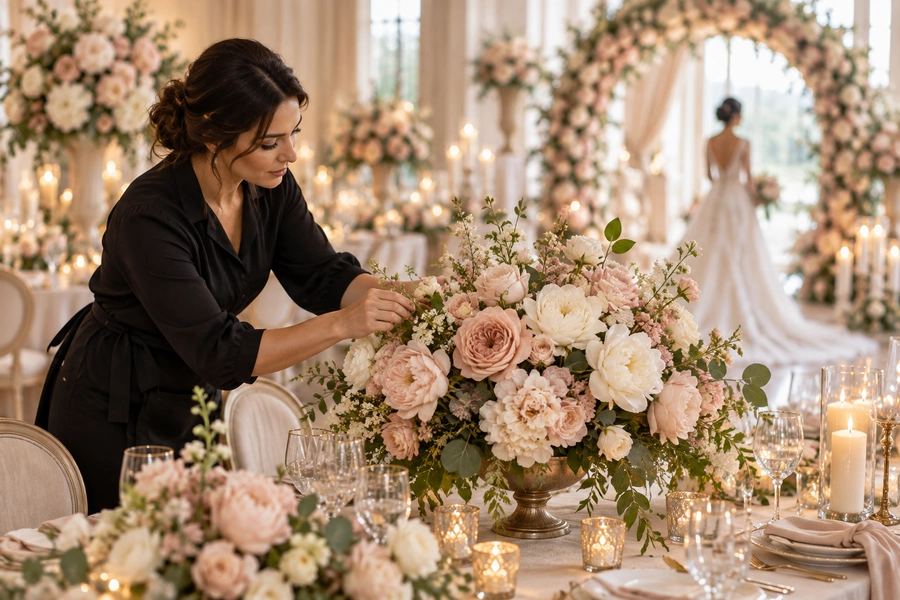
Wedding flowers affect photographs, décor, budget, and logistics. Choosing artificial blooms can simplify planning, but quality and placement determine whether they look elegant or obviously fake.
Artificial wedding flowers can be an excellent choice when you want predictable colors, year-round flower availability, advance preparation, resistance to wilting, and the option to rent, reuse, or keep arrangements. The best results come from realistic materials, careful styling, good photography tests, and choosing faux flowers strategically for the parts of the wedding where they offer the greatest advantage.
Modern artificial wedding flowers include polyester “silk” blooms, foam flowers, coated fabric flowers, latex-style flowers, paper flowers, and premium Real Touch products. Quality varies enormously, so I would never choose flowers simply because a product description says “silk,” “premium,” or “Real Touch.”
Why Do Couples Choose Artificial Wedding Flowers?
Artificial flowers solve several problems that fresh flowers cannot completely avoid.
Couples choose artificial wedding flowers because they do not wilt, can be ordered and arranged well before the wedding, are available regardless of natural blooming season, can provide predictable colors, and may reduce costs through rentals or reuse. They are especially practical for outdoor weddings, destination events, large installations, and couples who want more control over the finished design.
Artificial Flowers Can Be Prepared in Advance
Fresh flowers operate on a strict timeline.
They need to be sourced, conditioned, hydrated, arranged, transported, and installed close to the wedding date.
Artificial flowers give me far more flexibility.
I can make a bouquet weeks ahead.
I can build centerpieces before the final wedding week.
I can photograph an arch arrangement and decide whether it needs more color.
I can rearrange stems repeatedly without worrying about bruising delicate petals.
Zola specifically identifies advance preparation as one of the practical advantages of artificial wedding flowers and notes that wired artificial stems can be manipulated repeatedly during arranging.
This is particularly valuable for DIY weddings.
The final week before a wedding already includes:
- Venue coordination
- Rehearsal
- Guest arrivals
- Seating changes
- Clothing preparation
- Vendor communication
Removing last-minute floral construction from that period can significantly simplify the schedule.
They Do Not Depend on Flower Season
If I want peonies, tulips, hydrangeas, or another distinctive flower, fresh availability may depend on season, location, and supply.
Artificial flowers remove much of that uncertainty.
The Knot and Zola both identify year-round availability as a major advantage of faux wedding flowers.
That does not mean every artificial variety will be equally realistic.
It means I can choose a flower based on the wedding design rather than the agricultural calendar.
They Do Not Wilt
This may be the clearest practical advantage.
Fresh flowers can be affected by:
- Heat
- Direct sunlight
- Lack of water
- Long transportation
- Wind
- Repeated handling
Artificial flowers remain visually stable through the ceremony and reception.
A recent 2026 review from a couple using rented faux flowers described the benefit of keeping bright floral colors throughout a sunny July wedding without worrying about wilting.
For an outdoor summer wedding, that predictability can matter.
They Can Become Keepsakes
Purchased artificial flowers can remain intact long after the wedding.
A bridal bouquet can become:
- Home décor
- Anniversary décor
- A shadow-box display
- A family keepsake
- A piece reused at another celebration
Fresh flowers can also be preserved, but preservation is a separate process.
Artificial flowers already begin in a durable form.
Do Artificial Wedding Flowers Actually Look Realistic?
Yes—but the quality range is extremely wide.
High-quality artificial wedding flowers can look convincing in person and photography, especially when they use realistic petal textures, subtle color variation, botanical proportions, detailed centers, matte surfaces, and flexible stems. Low-quality flowers often reveal themselves through excessive shine, flat colors, frayed fabric, thick plastic stems, identical blooms, and visible glue or seams.
The Knot interviewed a wedding planner who said she was impressed by how natural rented silk flowers looked and, importantly, by how well they photographed.
That is why I consider photography a major part of artificial-flower selection.
“Silk” Does Not Usually Mean Natural Silk
One common misunderstanding is the term silk flowers.
Modern silk wedding flowers are generally made from synthetic fabrics such as polyester or nylon rather than actual silk.
These flowers can work very well, particularly in:
- Large arrangements
- Ceremony installations
- Garlands
- Centerpieces
- Background décor
But inexpensive fabric flowers may show frayed edges or obvious textile texture when photographed very closely.
Real Touch Flowers Aim for Greater Tactile Realism
Real Touch or fresh-touch artificial flowers sit toward the premium end of the faux-flower market.
Zola describes fresh-touch products as among the most realistic artificial options, designed to reproduce both the look and feel of fresh petals. They are also among the more expensive categories.
For close-up applications, I would pay attention to:
| Quality feature | What I want to see |
|---|---|
| Petals | Soft, flexible, species-appropriate |
| Color | Several related tones rather than one flat shade |
| Surface | Matte or naturally reflective |
| Flower center | Detailed rather than crude molded plastic |
| Leaves | Realistic veins and muted greens |
| Stem | Flexible, proportional, easy to position |
| Assembly | Minimal visible glue and seams |
| Variation | Slight differences between individual blooms |
The word Real Touch alone does not guarantee these qualities.
I still want to see a physical sample.
Perform a Camera Test
Before approving artificial flowers for an important wedding application, I photograph them.
I use:
- Window light
- Flash
- Indoor evening lighting
- Close-up mode
- Normal portrait distance
If the petals suddenly become shiny or obviously fabric-like in the photograph, I know they may not work for the bridal bouquet.
This is particularly important because the bouquet appears repeatedly in wedding photography.
Are Artificial Wedding Flowers Cheaper Than Fresh Flowers?
They can be, but the answer depends on whether I rent, buy, DIY, or hire a professional faux-floral designer.
Artificial flowers are often cheaper when rented or purchased as standardized arrangements, but premium Real Touch flowers and full-service faux floral design can still be expensive. The Knot’s current rental data puts average full wedding orders around $500 at Something Borrowed Blooms and $450 at Silk Stem Collective, while fresh wedding flowers average $2,800 according to The Knot’s 2026 Real Weddings Study.
Those numbers are not perfectly equivalent.
The $2,800 figure represents what surveyed couples spent on wedding flowers generally, while the $450–$500 numbers refer specifically to average orders from two faux-flower rental businesses.
Still, they demonstrate why rental has become attractive.
Current Rental Prices Can Be Much Lower
The Knot currently reports that artificial-flower rental orders typically stay below $1,000 depending on the number of pieces.
At two prominent vendors:
- Bridal bouquets run about $55–$80.
- Centerpieces run approximately $28–$138.
- Ceremony arch flowers can be rented for under $300.
- Average full orders are around $450–$500.
By comparison, The Knot’s May 2026 flower-cost report says U.S. couples spent an average of $2,800 on wedding flowers, with a median of $1,900 and an upper quartile average of $4,800. The study surveyed 10,474 U.S. couples married in 2025.
This does not mean every couple will save thousands by choosing faux.
It means rental can create a much lower entry point.
Buying Premium Faux Flowers Can Cost More Than Expected
Artificial does not always mean inexpensive.
Zola lists approximate artificial-flower pricing that includes:
- $20–$100 for an inexpensive silk bridal bouquet
- $300+ for a premium Real Touch bridal bouquet
- $10–$50 for silk bridesmaid bouquets
- $150+ for premium Real Touch bridesmaid bouquets
- $20–$100 for silk centerpieces
If I purchase:
one bridal bouquet,
six bridesmaid bouquets,
twenty centerpieces,
an arch,
aisle flowers,
and reception installations,
the total can still become substantial.
Rental, Purchase, and DIY Serve Different Couples
| Approach | Strongest advantage | Main drawback |
|---|---|---|
| Rent faux flowers | Lower cost and less storage | Limited customization |
| Buy ready-made faux | Keep or resell afterward | Higher upfront cost |
| DIY faux | Maximum control | Time and materials can add up |
| Hire faux floral designer | Custom professional result | Can cost thousands |
| Hybrid fresh + faux | Balances realism and practicality | Requires coordination between systems |
The Knot specifically warns that DIY artificial flowers can become expensive when high-quality products are used in large quantities.
So I price the complete project rather than comparing the cost of one fake rose with one fresh rose.
Where Should You Use Artificial Flowers at a Wedding?
Artificial flowers work almost anywhere, but some applications take better advantage of their strengths.
I particularly like artificial flowers for ceremony arches, aisle arrangements, flower walls, hanging installations, large centerpieces, entrance displays, and other décor that must stay perfect for hours. For bridal bouquets, boutonnieres, cake details, and low centerpieces seen at very close range, I use premium-quality faux flowers or consider mixing in fresh blooms.
Ceremony Arches
Large ceremony structures are excellent faux-flower applications.
An arch may need to be:
constructed early,
moved,
exposed to heat,
and reused at the reception.
Fresh flowers can accomplish all of that, but they require more hydration and professional handling.
Artificial flowers eliminate the wilting problem.
They can also be repurposed.
For example, one current 2026 wedding review described rented faux aisle pieces being reused around the sweetheart table after the ceremony.
That is a smart way to stretch a floral budget.
Flower Walls and Large Backdrops
Large-scale artificial flowers can make sense because guests see the installation as a complete visual field rather than examining individual petals.
Zola specifically recommends faux flowers for:
- Ceremony altars
- Draping
- Hanging installations
- Large decorative statements
- Backdrops
I can therefore allocate the highest-quality Real Touch flowers to the pieces people will handle and use less expensive but visually strong flowers at greater viewing distances.
Bridal Bouquets
The bridal bouquet requires more care.
It will be:
held,
photographed,
seen from multiple angles,
and often preserved as one of the day’s strongest visual memories.
Here I want my best materials.
If the budget does not support premium faux flowers, I would seriously consider using fresh flowers for the bridal bouquet and artificial flowers for the large décor.
Centerpieces
Artificial centerpieces can work extremely well because they do not need water and can be prepared early.
However, low centerpieces sit close to guests.
I therefore examine them from seated eye level.
Visible foam, plastic stems, or shiny leaves become much easier to notice when dinner guests are looking directly at the arrangement for several hours.
Should You Mix Fresh and Artificial Wedding Flowers?
Yes. A hybrid approach is one of the most practical ways to use artificial wedding flowers.
Mixing fresh and faux flowers allows me to use fresh blooms where fragrance, touch, and close-up botanical detail matter most, while using artificial flowers for large, distant, or weather-sensitive décor. Wedding professionals cited by The Knot report couples using both approaches successfully, including fresh table flowers with silk décor elsewhere or fresh bouquets with rented faux arrangements for the rest of the venue.
A Practical Hybrid Plan
| Wedding element | Option I would consider |
|---|---|
| Bridal bouquet | Fresh or premium Real Touch |
| Bridesmaid bouquets | Premium faux or rental |
| Boutonnieres | Fresh or high-quality faux |
| Ceremony arch | Faux |
| Aisle arrangements | Faux |
| Guest centerpieces | Fresh, faux, or mixed |
| Hanging florals | Faux |
| Flower wall | Faux |
| Cake flowers | Fresh or premium faux |
| Sweetheart table | Fresh or mixed |
This strategy concentrates the fresh flowers where their natural qualities are most noticeable.
It also lets artificial flowers handle the applications where durability matters most.
What Should You Check Before Ordering Artificial Wedding Flowers?
I would never place a large artificial-flower order without testing the product first.
Before ordering, I check a physical sample in daylight, photograph it, touch the petals, inspect the flower centers and leaves, bend the stems, confirm the color against wedding fabrics, and ask about shipping, setup, returns, damage fees, and replacement policies. For rental flowers, I also confirm delivery and return windows well before the wedding.
Order a Sample
A sample is especially important if the flowers will appear in:
- Bridal portraits
- Boutonnieres
- Corsages
- Cake photography
- Low centerpieces
The Knot notes that rental companies often charge a sample fee so couples can examine flowers before committing.
I consider that money well spent.
Check the Color in Real Lighting
Wedding colors can change dramatically between screens and physical materials.
I compare the flower to:
- Bridesmaid fabric
- Table linens
- Invitation colors
- Suit or tuxedo fabrics
- Venue finishes
Ivory, cream, white, blush, dusty rose, and champagne can be surprisingly different in person.
Understand Rental Logistics
Rental is convenient, but it still requires planning.
The Knot notes that couples may need to account for:
- Shipping thresholds
- Return deadlines
- Sample fees
- Damage charges
- Setup costs
- Repacking after the wedding
Some vendors do not offer setup.
That means someone must be responsible for arranging the pieces at the venue.
I would decide who that person is before wedding week.
Ask Who Handles the Flowers After the Reception
Purchased faux flowers need a destination.
Rented flowers need to be returned.
Fresh flowers may be donated or discarded.
I decide this in advance.
After a long reception, I do not want the wedding party suddenly discovering that twenty rental centerpieces need to be packed into specific boxes.
My insights: What to Know About Using Artificial Wedding Flowers for Your Big Day
After comparing current wedding-industry guidance, 2026 pricing data, rental practices, and real couple experiences, I think artificial flowers work best when they are treated as a legitimate floral design material rather than simply a cheaper substitute for fresh flowers.
What you should know about using artificial wedding flowers is that quality, application, and logistics matter more than whether the flower is technically fake. Premium faux flowers can photograph beautifully, stay perfect through heat and long events, provide year-round color consistency, and dramatically simplify large installations. But inexpensive flowers used in close-up applications can look artificial, and premium custom faux flowers are not automatically cheap.
My First Insight: Choose Faux Flowers for Their Strengths
I would not choose artificial flowers only because I want to save money.
I choose them when their physical properties solve a problem.
Artificial flowers are particularly strong when I need:
- Long setup periods
- Heat resistance
- Exact colors
- Out-of-season flowers
- Reusable installations
- Advance preparation
- Rental availability
Those advantages remain useful even when the wedding budget is generous.
My Second Insight: Distance Should Influence Quality
The closer guests get, the more quality matters.
My simple rule is:
Close to the body or camera = premium quality.
Farther away or overhead = visual impact matters more than tactile perfection.
A bridal bouquet requires excellent petals and stems.
A ceiling installation may mainly need the correct shape and color.
This distinction can prevent unnecessary spending.
My Third Insight: Rental Has Changed the Faux-Flower Decision
Artificial wedding flowers used to mean buying loose stems and building everything yourself.
That is no longer the only model.
The Knot currently describes a substantial rental market offering complete bouquets, centerpieces, garlands, arches, and other arrangements. Average full wedding orders at two major vendors are about $450–$500.
That means couples can obtain professionally designed faux flowers without owning or constructing them.
For many weddings, that is a fundamentally different proposition from DIY.
My Fourth Insight: Faux Does Not Automatically Mean Sustainable
Reuse is a major advantage, especially in rental systems where flowers serve multiple weddings.
But artificial flowers contain manufactured materials and should not automatically be described as environmentally superior in every situation.
The Knot notes that rental vendors often reuse both flowers and packaging, which reduces disposal after individual weddings. It also acknowledges that sustainably sourced local and seasonal fresh flowers can be another environmentally conscious option.
So I ask a better question:
Will these artificial flowers actually be reused?
If the answer is yes, rental and reuse become much more meaningful.
My Fifth Insight: Hybrid Flowers Solve Most Fresh-vs-Faux Debates
I do not think couples need to make every flower follow the same rule.
The bridal bouquet can be fresh.
The arch can be faux.
Centerpieces can mix both.
Bridesmaid bouquets can be rented.
A large reception installation can use artificial flowers.
Wedding professionals interviewed by The Knot describe exactly these kinds of mixed strategies.
That flexibility is one of the biggest advantages of modern wedding florals.
My Artificial Wedding Flower Checklist
Before making a final decision, I would check:
| Question | Why it matters |
|---|---|
| Do the petals look realistic in daylight? | Reveals shine and texture |
| Do they photograph well? | Critical for wedding images |
| Are the colors accurate in person? | Screens can be misleading |
| Are stems flexible? | Helps natural arranging |
| Are flower centers detailed? | Important for close-up realism |
| Are leaves convincing? | Cheap foliage reveals faux construction |
| Can I order a sample? | Reduces purchasing risk |
| Am I buying or renting? | Changes cost and logistics |
| Who handles setup? | Rental often excludes installation |
| Who packs or stores them afterward? | Prevents end-of-night confusion |
| Can ceremony flowers be repurposed? | Improves value |
| Do I want natural fragrance? | Fresh flowers still have an advantage |
| Will purchased faux flowers be reused? | Improves long-term value |
My Final View
If I were planning a wedding with artificial flowers, I would not begin by deciding that everything must be fake.
I would first identify the places where flowers have different jobs.
The bridal bouquet is tactile and photographic.
The ceremony arch is architectural.
The centerpieces create atmosphere.
The aisle flowers need durability.
The hanging installation is mostly viewed from a distance.
Once I separate those functions, choosing materials becomes much easier.
I might use premium Real Touch flowers in the bouquet.
I might rent artificial centerpieces.
I might use faux flowers across the ceremony structure because they can be installed early without water.
And I might add a few fresh fragrant flowers where scent matters.
That approach also fits current wedding practice. The Knot reports couples successfully mixing rented silk flowers with fresh florals, while artificial flower rentals can provide a much lower-cost entry point than the current $2,800 average couples spend on wedding flowers overall.
Artificial wedding flowers are therefore not simply an imitation of fresh florals.
Used well, they are a separate design tool with their own advantages:
durability, predictability, reuse, advance preparation, year-round availability, and scalable décor.
The key is to spend on realism where people get close, use durability where installations are large, test everything under real lighting, and decide the setup and post-wedding logistics before the wedding day arrives.
Conclusion
Artificial wedding flowers can be beautiful, practical, and cost-effective. Prioritize quality for close-up pieces, consider rentals or hybrid designs, and test samples before committing to your full wedding order.

