
Some artificial plants are convincing from across a room but instantly look fake when viewed closely. Others can sit beside living greenery and remain surprisingly difficult to identify.
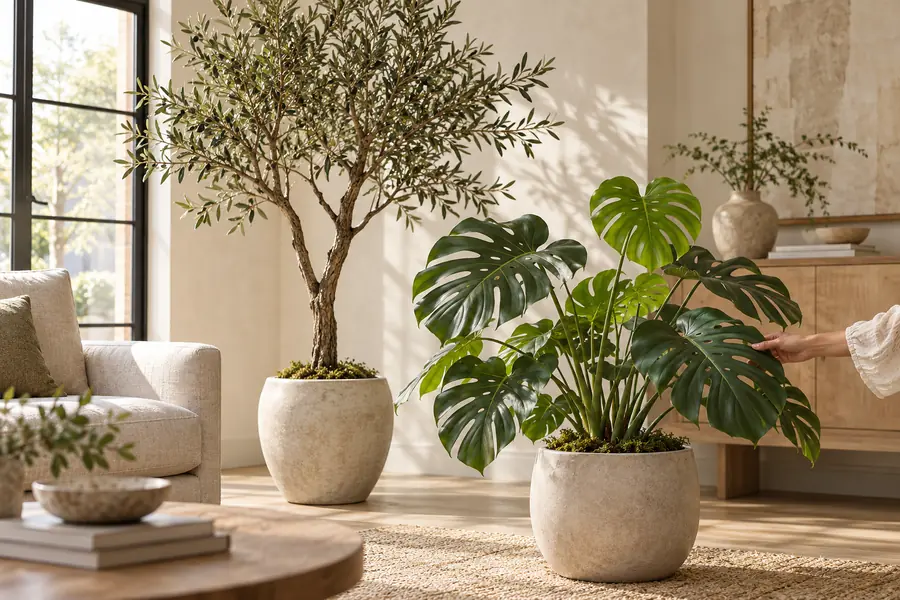
For most interiors, a high-quality faux olive tree is one of the safest choices if realism is the priority. Its small muted leaves, naturally sparse canopy, irregular branching, and slender trunk hide artificial construction well. For smaller plants viewed more closely, a well-made artificial monstera can be even more convincing; one tested by The Spruce was barely distinguishable from a real monstera placed beside it.
Tests found realistic faux plants rely on varied foliage, natural veining, adjustable stems, believable texture, and suitable species, with rankings changing by viewing distance overall.
Why Do Faux Olive Trees Often Look the Most Real?
Olive trees have several characteristics that work unusually well in artificial form.
A faux olive tree can look highly realistic because real olive trees naturally have small, narrow, muted leaves, open canopies, irregular branches, and weathered trunks. Those characteristics are easier to reproduce convincingly than the huge glossy leaves of species such as fiddle leaf figs.
Kazeila’s current six-foot artificial olive tree, for example, uses a real wood trunk, hundreds of silk leaves, artificial olives, and bendable internal wire branches. The adjustable structure lets the owner create a less symmetrical canopy after unpacking.
The company’s seven-foot version uses the same strategy, combining a natural wood trunk with silk foliage and adjustable branches.
Small Leaves Hide Material Imperfections
This is one of the biggest advantages.
Imagine an artificial fiddle leaf fig.
Each leaf may be 10 inches long.
That creates a large surface on which people can notice:
plastic shine,
poor veins,
unrealistic edges,
or repeated molding.
An olive leaf is tiny by comparison.
The viewer perceives hundreds of leaves as a complete canopy rather than examining one enormous synthetic surface.
Olive Trees Are Naturally Sparse
Artificial trees often look suspicious when manufacturers try to make them extremely full.
Perfectly distributed foliage can create a round, manufactured silhouette.
Living olive trees can naturally appear:
airy,
uneven,
slightly sparse,
and irregular.
Those imperfections are exactly what helps a faux version look convincing.
The Spruce’s tester even described the Kazeila tree as somewhat sparse, but still praised its realistic leaves and overall appearance.
In other words, what might look like a manufacturing limitation on another species can actually look botanically appropriate on an olive tree.
Natural Wood Trunks Help
Trunks are one of the weakest areas of artificial trees.
A perfectly molded brown plastic pole can ruin otherwise good foliage.
Using genuine wood gives a faux tree something authentically natural:
grain,
irregularity,
knots,
color variation,
and texture.
The leaves may be artificial, but the eye sees a real organic structure supporting them.
That can make the whole tree more believable.
Can an Artificial Monstera Look Even More Realistic?
At smaller scales, yes.
A premium faux monstera can be one of the most convincing artificial houseplants because its recognizable leaves naturally have firm structure, visible veins, irregular splits, and a slightly waxy surface—features that high-quality synthetic materials can reproduce well.
The most persuasive evidence comes from The Spruce’s home testing.
Its tester positioned the Der Rose artificial monstera beside a living monstera and reported that the two were difficult to distinguish visually. The artificial version used differently sized leaves, visible veining, multiple foliage tones, and bendable stems that could be arranged individually.
That ability to reshape the plant is extremely important.
Real Monstera Leaves Are Not Identical
A living monstera may contain:
younger leaves without deep splits,
older leaves with large fenestrations,
different stem lengths,
and leaves facing several directions.
A convincing artificial version should reproduce that variation.
If every leaf has:
the same shape,
the same holes,
the same color,
and the same angle,
the repetition becomes obvious.
Waxy Texture Can Help
Some artificial plants fail because their leaves are shiny.
Monstera is slightly more forgiving.
Living monstera foliage naturally has some surface sheen.
A well-controlled synthetic finish can therefore look botanically believable.
The problem comes when the material reflects light like polished plastic.
Species-appropriate shine is very different from plastic shine.
Which Specific Faux Plants Are the Most Convincing?
Current testing and editorial recommendations produce a useful shortlist rather than one universal winner.
| Faux plant | Best use | Why it can look convincing |
|---|---|---|
| Kazeila Artificial Olive Tree | Most realistic floor-tree style | Real wood trunk, small silk leaves, irregular canopy |
| Der Rose Artificial Monstera | Best close-range plant | Varied leaves, visible veining, adjustable stems |
| AllModern Alocasia Zebrina | Strong tabletop/floor hybrid | Large simple silhouette and durable two-leaf form |
| The Sill Fiddle Leaf Fig | Tall statement plant | Varied foliage and six-foot scale |
| West Elm Bird of Paradise | Premium tropical plant | Waxy leaf texture and upright architecture |
| Nearly Natural Boston Fern | Full leafy display | Numerous natural-looking fronds and adjustable structure |
| Artificial succulents | Small tabletop displays | Thick rigid leaves suit molded materials |
| Faux cactus | Sculptural spaces | Real cactus forms are naturally rigid |
The Spruce selected the AllModern Alocasia Zebrina as its best overall plant after testing, praising its distinctive two-leaf design and durability. Its tested monstera was among the most realistic in direct visual comparison, while the Kazeila olive was its preferred olive tree.
Forbes Vetted takes another approach, naming Nearly Natural’s Boston fern its best overall artificial plant and highlighting realistic materials, natural branching, and adjustable foliage.
That disagreement is useful rather than confusing.
It shows that realism depends on the room and the plant category.
Does a Fiddle Leaf Fig Look Real When Artificial?
A good one can look excellent, but this species is less forgiving.
Artificial fiddle leaf figs can look realistic from normal room distance, but their very large leaves make poor texture, repetitive molding, unnatural shine, and weak vein detail easier to notice. They work best as floor plants viewed from several feet away rather than close-up tabletop greenery.
The Sill’s current artificial fiddle leaf fig stands six feet tall and is designed as a statement floor plant.
The Spruce highlights its varied leaves as one reason the tree appears more realistic and recommends rearranging the foliage after delivery.
That reshaping process is essential.
Fiddle Leaf Figs Need Irregularity
A living fiddle leaf fig rarely forms a perfectly round artificial-looking crown.
Some leaves point upward.
Some lean sideways.
Lower leaves may be larger.
The spacing changes from branch to branch.
If I buy a faux fiddle leaf fig, I want branches I can manipulate.
Then I deliberately avoid perfect symmetry.
Leaf Color Should Vary
A fake fiddle leaf fig with one uniform emerald-green color usually looks synthetic.
Better versions introduce:
subtle gradients,
visible veins,
different leaf orientations,
and slight variation in leaf size.
From six or eight feet away, those details can create a convincing tree.
From six inches away, an olive tree is usually more forgiving.
Are Fake Palms Realistic?
They can be, particularly in large rooms.
Artificial palms work well because their numerous narrow leaflets create texture and movement, making individual material imperfections less obvious. Adjustable fronds also allow a palm to be reshaped into a natural, irregular canopy.
Architectural Digest currently includes Nearly Natural’s Golden Cane Palm among its recommended realistic faux plants.
Forbes Vetted also recommends Nearly Natural’s Double Robellini Palm as a tropical artificial option, noting its bendable fronds and realistic trunk imperfections.
Palms work particularly well in:
large living rooms,
sunrooms,
hospitality spaces,
and corners where height matters.
However, I would avoid perfectly fan-shaped fronds.
Real palms contain broken symmetry.
Do Artificial Succulents Look More Real Than Artificial Trees?
Close-up, they often can.
Succulents are among the easiest plants to reproduce artificially because living succulent foliage is naturally thick, firm, sculptural, and sometimes waxy. High-quality molded materials can reproduce those properties more convincingly than they can imitate thin delicate foliage.
Architectural Digest and Forbes both include faux succulents among their current realistic-plant recommendations. Forbes specifically highlights CB2’s faux succulent for its realistic color, shape, texture, and natural-looking imperfections.
The most convincing faux succulent types usually include:
agave,
aloe,
jade,
sedum,
and carefully made echeveria.
Their natural rigidity works in favor of artificial materials.
A stiff artificial fern looks wrong.
A stiff artificial agave may look completely normal.
Why Can Boston Ferns Look Surprisingly Real?
Fern realism works through quantity.
A convincing artificial Boston fern uses many irregular fronds to create a complex overall silhouette. Because the viewer sees layered foliage rather than one dominant leaf surface, small synthetic details become less noticeable.
Forbes Vetted currently ranks Nearly Natural’s Boston Fern with wicker basket as its best overall fake plant. Its editors highlight the silk foliage, outward-reaching fronds, adjustable branches, and natural basket presentation.
The product is also currently available as a 28-inch artificial Boston fern with a wicker basket.
There is one disadvantage.
Fern foliage collects dust across many small surfaces.
A large rubber plant is easier to wipe clean.
Realism is therefore not only about how a plant looks on day one.
It is also about whether you can keep it looking good.
What Features Make a Fake Plant Look Real?
The species matters, but construction matters more.
The most realistic artificial plants combine species-appropriate surface texture, subtle color variation, irregular branching, believable leaf thickness, realistic trunks, flexible stems, natural asymmetry, and a correctly scaled planter. No material name automatically guarantees realism.
Species-Appropriate Shine
Not every realistic plant should be matte.
An olive tree should generally be relatively muted.
A rubber plant can have more sheen.
Monstera may appear softly waxy.
Bird of paradise leaves can have a stronger surface texture.
The goal is not:
zero shine.
The goal is:
correct shine.
Color Variation
Real foliage does not come from one paint chip.
Look closely at living plants and you will see:
lighter young growth,
darker mature foliage,
visible veins,
slight yellow-green shifts,
and uneven exposure to light.
Good artificial plants imitate that variation.
Natural Asymmetry
The Spruce’s tested faux plants performed best when branches could be bent and foliage redistributed after unpacking. Its testers repeatedly valued adjustable stems on the olive tree and monstera.
I consider flexibility almost a requirement for a large artificial tree.
Factory shape is rarely the best shape.
A Believable Trunk
For floor trees, inspect the trunk before the leaves.
A poor trunk is difficult to hide.
I prefer:
real wood,
textured bark,
irregular branching,
and natural taper.
Avoid a trunk that looks like a uniformly painted cylinder.
A Correctly Sized Planter
The planter can determine whether the entire tree looks plausible.
A seven-foot olive tree growing from a tiny six-inch black pot looks physically wrong.
Place the factory base inside a larger planter.
The Spruce and Forbes both emphasize the visual importance of upgrading or selecting an appropriate planter for faux greenery.
How Does Viewing Distance Change Which Fake Plant Looks Best?
Viewing distance is one of the most overlooked factors.
A fake plant does not need the same level of detail everywhere. Coffee-table plants require convincing leaf surfaces and construction, while floor trees viewed from several feet away depend more on silhouette, scale, trunk quality, and color.
I use this basic rule:
| Distance | Most important realism factors |
|---|---|
| Under 2 feet | Texture, seams, veins, leaf edges |
| 2–5 feet | Color variation, branching, planter |
| 5–10 feet | Silhouette, scale, trunk |
| 10+ feet | Overall botanical shape and color |
This explains why olive trees work so well as room-scale artificial greenery.
From normal seating distance, viewers read:
a natural trunk,
fine leaves,
irregular branching,
and a sparse Mediterranean silhouette.
They do not usually inspect individual polyester leaves.
How Can You Make Any Fake Plant Look More Real?
Even excellent faux plants usually need styling after shipping.
Reshape branches, vary leaf directions, create small gaps in the canopy, upgrade the planter, conceal the factory base, and position the plant where a living version could plausibly grow. These adjustments can make a mid-priced faux plant look substantially more convincing.
The Spruce’s testers repeatedly adjusted bendable branches to improve the appearance of artificial olive trees and monstera.
I would also avoid over-fluffing.
A common mistake is trying to make every faux tree as full as possible.
Real trees have gaps.
You should be able to see:
parts of the trunk,
some interior branches,
and occasional empty space.
That visual breathing room makes the object feel biological rather than manufactured.
My insights: Which Fake Plant Looks Most Real
After comparing current product availability, independent home testing, editor recommendations, materials, and the visual characteristics of different plant species, I would choose a premium faux olive tree as the safest answer for most interiors.
Which Fake Plant Looks Most Real? For a large floor plant, a high-quality artificial olive tree is my first choice because its small muted leaves, sparse irregular canopy, adjustable branches, and natural wood trunk hide synthetic materials unusually well. For a smaller plant viewed close-up, a carefully made faux monstera may look even more convincing.
My First Insight: The Easiest Plant to Fake Is Not Necessarily the Most Popular Plant
Realism begins with species selection.
A plant with:
enormous translucent leaves,
fine hairs,
or delicate new growth
creates difficult manufacturing problems.
Olive trees ask less of synthetic materials.
Their leaves are:
small,
simple,
and numerous.
Their canopy is naturally irregular.
That gives manufacturers more room for imperfection.
My Second Insight: The Tested Monstera Is the Strongest Close-Up Example
The Spruce’s comparison is especially useful because its tester actually placed the Der Rose artificial monstera beside a living monstera.
The artificial plant held up remarkably well visually.
That is stronger evidence than a product page simply saying:
“ultra realistic.”
For a desk, side table, or low console, monstera is therefore one of my favorite categories.
My Third Insight: Olive Trees Win at Room Scale
If I step eight feet away from a plant, tactile realism stops mattering.
I care about:
shape,
branch structure,
trunk,
and color.
Olive trees perform extremely well under those conditions.
Kazeila’s current models reinforce the formula: real wood trunks, hundreds of silk leaves, olives, and bendable wired branches.
My Fourth Insight: Large Leaves Increase Risk
A fiddle leaf fig is beautiful, but every giant leaf becomes a test.
The surface must get:
veins,
color,
thickness,
edge shape,
and light reflection
right.
One cheap-looking leaf can attract attention.
That does not mean avoiding fiddle leaf figs.
It means purchasing them more carefully.
My Fifth Insight: Real Materials Improve Fake Plants
A real wood trunk changes the illusion.
So does:
terracotta,
stone,
ceramic,
bark,
or natural gravel.
An artificial plant surrounded by authentic materials does not have to create all the realism by itself.
This is why I almost always upgrade the planter before deciding whether a faux tree looks convincing.
My Sixth Insight: “Real Touch” Is Helpful but Not Necessary
Soft-touch leaves can improve realism for species that naturally have thick or waxy foliage.
But a Real Touch label does not fix:
wrong proportions,
flat color,
bad branching,
or a cheap trunk.
I would choose botanical accuracy before a marketing material name.
My Seventh Insight: Adjustable Branches Are a Major Quality Feature
A plant shipped in a box cannot arrive in its ideal mature shape.
I want wired branches that allow me to create:
uneven heights,
different directions,
gaps,
and a more organic silhouette.
The positive testing results for both Kazeila’s olive tree and the Der Rose monstera partly reflect this ability to reshape their foliage.
My Eighth Insight: A Plant Does Not Need to Pass a Touch Test to Look Real
This is important.
Most guests do not walk into a living room and start rubbing plant leaves.
They see the plant as part of the architecture.
The Spruce’s testing concluded that faux plants mainly need to look convincing from the distances at which people normally experience them.
That is a far more practical standard.
My Current Ranking by Realism
| Category | My realism choice |
|---|---|
| Most realistic floor-tree species | Olive tree |
| Strong current olive option | Kazeila Artificial Olive Tree |
| Most convincing close-up tested plant | Der Rose Artificial Monstera |
| Best tested overall plant | AllModern Alocasia Zebrina |
| Best premium tropical look | West Elm Bird of Paradise |
| Best large-leaf statement | The Sill Fiddle Leaf Fig |
| Best dense foliage | Nearly Natural Boston Fern |
| Safest small molded category | Succulents and cacti |
My Final View
If someone asked me to buy one fake plant that has the best chance of looking real in an ordinary home, I would choose a good artificial olive tree.
It has the right combination of:
small leaves,
muted coloration,
open structure,
irregular growth,
and natural-looking trunk possibilities.
Current Kazeila olive trees combine real wood trunks with silk foliage and bendable branches, and The Spruce selected the brand’s artificial olive tree as its preferred olive option after months of home testing.
If the plant needs to sit much closer to the viewer, I would consider the Der Rose monstera instead. Its performance beside an actual living monstera makes it one of the more persuasive tested examples available.
The key is not finding a plant that is universally “the most realistic.”
It is choosing a species whose natural characteristics work with artificial materials.
That is why the safest formula is:
small or naturally firm leaves + subtle color variation + irregular branching + realistic trunk + adjustable stems + properly scaled planter.
Get those details right, and a faux plant does not need to fool someone holding it in their hands.
It only needs to belong convincingly in the room.
Conclusion
For most interiors, a high-quality faux olive tree is the safest realistic choice. Its small leaves, irregular canopy, natural trunk, and adjustable branches hide artificial construction exceptionally well.