
Struggling to keep real plants alive? Do you desire consistent greenery without the constant effort? Many individuals face these challenges when considering live botanical decor.
People choose artificial plants for several compelling reasons, primarily their minimal maintenance, enduring aesthetic appeal, and adaptability. Unlike natural flora, they do not require watering, specific light conditions, or ongoing care, making them suitable for busy individuals or environments where live plants struggle. They also offer a consistent visual quality, retaining their vibrant appearance throughout the year, and can be easily integrated into any decor style.
Let us explore the compelling factors driving the popularity of artificial plants. We will examine their advantages, address common concerns, and discuss their evolving role in modern design.
Why Are Artificial Plants So Popular?
Have you noticed the increasing presence of artificial plants in various settings? This trend often prompts questions about the reasons behind their widespread adoption.
Artificial plants gain popularity because they effectively combine visual appeal with practical benefits. They deliver the beauty of natural elements without the demands of live plants, fitting diverse lifestyles and environments. Key factors in their broad appeal include consistent freshness, design flexibility, and a low-maintenance nature.
The floral and décor industry has observed a significant shift in consumer preferences. There is a clear demand for aesthetic solutions that also offer convenience.
The Advantage of Low Maintenance
Real plants require specific care routines. This includes regular watering, adequate sunlight, and controlled temperatures. These requirements can be challenging for many. For people with demanding schedules or those who travel frequently, maintaining live plants becomes a burden.
| Aspect | Real Plants | Artificial Plants |
|---|---|---|
| Watering | Regular | Not required |
| Sunlight | Specific requirements | No specific needs |
| Pruning | Frequent | Minimal |
| Pests | Susceptible | Resistant |
| Allergies | Potential trigger | Hypoallergenic |
Artificial plants eliminate these care demands. They do not need water. They do not need sunlight. They can be placed in any location. This makes them ideal for offices, homes, or commercial spaces where natural light is limited. Businesses, for instance, benefit from decor that maintains appearance without adding to operational overhead. Artificial plants provide this solution, enhancing environments without ongoing upkeep concerns.
Consistent Beauty and Versatility
A primary benefit of artificial plants is their lasting beauty. Live flowers can wilt and lose their vibrancy over time. Artificial plants retain their fresh and vibrant look throughout the year. This consistency is especially valuable for events or commercial environments. For example, in event planning, flawless floral arrangements are essential from start to finish. Artificial options ensure this consistency.
- Stable Aesthetics: They maintain their form and color indefinitely.
- Year-Round Use: They can be used regardless of seasonal availability.
- Design Freedom: They allow for creative arrangements and placement without growth limitations.
Modern artificial plants are crafted for high realism. They closely mimic the appearance of natural flora. This means they deliver the desired aesthetic without the associated drawbacks. Their durability ensures suitability across various climates, making them a practical choice for commercial settings where decor endures constant exposure.
Long-Term Cost-Effectiveness
While the initial cost of high-quality artificial plants might be comparable to, or even higher than, live plants, they often prove more economical in the long run. They eliminate recurring expenses associated with live plant care.
- No Replacement Costs: A single purchase offers longevity.
- Reduced Labor: No need for dedicated plant maintenance staff.
- Reusability: Quality artificial decor can be stored and reused for different occasions.
This provides significant financial advantages for both individuals and businesses. Enterprises looking to optimize decor budgets appreciate materials that minimize long-term transportation and maintenance expenses. Artificial plants offer this value, representing a sensible investment for enduring aesthetic needs.
Are Fake Plants Considered Tacky?
Is there a perception that artificial plants appear cheap or unsophisticated? This is a common reservation, often stemming from earlier generations of less convincing imitations.
No, modern artificial plants are generally not considered tacky due to significant advancements in manufacturing that produce highly realistic designs. The perception of artificial plants has changed considerably, driven by the use of premium materials, intricate detailing, and skilled craftsmanship. Contemporary artificial plants offer elegant and refined decor solutions, integrating seamlessly into diverse aesthetic styles without appearing cheap or undesirable.
The industry has seen a strong push towards elevating the quality of artificial botanicals. This has been driven by a demand for products that offer realism without compromise.
The Evolution of Artificial Plant Realism
In the past, artificial plants often lacked realism, characterized by plastic textures and unnatural colors. This led to the "tacky" label. However, manufacturing techniques and material science have advanced considerably.
- Improved Materials: Modern artificial plants utilize silk, high-grade plastics, and latex. These materials replicate the texture and visual qualities of real foliage and blooms.
- Advanced Production: Techniques such as precision molding and hand-painting create intricate details. They reproduce natural imperfections, making each component unique.
- Expert Craftsmanship: Production processes prioritize realism. Every effort is made to ensure the final product mimics natural forms.
These advancements mean that contemporary artificial plants are often difficult to distinguish from real ones. They provide a refined appearance, enhancing any space with sophistication.
The Importance of Quality
The distinction between a "tacky" fake plant and a sophisticated artificial one hinges on quality. Low-grade products will consistently fall short visually. Investing in superior quality items is crucial for desirable outcomes.
| Feature | Low-Quality Artificial Plants | High-Quality Artificial Plants |
|---|---|---|
| Material | Shiny, synthetic | Matte, natural-feeling |
| Color | Uniform, unnatural | Varied, natural gradients |
| Texture | Smooth, artificial | Textured, with natural veins |
| Details | Simplified | Intricate, realistic |
| Durability | Prone to damage | Resilient, long-lasting |
High realism is a core focus in the industry. Products are designed to closely resemble real flowers in look and feel, making them highly appealing. Businesses that prioritize high-quality decor can achieve elegant results with artificial options. This helps them elevate client events without compromising on visual standards.
Shifting Perceptions in Design
The improved quality has fundamentally altered public perception. Interior designers frequently incorporate artificial plants into upscale projects. Homeowners use them to introduce greenery with minimal upkeep. The stigma is diminishing. Individuals recognize that convenience does not necessitate a sacrifice in style. In fact, artificial plants offer greater design versatility. They allow for the selection of specific colors or plant types that might be unavailable seasonally in real form. This flexibility fosters greater creative expression in interior decor.
Do Fake Plants Attract Roaches?
Is there a concern that artificial plants might invite pests into your environment? This is a common misconception that requires clarification.
No, artificial plants do not attract roaches or other pests. Roaches are drawn to food sources, moisture, and decaying organic matter, none of which are inherent to artificial plants. While they might seek refuge within any decorative item, including artificial plants, the plants themselves do not provide an attractant or nourishment, indicating they are not a primary cause of pest infestations.
This particular concern is frequently raised and often stems from a misunderstanding of pest behavior. Artificial decor is designed for aesthetic enhancement, not as a haven for insects.
Understanding Pest Ecology
Roaches and other typical household pests prefer environments that are damp and dark. They actively search for food particles, sources of moisture, and decomposing organic materials. This explains why they are frequently found in areas like kitchens or bathrooms.
- Food Availability: Roaches are opportunistic feeders, consuming various organic substances, especially food scraps.
- Hydration: They require water for survival. Leaks or humid conditions are attractive.
- Shelter: They seek concealment in crevices, gaps, and cluttered areas, offering protection.
Artificial plants do not possess these attractive qualities. They are composed of inert materials such as plastic, silk, or latex. These materials do not provide food or moisture. There is nothing in an artificial plant that a roach would consume or from which it would derive hydration.
The Role of Environmental Hygiene
Pest infestations are typically indicators of inadequate sanitation or existing structural issues within a space. Clutter can provide numerous hiding spots. Unsecured food sources can draw pests.
| Factor | Pest Attractant | Artificial Plants’ Contribution |
|---|---|---|
| Food Scraps | High | None |
| Moisture | High | None |
| Decaying Matter | High | None |
| Clutter | Moderate | Can offer shelter (like any object) |
| Cleanliness | Low | No direct influence |
If pests are present, they are likely attracted by other factors in the environment. An artificial plant might serve as a temporary hiding place if an infestation is already established. However, the plant itself is not the underlying cause. Maintaining a clean and organized environment is the most effective strategy against pests. This includes routinely dusting artificial plants, similar to any other decor item.
Dispelling Misconceptions
The belief that artificial plants attract roaches often arises from a misinterpretation of pest biology. Some may confuse accumulated dust on artificial plants with organic material. Dust does not serve as a food source for roaches. It is simply particulate matter. Quality artificial plants are durable and easy to clean, minimizing dust accumulation. This further reduces any potential hiding places for pests. The focus of artificial plant providers is on delivering beauty and practicality, including products free from pest concerns.
Are Fake Plants In or Out of Style?
Is the use of artificial plants currently considered fashionable or outdated in interior design? Design trends are dynamic, making this a relevant question for many.
Artificial plants are currently in style and represent a prominent trend in contemporary interior design. They are no longer viewed as antiquated but rather as a sophisticated and practical decor option. Their renewed popularity stems from improvements in realism, the demand for low-maintenance greenery, and their adaptability in complementing various aesthetic themes, establishing them as a modern design staple.
The evolution of decor trends over the past decade indicates a clear shift. Artificial plants have secured a significant position in current design practices.
The Contemporary Revival
For a period, live plants were the preferred choice for indoor greenery. However, this trend has evolved. Modern lifestyles often prioritize practicality and ease of maintenance.
- Urban Living: Many residents in urban areas face constraints such as limited space or natural light. Artificial plants offer green solutions without these challenges.
- Demanding Schedules: Individuals seek aesthetically pleasing homes without extensive time commitments for plant care.
- Design Flexibility: Artificial plants allow for easy decor updates. They can be exchanged to suit different seasons or emerging trends.
The quality of artificial flowers and greenery has been a key driver in this revival. The emphasis on realism ensures that aesthetic appeal is not sacrificed for convenience. It is about effortlessly achieving a desired look.
Integrating Artificial Plants into Modern Decor
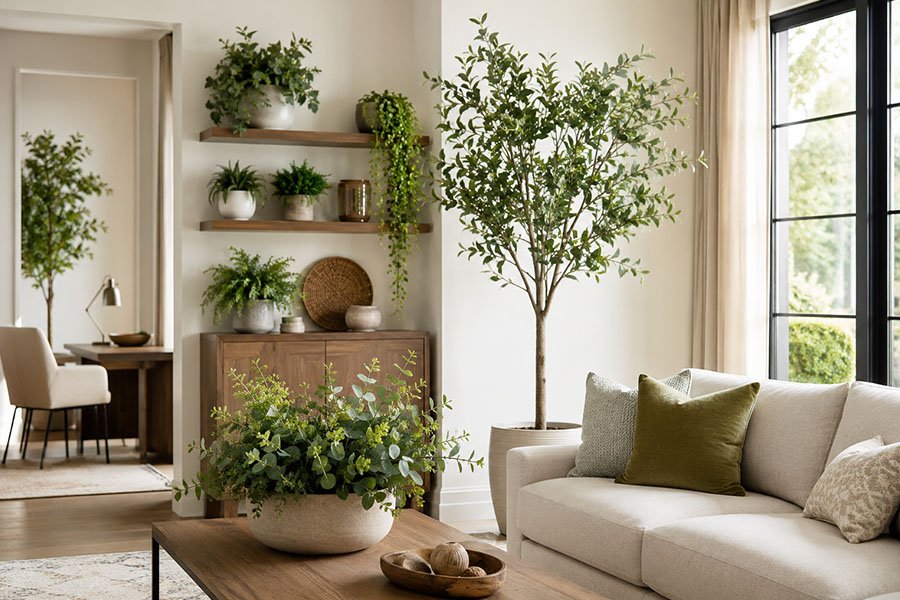
Modern interior design readily incorporates artificial plants for their ability to enhance diverse aesthetic styles. They introduce natural elements without the associated upkeep.
| Style | How Artificial Plants Integrate |
|---|---|
| Minimalist | Provides clean, understated greenery without clutter |
| Bohemian | Adds lush, varied textures without demanding care |
| Industrial | Softens rigid lines, introduces organic contrast |
| Scandinavian | Brings natural elements indoors, maintains simplicity |
| Contemporary | Offers color accents and textural variety, versatile |
Businesses involved in event planning or interior design frequently require decor materials that elevate client projects. Customization services often play a crucial role in meeting specific client requirements, ensuring the perfect aesthetic for any occasion or style. This adaptability is precisely why artificial plants are highly valued in today’s design landscape. They serve as a tool for creative expression, not a limitation.
Professional Endorsement
Interior designers and home stagers increasingly recommend and utilize artificial plants. They are featured in high-profile projects, signifying their mainstream acceptance. They are selected for their consistent appearance and durability, particularly in commercial environments. Hotels, restaurants, and retail spaces, for instance, use them to maintain a fresh aesthetic without the cost and effort of live plant care. The use of environmentally friendly materials also aligns with contemporary values, positioning artificial plants as a sustainable decor option. This focus on quality ensures that artificial plants remain a stylish and practical choice.
My insights: Beyond Green Thumbs: The Enduring Appeal of Artificial Plants
Struggling to keep plants alive? Craving vibrant greenery without the fuss? Artificial plants offer the perfect solution, bringing lasting beauty and effortless style to any space.
People buy artificial plants primarily for their zero maintenance, year-round aesthetic appeal, and versatility in design. They thrive in any environment, eliminate allergy and pest concerns, and offer long-term cost-effectiveness and durability. These benefits make them an ideal choice for enhancing spaces without the commitments and challenges of live foliage.
The Strategic Choice: Why Faux Foliage Flourishes in Modern Decor
The increasing popularity of artificial plants is a testament to their evolving quality and the practical advantages they offer in contemporary living and working spaces. Far from being mere substitutes, modern faux plants are strategic decor elements chosen for their enduring beauty and convenience.
Unpacking the Core Advantages
The decision to opt for artificial plants is often driven by a compelling combination of practical, aesthetic, and health-related benefits.
| Category | Key Benefits | Explanation |
|---|---|---|
| Maintenance | No watering, pruning, fertilizing | Saves time and effort; ideal for busy individuals or frequent travelers. |
| Environmental Adaptation | Thrives in any light condition (low-light, no-light) | Perfect for basements, bathrooms, offices, or dark corners where real plants would fail. |
| Durability & Longevity | Never wilts, fades, or perishes; consistent appearance | Ensures decor looks perfect year-round without seasonal changes or replacement costs. |
| Health & Safety | Allergy-free, pest-free, non-toxic | Eliminates pollen allergies, insect infestations, and risks from toxic plants to pets/children. |
| Cost-Effectiveness | One-time investment, no recurring costs | Saves money on soil, fertilizer, pots, and replacing dead plants over time. |
| Design Flexibility | Unlimited choice, customizable, lightweight | Access to any plant type/size regardless of climate; easy to move and rearrange for aesthetic changes. |
Beyond the Practical: The Evolving Perception
Modern manufacturing techniques have elevated artificial plants to a level of realism that was once unimaginable. High-quality silk, plastic, and "Real Touch" materials mimic the texture, color, and even subtle imperfections of natural foliage, making them virtually indistinguishable from real plants to the casual observer.
- Aesthetic Appeal: They provide immediate visual impact, adding color, texture, and a natural element that enhances mood and productivity, even in commercial settings.
- Problem Solvers: For renters, they avoid potential damage from soil spills or water leakage. In vacation homes, they provide lasting greenery without needing a caretaker.
- Sustainable Choice: While often overlooked, artificial plants can contribute to sustainability by reducing water consumption and the need for pesticides associated with real plant cultivation.
In essence, artificial plants are no longer a compromise but a deliberate choice for those seeking hassle-free, enduring botanical beauty that seamlessly integrates with their lifestyle and design aspirations.
Conclusion
Artificial plants offer significant advantages for modern living. They provide beauty, convenience, and versatility. They are a stylish and practical decor solution, rather than an outdated one.