
Fake flowers once had a reputation for shiny petals, stiff stems, and unrealistic colors. Modern faux florals can look completely different when I choose and style them well.
Fake flowers can be stylish rather than tacky when they have realistic colors, natural textures, believable stems, and thoughtful styling. High-quality faux flowers are now used in homes, weddings, hotels, and professional interiors. I find that fake flowers usually look tacky because of poor quality or bad arrangement, not simply because they are artificial.
The difference between stylish and tacky usually comes down to quality, proportion, color, arrangement, and context. I do not try to hide the fact that flowers are artificial at any cost. I focus on creating an arrangement that looks intentional, balanced, and appropriate for the space.
Are Fake Flowers Still Considered Tacky?
The old idea that every artificial flower looks cheap came from products that often used bright plastic, flat colors, obvious seams, and very stiff construction.
No, fake flowers are no longer automatically considered tacky. Better materials and manufacturing have made premium faux flowers much more realistic. Current designers and publications increasingly accept artificial florals as useful decorative objects. However, low-quality flowers with unnatural colors, excessive shine, perfect symmetry, or visible plastic details can still make an arrangement look dated or cheap.
The Reputation of Fake Flowers Has Changed
For years, artificial flowers were associated with inexpensive décor.
Many older faux flowers had a very obvious artificial appearance. Petals could be thick and shiny. Leaves might use one bright shade of green. Stems sometimes looked like molded plastic tubes. Arrangements were often very symmetrical.
That combination made fake flowers easy to identify.
Current products can be much more detailed.
Vogue reported in June 2026 that faux florals are gaining broader acceptance as improved materials and design make them more lifelike. High-end producers are even adding irregular stems and small imperfections because perfect flowers often look less natural.
Architectural Digest has also documented designers using artificial plants and flowers rather than treating them as an automatic decorating mistake. Its advice makes an important distinction: not all artificial greenery is equal, and overly perfect products can still move a room toward a kitschy look.
I think that distinction is more useful than asking whether the entire category is stylish.
The material itself does not decide the result.
What Usually Makes Fake Flowers Look Tacky?
I notice several visual problems repeatedly.
| Detail | More likely to look tacky | More likely to look stylish |
|---|---|---|
| Petal color | Bright, flat color | Soft natural variation |
| Texture | Shiny plastic | Matte or soft finish |
| Shape | Perfectly identical blooms | Small natural differences |
| Stems | Straight and rigid | Gently curved |
| Leaves | One uniform green | Several natural green tones |
| Arrangement | Dense and symmetrical | Loose and organic |
| Vase | Poor proportion | Suits the flowers and room |
| Condition | Dusty or crushed | Clean and reshaped |
| Quantity | Flowers everywhere | Used with restraint |
A 2026 designer interview about realistic faux flowers highlighted natural color, realistic texture, and avoiding excessive shine as key selection criteria. Muted botanical colors generally create a more believable result than unusually bright synthetic-looking shades.
So when an artificial arrangement looks tacky, I usually look at these details before blaming the fact that the flowers are fake.
How Do You Make Fake Flowers Look Stylish?
Buying an expensive artificial bouquet does not guarantee a stylish result. The flowers still need to be shaped, cut, arranged, and placed like a real floral design.
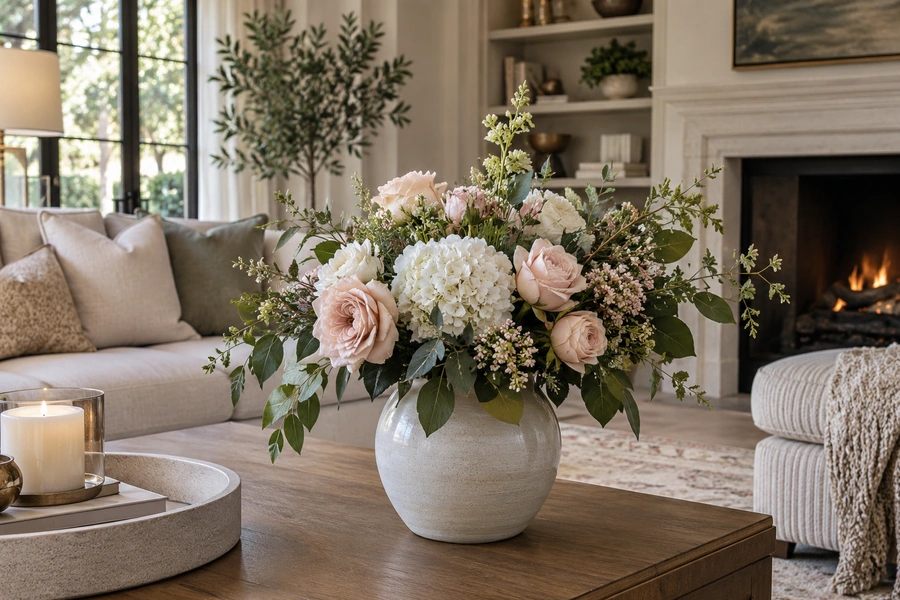
I make fake flowers look stylish by choosing realistic blooms, bending stems into natural positions, varying stem heights, limiting the color palette, leaving some open space, and using a good-quality vase. I avoid perfect symmetry and overcrowding because fresh flower arrangements usually contain irregular heights, movement, and small imperfections.
I Start With Natural Colors
Color is one of the first details I check.
A real rose is rarely one completely uniform color.
A pink rose may have slightly lighter outer petals. A cream hydrangea can contain soft green undertones. Leaves can range from yellow-green to deep olive.
I look for those subtle differences in artificial flowers.
I am more cautious with extremely bright colors because they are harder to reproduce realistically. A designer interviewed by KSL in 2026 similarly recommended softer, more natural shades and warned that neon-looking greenery can quickly make artificial arrangements appear fake.
This does not mean I only use beige or white flowers.
I can use red, purple, orange, or blue. I simply look for believable botanical color rather than a flat synthetic tone.
I Reshape the Stems
Artificial flowers often arrive tightly packed.
The stems may be perfectly straight. Flower heads can point in the same direction. Leaves may lie flat against the stem.
I never consider that the finished arrangement.
Many better artificial stems contain internal wire. I gently bend them into different shapes.
Some flowers lean slightly outward. Others remain more upright. I change the height of individual stems instead of creating one perfect horizontal line across the top.
Living Spaces also recommends trimming faux stems to different lengths and bending them into natural positions because fresh arrangements are rarely perfectly uniform.
This is a small adjustment, but I find that it changes the arrangement immediately.
I Leave Some Space
More flowers do not automatically make an arrangement more luxurious.
When every flower head is packed tightly against the next one, the arrangement can look artificial.
I leave some negative space.
I let a few stems extend beyond the central shape. I may allow one branch to lean farther to the side. I can use greenery to create movement rather than filling every gap with another large flower.
Current styling advice for faux flowers also favors loose arrangements, varied flower sizes, and organic shapes instead of arranging every bloom in exactly the same position.
I Use the Vase as Part of the Design
A vase can make inexpensive flowers look more considered, while the wrong vase can weaken premium flowers.
I look at proportion.
A large bouquet needs enough visual weight at the base.
A small arrangement may work better in a narrow ceramic vase than in a large clear glass cylinder.
For realistic arrangements, I often prefer ceramic, stone-effect, textured glass, or simple clear vessels.
Living Spaces also suggests using a carefully chosen vase and, in some clear-vase arrangements, creating the appearance of water to strengthen the illusion of fresh flowers.
I do not think fake water is necessary in every design. Sometimes an opaque vase creates a cleaner and more modern result.
What Fake Flowers Look the Most Realistic?
Not every artificial flower needs to imitate nature at the same level. Flowers placed on a dining table need more close-up detail than flowers installed several meters above the floor.
The most realistic fake flowers usually have soft or matte petals, subtle color gradients, detailed veins, natural-looking centers, flexible wired stems, and slight differences between individual blooms. Real-touch flowers, premium fabric flowers, and well-made molded flowers can all look convincing when their material suits the natural structure of the species being copied.
I Judge the Whole Flower, Not Only the Petal
Petal material gets a lot of attention, but I also inspect the center, stem, leaves, and underside.
A beautiful rose head attached to a bright green molded plastic stem can still look artificial.
I look for continuity.
If the petals are highly realistic, I want the leaves and stem to meet the same standard.
For large arrangements, I also inspect how flowers are attached. Visible glue, thick plastic joints, and exposed wire can weaken the effect.
A 2026 artificial-flower buyer guide describes material, petal construction, stem quality, and styling as important factors separating obviously artificial flowers from convincing premium products.
Real Touch Can Help at Close Range
Real-touch flowers are useful when guests will see an arrangement closely.
Their petals are designed to reproduce some of the softness and flexibility of fresh blooms.
I may use them for bridal bouquets, table centerpieces, reception arrangements, hotel displays, or other installations where people can easily touch the flowers.
I do not assume that every product labeled “real touch” is automatically high quality.
I still check color, shape, flower center, leaves, and stem construction.
Some Flowers Are Easier to Reproduce Than Others
I find that artificial flowers with strong sculptural forms can be especially convincing.
Orchids, tulips, calla lilies, roses, peonies, hydrangeas, and certain tropical flowers are commonly reproduced successfully when the proportions and materials are good.
The final result still depends on how I use them.
A single carefully selected orchid stem in a ceramic vase can look more sophisticated than twenty lower-quality flowers crowded into one arrangement.
This is why I focus on visual impact rather than stem count.
Are Fake Flowers Good for Home Décor?
Artificial flowers can be useful in rooms where I want color and softness without replacing fresh flowers every week.
Yes, fake flowers can work very well in home décor when I use them selectively. They provide consistent color, do not wilt, require no water, and allow me to display flowers regardless of season. I get the best result when the arrangement matches the scale, color palette, and style of the room rather than becoming the main theme.
I Use Them Where They Add Something
I do not place artificial flowers on every surface.
I use them where the room benefits from a softer shape or a controlled point of color.
A console table may need a tall branch arrangement to add height.
A dining table may benefit from a low floral centerpiece.
A bedroom can use a small arrangement beside a lamp.
A large kitchen island may need one sculptural vase rather than several small decorations.
This selective approach makes faux florals feel intentional.
I Match the Flowers to the Interior
The flower should make sense with the room.
| Interior style | Faux floral direction I might use |
|---|---|
| Minimalist | One sculptural branch or simple tulips |
| Traditional | Roses, peonies, hydrangeas |
| Modern organic | Branches, greenery, muted flowers |
| Coastal | White flowers and loose foliage |
| Romantic | Soft roses and layered blooms |
| Mediterranean | Olive branches and warm-toned flowers |
| Contemporary luxury | Large, controlled monochromatic arrangement |
| Rustic | Wildflower-inspired loose stems |
I do not treat these as strict rules.
They simply help me think about the flowers as part of the overall interior.
I Avoid Making Every Arrangement Permanent
One reason artificial flowers can begin to feel stale is that the same bouquet stays in exactly the same position for several years.
I can change the arrangement seasonally.
I may use lighter branches in spring, fuller flowers in summer, warmer foliage in autumn, and simpler greenery in winter.
Artificial flowers make this easier because I can store and reuse stems instead of replacing everything.
Recent design coverage also shows that faux florals are being used more intentionally rather than simply as permanent substitutes for fresh bouquets. Realtor.com reported in 2026 that artificial flowers have become highly visible in current home styling as product quality and arrangement techniques have improved.
My insights: Are Fake Flowers Tacky or Stylish
The strongest conclusion I take from current design coverage is that the question cannot be answered by the word “fake” alone. The finished arrangement matters much more.
Fake flowers can be stylish when quality, realism, proportion, color, and arrangement work together. They become tacky when I choose overly shiny or unrealistic products, use too many flowers, ignore natural shapes, or let arrangements become dusty and dated. I therefore judge faux florals as a design material rather than treating artificial flowers as automatically stylish or automatically cheap.
My First Insight: Artificial Flowers Have Moved Beyond Their Old Reputation
There is a real change in how faux flowers are being treated in interior design.
Vogue’s 2026 coverage describes artificial flowers moving away from their old stigma as new manufacturers focus on lifelike construction, intentional imperfection, and high-end presentation. Faux and fresh flowers are also increasingly treated as products that can coexist rather than opposing choices.
That matters because it changes the basic question.
I no longer ask whether fake flowers are acceptable.
I ask whether the specific flowers are well designed.
My Second Insight: Imperfection Is Often What Makes Faux Flowers Look Premium
Cheap fake flowers can look too perfect.
Every petal is the same.
Every stem has the same angle.
Every flower is equally open.
Nature does not work like that.
A realistic arrangement usually contains different heights, curved stems, slightly different flower positions, and some variation in color.
This is why high-quality producers and designers deliberately introduce imperfections. Vogue’s recent reporting even describes makers using tiny irregular details to make artificial botanicals feel more lifelike.
I therefore do not try to create perfect symmetry when styling faux flowers.
My Third Insight: One Good Arrangement Is Better Than Many Weak Ones
I prefer one strong floral statement to artificial flowers scattered across every shelf.
A room usually needs visual hierarchy.
If every surface has flowers, none of them feels special.
I might use one large vase on a dining table or console and allow the rest of the room to remain quieter.
This also lets me invest in fewer, better stems.
Quality becomes easier to notice when the arrangement has enough space around it.
My Fourth Insight: Styling Can Upgrade or Damage the Same Flowers
The same artificial flower can look very different depending on how I arrange it.
Straight stems in a cheap vase can look like craft-store décor.
If I trim those stems, bend them naturally, separate the flower heads, add a few pieces of greenery, and use a properly scaled vase, the arrangement can look much more sophisticated.
Current styling advice repeatedly recommends varying heights, bending stems, using natural colors, and avoiding overly perfect arrangements.
This means styling is not a small final step.
It is part of the product.
My Fifth Insight: Stylish Does Not Mean I Need to Fool Everyone
I think this is the most important shift.
I do not need every guest to believe my artificial flowers were cut from a garden that morning.
An arrangement can be beautiful even after someone realizes it is artificial.
The goal is not always deception.
The goal is good interior design.
If the color works with the room, the flowers have attractive texture, the arrangement has natural movement, and the vase has the right scale, the design can succeed.
This idea also appears in current coverage of premium faux florals. The category is increasingly being presented as a decorative medium in its own right rather than simply as a cheaper imitation of fresh flowers.
My Simple Test for Stylish Fake Flowers
When I look at an artificial arrangement, I ask myself whether I notice the flowers first or the fact that they are fake.
If I immediately see shiny plastic, identical petals, exposed artificial stems, or an unnatural color, I know the arrangement needs work.
If I first notice shape, color, movement, balance, and how well the flowers complement the room, then the design is doing its job.
That is why I would not describe fake flowers as either permanently tacky or automatically fashionable.
They are stylish when they are chosen and arranged with the same care I would give any other visible design element.
Modern artificial flowers give me far more realistic materials than earlier generations did. Still, better manufacturing does not replace good judgment.
I choose fewer flowers when fewer are enough.
I select natural colors.
I reshape stems.
I avoid excessive shine.
I keep arrangements clean.
I use a vase that belongs in the room.
And I allow a little imperfection.
When those details work together, fake flowers can look polished, current, and intentional rather than tacky.
Conclusion
Fake flowers can be stylish, not tacky. I get the best result from realistic materials, natural colors, imperfect shapes, thoughtful arrangements, good vases, clean petals, and restrained use.