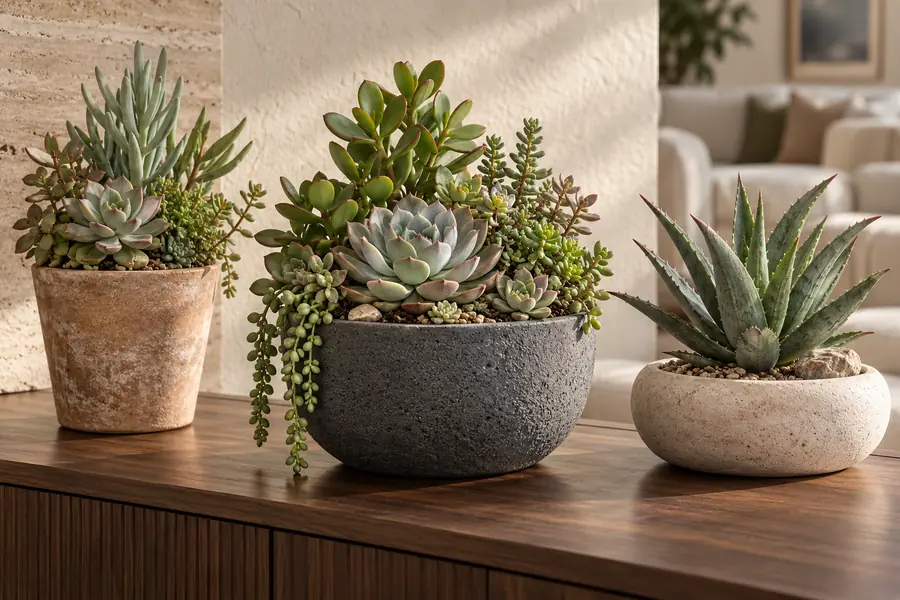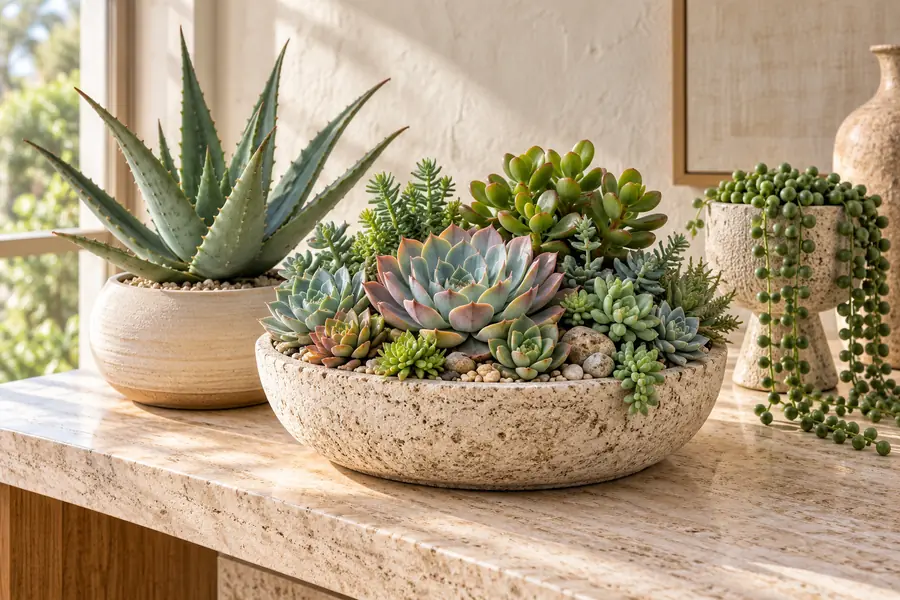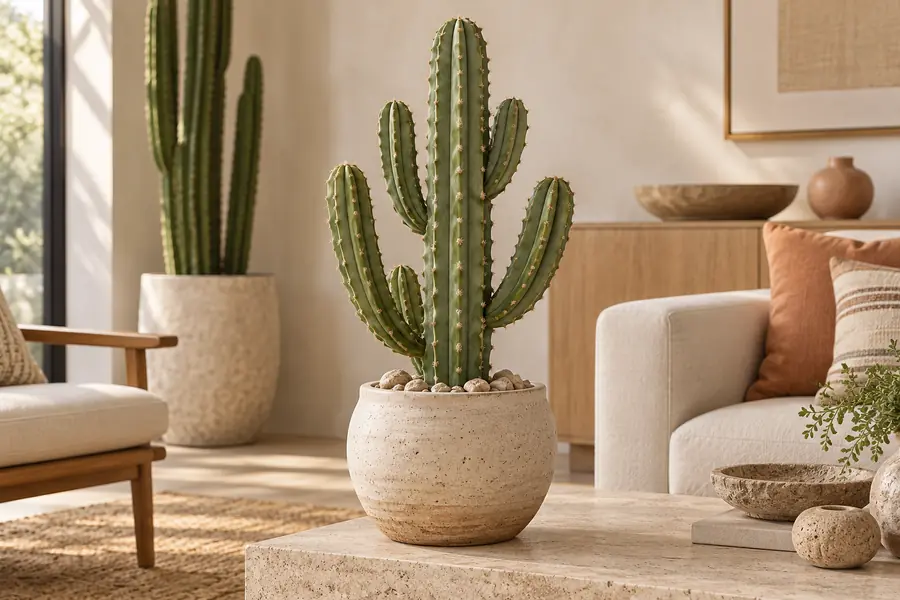
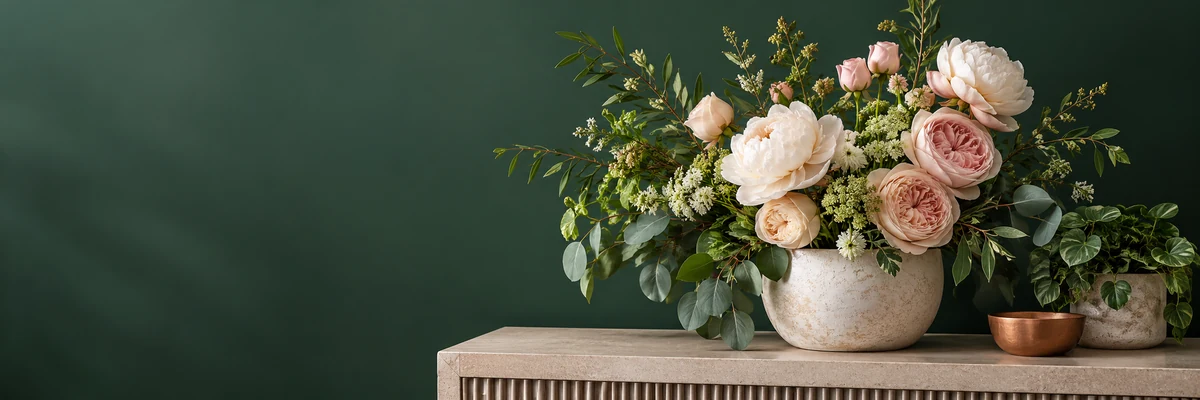

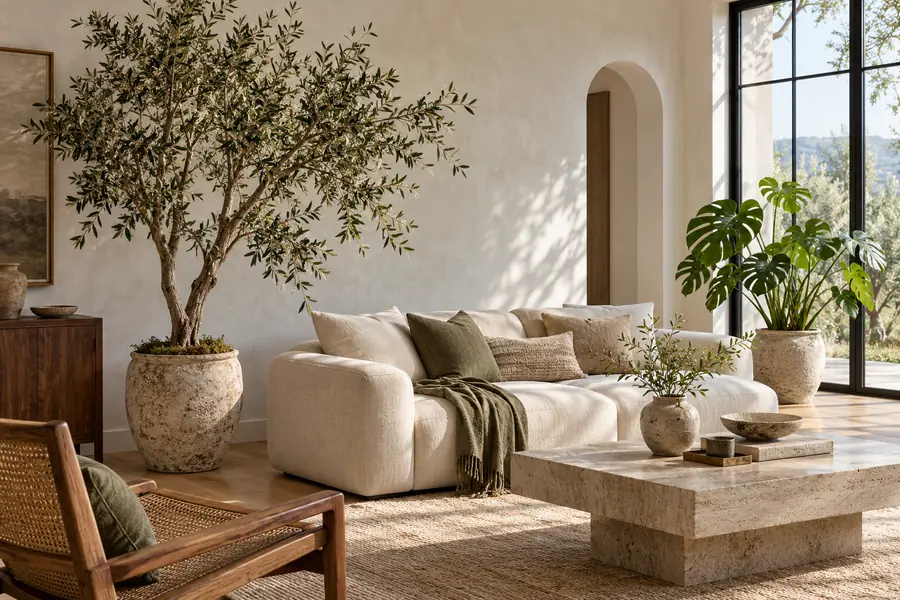
Fake plants have carried a reputation for shiny plastic leaves and dusty waiting-room décor. Modern artificial greenery, however, ranges from obviously synthetic to surprisingly convincing.
Fake plants are not automatically tacky. High-quality artificial plants can work beautifully when their foliage, scale, planter, shape, and placement feel natural. They usually look cheap when leaves are excessively glossy, colors are flat, branches are perfectly symmetrical, factory pots remain visible, or too many small faux plants are scattered around the room.
Artificial plants look sophisticated when quality, asymmetry, natural shaping, hidden bases, realistic textures, and thoughtful placement reduce the manufactured appearance that makes cheaper options tacky.
Why Do Some Fake Plants Look Tacky?
Artificial plants usually fail because several small visual clues reveal how they were manufactured.
Fake plants tend to look tacky when they have glossy plastic surfaces, one flat shade of green, repeated identical leaves, unrealistic symmetry, poor trunks, visible foam, tiny factory pots, or accumulated dust. A convincing artificial plant imitates the irregularity of natural growth rather than trying to look perfectly neat.
Excessive Shine Is One of the Biggest Problems
Not every real leaf is matte.
A rubber plant naturally has more surface shine than an olive tree.
A monstera can have a soft sheen.
An olive leaf is comparatively muted.
The problem appears when every artificial species has the same hard plastic reflection.
That is when the material becomes more noticeable than the plant.
When I evaluate faux greenery, I ask:
Does the surface finish make sense for the species?
For example:
| Plant type | More believable finish |
|---|---|
| Olive tree | Muted, gray-green, mostly matte |
| Rubber plant | Smooth with natural sheen |
| Fiddle leaf fig | Soft sheen with visible veins |
| Palm | Mostly matte |
| Monstera | Slight natural gloss |
| Succulent | Matte or softly waxy |
The objective is not to find the dullest leaf.
It is to find the right leaf.
One Flat Color Looks Manufactured
Living plants contain variation.
New growth may be lighter.
Older foliage may be darker.
Some leaves receive more light.
Others sit deeper in the canopy.
A fake plant made from one identical green material loses those cues.
Better artificial greenery usually contains several related tones rather than one saturated color.
Architectural Digest’s current fake-plant guide emphasizes lifelike foliage and convincing overall appearance rather than treating all artificial plants as interchangeable.
Perfect Repetition Exposes the Mold
Look closely at a cheap faux tree and you may notice:
the same leaf,
at the same angle,
at the same distance,
again and again.
That repetitive pattern is difficult to ignore once you see it.
Real plants contain biological repetition, but not mechanical duplication.
A realistic artificial plant should introduce enough variation in:
- Leaf angle
- Branch length
- Color
- Height
- Density
to avoid looking copied and pasted.
Perfect Symmetry Is Usually Too Perfect
House Beautiful’s recent advice specifically identifies artificial symmetry as a giveaway and recommends introducing uneven lengths, drooping and natural imperfection.
I agree with that principle.
A convincing faux tree might have:
one side slightly fuller,
one lower branch,
two leaves pointing away,
and several visible gaps.
That looks much more botanical than a perfectly round canopy.
Can High-Quality Artificial Plants Actually Look Stylish?
Yes, especially when they are chosen for the right room and viewed from a normal distance.
High-quality faux plants can look stylish because modern products use better molding, color variation, textured surfaces, adjustable branches, realistic trunks, and more refined planters. They are particularly useful in dark rooms, vacation properties, difficult corners, commercial spaces, or areas where consistent greenery is more practical than living plants.
Architectural Digest currently presents artificial palms, cacti, monstera, trees and other greenery as legitimate decorating options, emphasizing products designed to appear lush and lifelike rather than treating faux plants as an automatic design mistake.
Architectural Digest has also previously documented designers who actively use artificial greenery, arguing that the category has moved beyond its older “tacky” reputation when the product and styling are convincing.
Viewing Distance Changes Everything
This is one of the most useful principles.
Imagine two artificial plants.
One sits on a coffee table 18 inches from the viewer.
The other is a seven-foot olive tree across the living room.
The first requires excellent:
texture,
attachment points,
leaf edges,
and pot detail.
The second is judged mainly by:
silhouette,
trunk,
scale,
and color.
That means a moderately priced floor tree may look highly convincing from eight feet away even if its individual leaves would not survive close inspection.
Large Faux Trees Can Be Easier to Style
Large plants often function more like furniture.
A good faux olive, ficus, palm, or fiddle leaf fig contributes:
height,
vertical structure,
color,
and balance.
People perceive the complete silhouette before examining individual leaves.
That can make a single substantial tree more successful than ten small faux succulents scattered around the room.
Artificial Flowers Have Also Improved
Architectural Digest’s 2026 artificial-flower guide notes that modern faux florals now include more sophisticated materials such as fabric, paper and metal rather than only the traditional craft-store plastic stems associated with older artificial arrangements.
The broader lesson applies to plants too:
the category has evolved.
Quality still varies enormously.
How Can You Make Fake Plants Look Less Tacky?
Styling can improve artificial greenery almost as much as buying a better product.
To make fake plants look less tacky, reshape them asymmetrically, rotate leaves in different directions, expose parts of the trunk, replace small factory pots, conceal visible foam, use natural-looking materials around the base, keep foliage clean, and place plants where living greenery could plausibly grow.
House Beautiful’s 2026 recommendations make essentially the same point: treat artificial greenery like living plants instead of leaving it in perfect factory condition.
Reshape Everything After Unpacking
Shipping compresses artificial plants.
Branches often arrive:
vertical,
close together,
or flattened against the trunk.
Never assume this is the final shape.
For a large artificial tree, I usually:
- Spread the main branches outward.
- Bend several slightly downward.
- Rotate smaller stems in different directions.
- Create gaps around the trunk.
- Step back several feet.
- Make one side slightly less symmetrical.
That final irregularity often creates the most realism.
Upgrade the Pot
This may be the highest-impact improvement.
A six-foot tree in a tiny black shipping pot rarely looks convincing.
Place it inside a larger:
- Terracotta planter
- Ceramic pot
- Stone-effect container
- Textured plaster planter
- Woven basket
Architectural Digest specifically recommends ceramic pots as a simple way to improve the presentation of faux plants.
Hide the Artificial Base
Visible foam or molded plastic can ruin otherwise convincing greenery.
House Beautiful recommends using moss to conceal artificial bases.
Other useful options include:
- Bark
- Coconut fiber
- Neutral gravel
- Decorative stone
The key is restraint.
One believable top material is usually enough.
Keep Artificial Plants Clean
This is where critics of faux greenery have a legitimate point.
Homes & Gardens’ 2026 designer commentary specifically notes that artificial plants can collect dust and fade when neglected.
Dust affects more than cleanliness.
It changes:
color,
texture,
and reflected light.
A dusty leaf appears dull and gray.
That makes the plant look older and more artificial.
Put Faux Plants Where Plants Make Visual Sense
A fake plant does not biologically need daylight.
But visual logic still matters.
A tall faux tree often feels more natural:
near a window,
beside French doors,
in a bright corner,
or near an indoor-outdoor transition.
A huge tropical tree inside a completely dark narrow hallway may be harder for the eye to accept.
This is not a rule.
It is a useful illusion.
Are Fake Plants Out of Style in 2026?
Not exactly. The category is more controversial than outdated.
Artificial plants remain widely sold, styled and recommended in 2026, but current interior design is less forgiving of generic, mass-produced décor. That means poor-quality faux plants may feel dated while convincing or strategically placed artificial greenery can still work. The larger trend favors character, natural materials and thoughtful curation rather than simply banning artificial plants.
Homes & Gardens’ 2026 trend reporting says designers increasingly prefer interiors with personality and character instead of showroom-like sameness.
That helps explain why some designers criticize faux greenery.
The problem is often not:
“fake plant.”
The problem is:
“generic decorative filler.”
A small artificial eucalyptus plant identical to one in thousands of homes may feel impersonal.
A beautifully scaled faux olive tree integrated with:
stone,
wood,
art,
and textiles
can feel entirely different.
Design Opinions Remain Divided
Some designers clearly prefer real plants.
Homes & Gardens quoted interior designer Lexie Saine saying artificial plants can read as static and lifeless, particularly when they fade or collect dust.
Other respected design publications continue to curate and recommend artificial greenery.
Architectural Digest explicitly describes today’s best fake plants as capable of elevating interiors when they are lifelike and well selected.
Neither perspective needs to be dismissed.
They simply establish a higher standard.
Fake plants are not automatically stylish.
They need to earn their place visually.
Should You Choose Real Plants or Fake Plants?
The best choice depends on what you actually want from the plant.
Choose living plants when you value growth, natural variation, tactile interaction and caring for greenery. Choose artificial plants when low light, travel, difficult access, predictable appearance or low maintenance makes living plants impractical. Many successful interiors use both rather than treating the choice as all-or-nothing.
Real Plants Are Better When You Want Living Change
Real greenery:
grows,
leans,
drops leaves,
produces new shoots,
and responds to seasons and care.
That dynamic quality is difficult to imitate.
Real plants are therefore preferable when the living experience itself matters.
Artificial Plants Are Better for Certain Practical Problems
Faux greenery may make more sense in:
- Windowless rooms
- Dark corridors
- Vacation properties
- High shelves
- Commercial displays
- Hard-to-reach installations
- Areas requiring a highly consistent appearance
In those conditions, the alternatives may not be:
real plant vs fake plant.
They may actually be:
fake plant vs no greenery.
Mixing Real and Faux Plants Can Work Very Well
One of my favorite approaches is to use real plants where conditions support them and artificial greenery where they do not.
For example:
Real pothos beside the window.
Faux olive tree in the dark corner.
Real herbs in the kitchen.
Faux trailing plant on a high shelf.
The mix reduces the sense that the entire room has been artificially “greened.”
What Types of Fake Plants Usually Look the Most Realistic?
Some species are easier to reproduce than others.
Olive trees, palms, ficus, rubber plants, monstera, pothos, succulents and cacti can be particularly convincing because their natural forms translate well into molded materials. Large statement plants often work better than collections of small generic faux greenery because viewers judge their silhouette from farther away.
Olive Trees
One of the safest choices.
Their naturally sparse branching and small muted leaves make slight artificial irregularities less noticeable.
Palms
Individual fronds can be shaped in multiple directions.
That helps break symmetry.
Ficus
Small leaves and branching structure create depth.
Rubber Plants
Their naturally thicker, smoother leaves work well with molded materials.
Monstera
Large recognizable leaves create strong impact, although vein and surface detail need to be convincing.
Succulents and Cacti
These are particularly suitable for artificial reproduction because their real leaves or stems are already:
thick,
rigid,
and sculptural.
Artificial materials can reproduce those qualities more naturally than delicate flowers or thin fern fronds.
When Do Fake Plants Look Most Tacky?
Artificial plants become most problematic when decoration relies on quantity instead of quality.
The tackiest faux-plant interiors usually combine several problems at once: many tiny plants, repetitive species, obvious plastic shine, poor pots, visible bases, perfect symmetry, dust, and artificial greenery placed on nearly every available surface.
Too Many Small Plants
One on the coffee table.
One on every shelf.
One beside the television.
One on the bathroom counter.
One on the dining table.
Eventually, the room develops a pattern of small green objects.
I call this the green-dot effect.
The plants stop contributing nature.
They start contributing clutter.
I would usually prefer:
one convincing floor tree
plus
one trailing plant
rather than
eight generic tiny faux plants.
Fake Greenery Everywhere
Another problem occurs when artificial greenery becomes the entire decorating theme.
Fake vines around mirrors.
Artificial plants on shelves.
Faux trees in corners.
Leaf-print cushions.
Botanical artwork.
Artificial green walls.
At some point, restraint would create a stronger result.
Obviously Artificial Plants in Close-Up Locations
A mediocre faux tree across the room may work perfectly.
The same material placed on a dining table directly beneath someone’s face becomes much easier to identify.
Close-up placement requires higher quality.
My insights: Are Fake Plants Tacky-What You Need to Know About Artificial Plants
After comparing current 2026 designer criticism, artificial-plant recommendations and current styling guidance, I think the answer depends less on whether the plant is artificial and more on whether the room feels intentionally designed.
Are Fake Plants Tacky? What You Need to Know About Artificial Plants is that faux greenery becomes tacky when it looks generic, poorly maintained or obviously synthetic. High-quality artificial plants can still work beautifully when they have botanical accuracy, correct scale, natural asymmetry, believable containers and thoughtful placement. The safest approach is to use fewer, better plants rather than filling every surface with greenery.
My First Insight: “Fake” and “Tacky” Are Not Synonyms
Artificial describes material.
Tacky describes the result.
Those are different things.
A plastic object can be beautifully designed.
A natural object can be badly styled.
That is why I would never reject an artificial plant solely because it is artificial.
I evaluate the complete design.
My Second Insight: Current Designer Criticism Is Really About Generic Décor
The negative Homes & Gardens commentary is useful because it highlights real problems:
static appearance,
dust,
fading,
and artificiality.
But Architectural Digest’s continuing recommendations show that the conclusion is not simply “never use fake plants.”
The more useful interpretation is:
the quality threshold has risen.
People are less willing to accept artificial greenery simply because a room has an empty corner.
My Third Insight: Imperfection Is the Main Ingredient in Realism
House Beautiful’s 2026 styling guidance emphasizes varying stems and introducing drooping or asymmetry.
That principle applies to almost every artificial plant.
Nature is orderly.
But nature is rarely perfectly symmetrical.
The most convincing faux plants imitate that balance.
My Fourth Insight: The Planter Can Matter as Much as the Leaves
People often spend all their time comparing foliage.
Then they leave the plant in a nine-inch shipping pot.
That breaks the illusion.
A larger:
terracotta,
stone,
ceramic,
or plaster planter
gives the plant visual weight.
It makes the object feel rooted in the architecture rather than temporarily placed there.
My Fifth Insight: Styling Can Rescue a Mid-Priced Plant
You do not always need the most expensive faux tree.
A moderately priced plant can improve dramatically when you:
reshape it,
rotate leaves,
hide the base,
upgrade the planter,
and clean it.
That is why styling guidance from House Beautiful focuses so heavily on small physical adjustments rather than price.
My Sixth Insight: One Strong Tree Is Better Than Five Weak Plants
Current interiors increasingly emphasize character and intentional curation rather than generic showroom styling.
Artificial greenery should follow the same rule.
One good olive tree can become an architectural accent.
Five cheap tabletop plants can become filler.
When in doubt, edit.
My Seventh Insight: Natural Materials Make Faux Greenery More Convincing
A fake tree beside:
real oak,
linen,
stone,
wool,
or handmade ceramic
usually feels more integrated than one surrounded by synthetic surfaces.
Authentic materials supply natural irregularity around the artificial plant.
The plant no longer has to create the entire connection to nature by itself.
My Eighth Insight: Fake Plants Should Solve a Problem
I think artificial greenery works best when there is a practical reason for it.
Dark room: faux plant.
Frequently vacant home: faux plant.
Very high shelf: faux plant.
Commercial installation requiring consistency: faux plant.
Bright room with an enthusiastic plant owner: real greenery may be better.
When faux plants solve a real constraint, they feel intentional.
My Ninth Insight: Dust Is Part of the Design
I do not separate maintenance from appearance.
Dust changes:
leaf color,
surface reflection,
and texture.
A dirty high-end faux plant can look cheaper than a clean inexpensive one.
If artificial greenery is supposed to provide permanent beauty, cleaning has to be part of the ownership plan.
My Tenth Insight: Fake Plants Do Not Need to Fool Everyone
This is perhaps the most useful standard.
I do not require an artificial tree to deceive a botanist holding its leaves six inches from their face.
I need it to look convincing from the normal viewing distance of the room.
For a floor tree, that might be:
six to ten feet.
For a coffee-table succulent, the standard should be much higher.
Viewing distance should determine how much realism—and money—you need.
My Quick Faux Plant Checklist
Before buying an artificial plant, I ask:
| Question | What I want |
|---|---|
| Are the leaves too shiny? | Species-appropriate finish |
| Is the color flat? | Subtle variation |
| Are all leaves identical? | Natural irregularity |
| Is the canopy symmetrical? | Controlled asymmetry |
| Is the trunk convincing? | Texture and taper |
| Can branches be reshaped? | Flexible construction |
| Is the factory pot tiny? | Easy planter upgrade |
| Is the base visible? | Concealable construction |
| Does the size fit the room? | Correct scale |
| Will it be viewed closely? | Better material detail |
| Does its location make visual sense? | Plausible placement |
My Final View
So, are fake plants tacky?
They certainly can be.
But they do not have to be.
Current design opinion is divided for a reason. Some designers are tired of artificial plants that feel static, dusty and generic, while other respected publications continue to recommend high-quality faux greenery as a practical decorating tool.
Both sides are useful.
The criticism tells us what to avoid.
The positive examples tell us what works.
I would follow five rules:
Use fewer plants.
Choose better materials.
Avoid perfect symmetry.
Upgrade the planter.
Keep everything clean.
If I can also place the plant where greenery naturally belongs and combine it with authentic materials, the result becomes even more convincing.
The question is therefore not:
“Is this plant fake?”
The better question is:
“Does this plant improve the room?”
If the answer is yes, its artificial construction does not automatically make it tacky.
Conclusion
Fake plants are not inherently tacky. Realistic materials, natural asymmetry, correct scale, better planters, thoughtful placement and regular cleaning can make artificial greenery feel stylish and intentional.