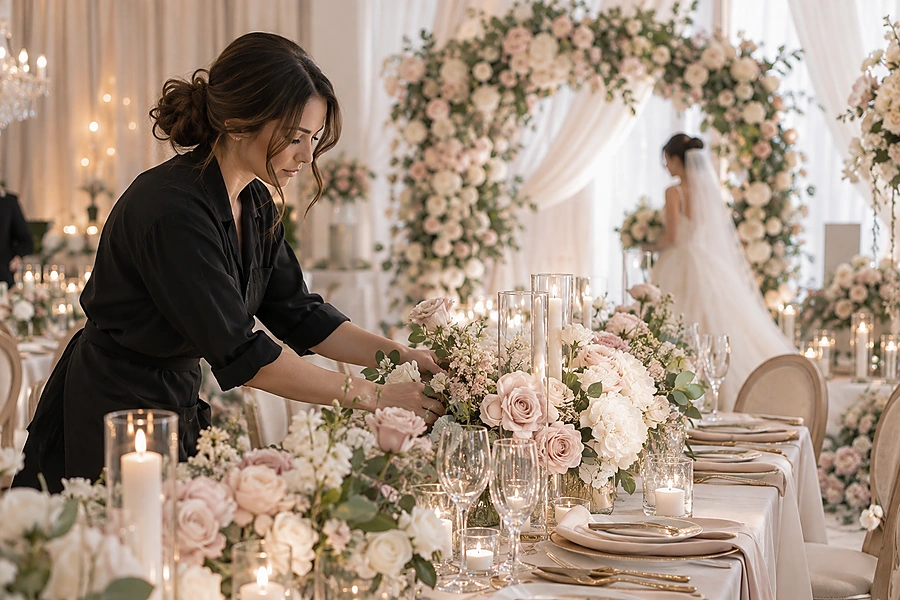

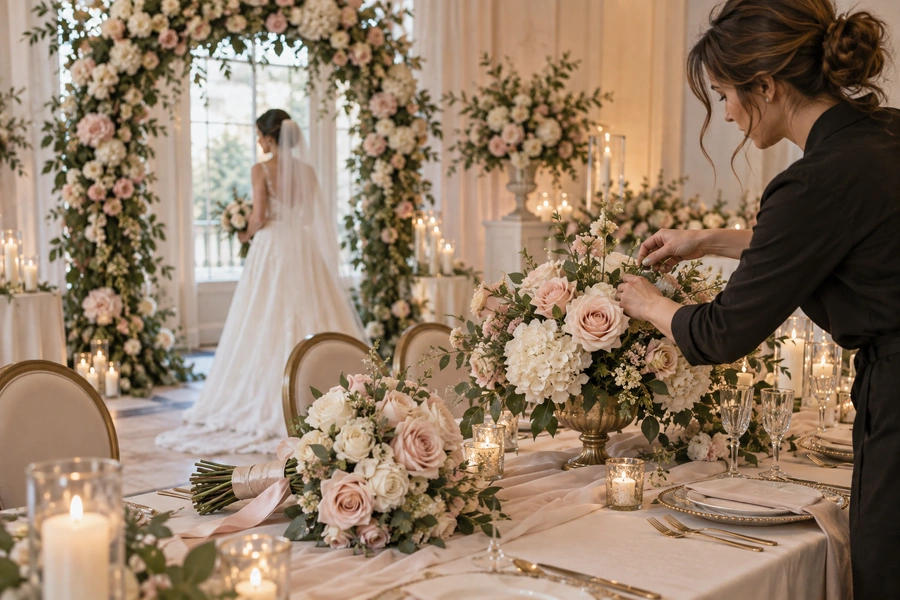
Wedding flowers no longer have to be fresh. Modern silk, foam, and real-touch flowers can look convincing enough that many couples now consider them for bouquets, centerpieces, and ceremony installations.
Yes, some florists do fake flowers for weddings, but not every traditional florist offers them. I can work with florists who specialize in artificial wedding flowers, dedicated faux-floral rental companies, or designers who combine fresh and artificial flowers. The best option depends on the wedding style, budget, installation needs, and whether I want to buy or rent the arrangements.
The important distinction is that “wedding florist” now covers several different service models. Some florists work almost entirely with fresh flowers. Others specialize in faux arrangements, and some deliberately use both.
Will a Wedding Florist Work With Artificial Flowers?
I would not assume that every florist is willing to design with artificial flowers. Fresh-flower floristry and faux-flower design overlap, but they are not exactly the same service.
Some wedding florists work with artificial flowers, while others only use fresh blooms. There are also specialized faux-floral designers and rental companies that provide complete artificial wedding arrangements. I therefore ask a florist directly whether they offer faux, silk, real-touch, or hybrid floral design before booking rather than assuming artificial flowers are included in their normal services.
Traditional Florists May Focus on Fresh Flowers
A traditional wedding florist often builds a business around fresh flowers.
The florist may order flowers from wholesalers, condition the stems, store them at controlled temperatures, design the arrangements shortly before the wedding, transport them to the venue, and set everything up on the wedding day.
Artificial flowers use a different workflow.
They can be purchased or rented much earlier. They do not need refrigeration or hydration. They can also be assembled weeks or months before an event.
That means a florist who specializes in fresh flowers may simply choose not to offer faux arrangements.
The Knot’s guide to wedding flower rentals makes this distinction clearly. It notes that artificial flower rental is usually offered by specialized wedding-flower rental businesses rather than by a standard florist.
I therefore ask questions such as:
- Do you design with artificial flowers?
- Do you provide fresh and faux combinations?
- Can I supply my own artificial stems?
- Do you rent the arrangements or sell them?
- Is setup included?
- Who installs large arches or ceremony flowers?
- Who removes the flowers after the reception?
Those questions tell me much more than asking only whether the business is called a florist.
Some Florists Specialize Entirely in Faux Flowers
There are also floral designers whose whole business is based on artificial flowers.
For example, Zola currently lists The Faux Bouquets as a wedding florist that says it designs its orders completely with artificial blooms. Zola also lists SoCal Flower Studio as a full-service floral designer specializing in custom high-quality faux flower arrangements for weddings and events.
These vendors can provide much more than a bridal bouquet.
Depending on the business, faux-floral services may include:
| Wedding floral item | Can be made with faux flowers? |
|---|---|
| Bridal bouquet | Yes |
| Bridesmaid bouquets | Yes |
| Boutonnieres | Yes |
| Corsages | Yes |
| Centerpieces | Yes |
| Aisle arrangements | Yes |
| Ceremony arches | Yes |
| Welcome-table flowers | Yes |
| Sweetheart-table flowers | Yes |
| Cake flowers | Yes, with appropriate food-safe separation |
| Large floral installations | Yes |
This is why I would not think of artificial wedding flowers as only a DIY option.
They can be professionally designed, delivered, installed, and removed in much the same way as other wedding décor.
Faux Flower Rentals Are Another Option
Rental companies create another category.
The Knot reports that wedding flower rental vendors generally use artificial flowers rather than fresh blooms. Couples choose arrangements from an existing collection, receive them for the wedding, and return them afterward.
Something Borrowed Blooms is one example. It currently offers rental bouquets, centerpieces, and installation pieces designed with silk and artificial flowers.
This model can work well when I like one of the existing collections and do not need completely custom flowers.
A custom faux florist gives me more control.
A rental company may give me lower costs and less storage after the wedding.
Neither model is automatically better. They solve different problems.
Are Fake Flowers Cheaper for a Wedding?
Artificial flowers are often promoted as a budget-friendly alternative, but I do not assume that every faux arrangement will cost less than fresh flowers.
Fake wedding flowers can cost less, especially when I rent them or reuse the same arrangements in several parts of the wedding. However, premium real-touch flowers, custom design, delivery, setup, and large installations can still be expensive. The final cost depends on flower quality, arrangement size, labor, customization, rental terms, and installation requirements.
Rental Flowers Can Reduce the Floral Budget
Flower rentals can be much less expensive than some full-service fresh-flower packages.
The Knot reported in its September 2024 guide that full wedding flower rental orders from two featured faux-flower companies averaged roughly $450 to $500, although shipping, damage fees, and setup could add to the total.
For context, The Knot’s May 2026 Real Weddings Study reported average wedding-flower spending of $2,800 among 10,474 U.S. couples who married in 2025. That figure covers the broader wedding-floral market and should not be treated as a direct like-for-like comparison with a standardized rental package.
A fresh florist may include custom design, sourcing, conditioning, delivery, installation, room flips, breakdown, and large quantities of perishable flowers.
A rental order may use standardized designs and may require me or my planner to handle part of the setup.
So I compare the entire service rather than only the flower price.
High-Quality Artificial Flowers Can Be Expensive
There is another misconception I avoid.
Fake does not always mean cheap.
Real-touch wedding flowers can use detailed materials, molded petals, hand-finished coloring, wired stems, and premium foliage. The Knot’s artificial-wedding-flower guide notes that high-quality polymer or real-touch flowers tend to cost more than basic foam or fabric alternatives.
This matters if I am buying enough stems for:
- A bridal bouquet
- Eight bridesmaid bouquets
- Twenty centerpieces
- A ceremony arch
- Aisle flowers
- A sweetheart table
- A large reception installation
Premium artificial stems add up quickly.
The advantage is that I may be able to prepare the flowers earlier and reuse them.
Reuse Can Change the Calculation
One artificial arrangement can sometimes do several jobs.
I might use aisle arrangements during the ceremony and move them to the reception.
An arch piece may become sweetheart-table decoration.
Bridesmaid bouquets can decorate the bar or cake table after photographs.
A faux-floral wedding vendor currently listed on Zola specifically markets arch and aisle pieces that can be repurposed between ceremony and reception.
That can reduce the number of separate arrangements I need.
I use a table like this when comparing the budget:
| Cost factor | Fresh flowers | Artificial flowers |
|---|---|---|
| Flower material | Seasonal and perishable | Reusable |
| Advance preparation | Limited | Much easier |
| Refrigeration | Often important | Not required |
| Rental option | Uncommon | Common |
| Custom design labor | Yes | Yes |
| Delivery | Usually | Often |
| Setup | Usually available | Varies |
| Breakdown | Often available | Varies |
| Storage after wedding | Not usually needed | Needed if purchased |
| Reuse | Limited | Strong advantage |
Artificial flowers can save money, but I only know that after comparing equivalent services.
Can You Mix Real and Fake Flowers at a Wedding?
I do not have to choose between an entirely fresh wedding and an entirely artificial wedding. A hybrid approach can be one of the most practical options.
Yes, real and fake flowers can be mixed at a wedding. I can use fresh flowers where guests interact closely with the arrangement and artificial flowers in large installations, difficult-to-reach areas, or designs that need to stay perfect for many hours. High-quality faux flowers mixed with fresh greenery can also make the artificial elements less obvious.
Some Professional Florists Already Use Hybrid Designs
This is not only a theoretical idea.
Current vendor listings show wedding florists offering both materials. Cardinal Co. Floral Rentals lists an all-inclusive wedding package that combines fresh and faux flowers.
The Knot also lists Floral Kitchen, where a client described using the florist’s recommended combination of realistic artificial and fresh flowers. Another listed florist, Olivia Floral Design & Events, has a review describing fresh bouquets combined with centerpieces and a chuppah that used high-quality artificial flowers alongside fresh material.
That tells me hybrid wedding flowers can be part of professional floral design rather than a compromise couples need to hide.
I Put Fresh Flowers Where They Matter Most
If I want the scent and natural texture of fresh flowers, I may prioritize them for close-up items.
For example:
Fresh flowers might go into:
- Bridal bouquet
- Boutonnieres
- Corsages
- Small table arrangements
- Detail photographs
Artificial flowers might go into:
- Ceremony arches
- Ceiling installations
- Large aisle arrangements
- Backdrops
- Distant stage flowers
- Reusable centerpieces
This approach lets me decide where the extra realism or fragrance of fresh flowers matters most.
Fresh Greenery Can Help Artificial Flowers Look Natural
Zola recommends mixing faux flowers with real greenery as one way to get some of the benefits of both materials, particularly in designs that need natural movement.
I find this approach useful because greenery often creates the loose edges of an arrangement.
The focal rose or peony may remain relatively still.
A eucalyptus branch, vine, or loose leaf creates movement.
Using natural greenery around premium artificial focal flowers can soften the boundary between fresh and faux.
I Still Check Material Compatibility
A hybrid arrangement needs planning.
Fresh stems may require water.
Some artificial flower materials should not remain soaked.
I do not simply push every faux stem into a vase of water without checking the product.
For bouquets, floral installations, and centerpieces, the florist should understand how both materials will be mechanically supported.
The aesthetic combination is easy.
The technical combination still needs proper design.
What Wedding Flowers Work Best as Artificial Flowers?
Some wedding arrangements are particularly well suited to artificial flowers because the flowers need to maintain a fixed shape for a long time.
Artificial flowers work especially well for bridal and bridesmaid bouquets, centerpieces, ceremony arches, aisle flowers, garlands, backdrops, and large decorative installations. I get the most realistic results when I use high-quality focal flowers, natural-looking greenery, varied stem positions, and a florist who understands how artificial materials behave.
Bouquets Are an Obvious Starting Point
Wedding bouquets are a popular use because they can be finished well before the ceremony.
I can see the complete bouquet in advance.
I do not have to worry about a particular flower arriving smaller, darker, or more open than expected.
The bouquet does not wilt during photographs.
It can also become a keepsake.
Afloral currently markets artificial wedding flowers specifically for bouquets and for repurposing after the celebration.
For a close-up bouquet, however, quality matters more.
Guests will see the flower centers.
The photographer will capture the petals in detail.
I therefore pay attention to:
- Petal texture
- Flower centers
- Leaf color
- Stem construction
- Matte versus glossy surfaces
- Natural color gradients
Centerpieces Can Be Very Practical
Artificial flowers also work well on tables.
They can be assembled days or weeks beforehand.
Their shape stays consistent.
I do not need to worry about flowers opening differently on each table.
If the arrangements are rented, they can simply be returned after the event.
I still keep the arrangement scale appropriate.
A huge artificial centerpiece made from obviously repetitive flowers can look less natural than a smaller design using fewer premium stems.
Large Installations Can Be an Excellent Use
Large wedding arches and backdrops require a lot of material.
They may also be installed several hours before guests arrive.
Artificial flowers remove the risk of wilting during setup.
They can be placed onto structures ahead of time.
They can also be reused or rented.
This makes faux flowers especially practical for:
- Arches
- Flower walls
- Stage designs
- Hanging installations
- Staircase decorations
- Entrance arrangements
I still treat installation as a professional task when pieces are large, overhead, or exposed to wind.
The flower itself may be lightweight, but the complete structure needs safe support.
My insights: Do Florists Do Fake Flowers for Weddings
After comparing traditional florists, faux specialists, rental companies, and hybrid designers, I think the most useful answer is more specific than a simple yes.
Yes, florists can do fake flowers for weddings, but I should choose the right type of florist. Some traditional florists work only with fresh flowers, while specialized faux-floral designers create complete artificial weddings and other florists intentionally mix fresh and faux blooms. Rental companies provide another option when I want professionally designed artificial arrangements without purchasing them permanently.
My First Insight: “Florist” No Longer Means Fresh Flowers Only
The wedding floral market now contains several different service models.
I can book a traditional fresh florist.
I can hire a designer who specializes in artificial florals.
I can rent a complete faux collection.
I can hire a florist who mixes both.
This matters because I should search for the service I actually want instead of contacting random florists and asking them to work outside their normal process.
If I know I want artificial flowers, I search specifically for:
- Faux wedding florist
- Artificial wedding florist
- Silk flower wedding designer
- Real-touch wedding florist
- Wedding flower rental
- Hybrid fresh and faux florist
Current Zola and The Knot vendor listings show that these services exist as professional wedding businesses, including full-service faux designers and florists offering mixed fresh-and-artificial packages.
My Second Insight: Faux Flowers Work Best When I Choose Them for a Reason
I do not use artificial flowers only because they are “fake fresh flowers.”
I choose them when their properties solve a wedding-planning problem.
| Wedding need | Why faux flowers can help |
|---|---|
| Long setup time | They do not wilt |
| Difficult flower season | Availability is predictable |
| Early preparation | Arrangements can be completed ahead |
| Destination logistics | Designs can be shipped in advance |
| Reusable décor | Flowers can move between spaces |
| Keepsake bouquet | Bouquet can be kept afterward |
| Rental strategy | Large floral package can be returned |
| Color consistency | Flowers remain predictable |
| Large installation | No hydration needed |
| Pollen concern | Artificial flowers contain no flower pollen |
This is a more useful way to decide than asking whether artificial flowers are socially acceptable.
My Third Insight: Artificial Does Not Automatically Mean Budget
The quality range is enormous.
A craft-store foam flower and a premium real-touch rose are both artificial, but they do not create the same result.
Labor also remains important.
A florist still needs to:
- Design the composition
- Purchase or manage inventory
- Prepare stems
- Build arrangements
- Transport pieces
- Install them
- Move or repurpose them
- Take them down
That work has value regardless of whether the petals grew on a plant.
So I do not begin with the assumption that custom fake flowers should be inexpensive.
Rental packages can create meaningful savings in some cases, while fully custom premium faux installations can still represent a significant wedding expense.
My Fourth Insight: Hybrid Flowers Can Be More Flexible Than Choosing One Side
I think one of the strongest options is using each material where it performs best.
I can keep the bridal bouquet fresh because I will hold it closely and enjoy the scent.
I can use faux flowers on a huge ceremony arch because it has to remain stable for many hours.
I can add fresh greenery to artificial focal flowers.
I can also move faux ceremony flowers into the reception without worrying about them deteriorating.
Current wedding-vendor listings show that professional florists are already using this hybrid strategy.
That makes the decision much less restrictive.
My Fifth Insight: I Would Ask to See the Flowers Before Booking
Artificial flower quality is highly visual.
I want to know what the petals look like in daylight.
I want to see photographs taken at real weddings rather than only studio product images.
For bouquets that guests will touch, I also want to understand how the flowers feel.
Zola specifically advises reviewing portfolios because some artificial flowers photograph extremely well while others can look obviously artificial in detailed photography.
My checklist would include:
- Can I see full wedding galleries?
- Are the photos taken in natural light?
- What type of artificial flowers do you use?
- Do you use real-touch focal blooms?
- Can I view a sample?
- Are arrangements custom or from a collection?
- Do you mix fresh and faux?
- Is delivery included?
- Is setup included?
- Will you move ceremony flowers to the reception?
- Who handles breakdown?
- Are the flowers purchased or rented?
- Are there return or damage fees?
Those answers tell me whether the service fits my wedding much better than the label “fake flowers.”
My Final View
When someone asks me, “Do florists do fake flowers for weddings?”, my answer is yes—but I would not expect every florist to offer the service.
The wedding industry now includes professional artificial-flower designers, faux-flower rental companies, conventional florists who use artificial materials, and hybrid designers who combine fresh and faux flowers.
That gives me much more flexibility.
If I want a completely artificial wedding, I can work with a specialist.
If I want natural fragrance in the bridal bouquet but long-lasting ceremony installations, I can choose a hybrid approach.
If I want professionally designed flowers without storing them after the wedding, I can rent.
If I want to keep the bouquet for years, I can purchase high-quality faux flowers.
The best approach is therefore not deciding whether fake wedding flowers are “right” or “wrong.”
I decide what I need each arrangement to do, then choose a florist or floral service whose materials, style, price, installation process, and level of realism fit that job.
Conclusion
Yes, florists do fake flowers for weddings. I can choose a faux-floral specialist, rental company, or hybrid florist depending on my budget, style, setup needs, and desired level of realism.