
A beautiful artificial tree can transform a lobby, restaurant, office, or retail space. A poorly specified one can create maintenance, durability, realism, and even code-compliance problems.
The best artificial trees for commercial projects in 2026 include olive, ficus, palm, banyan, birch, maple, cherry blossom, bamboo, topiary, and custom steel-core statement trees. I choose between them according to scale, viewing distance, traffic, indoor or outdoor exposure, fire-safety requirements, installation constraints, maintenance expectations, and the architectural character of the project.
Commercial artificial trees are architectural elements, not oversized décor. Public projects require engineered solutions tailored specifically to hospitality, offices, airports, casinos, restaurants, and retail spaces.
What Are the Best Artificial Trees for Commercial Projects in 2026?
There is no single species that works everywhere. The most successful choice matches the visual character of the space and its operational requirements.
For most commercial interiors, I start with olive trees for luxury hospitality and restaurants, ficus for offices and versatile interiors, palms for resorts and large leisure spaces, birch or maple for architectural environments, and custom sculptural trees for atriums. Outdoor locations require purpose-built UV- and weather-resistant trees rather than ordinary indoor foliage.
1. Artificial Olive Trees for Hotels and Restaurants
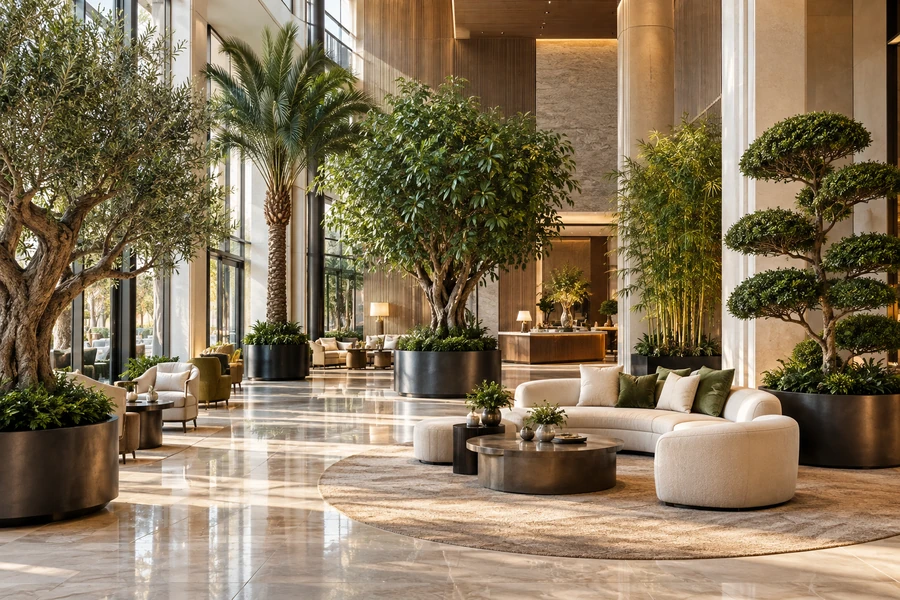
Olive trees remain one of the strongest commercial choices because they create substantial visual character without producing an excessively dense canopy.
Their key features are:
- Silvery gray-green foliage
- Open branching
- Gnarled trunks
- Broad but relatively airy canopies
- Strong Mediterranean associations
I particularly like commercial olive trees in:
- Hotel lobbies
- Upscale restaurants
- Luxury retail
- Atriums
- Reception spaces
- Hospitality lounges
Current commercial fabricators report olive trees as one of their most frequently requested species, with natural-trunk, fully fabricated, and engineered steel-core versions available depending on scale and exposure.
For a restaurant, an olive tree can create the impression of dining beneath a mature courtyard tree without requiring the root volume, daylight, irrigation, pest management, and pruning that a comparable living specimen could demand.
I still avoid undersized residential-style olive trees in large commercial rooms.
A seven-foot tree that looks substantial in a house can disappear visually beneath a twenty-foot lobby ceiling.
2. Artificial Ficus Trees for Offices and General Commercial Interiors
If I need the most versatile commercial tree, ficus is usually near the top of my list.
Ficus provides a fuller canopy than olive and adapts to many interior styles.
I use it in:
- Corporate offices
- Reception areas
- Healthcare interiors
- Coworking spaces
- Restaurants
- Hotel lounges
- Shopping environments
Commercial fabricators offer ficus trees at scales ranging from ordinary six-foot specimens to large atrium installations exceeding thirty feet.
The species works particularly well when the design brief calls for greenery without a strong thematic association.
An olive tree immediately suggests Mediterranean architecture.
A palm suggests tropical or resort environments.
A ficus is more neutral.
That makes it useful in contemporary office and mixed-use projects.
3. Artificial Palm Trees for Resorts, Casinos, and Leisure Projects
Palms remain one of the strongest options for large hospitality environments.
They create vertical scale without requiring a dense lower canopy, making them particularly useful where I need people to see beneath the foliage.
Possible styles include:
- Date palm
- Coconut palm
- Royal palm
- Fan palm
- Areca palm
- Phoenix palm
I use commercial artificial palms for:
- Resort lobbies
- Pool environments
- Casinos
- Shopping centers
- Entertainment venues
- Airport spaces
- Tropical restaurants
- Large atriums
The commercial market includes both fully fabricated palms and preserved-natural-material systems. Current industry guidance distinguishes preserved palms, which can give excellent natural texture indoors, from synthetic UV-stabilized palms intended for harsher exterior exposure.
For outdoor work, I would never assume an ordinary indoor artificial palm can survive direct sun simply because its leaves are made from plastic.
Exterior specification is a separate issue.
4. Artificial Birch and Maple Trees for Architectural Interiors
Birch and maple trees can be excellent when I want visible trunk and branch character.
They work well in spaces where an olive or ficus feels too conventional.
I might specify them for:
- Hotel atriums
- Luxury retail
- Restaurants
- Museums
- Wellness spaces
- Event environments
- Themed interiors
Birch can create a lighter, more vertical rhythm.
Maple can support a broader, more branching canopy.
For permanent large-scale installations, the structural system matters as much as the leaf choice.
A commercial tree may require a steel internal structure, base plates, anchoring, sectional fabrication, or site assembly.
At that scale, I am no longer shopping for a decorative plant.
I am coordinating an installation.
5. Artificial Cherry Blossom Trees for Experiential Spaces
Cherry blossom trees have a stronger decorative personality.
I do not use them everywhere.
But when the project needs visual drama, they can be extremely effective.
Suitable applications include:
- Restaurants
- Event venues
- Retail launches
- Hotel bars
- Wedding and event spaces
- Entertainment environments
- Seasonal installations
Their main strength is immediate visual recognition.
Their main weakness is that they can become visually dominant.
I therefore let the blossom tree be the focal point rather than surrounding it with many competing botanical elements.
For permanent installations, I also inspect the flowers carefully.
Cheap petals and repeated identical blossom clusters are much easier to notice when the entire design depends on flowers.
6. Artificial Banyan and Large-Canopy Trees for Atriums
Large atriums create a different design problem.
The architecture may have:
- Twenty-foot ceilings
- Multiple viewing levels
- Large circulation zones
- Escalators
- Balconies
- Oversized furniture
A conventional artificial tree may simply look too small.
This is where banyans, large ficus forms, and custom branching trees become valuable.
Commercial fabricators now produce engineered artificial trees tens of feet high, sometimes using modular sections so the tree can be transported through conventional loading routes and assembled on site.
For these projects, I coordinate:
- Height
- Canopy diameter
- Ceiling clearance
- Sprinkler clearance
- Sightlines
- Structural anchoring
- Installation route
- Egress
- Maintenance access
- Lighting
A giant tree should feel like part of the architecture.
7. Artificial Bamboo for Screening and Vertical Rhythm
Bamboo is useful when I need greenery to perform a spatial function.
Its narrow vertical structure can:
- Separate seating zones
- Soften glass partitions
- Screen service areas
- Define restaurant booths
- Create privacy
- Fill long narrow planters
I often prefer bamboo where a broad artificial tree canopy would obstruct circulation.
It works especially well in:
- Spas
- Offices
- Restaurants
- Asian-inspired hospitality spaces
- Wellness environments
- Waiting areas
The important detail is density.
Too little foliage can look skeletal.
Too much perfectly repeated foliage can look manufactured.
I prefer varied cane spacing and naturally irregular leaf positions.
8. Artificial Topiary for Entrances and Formal Spaces
Topiary has a more controlled appearance.
That can be an advantage when the architecture itself is formal.
Commercial applications include:
- Hotel entrances
- Restaurant entry zones
- Retail storefronts
- Luxury residences with shared amenities
- Event spaces
- Traditional hospitality interiors
I might specify:
- Ball topiary
- Cone topiary
- Spiral forms
- Olive topiary
- Boxwood-style trees
For exterior use, however, the foliage must be designed and tested for the exposure.
A residential indoor topiary placed outside a hotel entrance may fade or become brittle quickly.
9. Outdoor-Rated Artificial Trees
For exterior projects, I stop selecting by appearance first.
I start with exposure.
I ask:
Will the tree receive full sun?
Will it experience freezing?
Salt air?
Heavy rain?
Wind?
High heat?
Exterior artificial plants need materials formulated or protected against weathering, and claims such as “UV resistant” should ideally be supported with meaningful test information.
ASTM’s active D4329-26 practice addresses fluorescent-UV exposure of plastics and evaluates deterioration associated with UV radiation, moisture, and heat. ASTM’s outdoor-weathering guidance also warns that plastic durability can vary substantially by climate and that short-term exposure results should not be treated as an exact prediction of service life everywhere.
That leads to one of my most important commercial rules:
“UV resistant” should be treated as a specification to verify, not a marketing phrase to trust automatically.
I request information about:
- Material formulation
- UV stabilization method
- Test standard
- Exposure duration
- Color-change result
- Brittleness or mechanical degradation
- Warranty conditions
- Geographic limitations
10. Custom Steel-Core Sculptural Trees
For flagship commercial environments, a custom tree may be the best solution.
These trees are fabricated around an engineered internal armature rather than simply enlarged from residential products.
They can support:
- Massive canopies
- Multiple trunks
- Integrated seating
- Architectural columns
- Themed environments
- Special lighting
- Large atrium installations
Commercial fabricators describe steel-core trees as the highest tier of custom artificial-tree construction, particularly for large public spaces where engineering, realism, and long-term durability all matter.
I consider custom construction when the tree is becoming a permanent landmark rather than replaceable décor.
What Specifications Matter Most for Commercial Artificial Trees?
Appearance gets the project approved visually. Technical documentation helps it survive procurement, installation, inspection, and long-term operation.
The most important commercial artificial-tree specifications are fire performance, structural stability, appropriate scale, UV/weather resistance where required, foliage realism, installation method, cleanability, replacement-part availability, and documented material performance. For public buildings, I verify applicable requirements with the project’s architect, code consultant, and local authority having jurisdiction rather than relying only on supplier marketing.
Fire Performance Is a Specification Issue
This deserves particular attention.
Artificial decorative vegetation is addressed directly by fire codes.
Under the 2021 International Fire Code, artificial decorative vegetation subject to Section 807.4 must meet the flame-propagation criteria of the appropriate NFPA 701 test method, or alternatively satisfy an NFPA 289 heat-release test with a maximum specified heat-release rate of 100 kW. The code also requires documentation and manufacturer certification where the relevant criteria apply.
The 2025 California Fire Code contains comparable artificial-vegetation provisions and also addresses egress, open flames, and wiring.
Proposed 2026 NFPA 101 language similarly identifies NFPA 701 or NFPA 289 performance pathways for combustible artificial decorative vegetation.
For me, this means a supplier saying:
“It’s fire retardant.”
is not enough.
I ask for the documentation relevant to the specific product.
I Request Actual Fire Documentation
My commercial procurement checklist may include:
- Applicable test standard
- Test laboratory
- Report or certificate number
- Tested product description
- Date
- Whether the submitted tree matches the tested material
- Whether treatment is inherent or topical
- Restrictions on installation
- Local acceptance requirements
I also confirm the requirement with the project’s authority having jurisdiction.
Building and fire codes vary by jurisdiction, edition, occupancy, sprinkler protection, size, and installation type.
A supplier certificate is evidence.
It is not permission to ignore local code review.
Decorative Trees Must Not Create Egress Problems
Fire code requirements go beyond material flammability.
Decorative vegetation cannot be allowed to obstruct required egress. The IFC specifically regulates obstruction around means of egress and artificial decorative vegetation.
That matters with large trees.
A broad planter and canopy may interfere with:
- Exit routes
- Accessible circulation
- Door operation
- Sign visibility
- Fire equipment
- Sightlines
I therefore coordinate the complete tree footprint—not merely the trunk location.
Structural Stability Matters in Public Spaces
A residential tree may only need to stand upright.
A commercial tree may be touched by hundreds of people every day.
It may sit beside luggage.
Shopping carts.
Children.
Banquet furniture.
Housekeeping equipment.
For tall or custom trees, I want a clear anchoring and stability strategy.
Exterior trees may also require project-specific wind engineering.
Large interior installations may require structural and, depending on location and project conditions, seismic coordination.
I do not assume a decorative planter provides sufficient structural support.
How Do I Choose the Right Artificial Tree for Each Commercial Setting?
The best artificial tree should solve a design problem rather than simply fill an empty corner.
I match commercial trees to the environment: olive and statement trees suit luxury hospitality; ficus works well in offices; palms fit resorts and entertainment projects; topiary supports formal entrances; bamboo provides screening; and engineered large-canopy trees suit atriums. I then adjust the specification for code, traffic, lighting, exposure, and maintenance.
| Commercial setting | Trees I would consider | Main priorities |
|---|---|---|
| Hotel lobby | Olive, ficus, palm, custom statement tree | Scale, photography, fire documentation |
| Restaurant | Olive, ficus, blossom tree | Atmosphere, sightlines, cleanability |
| Corporate office | Ficus, olive, bamboo | Neutral styling, consistency, maintenance |
| Retail | Ficus, topiary, blossom, sculptural tree | Brand identity, durability |
| Resort | Palm, olive | Weather resistance, scale |
| Casino | Palm, ficus, custom steel-core tree | Fire compliance, durability, visual drama |
| Airport | Ficus, palm, engineered feature tree | Safety, anchoring, maintenance access |
| Spa | Bamboo, olive, Japanese-style branching tree | Calm silhouette, screening |
| Healthcare | Ficus, understated broadleaf trees | Cleanability, circulation, stable planters |
| Exterior plaza | Purpose-built UV-rated trees | UV, rain, wind, temperature |
Hotels Need Scale
Hotel lobbies often fail when the greenery is too small.
A room with a double-height ceiling can make an ordinary six-foot tree feel like tabletop décor.
I look at:
tree height + canopy width + furniture scale + ceiling volume
together.
Industry guidance for large commercial artificial trees similarly identifies undersizing as one of the most common specification mistakes.
Restaurants Need Sightline Control
Restaurants need atmosphere without sacrificing functionality.
I do not want foliage blocking:
- Server circulation
- Guests’ faces
- Menus
- Lighting
- Signage
- Exit paths
Olive trees are effective here because their branching can remain visually open.
I also like column-integrated trees where the trunk visually absorbs an existing structural element.
Offices Need Consistency
Workplace greenery increasingly forms part of a broader biophilic design approach rather than being treated as random decoration.
Current 2026 workplace design coverage describes biophilia as becoming more integrated into architectural planning, with greenery used to define space rather than merely fill it.
Artificial trees can be useful where living plants would experience inconsistent daylight or maintenance.
However, I would not claim that a fake plant reproduces every benefit of living vegetation.
The design benefit is primarily visual and spatial.
Hospitality Projects Need Camera-Ready Realism
Hospitality interiors are photographed constantly.
Guests photograph:
- Lobbies
- Restaurants
- Bars
- Seating areas
- Event spaces
A 2026 study in the International Journal of Hospitality Management found that indoor greenery attracted visual attention and was associated with guest pleasure and perceptions of sustainability in luxury hotels. The study concerns greenery generally, not artificial trees specifically, but it reinforces why botanical elements receive significant visual attention in hospitality environments.
For artificial trees, that means close-up realism matters.
I inspect the tree not only in person but through a phone camera.
How Can I Tell Whether an Artificial Tree Is Truly Commercial Grade?
“Commercial grade” is not useful if it is only a marketing label.
A commercial-grade artificial tree should have documentation and construction appropriate to its actual project conditions. I look for convincing botanical detail, durable foliage attachment, strong structural components, stable or engineered anchoring, applicable fire-test documentation, outdoor weathering evidence where relevant, replacement parts, installation drawings for large trees, and a supplier capable of supporting the installation after delivery.
I Inspect the Trunk First
For large trees, the trunk occupies substantial visual area.
A glossy molded pole can ruin an otherwise good canopy.
The strongest commercial approaches may use:
- Natural preserved wood trunks
- Sculpted synthetic bark
- Molded bark from natural references
- Steel armatures hidden beneath sculpted finishes
Natural-trunk construction can provide excellent bark realism indoors.
Fully fabricated trunks may be more appropriate in high-humidity or outdoor locations where natural wood is less practical. Commercial olive-tree suppliers currently use both approaches for different applications.
I Inspect Foliage at the Actual Viewing Distance
I do not judge a 25-foot atrium tree from twelve inches away.
Most people will never see the upper canopy closely.
For distant trees, I prioritize:
- Silhouette
- Branch distribution
- Color depth
- Canopy scale
- Natural irregularity
For a restaurant tree beside a dining table, I care much more about:
- Leaf texture
- Stem connections
- Mold seams
- Color gradients
- Bark detail
Commercial quality should match the viewing distance.
I Ask How the Tree Ships
This becomes crucial with large installations.
Can it fit through the loading dock?
The elevator?
A standard doorway?
Can the canopy sections be removed?
Will the trunk arrive as modular segments?
Who assembles it?
Commercial tree fabricators frequently use modular or sectional systems for very large trees so components can travel through conventional building access routes and be assembled in place.
I want that method resolved before manufacturing begins.
Are Artificial Trees Good for Outdoor Commercial Projects?
They can be, but only when the product was actually designed for exterior service.
Artificial trees can work well outdoors when their foliage, trunk, hardware, anchoring, and colorants are specified for UV, rain, temperature, wind, and the local environment. An indoor artificial tree with a generic UV spray is not equivalent to an engineered outdoor tree, and accelerated-weathering claims should be interpreted carefully rather than converted into unrealistic lifespan promises.
ASTM D1435 emphasizes that outdoor plastic durability depends heavily on location because UV radiation, moisture, temperature, pollutants, and other conditions vary. It specifically warns against assuming one exposure location precisely predicts performance elsewhere.
That is important for projects in:
Phoenix,
Miami,
Chicago,
Dubai,
Singapore,
or coastal California.
Those are not equivalent environments.
I Distinguish UV Coating From UV-Stabilized Material
In the commercial market, suppliers may use either:
- Surface-applied UV protection
- UV inhibitors incorporated into the material
- A combination of both
I prefer a clear description of the system and supporting test information.
I also clarify whether the warranty covers:
- Fading
- Brittleness
- Cracking
- Leaf loss
- Structural components
And I check whether salt exposure, freezing, or extreme temperatures are excluded.
What About Maintenance and Total Cost of Ownership?
Artificial does not mean maintenance-free.
It means the maintenance is different.
Commercial artificial trees eliminate watering, pruning, fertilizing, and horticultural pest management, but they still require dust removal, inspection, branch reshaping, occasional foliage replacement, planter cleaning, and structural checks. I evaluate total cost over the intended project life rather than assuming artificial greenery has zero ongoing expense.
Artificial Trees Still Need Cleaning
Commercial spaces generate:
- Dust
- HVAC deposits
- Food particles
- Grease
- Hand contact
- Exterior dirt
A restaurant tree near a kitchen may need more cleaning than a corporate lobby tree.
Large leaves are easier to wipe than thousands of tiny ficus leaves.
That becomes a meaningful facilities-management consideration.
Replaceable Components Add Value
For long-term projects, I like systems where damaged foliage can be replaced.
A premium artificial tree should not necessarily require complete replacement because:
one branch breaks,
a small canopy area fades,
or a guest damages several leaves.
Modular construction can extend usable life.
Artificial and Living Trees Solve Different Problems
I do not treat artificial plants as automatically superior to living plants.
Living trees offer real biological growth and change.
Artificial trees provide predictable scale and appearance in locations where:
- Light is inadequate
- Irrigation is undesirable
- Access is difficult
- Consistency is critical
- Maintenance contracts are impractical
Current commercial interior-landscape providers offer living, artificial, and moss-based solutions because different environments require different systems.
That is how I approach the choice.
It is a specification decision, not an ideological one.
My insights: Best Artificial Trees for Commercial Projects: An Industry Guide (2026)
After reviewing current commercial interior trends, artificial-tree fabrication practices, fire-code provisions, and material-weathering guidance, my main conclusion is that the best artificial tree for a commercial project is rarely the most realistic catalog photograph.
The best artificial trees for commercial projects in 2026 are the ones that combine appropriate species, architectural scale, botanical realism, documented fire performance, structural stability, exposure-specific materials, practical installation, and maintainability. Olive, ficus, palms, bamboo, birch, blossom trees, and custom steel-core trees are all strong options, but the correct specification depends on the building and application.
My First Insight: Commercial Trees Should Be Specified Like Interior Architecture
This is the biggest difference between residential and commercial artificial greenery.
For a home, I might ask:
Does this tree look good beside the sofa?
For a commercial project, I ask:
Will it fit through the building?
Does it affect egress?
Is it stable?
Is the fire documentation acceptable?
Can it be cleaned?
Can components be replaced?
Will the scale still look correct from the mezzanine?
That change in thinking prevents many expensive mistakes.
My Second Insight: Fire Documentation Should Come Before Final Product Approval
Designers understandably start with appearance.
But I would move fire documentation much earlier in the procurement process.
The International Fire Code expressly regulates artificial decorative vegetation and provides specific flame-performance pathways.
I therefore do not want to approve a beautiful tree and discover during final inspection that the supplier cannot document what the project requires.
My specification sequence is:
code requirement → documentation → material → aesthetic approval.
Not the reverse.
My Third Insight: The Best Species Depends on What the Tree Needs to Do
I summarize the categories this way:
| If I need… | I would start with… |
|---|---|
| Luxury Mediterranean character | Olive |
| Flexible general greenery | Ficus |
| Tropical height | Palm |
| Open architectural branching | Birch or maple |
| Dramatic focal color | Cherry blossom |
| Privacy or screening | Bamboo |
| Formal entry styling | Topiary |
| Huge atrium statement | Custom steel-core tree |
| Exterior greenery | Purpose-built UV/weather-rated tree |
Species is therefore a functional design decision.
My Fourth Insight: Bigger Commercial Spaces Usually Need Bigger Trees Than Designers Initially Expect
Scale behaves differently in photographs and architectural drawings.
A twelve-foot tree sounds huge.
In a thirty-foot atrium, it may not be.
Current commercial-tree guidance repeatedly identifies undersizing as a common problem in atrium work.
I therefore mock up the dimensions whenever possible.
I might model:
- Overall height
- Canopy width
- Lowest branch height
- Planter diameter
- Human figure
- Adjacent furniture
This gives me a more reliable impression than looking at a tree image without architectural context.
My Fifth Insight: Outdoor Artificial Trees Require Evidence, Not Adjectives
I would never specify an exterior tree merely because the catalog says:
“UV protected.”
ASTM’s weathering guidance makes clear that exposure performance depends on sunlight, heat, moisture, location, and time.
I therefore want measurable information.
What was tested?
For how long?
Using which method?
What changed?
Does the warranty apply in my climate?
That turns a marketing claim into a specification.
My Sixth Insight: Artificial Trees Can Support Biophilic Design Without Being the Entire Biophilic Strategy
Biophilic design remains prominent in 2026 commercial interiors, with current workplace guidance increasingly treating greenery as integrated spatial infrastructure rather than decorative afterthought.
But adding three fake trees does not automatically make a project deeply biophilic.
I combine greenery with:
- Daylight
- Natural materials
- Organic forms
- Exterior views
- Texture
- Spatial variation
The artificial tree should participate in the architecture rather than substitute for every other natural connection.
My Seventh Insight: I Would Spend More Where Guests Get Closer
Budget allocation should follow viewing distance.
I would invest most heavily in botanical realism for:
- Restaurant trees beside tables
- Retail trees at eye level
- Lobby trees people walk beneath
- Hotel trees photographed closely
For very tall atrium canopies, I spend more attention on:
- Silhouette
- structural quality
- color
- branch distribution
rather than microscopic leaf realism.
This is more efficient than specifying museum-level detail where nobody can see it.
My Commercial Artificial-Tree Specification Checklist
Before approving a tree, I want answers to these questions:
| Specification question | What I want to know |
|---|---|
| Species | Does it fit the design concept? |
| Height | Is it proportional to the architecture? |
| Canopy width | Does it preserve circulation and sightlines? |
| Viewing distance | How detailed must foliage be? |
| Trunk construction | Natural wood, fabricated, or steel-core? |
| Fire performance | What documentation applies? |
| Outdoor use | Is UV/weather performance documented? |
| Structural support | How is it anchored? |
| Installation | Can all components reach the site? |
| Egress | Does it interfere with required routes? |
| Maintenance | How will it be cleaned and inspected? |
| Replacement parts | Can foliage or branches be replaced? |
| Warranty | What performance is actually covered? |
| Mockup/sample | Can I approve materials before production? |
| Documentation | Will the supplier provide records for the project file? |
My Final View
When someone asks me for the best artificial trees for commercial projects in 2026, I would not begin by ranking ten trees from an online store.
I would begin with the project.
For a luxury restaurant, I may choose a natural-trunk artificial olive tree.
For a corporate office, a well-built ficus may offer the most versatile silhouette.
For a resort, I might specify engineered artificial palms.
For a spa, bamboo may provide both greenery and screening.
For a thirty-foot atrium, I may need a completely custom steel-core tree rather than anything available from a catalog.
For an exterior project, UV and weather performance become central.
And for almost every public interior, I investigate fire-code requirements and supporting documentation before final approval.
The artificial-tree industry in 2026 is sophisticated enough that designers no longer need to treat faux greenery as a compromise product. Commercial suppliers can create substantial natural-trunk trees, fully fabricated weather-resistant specimens, modular atrium installations, and custom sculptural structures at architectural scale.
But the same sophistication makes specification more important.
A commercial tree succeeds when five things come together:
appearance, scale, compliance, durability, and maintainability.
If one fails, the project can feel wrong even when the other four are strong.
That is why my definition of the “best” commercial artificial tree is simple:
it should look convincing enough for the guest, perform reliably enough for facilities management, and be documented thoroughly enough for the professionals responsible for approving the building.
Conclusion
The best commercial artificial trees combine believable botanical design with architectural scale, documented safety performance, durable construction, and project-specific materials rather than relying on appearance alone.