

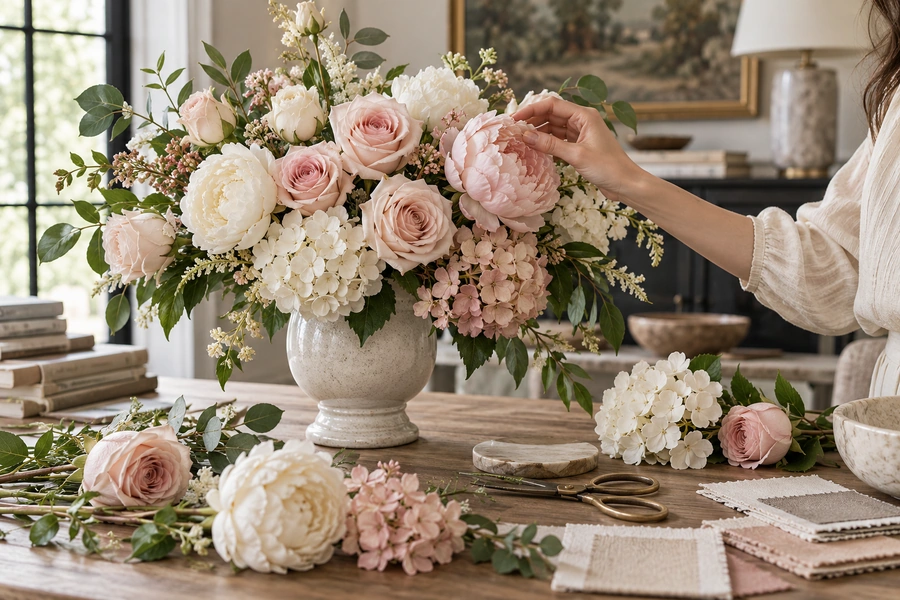
Real Touch artificial flowers can feel surprisingly natural, but that realism does not come from one universal material. Different polymers, coatings, fabrics, plastics, and internal structures create very different results.
The main material differences in Real Touch artificial flowers involve polyurethane (PU), latex or synthetic rubber, silicone-like polymers, polymer-coated synthetic fabric, polyester, PVC or PE components, and metal wire. PU is useful for soft molded petals, latex-coated fabric creates thin flexible petals, silicone allows fine molded detail, while polyester is lighter and usually more fabric-like.
The most important thing I keep in mind is that “Real Touch” is a performance description rather than one standardized chemical specification. Two flowers can both be marketed as Real Touch and still use completely different materials, manufacturing processes, textures, and levels of durability.
What Materials Are Real Touch Artificial Flowers Made From?
Real Touch flowers are usually made from combinations of soft polymers and synthetic textiles rather than a single material throughout the entire stem.
Common Real Touch materials include polyurethane, latex or synthetic rubber, silicone or silicone-like polymers, polymer-coated synthetic fabric, polyester, PVC or other plastics, adhesives, pigments, and internal metal wire. Manufacturers select different combinations according to the natural flower’s petal thickness, flexibility, surface texture, and structure.
Polyurethane (PU)
Polyurethane is one of the materials most closely associated with premium Real Touch flowers.
It can be molded into three-dimensional petals while retaining enough flexibility to imitate natural flower tissue.
PU can help reproduce:
- Petal thickness
- Curved edges
- Veining
- Surface texture
- Softness
- Flexible movement
- Three-dimensional shape
Industry material descriptions identify polyurethane as particularly useful for flowers where both density and softness matter, including varieties such as peonies and gerberas.
I often prefer PU when the flower has relatively substantial petals.
For example, a peony petal should not feel like a flat piece of woven cloth.
It needs volume.
A molded polymer can reproduce that volume more naturally.
PU also allows manufacturers to control the thickness of different areas of the petal.
The center can remain structurally stable while the edge feels softer and thinner.
That creates a more convincing tactile experience.
Latex or Synthetic Rubber
Latex-style materials are another important Real Touch category.
One established manufacturing method begins with a synthetic fabric petal.
The manufacturer then applies a liquid latex or synthetic-rubber-type polymer to one or both sides of the material.
The fabric provides:
- Shape
- Thinness
- Lightweight structure
- Flexibility
The polymer coating adds:
- Softer touch
- More natural weight
- Reduced fabric texture
- Greater petal-like flexibility
Real Touch manufacturers particularly associate this construction with flowers such as roses and peonies.
I think this makes sense botanically.
A rose petal is relatively thin.
Producing it as a heavy solid molded piece can sometimes make it feel too thick.
A fabric core with a flexible coating can create a better balance.
Synthetic Rubber Is Highly Elastic
The word latex can also create confusion because manufacturers do not always mean natural rubber latex.
Some may use synthetic rubber or proprietary elastomeric polymer blends.
Synthetic rubbers are elastic polymers designed to deform and then recover their shape, which helps explain why they can create soft, flexible artificial petals.
I therefore do not assume that every product described as a “latex flower” contains natural latex from rubber trees.
For professional purchasing, I ask:
Is this natural latex, synthetic rubber, or another polymer coating?
That distinction can matter when I need accurate material documentation.
Silicone and Silicone-Like Polymers
Silicone is another material associated with Real Touch production.
It is particularly useful when the flower needs fine sculptural detail.
Manufacturing sources describe silicone-type materials being used for flowers such as:
- Orchids
- Hydrangeas
- Tulips
- Calla lilies
- Lilies
- Delphiniums
- Peonies
depending on the factory and construction method.
I like silicone-style molded materials for flowers with complex curves.
An orchid is a good example.
Its petals and central lip can have highly specific shapes that are difficult to reproduce using simple flat fabric.
Molding allows a manufacturer to build those details directly into the flower.
Polymer-Coated Synthetic Fabric
This category sits between traditional fabric flowers and completely molded polymer flowers.
The petal begins as synthetic textile.
Today, that textile is often polyester or another manufactured fabric rather than genuine silk.
The surface is then treated with a polymer coating.
This creates a combination of:
fabric structure + polymer touch.
Silk by Design describes modern Real Touch materials as including latex, poly-silk blends, and polyurethane, emphasizing the flexibility, surface texture, and realistic weight these materials can create.
I find this construction particularly effective for flowers that require:
- Thin petals
- Soft edges
- Lightweight movement
- Subtle translucency
The fabric keeps the petal from becoming excessively heavy while the coating reduces the obvious textile feel.
Polyester
Polyester is still extremely common in artificial flowers.
However, polyester alone usually feels different from what I associate with premium Real Touch construction.
It is lightweight and easy to shape and color.
That makes it excellent for:
- Large flower heads
- Hydrangeas
- Filler flowers
- Volume arrangements
- Decorative installations
But when I touch it closely, I may still notice the textile weave.
That is why many premium flowers combine fabric with coatings or use molded polymers in the most tactile parts of the bloom.
Plastic Components
Not every part of a Real Touch flower needs to feel like a petal.
Manufacturers often use harder plastics for:
- Flower centers
- Calyxes
- Leaf supports
- Branch structures
- Stem coverings
- Small botanical details
PVC, polyethylene, and other polymers may therefore appear in the same stem even when the petals are PU or coated fabric.
Metal Wire
Metal wire is usually hidden inside stems, branches, or leaves.
It gives me the ability to:
- Bend stems
- Angle blooms
- Reshape leaves
- Create asymmetry
- Hold an arrangement in position
The wire does not improve petal softness, but it strongly affects how usable the flower is for designers.
A beautiful flower with a completely rigid stem can be difficult to arrange naturally.
How Do PU, Latex, Silicone, and Fabric Feel Different?
The material differences become most obvious when I touch, bend, photograph, and arrange the flowers.
PU generally feels soft and molded, latex or synthetic rubber feels more elastic and sometimes slightly rubbery, silicone can feel smooth and highly flexible, while polyester fabric feels lighter and more textile-like. Coated fabric combines the thinness of woven material with a softer polymer surface. The exact feel still depends heavily on formulation and manufacturing quality.
PU: Soft and Substantial
I usually associate PU with a soft but substantial feel.
The petal can have real thickness.
It may compress slightly when pressed.
Then it returns to shape.
This makes it useful for flowers that need a fuller tactile presence.
A florist-oriented 2026 material guide describes PU as generally soft and consistently pliable compared with the somewhat more rubbery character of latex.
Latex: Elastic and Flexible
Latex-style materials often feel more elastic.
That is consistent with the general properties of rubber-like polymers, which can deform under stress and recover after release.
In flowers, this can create a very convincing soft petal.
However, formulation matters.
One latex-coated rose may feel beautifully natural.
Another may feel tacky or overly rubbery.
That is why I never judge the material name alone.
Silicone: Fine Detail and Smooth Flexibility
Silicone-type materials can produce very detailed molded surfaces.
I especially notice the benefit around:
- Veins
- Petal edges
- Flower centers
- Irregular curves
For sculptural flowers, that precision can be more important than extreme softness.
Polyester: Light but More Obviously Fabric
A good polyester flower can look excellent from normal viewing distance.
But at very close range, I may notice:
- Woven texture
- Fraying
- Flat edges
- Less natural compression
That does not make polyester bad.
It simply makes it better suited to some applications than others.
Which Material Looks the Most Realistic?
There is no universal answer because different flowers have different natural structures.
The most realistic material is the one that best reproduces the botanical flower being copied. PU works well for substantial soft petals, latex-coated fabric can be excellent for thinner roses and peonies, silicone can reproduce highly sculptural petals, while polyester remains useful for lightweight flowers and large-volume arrangements. Material suitability matters more than choosing one supposedly superior polymer.
Roses Often Benefit From Coated Fabric
A natural rose has thin, layered petals.
If those petals are molded too thickly, the bloom may look heavy.
An established Real Touch manufacturer specifically describes fabric with latex-type coating as a strong construction for roses and peonies.
The fabric supplies thinness.
The coating supplies softness.
That is a useful combination.
Peonies Can Use Several Materials
Peonies are more complicated.
Their blooms contain many layers, and different artificial versions may use:
- PU
- Latex-coated fabric
- Silicone-like polymers
- Mixed construction
This is a good example of why I do not say:
“Peonies should always be made from PU.”
Different manufacturers solve the same botanical challenge differently.
Orchids Benefit From Precise Molding
Orchids have sculptural flowers.
Their petals and centers can require detailed forms that fabric alone may struggle to reproduce.
Real Touch production sources commonly identify silicone or molded polymers as useful for orchid-type flowers.
For these flowers, mold quality matters greatly.
Hydrangeas May Benefit From Mixed Construction
Hydrangeas contain many individual florets.
Producing every floret from a heavy molded polymer could make the entire flower unnecessarily dense.
This is one place where a manufacturer may combine materials.
I might see fabric-based petals for volume and molded or polymer components for specific details.
Mixed-material construction is not necessarily lower quality.
It can actually be more appropriate.
What Is the Difference Between Real Touch and Silk Flowers?
The words can be confusing because both categories describe artificial flowers.
Real Touch flowers usually emphasize soft polymer-based or polymer-coated petals, while modern “silk” flowers are generally fabric-based and often made from polyester rather than natural silk. Real Touch usually provides stronger tactile realism, while high-quality fabric flowers can be lighter, more affordable, and particularly effective for large blooms or installations viewed from a distance.
Real Touch Is About Tactile Performance
When I see the term Real Touch, I expect the flower to perform well when someone touches it.
That makes it particularly useful for:
- Bridal bouquets
- Boutonnieres
- Luxury centerpieces
- Hotel arrangements
- Retail displays
- Close-up photography
Silk Flowers Are Usually Synthetic Fabric
The term silk flower is now largely a category name.
Modern products are commonly made from polyester or other synthetic textiles rather than genuine silk.
High-quality fabric flowers can still look extremely convincing.
They simply create realism differently.
Instead of relying primarily on tactile softness, they may use:
- Printed color gradients
- Fine cutting
- Heat shaping
- Layered petals
- Detailed centers
For a ceiling installation ten feet above the guest, tactile realism may not matter at all.
That is why I choose according to application.
Which Real Touch Material Is Best for Weddings, Hotels, and Commercial Projects?
Professional designers should not automatically specify the same material for every job.
For bridal bouquets and close-up wedding flowers, I prioritize PU, latex-coated fabric, or other soft Real Touch materials. For large installations, polyester or mixed-material flowers can reduce weight and cost. Hotels and retail projects require durability and cleanability, while commercial buyers should also ask about UV resistance, fire-performance documentation, and replacement consistency when relevant.
Bridal Bouquets
For a bridal bouquet, people will:
- Hold the flowers
- Photograph them closely
- See the underside
- Touch the petals
I therefore prioritize tactile materials.
PU, coated fabric, and well-made silicone-style flowers can perform well here.
Large Wedding Installations
For arches, flower walls, and ceiling designs, I think differently.
The flowers may be viewed from several feet away.
My priorities shift toward:
- Color
- Shape
- Weight
- Volume
- Stability
- Cost
Using premium molded PU for every flower may be unnecessary.
A mixed arrangement can be more efficient.
Hotels and Restaurants
For permanent hospitality arrangements, I consider:
- Dust resistance
- Cleaning method
- Surface durability
- Color stability
- Stem strength
- Replacement availability
A beautiful flower that becomes sticky, brittle, or difficult to clean may be unsuitable for long-term commercial use.
Outdoor Projects
For outdoor artificial flowers, I care less about whether the petal is called PU or silicone and more about whether the complete product has been designed for:
- UV exposure
- Temperature changes
- Moisture
- Wind
- Long-term color stability
Material names alone do not prove outdoor suitability.
My insights: What Are the Material Differences in Real Touch Artificial Flowers
After comparing current Real Touch manufacturing descriptions and material guidance, I think the biggest mistake is treating Real Touch as if it were the name of one raw material.
The material differences in Real Touch artificial flowers come down to how PU, latex or synthetic rubber, silicone, coated fabric, polyester, plastics, and wire reproduce different botanical properties. PU provides soft molded structure, latex-coated fabric combines thinness with elasticity, silicone supports detailed molding, polyester creates lightweight volume, and wire provides adjustable structural support.
My First Insight: “Real Touch” Describes the Result, Not the Formula
This is the most important distinction.
Two manufacturers can both label a flower:
Real Touch Rose
while one uses:
polymer-coated polyester
and the other uses:
molded PU.
Both products may technically fit the marketing category.
Their performance may be very different.
I therefore treat Real Touch as the beginning of the material conversation.
Not the end.
My Second Insight: There Is No Universally Best Material
I do not think PU is automatically better than silicone.
I do not think silicone is automatically better than coated fabric.
The correct question is:
Which material best reproduces this specific natural flower?
That is also the logic used by manufacturers that assign different material systems to different flower types.
A rose needs thin layered petals.
An orchid needs sculptural detail.
A calla lily needs a smooth curved surface.
A peony needs softness and volume.
Those are different engineering problems.
My Third Insight: Mixed Materials Are Often a Sign of Smart Design
A premium artificial flower does not need to be made completely from one expensive polymer.
One stem may combine:
| Flower component | Possible material |
|---|---|
| Petals | PU, silicone, coated fabric |
| Leaves | Polyester, PE, PVC |
| Calyx | Molded plastic |
| Flower center | Molded polymer |
| Stem surface | Plastic or polymer coating |
| Internal structure | Metal wire |
| Assembly | Adhesives |
This can produce better performance than forcing every component into one material.
My Fourth Insight: Close-Up Use Requires Better Tactile Materials
When guests can touch the flower, tactile realism matters.
That means I spend more on material quality for:
- Bridal bouquets
- Boutonnieres
- Low centerpieces
- Hotel reception arrangements
- Luxury retail displays
For high arches or ceiling installations, I may allocate more budget toward silhouette and color instead.
My Fifth Insight: Material Labels Should Be Verified With Suppliers
For professional sourcing, I ask specific questions.
I want to know:
- What is the petal material?
- Is the latex natural or synthetic?
- Is the flower solid molded or fabric coated?
- What is the leaf material?
- What plastic is used in the stem?
- Is there internal wire?
- What adhesive system is used?
- Can the petals be cleaned?
- Is the flower suitable for heat or moisture?
- Has it been UV tested?
- Is the composition consistent between production batches?
This is much more useful than simply asking:
“Is it Real Touch?”
My Material Comparison
| Material | Typical construction | Main strength | Possible limitation |
|---|---|---|---|
| Polyurethane (PU) | Molded petal | Softness and 3D detail | Quality varies by formulation |
| Latex/synthetic rubber | Coating or flexible petal | Elastic, petal-like feel | Can feel rubbery in weaker products |
| Silicone-like polymer | Molded petal | Fine sculptural detail | Can be heavier or more costly |
| Polymer-coated fabric | Fabric with soft coating | Thinness plus tactile softness | Coating quality matters |
| Polyester | Fabric petal | Lightweight and economical | More obvious fabric feel close up |
| PVC/PE plastics | Leaves/stems/components | Structure and durability | Poor finishing can look plastic |
| Metal wire | Internal support | Bendability and shaping | Must remain hidden |
| Adhesives | Assembly | Holds components together | Visible glue reduces realism |
My Final View
When someone asks me “What are the material differences in Real Touch artificial flowers?”, I would not answer with a single word such as polyurethane or silicone.
Real Touch flowers are a material system.
A flower may contain:
PU + polyester + plastic + metal wire + adhesive
or:
latex-coated fabric + PE leaves + wired stems
or:
silicone-like molded petals + plastic botanical components + metal reinforcement.
The exact combination depends on what the manufacturer is trying to reproduce.
Polyurethane is particularly useful for softness and molded petal thickness.
Latex or synthetic rubber creates elasticity and can transform thin fabric petals into more tactile surfaces.
Silicone-style polymers support detailed sculptural molding.
Polyester gives lightweight structure and economical volume.
Plastic creates practical stems, leaves, and centers.
Wire allows the designer to reshape the flower.
That is why I do not rank Real Touch materials in isolation.
I judge whether the material matches the botanical form, application, viewing distance, handling requirements, and expected lifespan.
For a professional buyer, the most useful question is therefore not:
“Is this flower Real Touch?”
It is:
“What exactly is each part made from, and why was that material chosen for this flower?”
Conclusion
Real Touch flowers use PU, latex, silicone, coated fabric, polyester, plastics, and wire differently. The best material depends on the flower’s natural texture, structure, and intended use.