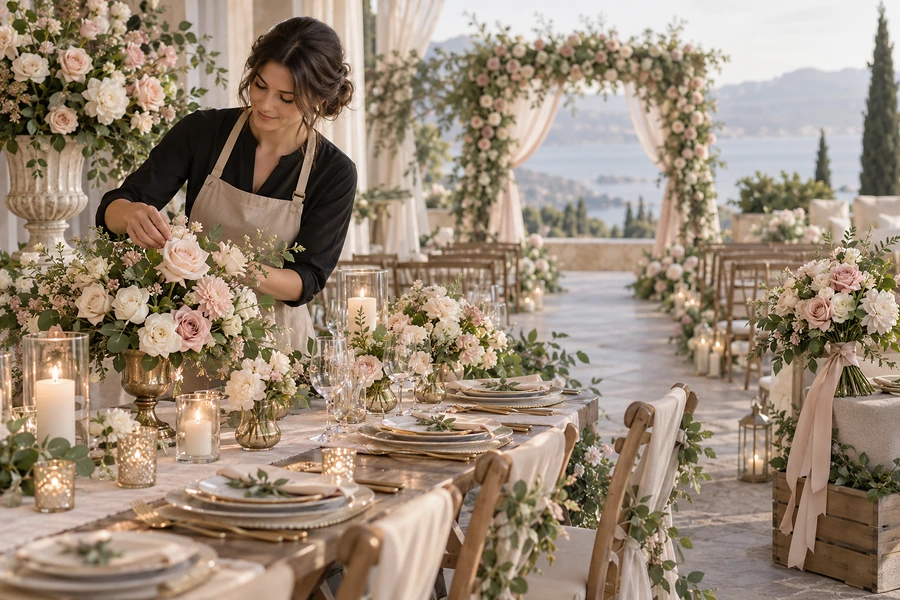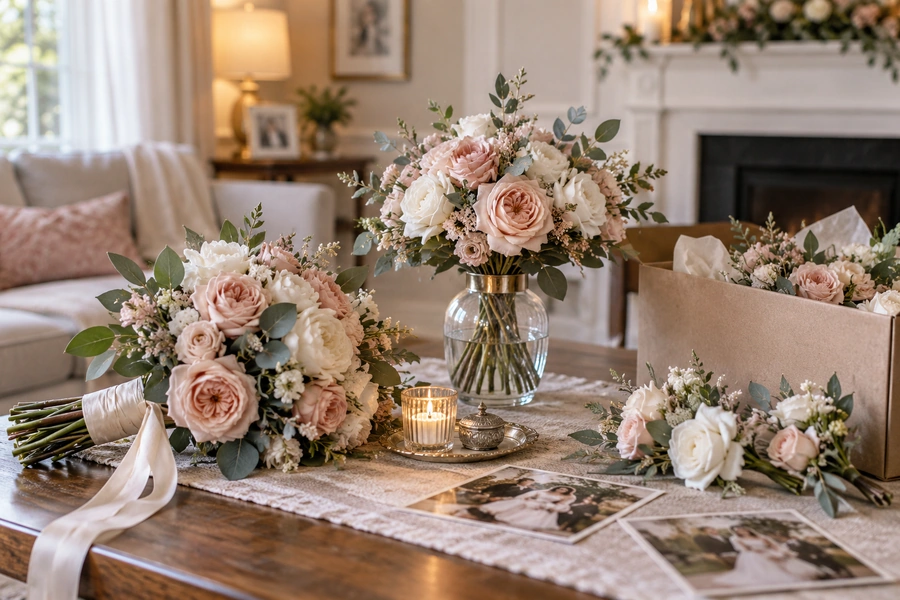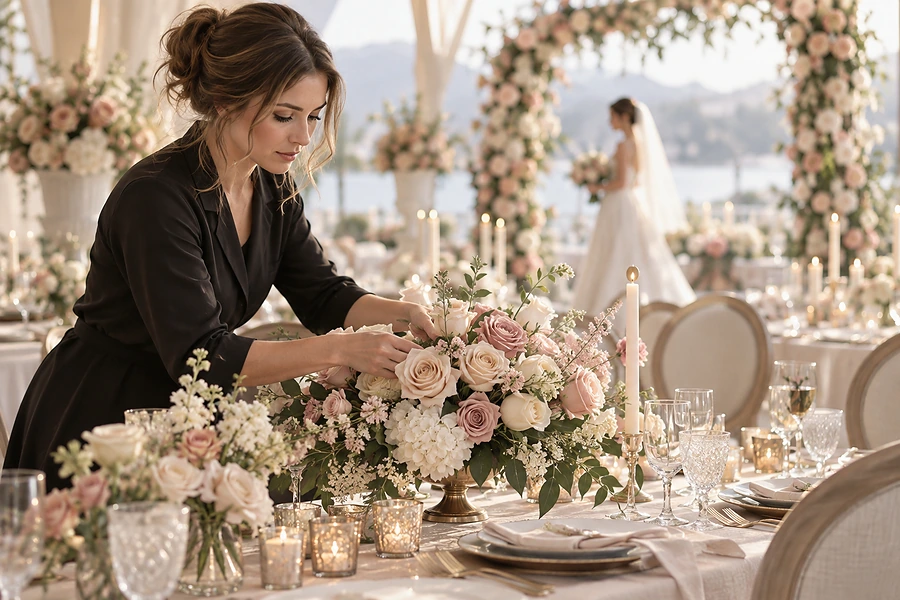

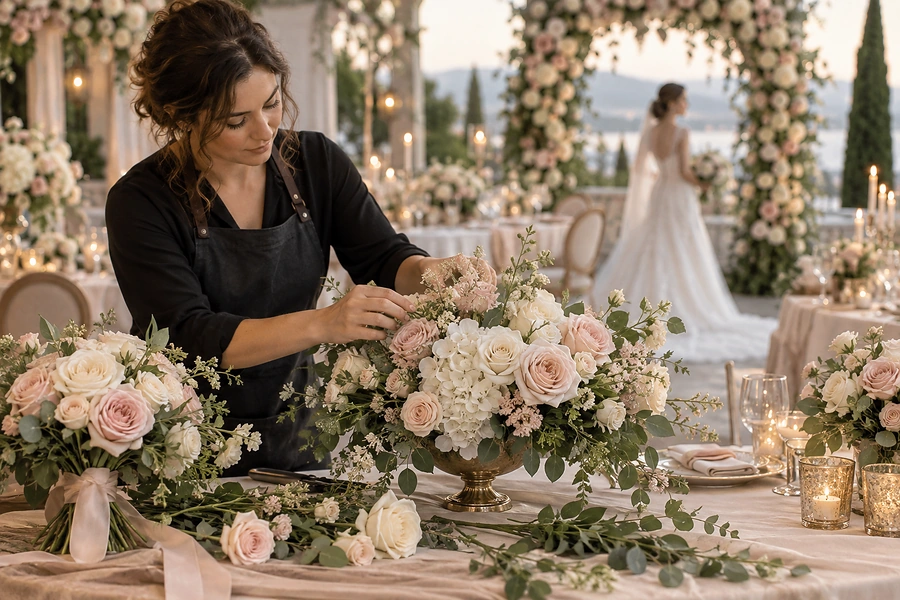
Wedding flowers affect everything from the bridal bouquet to photographs and centerpieces, so choosing between fresh and artificial blooms can influence both the look and logistics of the day.
Real wedding flowers offer natural fragrance, movement, texture, and botanical variation, while fake flowers offer durability, predictable colors, year-round availability, early preparation, and reuse. Fresh flowers can wilt and depend on seasonality; realistic faux flowers can be expensive and lack natural scent. For many weddings, a fresh-and-faux combination provides the best balance.
I do not think one category is automatically better. I compare how close guests will get to the flowers, how much installation is required, the wedding season and weather, the available budget, and whether keeping or reusing the arrangements matters after the celebration.
Are Real Flowers Better Than Fake Flowers for a Wedding?
Fresh flowers are still difficult to beat when I want the complete sensory experience of natural blooms. Their scent, texture, movement, and slight imperfections give arrangements a character that manufactured flowers cannot reproduce perfectly.
Real flowers are often better for wedding bouquets and other close-up arrangements when natural fragrance, organic variation, and authentic botanical detail matter most. Their disadvantages are perishability, seasonal availability, hydration requirements, short preparation windows, and potential sensitivity to heat or cold. Fresh flowers are beautiful, but they require more careful timing and handling.
The Pros of Real Wedding Flowers
The first advantage is authenticity.
A fresh rose does not have identical petals.
A peony changes as it opens.
A tulip bends.
Leaves turn toward different directions.
Small imperfections create natural movement that is extremely difficult to manufacture exactly.
I especially value this quality in a bridal bouquet because the arrangement is seen very closely. It may appear in detailed photographs of the dress, rings, invitation suite, ceremony, and portraits.
Fresh flowers also provide natural fragrance.
A bouquet containing garden roses, sweet peas, stock, or other scented flowers can add another sensory layer to the wedding. The Knot’s comparison of silk and fresh flowers similarly points out that even convincing artificial flowers do not fully replace the look and fragrance of living blooms.
Fresh flowers also allow me to make the season part of the design.
Spring may suggest tulips or ranunculus.
Summer may offer abundant garden flowers.
Autumn can bring dahlias and deeper colors.
Seasonal choices can help the floral design feel connected to the time and place of the wedding.
The Cons of Real Wedding Flowers
The biggest disadvantage is that fresh flowers are perishable.
They need careful conditioning.
They may need refrigeration.
They need hydration.
Certain varieties are more delicate than others.
Hot weather can accelerate wilting, while cold conditions can damage sensitive flowers. The Knot specifically notes that artificial flowers avoid the wilting and freezing concerns associated with fresh blooms at temperature-sensitive weddings.
Fresh flowers also have a relatively short design window.
A florist cannot usually create a fresh bridal bouquet months in advance.
The flowers have to be sourced and prepared close to the wedding date.
Seasonality can also affect price and availability. The Knot’s current 2026 flower-cost data identifies seasonality, the amount of flowers, the flower-to-greenery ratio, preparation, and logistics among the major factors affecting wedding floral costs.
That means a fresh floral vision may sometimes need substitutions.
If a specific variety is unavailable, the florist may suggest a similar flower rather than guarantee exactly what appeared on an inspiration board.
Real Flower Pros and Cons at a Glance
| Real wedding flowers | Advantages | Disadvantages |
|---|---|---|
| Appearance | Naturally varied and detailed | Can change as blooms open |
| Fragrance | Natural scent | Some people may dislike strong floral fragrance |
| Texture | Authentic petals and foliage | Delicate flowers bruise easily |
| Seasonality | Creates a seasonal feeling | Some varieties may be unavailable |
| Preparation | Professional fresh-floral craft | Must happen close to wedding day |
| Weather | Beautiful in suitable conditions | Heat and cold can cause problems |
| Keepsake value | Can be dried or preserved | Requires additional preservation |
| Logistics | Florist can manage the process | Requires water, conditioning, transport, and setup |
I think fresh flowers are strongest when their natural qualities are actually going to be experienced.
If nobody will see an installation from closer than twenty feet away, the advantage of perfectly natural petal texture becomes less important.
What Are the Pros and Cons of Fake Wedding Flowers?
Artificial flowers solve many of the practical problems fresh flowers create. Modern options range from inexpensive fabric blooms to detailed real-touch flowers designed for close-up use.
The main benefits of fake wedding flowers are durability, year-round availability, color consistency, advance preparation, easy reuse, and freedom from wilting. Their disadvantages are the possibility of looking artificial, lack of natural fragrance, thicker or less natural stems, and the potentially high cost of premium real-touch flowers. The quality range is extremely wide.
The Pros of Artificial Wedding Flowers
The biggest advantage for me is predictability.
If I choose a particular artificial rose months before the wedding, I know what its color, size, and level of openness will be.
The flower will not arrive unexpectedly smaller or more closed than the sample.
Artificial flowers are also available throughout the year.
Zola lists year-round availability as one of their key advantages, along with the ability to prepare arrangements well in advance and avoid wilting during outdoor summer weddings.
That makes fake flowers useful when I want:
- Peonies outside their normal season
- Exact wedding colors
- Early DIY preparation
- Destination-wedding arrangements
- Keepsake bouquets
- Large installations with long setup periods
- Reusable ceremony décor
Artificial flowers are also much easier to practice with.
I can build a bouquet.
Take it apart.
Change the stem positions.
Photograph it.
Rebuild it.
Fresh flowers give me much less room for repeated experimentation.
Zola notes that wired artificial stems can be manipulated repeatedly and that bouquets can be created far earlier than fresh-flower arrangements.
Fake Flowers Do Not Wilt
This can be a major advantage for a long wedding day.
A faux bouquet can move from getting-ready photographs to the ceremony, outdoor portraits, cocktail hour, and reception without needing water.
A large artificial ceremony arch can be installed long before guests arrive.
This can reduce some of the time pressure surrounding floral setup.
Artificial Flowers Can Be Kept or Reused
A faux bridal bouquet can become a permanent keepsake.
Centerpieces can move into home décor.
Large arrangements can potentially be sold, lent, or used at another event.
The Knot identifies this reusability as one of the practical advantages of artificial wedding flowers.
This is fundamentally different from fresh flowers, which generally require preservation if I want to keep them.
The Cons of Artificial Wedding Flowers
The quality range is the biggest drawback.
A cheap artificial rose can have:
- Shiny fabric
- Fraying edges
- Visible glue
- Bright plastic stems
- Flat color
- Identical petals
- Unrealistic leaves
These details become particularly noticeable in bouquets and low centerpieces.
Zola specifically warns that inexpensive faux flowers can look cheap or tacky, while the most realistic wax-coated, latex, or real-touch varieties are substantially more expensive.
This means I cannot assume that choosing fake flowers gives me both maximum realism and minimum cost.
Those goals can conflict.
Artificial Stems Can Be Heavier and Bulkier
Some faux stems contain wire covered with plastic.
When many stems are combined, the finished bouquet can become thicker or heavier than expected.
Zola notes that artificial stems may be less pliable and that wired bouquets can create a thicker bundle than fresh-flower stems.
For a bridal bouquet that will be held for hours, I would test the weight before the wedding.
Fake Flowers Lack Natural Fragrance
A high-quality real-touch rose may look extremely convincing.
It still does not smell like a freshly cut rose.
Artificial fragrance can be added in some cases, but it is not the same botanical experience.
This matters more to some couples than others.
Fake Flower Pros and Cons at a Glance
| Fake wedding flowers | Advantages | Disadvantages |
|---|---|---|
| Appearance | Premium versions can be highly realistic | Cheap products may look obviously artificial |
| Availability | Available year-round | Exact products may be discontinued |
| Color | Predictable and consistent | Poor products can have flat colors |
| Durability | No wilting | Petals can still crush during packing |
| Preparation | Can be prepared months ahead | Requires storage before wedding |
| DIY | Easy to practice and redo | Wired stems require proper cutters |
| Keepsake | Can be retained indefinitely | Requires storage or disposal eventually |
| Fragrance | No flower pollen or natural floral scent | Lacks genuine fresh-flower fragrance |
| Cost | Rental/basic faux can save money | Premium real-touch can be expensive |
The biggest lesson for me is that “fake flowers” is too broad a category.
A basic foam rose and a premium real-touch peony are not equivalent products.
Are Real or Fake Flowers Cheaper for a Wedding?
Cost is one of the most common reasons couples compare these options, but neither category wins in every situation.
Fake flowers can be cheaper, particularly when I rent standardized artificial arrangements or choose basic DIY flowers. Real flowers can be competitive when I use seasonal varieties and simple designs. Premium real-touch flowers and custom faux installations can cost as much as or more than fresh arrangements, so I compare complete proposals rather than individual stem prices.
Fresh Wedding Flower Costs
According to The Knot’s 2026 Real Weddings Study, U.S. couples who married in 2025 spent an average of $2,800 on wedding flowers. The study was based on 10,474 couples, though individual floral budgets vary substantially according to location, size, design, and flower choice.
That $2,800 is not simply the cost of cut stems.
A professional floral package may include:
- Design
- Sourcing
- Conditioning
- Storage
- Vessels
- Delivery
- Installation
- Room transitions
- Breakdown
This is why I am cautious about comparing a DIY artificial-flower shopping cart directly with a professional fresh-florist proposal.
They may include completely different services.
Artificial Flower Costs Vary Widely
Zola reports that artificial wedding arrangements can cost anywhere from about $20 to $300 each depending on the size and type. Real-touch products sit at the expensive end, with premium bridal bouquets potentially costing $300 or more.
Artificial flowers therefore have a broad price spectrum.
At one end:
basic silk or foam flowers.
At the other:
premium real-touch flowers professionally designed into custom installations.
Those two choices should not be discussed as if they have the same economics.
Renting Faux Flowers Can Be Particularly Economical
Rental is where artificial flowers have a unique financial advantage.
Fresh flowers generally cannot be rented.
Artificial arrangements can move from one wedding to another.
The Knot reports that wedding-flower rental businesses use high-quality artificial blooms, with rental offerings covering bouquets, centerpieces, and ceremony pieces.
For couples who like an existing rental collection, this can reduce costs substantially because they do not purchase the flowers permanently.
The tradeoff is customization.
I may have fewer options than I would with a custom florist.
I Compare Like With Like
I use a table like this:
| Cost factor | Fresh flowers | Purchased faux flowers | Rented faux flowers |
|---|---|---|---|
| Flower material | One-event use | Purchased permanently | Temporary use |
| Customization | High with florist | High if DIY/custom | Usually more limited |
| Design labor | Usually included professionally | DIY or paid separately | Often built into rental design |
| Delivery | Often added/included | Shipping or transport | Shipping/pickup |
| Installation | Usually available | DIY or separate labor | Varies |
| Breakdown | Often available | My responsibility | Return process required |
| Keepsake | Requires preservation | Easy | Usually must be returned |
| Resale | Limited | Possible | Not applicable |
That gives me a much more useful comparison than asking whether “fake” or “real” is inherently cheaper.
Do Fake Wedding Flowers Look as Good as Real Flowers?
This depends heavily on quality, viewing distance, lighting, and floral design.
High-quality fake flowers can look extremely convincing in wedding photographs and large installations, particularly when realistic focal blooms are mixed with varied greenery and natural-looking stems. Fresh flowers still have the advantage at very close range because their botanical variation, movement, scent, and petal texture occur naturally rather than being manufactured.
Close-Up Arrangements Need the Highest Quality
If I am using artificial flowers in:
- Bridal bouquets
- Boutonnieres
- Low centerpieces
- Cake flowers
- Detail photographs
I buy the most convincing materials I can justify.
These areas receive close visual attention.
Zola actually advises using faux flowers more selectively in highly photographed or close-up locations unless their quality is strong, while suggesting that artificial flowers can be particularly effective in large or more distant decorative applications.
That makes sense to me.
A ceiling installation is viewed primarily as a composition.
A bridal bouquet is viewed flower by flower.
Large Installations Can Favor Faux Flowers
A large ceremony backdrop may require hundreds of stems.
From normal viewing distance, silhouette and color can matter more than whether every petal feels natural.
Artificial flowers can work particularly well for:
- Ceremony arches
- Floral walls
- Hanging installations
- Staircase flowers
- Aisle markers
- Stage backdrops
They remain stable during long setup periods and do not require hydration.
Natural Imperfection Helps Fake Flowers
I also style artificial flowers differently from inexpensive craft arrangements.
I avoid:
- Identical heights
- Perfectly round bouquets
- Every bloom facing forward
- Repeated identical flowers
- Extremely flat colors
I vary stem positions.
I use buds and open blooms.
I add greenery.
I allow some negative space.
The goal is not making the arrangement messy.
It is reducing the mechanical repetition that reveals artificial construction.
Can You Mix Real and Fake Wedding Flowers?
I do not have to select one material for the entire wedding. In many cases, a hybrid floral plan offers the greatest flexibility.
Yes, I can mix real and fake wedding flowers. I might use fresh flowers for the bridal bouquet and close-up table arrangements while using faux flowers for arches, aisle décor, and large installations. Artificial flowers can also be mixed into fresh arrangements when I need an out-of-season bloom, greater volume, or more predictable color.
I Assign Materials According to the Job
This is my preferred method.
I do not decide that a wedding must be entirely fresh or entirely faux.
Instead, I ask:
What will guests touch?
What will be photographed closely?
What needs to stay perfect for ten hours?
What needs hundreds of flowers?
What do I want to keep afterward?
That may lead me to use fresh flowers for:
- Bridal bouquet
- Boutonnieres
- Small guest-table arrangements
and faux flowers for:
- Ceremony arch
- Hanging installations
- Aisle flowers
- Large backdrop pieces
Another couple might reverse that formula.
Hybrid Designs Can Help With Out-of-Season Flowers
Suppose I want peonies at a time when they are difficult or expensive to source fresh.
A florist may be able to combine realistic faux peonies with fresh roses and greenery.
Zola specifically identifies mixing faux and real flowers as one way to incorporate varieties that might otherwise be difficult to source.
The key is color and scale.
The artificial flower should belong visually with the fresh materials around it.
Fresh Greenery Can Help Faux Flowers Blend
I particularly like fresh greenery around premium artificial focal blooms.
The movement and irregularity of the fresh foliage can make the complete arrangement feel more organic.
I also repeat the same colors and greenery throughout the wedding so the fresh and faux pieces look like one design rather than two unrelated floral systems.
My insights: What Are the Pros and Cons of Using Real Flowers Versus Fake Flowers for a Wedding
After comparing appearance, cost, durability, preparation, seasonality, rental options, and reuse, I do not think the decision should begin with the question “Which one is better?”
The main advantage of real wedding flowers is authenticity: natural fragrance, texture, movement, and botanical variation. Their disadvantages are perishability, seasonality, and more demanding logistics. Fake flowers offer durability, year-round availability, advance preparation, rental, and keepsake value, but premium realism can be expensive and they cannot completely reproduce the sensory experience of fresh flowers.
My First Insight: Viewing Distance Should Influence the Decision
I think this is one of the most useful planning principles.
The closer people get to the flowers, the more the small details matter.
For a bridal bouquet, I value:
- Petal texture
- Flower centers
- Stem quality
- Natural color
- Movement
Fresh flowers perform naturally in all of these areas.
Premium real-touch artificial flowers can also perform well, but inexpensive faux flowers have fewer places to hide.
For a hanging installation high above the reception, the priorities shift.
I care more about:
- Silhouette
- Scale
- Color
- Stability
Artificial flowers can be excellent there.
My Second Insight: Weather Can Change the Answer
A delicate fresh arrangement might work beautifully at a climate-controlled indoor wedding.
The same arrangement may be harder to manage during a very hot outdoor ceremony.
Artificial flowers do not wilt and are not dependent on water, which The Knot and Zola both identify as important practical advantages.
That does not mean every outdoor wedding should use fake flowers.
It means environmental conditions belong in the decision.
My Third Insight: Cost Depends More on Service Level Than Petal Material
The current national average of $2,800 for wedding flowers tells me what real couples spend, but it does not tell me what my particular fresh or faux design will cost.
A simple seasonal fresh bouquet may be inexpensive.
A custom real-touch artificial bouquet may cost hundreds of dollars.
A mail-order faux rental may be much less expensive than a full-service florist.
A custom faux installation with professional delivery and setup may still cost thousands.
So I compare:
design + materials + labor + delivery + installation + breakdown
instead of only comparing flowers.
My Fourth Insight: Fake Flowers Have Stronger Planning Flexibility
Artificial flowers allow me to finish much of the work early.
This is particularly useful for DIY weddings.
I can arrange bouquets weeks ahead.
I can see exactly how they will photograph.
I can change the design.
I can label every arrangement before the wedding.
Zola specifically identifies advance preparation and the ability to redo arrangements as major benefits of artificial wedding flowers.
Fresh DIY flowers have a much narrower preparation window.
That creates additional pressure immediately before the wedding.
My Fifth Insight: Fresh Flowers Deliver an Experience, Not Just an Appearance
I think this is sometimes missing from comparisons.
A fresh wedding flower is not valuable only because it looks real.
It is real.
It has scent.
It changes through the day.
It may remind me of a season, garden, or place.
If that experience is emotionally important, I would not replace fresh flowers simply because faux flowers are easier.
Similarly, if I do not care about fragrance or seasonality and mainly want a beautiful, stable installation, I would not insist on fresh flowers just because they are traditional.
My Sixth Insight: Artificial Flowers Have More Post-Wedding Value
Fresh flowers generally have a short life unless I dry or preserve them.
Artificial flowers can continue as:
- Home décor
- Keepsakes
- Future event flowers
- Resale items
- Loaned arrangements
The Knot specifically points to the ability to keep, loan, or sell artificial wedding flowers as one of their practical benefits.
This can change how I calculate value.
My Seventh Insight: Hybrid Flowers Solve Many of the Tradeoffs
For many weddings, my preferred answer is not real or fake.
It is deciding which material makes sense for each floral moment.
| Wedding element | My likely choice | Why |
|---|---|---|
| Bridal bouquet | Fresh or premium real-touch | Close viewing |
| Boutonnieres | Fresh or premium faux | Small and highly visible |
| Guest centerpieces | Either | Depends on budget and style |
| Ceremony arch | Faux or hybrid | Large volume and long setup |
| Hanging installation | Faux | Stability and viewing distance |
| Cake flowers | Fresh or carefully selected faux | Close photography |
| Aisle décor | Faux or hybrid | Easy reuse |
| Keepsake bouquet | Faux | Long-term preservation |
| Fragrant floral display | Fresh | Natural scent |
I see hybrid florals as a design strategy rather than a compromise.
My Final View
When someone asks me “What are the pros and cons of using real flowers versus fake flowers for a wedding?”, my answer depends on what they expect the flowers to accomplish.
I choose real flowers when I value natural scent, botanical variation, authentic texture, seasonal character, and the experience of fresh floristry.
I choose fake flowers when I value durability, advance preparation, predictable colors, out-of-season availability, rental, reuse, and protection from wilting.
I consider a hybrid design when different areas of the wedding have different priorities.
The Knot’s 2026 data shows that U.S. couples who married in 2025 spent an average of $2,800 on wedding flowers, but cost is only one part of this choice.
The bridal bouquet may justify fresh flowers because I will hold and photograph it closely.
A large ceremony arch may justify artificial flowers because it needs hundreds of blooms and hours of stable display.
A rental faux centerpiece package may help control costs.
Fresh seasonal flowers may provide a better result for a small intimate dinner.
I therefore would not choose based on the idea that real flowers are always luxurious or fake flowers are always economical.
I would choose according to appearance, distance, weather, logistics, budget, emotional value, and what I want to do with the flowers after the wedding.
That produces a much more useful floral plan than forcing every arrangement into the same category.
Conclusion
Real wedding flowers offer unmatched natural detail and fragrance, while fake flowers provide durability and flexibility. Comparing each wedding floral element separately—or combining both—often produces the strongest result.