

Ironwork no longer has to mean heavy scrolls and traditional gates. Used carefully, metal can make a modern home feel architectural, crafted, and visually distinctive.
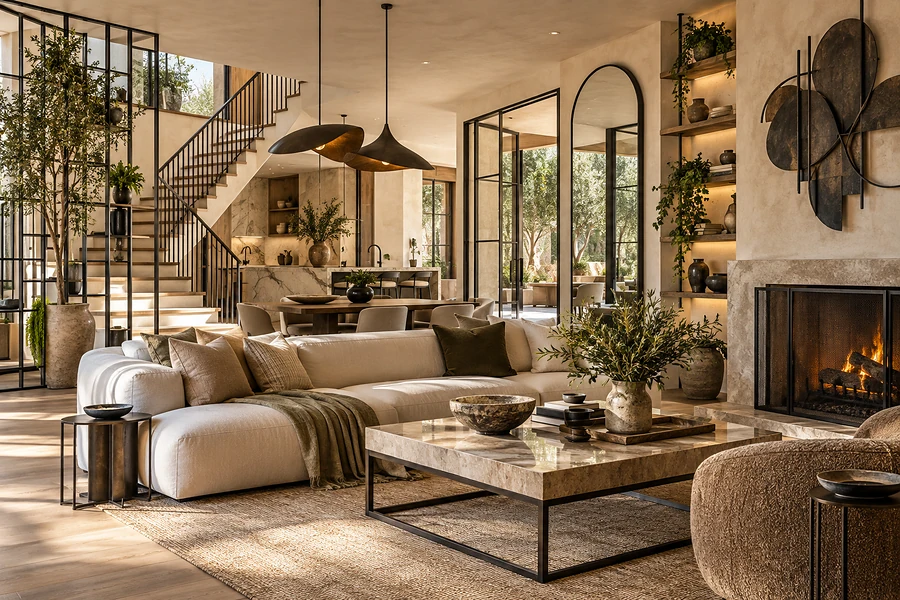
The best modern ironwork ideas include minimalist stair railings, open room dividers, sculptural lighting, fireplace screens, metal-and-stone furniture, glass-and-iron doors, floating shelves, oversized mirrors, decorative plant structures, and custom wall sculptures. In 2026, iron works best when combined with wood, stone, glass, plaster, and softer textiles rather than used as a matching theme throughout the house.
This direction fits several current interior trends. Designers are using decorative metals—including iron—alongside brass, pewter, nickel, and aged finishes, while Milan Design Week 2026 highlighted “soft industrialism,” handcrafted surfaces, and combinations of metal with organic forms and tactile materials.
Why Does Ironwork Work So Well in Modern Home Design?
Modern ironwork is effective because metal can create strong architectural definition without requiring a visually heavy object.
Ironwork works particularly well in contemporary interiors because relatively slender metal profiles can define space, frame materials, and create contrast. Current design trends favor craftsmanship, mixed materials, patina, sculptural form, and rooms that feel collected rather than perfectly matched—all qualities that allow iron to feel relevant without returning to heavily ornamental traditional décor.
Iron Creates Strong Lines
A narrow black metal frame can do something a bulky wood element cannot.
It can outline:
- A staircase
- A doorway
- A fireplace
- A shelving unit
- A glass partition
without visually closing the room.
That makes iron especially useful in interiors where I want structure while maintaining openness.
Iron Adds Contrast
Metal becomes most interesting when placed beside a material that behaves differently.
I particularly like combinations such as:
blackened iron + oak
iron + travertine
iron + glass
iron + linen
iron + plaster
iron + marble
The metal gives the room precision.
The natural material keeps it from feeling cold.
That relationship is closely aligned with the “soft industrialism” identified by Architectural Digest’s editors at Milan Design Week 2026, where hard metals were repeatedly softened with organic shapes and tactile materials.
Iron Fits the Return to Craftsmanship
Current furniture trends are also moving toward artisan-made objects, visible craftsmanship, natural imperfections, and pieces that feel more individual than standardized mass-market furniture.
Ironwork fits naturally into that direction.
Forged curves, welded joints, textured finishes, hammer marks, and subtle irregularity can become part of the design instead of something manufacturers need to hide.
The result feels very different from a generic black metal frame purchased simply because black metal is fashionable.
What Are 10 Innovative Ironwork Ideas for Modern Home Design?
The most successful applications combine practical function with architectural character.
1. Use Minimalist Iron Stair Railings
A staircase is one of the strongest places to use iron because the material naturally emphasizes movement through the house.
For a modern interior, I usually avoid elaborate repeated scrollwork.
Instead, I consider:
- Thin vertical balusters
- Simple geometric grids
- Blackened steel-style frames
- Curved forged handrails
- Iron combined with a warm timber rail
- Metal frames surrounding glass panels
A straightforward vertical railing can give a staircase much more definition without overwhelming the architecture.
I also like iron railings because they work across several design languages.
A thin black railing can suit:
a modern farmhouse,
a contemporary loft,
a Mediterranean renovation,
an industrial home,
or a warm minimalist interior.
The surrounding materials determine the final style.
For example, pair iron with pale oak and white plaster for a lighter contemporary look.
Pair it with walnut and stone for something richer.
Because railings and guards are safety components, however, I would never treat them as decoration alone. Residential codes regulate issues such as required guard locations, handrail heights, openings, graspability, and structural performance. Applicable requirements vary by jurisdiction, so custom metalwork needs to be designed and installed accordingly.
2. Create an Open Iron Room Divider
Open-plan homes sometimes need separation without another solid wall.
This is where decorative ironwork can become especially innovative.
I can use a floor-to-ceiling metal framework to define:
- Entry from living room
- Kitchen from dining space
- Home office from lounge
- Bedroom from dressing area
- Staircase from adjacent room
Instead of creating a solid barrier, I use thin vertical bars, geometric shapes, or a custom abstract pattern.
The goal is to separate functions while keeping:
light,
views,
and visual continuity.
Room dividers remain highly relevant in 2026 because designers are using them to define flexible areas and add decorative layers without major construction. Architectural Digest and House Beautiful both highlight room dividers as practical tools for changing circulation and visually organizing open interiors.
An iron divider takes that concept further by making the partition feel permanent enough to belong to the architecture while remaining visually open.
3. Turn Iron Lighting Into Sculpture
Lighting is one of my favorite places for custom ironwork.
Rather than using a conventional fixture, I can treat the metal frame as a drawing suspended in space.
Possible designs include:
- Branch-like chandeliers
- Large rings
- Linear forged pendants
- Abstract geometric structures
- Curved wall sconces
- Iron frames combined with hand-blown glass
Current 2026 lighting trends strongly favor statement silhouettes, handcrafted surfaces, imperfect finishes, and combinations of metal with glass, stone, ceramic, plaster, and other tactile materials.
That gives iron lighting enormous potential.
A sculptural iron chandelier above a simple dining table may provide enough character that the rest of the room needs very little ornament.
This is also where I would move away from the older “iron chandelier” stereotype.
Instead of twelve curled arms and faux candles, I would use:
one strong shape,
a restrained dark finish,
and good warm lighting.
4. Modernize the Fireplace With a Custom Iron Screen
A fireplace is already a natural focal point.
An iron screen can reinforce that importance without covering the stone or plaster around it.
For a contemporary fireplace, I like:
- Slim rectangular frames
- Fine metal mesh
- Arched screens
- Minimal folding panels
- Simple geometric detailing
- Custom screens matching nearby architectural ironwork
The strongest designs feel like part of the fireplace architecture.
I would avoid excessive ornament unless the room itself has strong historic detailing.
An iron screen can work especially well with:
limestone,
travertine,
marble,
brick,
or hand-finished plaster.
Those materials create a useful contrast between the rough or organic fireplace surround and the controlled line of the metal.
5. Combine Iron Bases With Stone or Wood Furniture
Iron does not need to be the main visual surface.
Sometimes it works best as the supporting framework.
I can pair an iron base with:
- Travertine coffee table top
- Marble console
- Reclaimed wood dining table
- Oak bench
- Glass side table
- Leather upholstered stool
This gives heavy materials visual lightness.
A large slab of stone can look almost weightless when supported by a thin metal framework.
That material contrast also fits 2026’s broader interest in mixed materials and furniture that combines sculptural geometry with craftsmanship.
For modern interiors, I usually prefer the frame to remain simple.
The beauty comes from the relationship between the materials rather than decorative metal motifs.
6. Install Glass-and-Iron Interior Doors
Steel-look glazed doors have become popular because they divide rooms without blocking light.
Ironwork can give this idea a more custom character.
I can use narrow metal frames to create:
- Kitchen doors
- Office doors
- Pantry doors
- Wine-room enclosures
- Bedroom partitions
- Conservatory-style internal walls
Clear glass keeps the view open.
Fluted or textured glass provides more privacy.
The metal grid can be:
strictly rectangular,
arched,
asymmetrical,
or inspired by older industrial windows.
This is a particularly effective way to connect historic and contemporary design.
A traditional arch rendered in a very slim dark metal frame can feel timeless rather than nostalgic.
7. Design Floating Iron Shelving
Shelving does not always need thick cabinetry.
A thin metal framework can produce a much lighter storage system.
I particularly like iron shelving for:
- Kitchens
- Home bars
- Libraries
- Bathrooms
- Living-room displays
The metal can support shelves made from:
wood,
stone,
glass,
or metal itself.
One approach is to create a floor-to-ceiling framework with wooden shelves inserted between vertical iron supports.
Another is to suspend open shelving from the ceiling above a bar or kitchen peninsula.
The advantage is that the shelving can provide storage while preserving sightlines.
It also fits current preferences for rooms that feel layered and personal rather than completely concealed behind smooth cabinetry. Current 2026 interior coverage emphasizes personality, patina, collected objects, and visible material character.
8. Frame an Oversized Mirror in Iron
An oversized mirror can visually enlarge a room, while iron gives the mirror architectural presence.
I might use:
- A slim black rectangular frame
- An arched iron frame
- A softly irregular forged outline
- A divided window-style mirror
- A full-height leaning mirror
The simpler the room, the more sculptural the frame can become.
In an entryway, a large iron mirror above or behind a console can create a strong focal point without requiring a lot of smaller décor.
In a bedroom, an arched version can soften the straight lines of cabinetry and walls.
Curved and sculptural forms continue to be prominent in 2026 furniture and interior trends, making iron especially useful because metal can produce curves while remaining visually slender.
9. Use Ironwork as a Structure for Plants
Iron and greenery create one of the strongest material contrasts available in a home.
I can use custom ironwork to support:
- Climbing plants
- Indoor vines
- Hanging planters
- Herb gardens
- Vertical greenery
- Large artificial plant installations
Instead of placing individual pots randomly around a room, an iron frame can turn greenery into part of the architecture.
For example, I might install a narrow floor-to-ceiling trellis behind a console and allow a climbing plant to grow through it.
Or I might use an iron grid as a backdrop for mixed real and artificial greenery in a dark area where some parts of the installation cannot support living plants.
The important design principle is restraint.
I want the metal to provide structure while the foliage creates movement.
10. Commission a Sculptural Iron Wall Installation
The most innovative ironwork does not necessarily need to serve a conventional furniture function.
Metal can become art.
A custom wall installation might use:
- Forged lines
- Repeated geometric forms
- Botanical silhouettes
- Abstract curves
- Layered metal panels
- Three-dimensional reliefs
This works particularly well on:
large stair walls,
double-height spaces,
entry halls,
or above a long console.
Current 2026 interiors are moving toward sculptural accents and stronger personal expression rather than generic décor objects.
A commissioned iron piece can answer that trend without becoming disposable.
Unlike printed trend art, well-made architectural metalwork can remain part of the home for decades.
How Do You Make Ironwork Look Modern Instead of Old-Fashioned?
Material alone does not determine style.
To make ironwork feel modern, I use simpler profiles, fewer repetitive scrolls, restrained finishes, asymmetrical or architectural forms, and strong material contrast. Iron should usually appear as one carefully chosen layer rather than being repeated across every piece of furniture, lighting, and wall décor.
Avoid Matching Everything
A room does not need:
iron lighting,
iron tables,
iron chairs,
iron shelves,
iron mirrors,
and iron accessories
all in the same black finish.
That can quickly become thematic.
Current designers are actively mixing iron with brass, pewter, nickel, and other metals instead of requiring every metal finish to match.
I prefer something like:
blackened iron railing + aged brass lamp + nickel hardware
because the variation makes the room feel collected.
Pair Hard Metal With Soft Materials
Iron needs contrast.
The easiest way to modernize it is to place it beside materials with warmth or texture.
For example:
| Iron element | Material pairing |
|---|---|
| Stair railing | Oak handrail |
| Coffee table | Travertine top |
| Dining chair frame | Linen upholstery |
| Fireplace screen | Limestone surround |
| Shelving | Walnut |
| Pendant | Hand-blown glass |
| Room divider | Plaster walls |
| Console | Marble |
This balance is closely related to the 2026 “soft industrial” direction identified at Milan, where designers are combining metal with organic shapes and tactile materials rather than creating harsh all-industrial spaces.
Choose Finish Carefully
I usually prefer:
- Blackened metal
- Soft charcoal
- Aged iron
- Waxed finishes
- Subtle patina
- Dark bronze tones
over extremely glossy black paint.
A softer finish allows the metal to retain texture.
It also works better with the current design emphasis on natural imperfection and craftsmanship.
What Should You Consider Before Adding Custom Ironwork?
Innovative metalwork still needs to function properly.
Before installing ironwork, I consider whether the piece is decorative or structural, its weight, attachment method, finish, exposure to moisture, cleaning requirements, interaction with glass or stone, and applicable building codes. Railings, guards, balconies, and other safety-related metalwork should always be fabricated and installed to the requirements of the project jurisdiction.
Structural Elements Need Professional Design
A decorative wall sculpture and a stair guard are not equivalent.
Railings have to protect people.
Current building codes regulate minimum heights, openings, graspability, attachment, and structural resistance for handrails and guards.
That means I would use qualified designers and fabricators for:
- Stair railings
- Guards
- Balconies
- Structural dividers
- Heavy suspended pieces
A beautiful railing that fails required safety performance is not successful design.
Think About Finish and Maintenance
Indoor ironwork is relatively easy to maintain, but moisture can still matter in:
bathrooms,
entryways,
and indoor-outdoor transitional spaces.
I would confirm the intended finish with the fabricator.
For frequently touched elements such as handrails, the finish should also be appropriate for normal cleaning and wear.
Prototype Important Details
For custom projects, I like seeing a physical sample.
A small metal sample can reveal:
- Color
- Texture
- Weld quality
- Edge treatment
- Patina
- Relationship with adjacent materials
A “black” finish can look completely different in matte, satin, waxed, powder-coated, or patinated versions.
The sample prevents surprises.
My insights: 10 Innovative Ironwork Ideas for Modern Home Design
After looking at current 2026 furniture, lighting, material, and interior-design trends, I think ironwork has unusual potential because it sits between architecture, furniture, and craft.
10 Innovative Ironwork Ideas for Modern Home Design work best when iron is treated as a structural and sculptural material rather than a decorative theme. Minimal railings, open dividers, statement lighting, fireplace screens, stone-topped furniture, glazed doors, shelving, mirrors, plant structures, and custom wall art all use iron to create line, contrast, and craftsmanship without recreating heavy traditional interiors.
My First Insight: Iron’s Biggest Advantage Is Visual Strength Without Visual Weight
Wood needs physical mass to create certain structures.
Stone needs even more.
Metal can remain thin.
That makes iron ideal for defining space without closing it.
A narrow metal room divider can separate two functions while allowing daylight to pass through.
A thin stair railing can provide a strong architectural line without turning the staircase into a wall.
A delicate iron table base can support visually heavy stone.
This is where metal becomes particularly useful in modern homes.
My Second Insight: Iron Should Be a Line, Not a Theme
I think older iron-heavy interiors often became dated because iron was repeated everywhere.
The chandelier matched the table.
The table matched the chairs.
The chairs matched the mirror.
The mirror matched the wall décor.
Modern interiors benefit from less repetition.
I want iron to provide one strong visual language while the other materials remain different.
For example:
iron railing + oak stairs + plaster walls
is more interesting to me than an entire staircase covered in decorative black metalwork.
My Third Insight: The Future of Ironwork Is More Custom
Current design trends increasingly favor handcrafted furniture and objects with visible signs of workmanship.
That makes iron especially relevant.
Custom metalwork can respond directly to:
a staircase curve,
a doorway,
a specific room dimension,
or a client’s preferred pattern.
It does not have to look mass-produced.
That is where I think the strongest innovation will happen.
My Fourth Insight: Room Dividers Have Significant Potential
Open-plan spaces are useful, but many homes still need zones.
Room dividers are receiving renewed attention in 2026 as designers look for ways to separate functions without conventional walls.
Iron makes this idea architectural.
A custom metal partition can define:
an entry,
home office,
dining room,
or staircase
without reducing light.
For me, this is one of the most promising modern ironwork applications.
My Fifth Insight: Lighting Is Where Iron Can Become Most Sculptural
Lighting allows ironwork to stop behaving like construction and start behaving like drawing.
A forged line can curve through space.
A large ring can appear almost weightless.
A branch-like structure can hold small light sources.
This fits the current move toward oversized, handcrafted, sculptural lighting and mixed materials.
If I wanted one custom iron feature in a modern home, a statement pendant would be high on my list.
My Sixth Insight: Iron Becomes Warmer When Paired With Nature
The easiest way to prevent iron from feeling cold is to combine it with:
wood,
stone,
plants,
linen,
leather,
or wool.
That combination creates tension.
The iron is precise.
The natural material is irregular.
The iron is dark.
The textile is soft.
The iron feels permanent.
The plant changes.
That contrast is often more interesting than using one material throughout the room.
My Seventh Insight: Modern Ironwork Can Be Long-Lived Because It Is Architectural
Many décor trends depend on objects that are easy to replace.
Architectural ironwork works differently.
A railing, divider, door, or custom fireplace screen can remain in the home through several furniture and color changes.
That means I would avoid overly trend-specific motifs.
I prefer:
- Simple geometry
- Controlled curves
- Good proportions
- High-quality fabrication
- Durable finishes
These age more easily.
My Practical Top 10
If I were prioritizing modern ironwork by application rather than fashion, my shortlist would be:
| Ironwork idea | Main design benefit |
|---|---|
| 1. Minimal stair railing | Architectural definition |
| 2. Open room divider | Zoning without blocking light |
| 3. Sculptural lighting | Functional statement art |
| 4. Fireplace screen | Refined focal-point detail |
| 5. Iron-and-stone furniture | Material contrast |
| 6. Glass-and-iron doors | Separation with transparency |
| 7. Floating shelving | Storage without visual bulk |
| 8. Oversized iron mirror | Architectural focal point |
| 9. Plant structure | Combines metal with organic form |
| 10. Custom wall sculpture | Personal craftsmanship |
My Final View
When someone asks me for 10 Innovative Ironwork Ideas for Modern Home Design, I would not begin with decorative iron accessories.
I would begin with the architecture.
Where does the home need a line?
Where does it need separation without a wall?
Where could a heavy material appear lighter?
Where could craftsmanship replace a generic mass-produced object?
Those questions lead naturally to:
railings,
dividers,
doors,
lighting,
shelving,
and custom furniture.
Current 2026 interior trends support this approach. Decorative metals are being mixed rather than perfectly matched, artisan craftsmanship is gaining value, sculptural lighting is becoming more prominent, and designers are combining harder industrial materials with softer organic surfaces.
That means modern ironwork does not need to recreate an old-fashioned wrought-iron aesthetic.
Its future can be much lighter.
Use iron for structure.
Use it for contrast.
Use it for craftsmanship.
Use it where a thin dark line can improve the architecture.
Then let wood, stone, textiles, glass, plants, and personal objects provide the warmth around it.
That balance is what makes ironwork feel modern rather than nostalgic.
Conclusion
Modern ironwork succeeds through restraint. Use it for architectural lines, sculptural lighting, transparent dividers, furniture, and custom details—then balance the metal with warmer natural materials.