

Real Touch flowers are often marketed as the most realistic artificial flowers available. But terms such as “silk,” “latex,” “Real Touch,” “outdoor-safe,” and “premium” can easily create misleading expectations.
The biggest myths in the Real Touch flower market are that Real Touch is one standardized material, every Real Touch flower is equally realistic, softer always means better, modern “silk flowers” contain real silk, all faux flowers are suitable outdoors, premium products last forever, photographs prove quality, and artificial flowers are automatically sustainable. In reality, materials, construction, use conditions, and reuse matter much more than the marketing label.
Real Touch flowers use varied materials and terminology. Understanding their construction helps buyers compare quality, durability, and performance instead of relying on marketing labels alone.
Is “Real Touch” One Specific Material?
This is probably the most important myth in the market.
No. Real Touch is not one universal raw material. It is better understood as a category of artificial flowers designed to provide greater visual and tactile realism. Depending on the flower and manufacturer, petals may use polyurethane, latex or synthetic-rubber coatings, silicone-like polymers, polymer-coated fabric, or other synthetic material combinations.
Myth 1: All Real Touch Flowers Are Made From the Same Material
When I see the words Real Touch, I do not assume I know the chemical composition.
An established Real Touch industry reference describes several constructions, including:
- Synthetic fabric with polymer coating
- Polyurethane
- Silicone or silicone-like polymers
- Plastic components
- Flexible metal inside stems
It also notes that different factories sometimes use different informal names for related materials.
This matters because two products carrying the same category label can perform very differently.
One rose might use a thin coated fabric petal.
Another flower may use fully molded polymer petals.
Their:
texture,
weight,
flexibility,
surface appearance,
and durability
may all be different.
A recent 2026 Real Touch material guide makes the same broader point: Real Touch quality ranges from coated fabrics to more heavily molded polymer constructions, so the term itself does not represent one uniform technical standard.
Different Flowers Need Different Materials
I also would not want every species made from one material.
A natural rose has thin layered petals.
An orchid has a more sculptural form.
A peony needs softness and volume.
A tulip has its own thickness and surface characteristics.
Real Touch manufacturing references specifically describe different materials being selected for different flower types because each botanical structure creates a different reproduction problem.
So when a supplier says:
“This is premium Real Touch material,”
my next question is:
“What material is used for this particular flower?”
That is far more useful.
Does “Real Touch” Automatically Mean High Quality?
Another major misconception is that the label itself functions as a quality grade.
No. A flower can be marketed as Real Touch and still have poor color, inaccurate proportions, shiny leaves, crude flower centers, thick seams, visible glue, or weak stems. Real Touch describes an attempt at tactile realism; truly high quality depends on the entire flower, including botanical shape, color variation, finishing, stem construction, leaves, and consistency.
Myth 2: Every Real Touch Flower Looks Real
A soft petal can still look fake.
This happens when the rest of the flower has problems such as:
- Flat color
- Perfect symmetry
- Incorrect flower-head size
- Bright plastic leaves
- Crude centers
- Oversized stems
- Visible adhesive
Recent artificial-flower quality guidance emphasizes natural texture, color balance, flexible stems, and overall botanical appearance rather than relying solely on the Real Touch label.
That matches how I evaluate samples.
I first look at the flower from a few feet away.
Then I examine it at arm’s length.
Only after that do I touch the petals.
If it already looks artificial before I touch it, the Real Touch material has not solved the main problem.
Myth 3: The Softest Flower Is the Best Flower
This is another mistake.
Softness is not the same as realism.
A real orchid does not feel exactly like a rose.
A tulip does not have the same petal structure as a hydrangea.
The ideal artificial material should reproduce the characteristics of the species rather than simply being as soft as possible.
Real Touch production guidance explicitly associates different polymer systems with different flower structures, reinforcing the point that no single tactile formula is ideal for every bloom.
My test is therefore:
Does this material feel appropriate for the flower being copied?
not:
How soft is it?
Myth 4: Expensive Means Realistic
Higher cost can reflect:
better molds,
hand finishing,
more complex coloring,
better stems,
or more expensive materials.
But price alone does not guarantee botanical accuracy.
A costly flower with the wrong petal shape is still wrong.
A reasonably priced flower with strong color variation and a convincing silhouette may perform better in the actual project.
That is why I evaluate physical samples rather than using price as a substitute for quality control.
Are “Silk Flowers” Really Made From Silk?
The artificial-flower market contains another confusing term: silk.
Most modern commercial flowers described as “silk flowers” are not made from natural silk. The term has become a general category name for fabric-based artificial flowers, which today commonly use polyester or other synthetic textiles. Real Touch flowers may also combine synthetic fabric with polymer coatings.
Myth 5: “Silk” Means Genuine Silk Fabric
Modern artificial flowers commonly use synthetic textiles because these materials are easier to manufacture consistently and at scale.
A current 2026 material comparison describes modern “silk flowers” as primarily woven polyester rather than natural silk.
The older Real Touch manufacturing reference similarly explains that although silk was historically used as a fabric base, modern production commonly uses synthetic fabric beneath polymer coatings.
So I do not treat these terms as literal material specifications:
silk
Real Touch
soft touch
fresh touch
Instead, I check the product’s actual material information.
Mixed Materials Are Normal
One flower stem may contain several materials.
For example:
| Flower component | Possible construction |
|---|---|
| Petals | Polymer, coated fabric, polyester |
| Flower center | Molded plastic or polymer |
| Leaves | Fabric or molded plastic |
| Stem exterior | Plastic or coated material |
| Stem core | Metal wire |
| Assembly | Adhesive |
This is normal.
A mixed-material flower is not automatically inferior.
In fact, using different materials for different components can produce a more convincing result than forcing the entire flower to use one polymer.
Are Real Touch Flowers Waterproof, Outdoor-Safe, and Permanent?
This is where marketing assumptions can cause practical problems.
Real Touch does not automatically mean waterproof, UV-resistant, weatherproof, or suitable for permanent outdoor exposure. Products designed mainly for interiors may fade or deteriorate when exposed to prolonged sunlight. Outdoor artificial flowers should carry specific outdoor-safe or UV-resistant guidance from the manufacturer.
Myth 6: If It Is Artificial, It Can Go Outside
Plastic and polymer materials may seem naturally weatherproof.
But a complete artificial flower includes much more than the visible petal.
There may be:
pigments,
fabric,
adhesives,
metal wire,
surface coatings,
and molded connectors.
Each component responds differently to sun and moisture.
Balsam Hill specifically recommends looking for an outdoor-safe label because those products receive UV protection intended to reduce fading. It also recommends protecting artificial flowers from severe exposure and limiting outdoor display time for many products.
Similarly, a current artificial-flower supplier FAQ states that its flowers are primarily intended for indoor use and warns that prolonged direct sunlight may gradually fade the colors.
So my rule is:
Real Touch ≠ outdoor-rated.
Those are separate specifications.
Myth 7: Real Touch Flowers Last Forever
Artificial flowers last longer than fresh flowers.
That does not make them permanent.
An older Real Touch market article itself warns against claims of unlimited lifespan and notes that different materials age differently.
Artificial flowers can eventually experience:
- Fading
- Dust accumulation
- Surface changes
- Brittleness
- Adhesive aging
- Bent stems
- Damaged petals
Direct sun and inappropriate storage can accelerate the process.
Even outdoor-safe Balsam Hill products are recommended for limited annual outdoor display to help maintain their appearance.
That tells me something important:
outdoor-safe does not mean immortal.
Myth 8: Real Touch Flowers Are Maintenance-Free
They do not need water.
They still need care.
An established Real Touch maintenance guide recommends periodically removing dust by blowing with cool air or cleaning suitable materials with a soft dry or damp cloth.
Dust matters particularly for long-term interiors.
A beautiful flower sitting in a hotel lobby for twelve months can look noticeably less convincing if the petals and leaves develop a visible gray layer.
So I describe Real Touch flowers as:
low-maintenance
rather than:
maintenance-free.
Can You Judge Real Touch Quality From Photos, Price, or Sustainability Claims?
Online purchasing makes this especially important.
Product photos and marketing claims are useful screening tools, but they cannot fully reveal petal feel, surface shine, stem flexibility, packing recovery, flower-center detail, odor, or batch consistency. For professional purchasing, physical samples remain one of the best ways to evaluate Real Touch flowers before committing to a large order.
Myth 9: Product Photos Tell Me Everything
Photography can hide problems.
Soft lighting may reduce plastic shine.
Retouching can strengthen colors.
A front-facing product image may hide poor construction on the back.
The flower might also look excellent but feel too rubbery or stiff when handled.
Current material guidance recommends checking individual product composition instead of relying only on collection labels or close-up images.
For professional buying, I test a sample in:
- Daylight
- Indoor lighting
- Close-up photography
- Normal room viewing distance
Then I inspect:
the underside,
flower center,
leaves,
stem,
and attachment points.
Myth 10: One Great Sample Guarantees the Whole Order
A sample proves that one flower can look good.
It does not prove that 500 stems will match it.
For large projects, I care about:
- Color consistency
- Bloom diameter
- Stem length
- Surface finish
- Leaf count
- Construction
- Packaging recovery
This is especially important for:
weddings,
hospitality,
retail,
commercial installations,
and wholesale buying.
Batch consistency is part of quality.
Myth 11: Artificial Flowers Are Automatically More Sustainable
This claim needs nuance.
Artificial flowers are manufactured products, often containing polymers, textiles, wire, and adhesives.
A current artificial-flower seller explicitly notes that its materials are not biodegradable.
Their environmental argument becomes stronger when the same flowers are reused many times.
Wedding rentals are a good example.
The Knot notes that artificial-flower rental companies reuse both the blooms and often the packaging, reducing the amount discarded after an individual event. It also points out that locally sourced seasonal fresh flowers can be another sustainability strategy.
So I would not say:
fake flowers are environmentally friendly.
I would say:
reusable artificial flowers can reduce single-event waste when they are actually reused repeatedly.
That is a more defensible statement.
My insights: Myths of the Real Touch Flower Market Everyone Should Know
After comparing current Real Touch material information, 2026 product guidance, outdoor-use recommendations, and wedding-rental practices, I think the largest problem in the market is not artificial flowers themselves.
It is oversimplified terminology.
Myths of the Real Touch Flower Market Everyone Should Know begin with one fundamental misunderstanding: “Real Touch” is not a guarantee of material, quality, durability, outdoor performance, sustainability, or botanical accuracy. Buyers should evaluate the specific flower—its composition, construction, appearance, use environment, supplier information, sample quality, and expected reuse—rather than relying on a category label.
My First Insight: “Real Touch” Should Start the Questions, Not End Them
When a supplier says:
Real Touch
I want to know:
What are the petals made from?
Are they molded or coated fabric?
What are the leaves made from?
Is there internal wire?
What is the recommended use?
Is it designed for indoors or outdoors?
How should it be cleaned?
The label gives me a category.
It does not give me the entire specification.
My Second Insight: Realism Is a System
A truly convincing flower depends on several elements working together.
| Quality factor | What I evaluate |
|---|---|
| Botanical shape | Correct species proportions |
| Petal material | Appropriate flexibility and thickness |
| Color | Natural gradients |
| Surface | Species-appropriate shine |
| Center | Detailed construction |
| Leaves | Realistic shape and green variation |
| Stem | Flexible and proportional |
| Assembly | Minimal visible seams and glue |
| Variation | Natural irregularity |
| Batch consistency | Reliable production quality |
A beautiful material cannot compensate for poor botanical design.
My Third Insight: No Single Material Is Best for Every Flower
This is one of the most important lessons from Real Touch manufacturing information.
A polymer that works beautifully for one bloom may be wrong for another.
Real Touch manufacturing guidance specifically describes coated fabric, polyurethane, silicone-type materials, plastics, and other constructions being used selectively according to flower type.
That means a serious supplier should understand the flower first and material second.
My Fourth Insight: Outdoor Claims Need Separate Verification
I never treat the phrase Real Touch as evidence of UV resistance.
For outdoor projects, I ask separately:
- Is it outdoor-safe?
- Is it UV-treated?
- Is full sun allowed?
- Is covered outdoor use recommended?
- Is there a maximum seasonal exposure period?
Balsam Hill’s current guidance clearly distinguishes outdoor-safe UV-protected artificial flowers from general faux florals.
That should be normal purchasing practice.
My Fifth Insight: Professional Buyers Need Samples
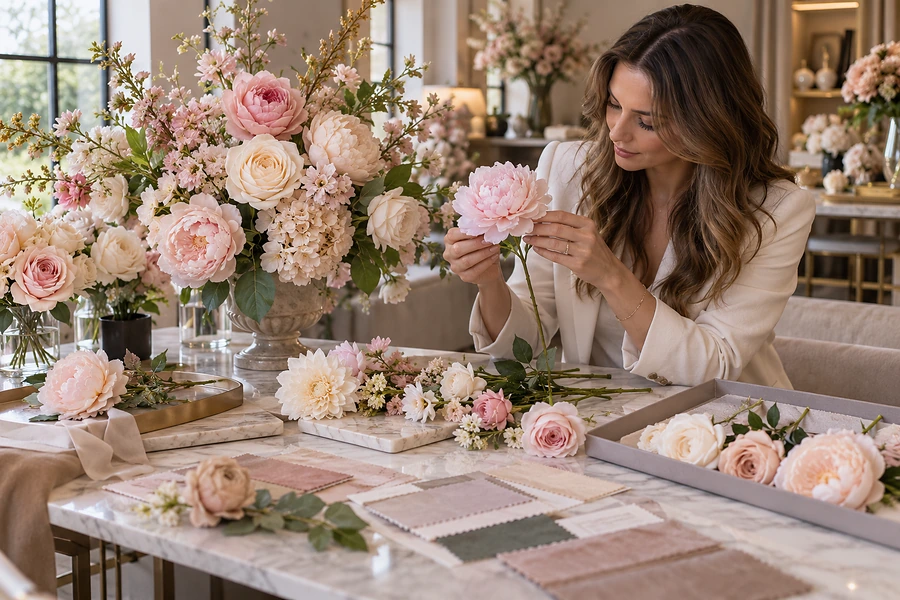
For a single home arrangement, buying one flower online may be fine.
For a hotel, wedding company, retailer, wholesaler, or large commercial installation, I want physical approval.
My sample check includes:
- View the flower from several feet away.
- Inspect it closely.
- Touch the petals.
- Bend the stem.
- Photograph it.
- Check the reverse side.
- Compare multiple pieces.
- Review the actual material specification.
This catches far more problems than a product title.
My Sixth Insight: Real Touch Is Not Always the Best Material for Every Part of an Arrangement
This may sound strange, but a premium arrangement does not need every flower to be Real Touch.
For a bridal bouquet held close to the camera, Real Touch roses or peonies can be valuable.
For a large ceremony arch viewed from fifteen feet away, premium fabric hydrangeas may create volume more efficiently.
A current 2026 comparison similarly suggests blending Real Touch focal flowers with fabric-based flowers where tactile realism is less important.
I think that is smart design.
Use expensive realism where viewers can actually experience it.
My Seventh Insight: Reuse Determines Much of the Long-Term Value
Artificial flowers can have a long useful life only if they are:
stored correctly,
cleaned,
protected from unnecessary sunlight,
and reused.
A flower purchased for one event and thrown away immediately does not capture the main practical advantage of artificial florals.
Rental models demonstrate the opposite approach: flowers can circulate through multiple weddings, with companies reusing both arrangements and packaging.
That is where artificial flowers become far more interesting economically and operationally.
My Myth-vs-Reality Checklist
| Myth | Reality |
|---|---|
| Real Touch is one material | Several materials and constructions exist |
| Every Real Touch flower is premium | Quality varies significantly |
| Softer means more realistic | Texture should match the species |
| Silk flowers are made from silk | Most modern versions use synthetic fabric |
| Real Touch means outdoor-safe | Outdoor/UV rating must be checked separately |
| Artificial flowers last forever | Materials still age, fade, and collect dust |
| Faux flowers need no maintenance | Cleaning and reshaping are still necessary |
| High price guarantees realism | Botanical accuracy matters more |
| Online photos prove quality | Physical samples reveal much more |
| One sample guarantees bulk quality | Batch consistency must be checked |
| Artificial is automatically sustainable | Reuse frequency and full lifecycle matter |
My Final View
When someone asks me about the myths of the Real Touch flower market everyone should know, I would begin with one sentence:
Do not buy the label; evaluate the flower.
Real Touch can describe some of the most convincing artificial flowers available.
Modern polymers, coated fabrics, detailed molding, flexible stems, layered pigments, and careful finishing can create flowers that perform exceptionally well in:
weddings,
hotels,
restaurants,
retail,
photography,
and permanent interiors.
But the category also creates room for confusion.
A flower can be labeled Real Touch without being the right material for its species.
It can feel soft without looking botanical.
It can look beautiful online without performing well in person.
It can be artificial without being outdoor-safe.
It can be reusable without automatically being sustainable.
And it can be expensive without being the best flower for the project.
That is why I evaluate the entire system:
material + shape + color + texture + stem + leaves + construction + intended environment + supplier consistency.
The strongest buyers—whether designers, florists, wedding professionals, wholesalers, or homeowners—treat Real Touch as a category to investigate rather than a quality certificate.
Once that mindset changes, most of the market myths become much easier to recognize.
Conclusion
Real Touch is a category, not a guarantee. Judge artificial flowers by materials, botanical accuracy, construction, intended use, testing, maintenance needs, and real sample quality—not marketing terminology alone.