

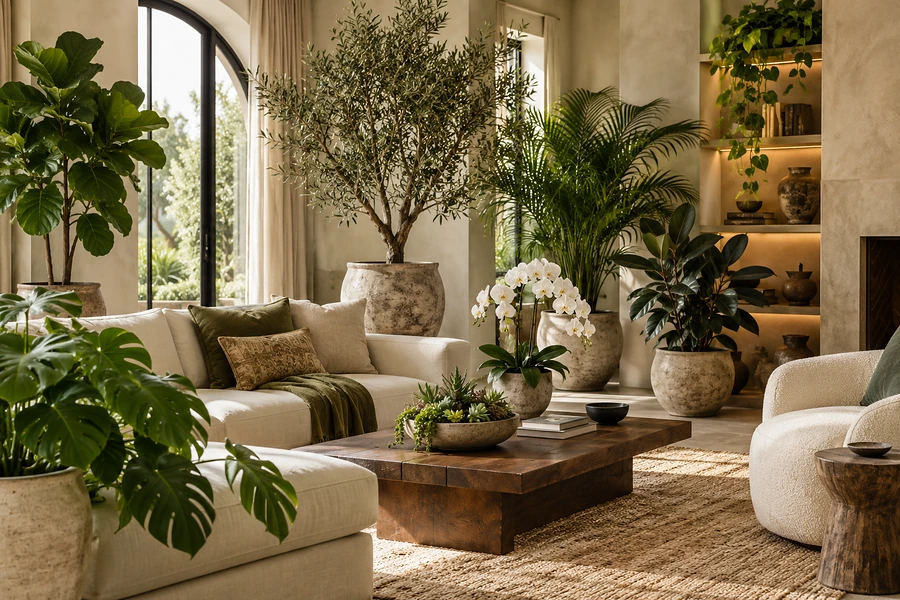
Fake plants can look remarkably convincing today, but realism varies enormously. The strongest options succeed because their leaves, trunks, colors, proportions, and imperfections resemble actual plant growth.
The best fake plants that look real are faux olive trees, fiddle leaf figs, palms, monstera, ficus trees, rubber plants, pothos, succulents, orchids, and eucalyptus-style greenery. In 2026, designers especially favor larger statement plants with matte foliage, irregular branching, varied green tones, realistic trunks, bendable stems, and substantial planters.
The best fake plants combine realistic species with quality materials, botanical accuracy, natural asymmetry, varied colors, proper scale, and thoughtful styling for lifelike results indoors.
Which Fake Plants Look the Most Realistic?
Some plants are naturally easier to reproduce convincingly because their real forms already contain irregularity, strong textures, or relatively simple foliage.
The most realistic fake plants tend to be olive trees, fiddle leaf figs, palms, monstera, ficus, rubber plants, pothos, succulents, orchids, and loose eucalyptus-style greenery. Larger faux trees can be especially convincing because viewers usually experience their overall silhouette rather than inspecting every leaf from a few inches away.
1. Faux Olive Trees
If I want one large artificial plant that has a high chance of looking natural, I usually start with an olive tree.
House Beautiful’s March 2026 guide describes faux olive trees as a designer favorite and notes that the more convincing examples are often intentionally sparse rather than excessively lush.
That matters because real olive trees naturally have:
- Narrow leaves
- Airy branching
- Visible gaps
- Muted gray-green foliage
- Irregular silhouettes
Those characteristics help artificial versions.
A perfectly symmetrical artificial plant often looks fake.
An olive tree is supposed to look a little irregular.
I look for several shades of muted green, a trunk that bends or forks naturally, and branches positioned at different heights.
I avoid trees with every leaf cluster facing outward in exactly the same way.
2. Faux Fiddle Leaf Fig Trees
A high-quality artificial fiddle leaf fig can create an impressive statement in a living room.
ELLE Decor’s 2026 faux fiddle leaf fig guide notes that modern artificial versions can be realistic enough that people may need to touch them to determine whether they are real.
The category works particularly well because the real plant is so recognizable.
Its broad, sculptural leaves create immediate visual impact.
However, those large leaves also make quality especially important.
I examine:
- Vein texture
- Leaf-edge shape
- Gloss level
- Color variation
- Leaf thickness
- Stem attachment
One shiny oversized leaf can reveal an inexpensive fake quickly.
A premium version with matte, slightly varied foliage and an irregular trunk can be much more convincing.
3. Artificial Palms
Palms are another category that can work surprisingly well.
Architectural Digest currently includes a Golden Cane Palm among its best lifelike artificial plants. The publication specifically notes that adjustable leaves and branches allow the plant to be shaped more naturally.
Palms benefit from movement.
Their leaves already point in many directions.
That makes perfect symmetry less necessary.
When styling one, I spread the fronds rather than leaving them compressed around the center.
I also vary the height and angle.
A palm should look loose, not like an umbrella.
4. Faux Monstera
Monstera is one of the easiest large-leaf plants to recognize because of its distinctive cut foliage.
Architectural Digest includes artificial monstera among its current recommendations and notes that its sculptural foliage works well around seating areas or windows.
For realism, the leaf shape must be right.
I look for different leaf sizes and slightly different fenestration patterns.
If every leaf has the same holes in the same places, the plant immediately begins to feel manufactured.
I also want some younger-looking leaves with less dramatic splitting because real monsteras do not produce identical mature foliage on every stem.
5. Faux Ficus Trees
Ficus works well when I want a fuller canopy than an olive tree.
A realistic artificial ficus should have:
- Multiple branch levels
- Small-to-medium foliage
- Several greens
- A convincing trunk
- Natural gaps within the canopy
Ficus can be useful in traditional, transitional, office, or hospitality interiors because it does not strongly belong to one decorating style.
The challenge is density.
I avoid versions that look like perfectly spherical green balls on sticks.
Real trees have internal structure.
I want to see some branches.
6. Faux Rubber Plants
Rubber plants naturally have thick, substantial leaves with a slight sheen.
That makes them relatively compatible with molded artificial foliage.
A plastic-like surface that would look terrible on an olive leaf can appear more believable on a rubber plant because real rubber-tree foliage is naturally smoother and glossier.
I still look for variation.
The best versions should not use one identical bright green across every leaf.
Dark green, slightly lighter new growth, and convincing veins help.
7. Artificial Pothos
Pothos is one of my favorite options for shelves and elevated planters.
Architectural Digest currently recommends faux pothos specifically because its multicolored leaves and trailing growth can look elegant when draped from a higher shelf or windowsill.
Trailing plants have another advantage.
Their stems overlap.
That layered growth hides some artificial construction.
I vary the lengths rather than arranging every vine at the same level.
8. Faux Succulents
Succulents can look exceptionally realistic because many living succulents already have thick, sculptural, almost artificial-looking foliage.
Architectural Digest includes faux succulents among its current lifelike recommendations.
I especially like artificial:
- Echeveria
- Aloe
- Agave
- Jade
- Sedum
The key is surface finish.
Many natural succulents have a matte or powdery appearance.
If an artificial echeveria looks glossy and waxed, I reject it.
9. Artificial Orchids
Orchids can work very well when the flower structure and roots are detailed.
Architectural Digest’s current fake-plant guide includes artificial orchids as a realistic way to add color without maintaining a flowering plant.
For orchids, I pay close attention to the center of each flower.
The petals may look excellent, but a crude flower center can expose the illusion.
I also prefer several stages of bloom:
open flowers,
partially open flowers,
and buds.
That variation makes the plant feel more natural.
10. Faux Eucalyptus and Branch Greenery
Eucalyptus-style greenery is useful when I do not need a complete potted plant.
A few stems in a vase can soften a kitchen, bathroom, console, or shelf.
The best artificial branches have:
- Variable stem lengths
- Muted colors
- Small leaf irregularities
- Flexible wired construction
Architectural Digest’s 2026 artificial-flower coverage emphasizes that high-quality faux stems now use a range of materials and can function as long-lasting alternatives to fresh arrangements.
For stems in a clear vase, one current styling trick from House Beautiful is to add water when the material allows it, helping the arrangement subconsciously read more like fresh greenery.
How Can You Tell if a Fake Plant Will Actually Look Real?
The easiest mistake is judging an artificial plant only from an online product photograph.
A realistic fake plant should have multiple green tones, visible texture, botanical proportions, irregular branching, matte or species-appropriate foliage, and a believable trunk. I also look for wired stems that can be reshaped. Excessive gloss, identical leaves, perfect symmetry, smooth plastic trunks, and tiny nursery pots are the biggest warning signs.
Look for Imperfection
Nature is not perfectly symmetrical.
House Beautiful’s designer guidance specifically recommends avoiding artificial plants that are too glossy or unnaturally symmetrical and instead choosing foliage with variation in color, texture, and shape.
This is probably my fastest quality test.
I ask:
Does every branch have the same length?
Does every leaf face outward?
Is the tree equally full on every side?
If the answer is yes, it may need substantial reshaping—or it may simply be poorly designed.
Check the Leaf Surface
Different plants need different finishes.
| Plant | Surface I expect |
|---|---|
| Olive | Muted and slightly matte |
| Fiddle leaf fig | Subtle natural sheen |
| Rubber plant | Smoother and slightly glossy |
| Succulent | Matte or powdery |
| Monstera | Soft natural sheen |
| Palm | Relatively matte |
The mistake is using one plastic finish for every species.
Examine the Trunk
For trees, I often evaluate the trunk before the leaves.
A convincing trunk should contain:
- Texture
- Color variation
- Taper
- Irregularity
- Natural branching
A smooth brown plastic pole is difficult to disguise.
Even excellent foliage cannot completely rescue it.
Look for Flexible Branches
Wired branches allow me to reshape the plant.
Architectural Digest specifically notes adjustable foliage as an advantage in some of its recommended artificial plants, while current House Beautiful styling advice encourages introducing drooping, uneven branches and imperfect forms.
This flexibility matters because most faux plants arrive compressed for shipping.
They rarely look good immediately out of the box.
How Do You Make Fake Plants Look More Real?
Even an expensive artificial tree can look cheap if it is poorly styled.
The fastest ways to make fake plants look more realistic are to reshape every branch, create asymmetry, upgrade the planter, conceal the factory base, vary stem lengths, and place the plant where living greenery would logically grow. Current 2026 styling advice also recommends using moss to hide artificial bases and allowing some leaves or stems to droop naturally.
Reshape Everything
This is my first step.
I never expect a tree shipped in a box to look natural immediately.
I pull branches:
outward,
downward,
and sideways.
I leave some areas more open.
I bend several stems differently.
House Beautiful’s current advice recommends creating subtle imperfections because real plants contain uneven growth, drooping leaves, and asymmetrical forms.
Replace the Factory Pot
A realistic six-foot tree in a tiny plastic nursery pot is one of the quickest ways to reveal that it is artificial.
Architectural Digest recommends better-quality ceramic planters as an immediate visual upgrade for faux greenery.
I use a pot proportional to the plant.
For larger trees, that might mean:
- Textured ceramic
- Terracotta
- Plaster
- Stone-effect composite
- Woven basket
I then conceal the original weighted base inside it.
Cover Visible Foam
House Beautiful specifically recommends moss as a way to conceal artificial bases and make faux greenery feel more integrated into the planter.
I can also use:
- Preserved moss
- Bark
- Decorative gravel
- Coconut fiber
The goal is to hide anything that looks like packaging.
Use Fewer, Better Plants
One high-quality statement tree usually looks more convincing to me than many inexpensive small fake plants.
House Beautiful’s designer guidance makes a similar point: larger artificial plants often work better because they read as sculptural elements and are less likely to be inspected closely.
I would rather have:
one excellent olive tree
than
six glossy little faux plants scattered around the room.
Dust Them
This may sound obvious, but dust is a strong visual giveaway.
Artificial plants do not refresh their leaves through natural growth.
Dust simply accumulates.
House Beautiful’s designer guidance explicitly notes that faux greenery needs to be included in normal dusting routines or it begins to reveal itself quickly.
Clean foliage reflects light more naturally and preserves color variation.
Where Should You Use Fake Plants Instead of Real Plants?
Artificial plants are most useful where design goals conflict with horticultural reality.
I use fake plants in dark corners, windowless rooms, hard-to-reach areas, frequently vacant homes, high shelves, commercial interiors, and spaces where a precise tree size needs to remain stable. Real plants are usually preferable where conditions support healthy growth and someone enjoys caring for them, but faux greenery is more practical when light or maintenance is inadequate.
Dark Corners
A living tree cannot thrive indefinitely without appropriate light.
Artificial plants can.
This makes a realistic faux fiddle leaf fig, ficus, or olive tree useful in a corner where a living specimen would gradually decline.
High Shelves
I generally avoid living plants where watering them requires a ladder.
Artificial pothos or trailing greenery makes much more sense.
Guest Rooms and Second Homes
If a room is rarely used, a faux plant can provide visual softness without creating another maintenance obligation.
Commercial Spaces
Hotels, offices, restaurants, and retail spaces sometimes need greenery where lighting or maintenance conditions are unsuitable for healthy living plants.
Large artificial trees can provide stable height and form without horticultural care.
Mixed Real and Faux Greenery
I do not think a room needs to choose between artificial and living plants.
A realistic strategy is to use:
real plants near windows,
and faux plants in darker areas.
The two can coexist successfully when their scale and styling are consistent.
My insights: The BEST Fake Plants That Look Real
After comparing current 2026 design guidance and recent artificial-plant recommendations, I think the best fake plants are not necessarily the ones with the most leaves or the highest price.
The BEST Fake Plants That Look Real are usually olive trees, fiddle leaf figs, palms, monstera, ficus, rubber plants, pothos, succulents, orchids, and natural-looking branches. Their realism comes from botanical accuracy, matte or species-appropriate surfaces, varied greens, believable trunks, flexible branches, and intentional styling rather than simply being labeled “premium.”
My First Insight: Olive Trees Are the Safest Large-Plant Choice
If someone asks me where to begin, I usually say:
faux olive tree.
Its naturally airy structure makes small imperfections feel believable.
House Beautiful’s 2026 testing and shopping guide reinforces this, specifically highlighting realistic artificial olive trees and explaining that deliberately sparse canopies can actually look more natural.
I look for:
gray-green foliage,
irregular trunks,
small leaf clusters,
and visible negative space.
My Second Insight: Fiddle Leaf Figs Need Better Quality
Fiddle leaf figs can look spectacular, but I would not buy the cheapest version.
Their large leaves expose every problem.
A premium version needs convincing:
veins,
color,
edges,
surface finish,
and branch positioning.
ELLE Decor’s 2026 guide reflects the strong current market for artificial fiddle leaf figs specifically because modern versions can reproduce the appearance without the maintenance demands of the living plant.
My Third Insight: Large Plants Often Look Better Than Small Ones
This seems counterintuitive.
Larger plants contain more material and therefore more opportunities to look fake.
But designers interviewed by House Beautiful argue that statement faux trees are often more convincing because they function as sculptural interior elements and are normally viewed from greater distances.
I agree.
A six-foot tree creates:
height,
shadow,
shape,
and movement.
A four-inch plastic succulent sitting six inches from someone’s face has far less room for error.
My Fourth Insight: Styling Can Matter Almost as Much as Product Quality
An artificial plant does not automatically arrive looking natural.
Shipping compresses branches.
Factory pots are often undersized.
Leaves face the wrong direction.
That is why I consider styling part of the product.
My basic routine is:
- Open every branch.
- Bend branches at different angles.
- Create some visible gaps.
- Upgrade the planter.
- Conceal the artificial base.
- Clean the leaves.
House Beautiful’s September 2026 advice follows a similar logic, emphasizing unequal stem lengths, slight drooping, asymmetry, and concealed bases.
My Fifth Insight: Botanical Accuracy Matters More Than Leaf Count
A tree with 2,000 poorly shaped leaves can look less realistic than one with 600 well-designed leaves.
I pay attention to whether the plant behaves visually like the species.
An olive tree should be airy.
A ficus should be fuller.
A palm should spread.
A monstera should contain leaves of different sizes.
A pothos should trail.
Realism comes from reproducing those differences.
My Sixth Insight: The Best Fake Plant Is Often the Plant That Would Be Difficult to Keep Alive There
This is where artificial greenery makes the most sense.
If the room has perfect conditions for a living pothos, I may prefer the real thing.
If I want a fiddle leaf fig in a dark interior corner, I would rather use a convincing artificial version than watch a living tree slowly lose its leaves.
Fake plants are strongest when they solve a real environmental problem.
My Top 10 Fake Plant Types
| Fake plant | Why it can look realistic | Best use |
|---|---|---|
| Olive tree | Airy, irregular silhouette | Living-room corner |
| Fiddle leaf fig | Large sculptural leaves | Statement tree |
| Palm | Natural multidirectional fronds | Relaxed interiors |
| Monstera | Recognizable cut leaves | Modern/tropical rooms |
| Ficus | Full natural canopy | Offices and living rooms |
| Rubber plant | Naturally substantial foliage | Modern interiors |
| Pothos | Layered trailing growth | Shelves and cabinets |
| Succulent | Thick sculptural leaves | Tabletops |
| Orchid | Detailed floral focal point | Consoles and bathrooms |
| Eucalyptus/branches | Loose asymmetry | Vases and shelves |
My Final View
When someone asks me for The BEST Fake Plants That Look Real, I do not start with a specific brand.
I start with plants whose natural growth can be reproduced convincingly.
My strongest overall categories are:
olive trees, fiddle leaf figs, palms, monstera, ficus trees, rubber plants, pothos, succulents, orchids, and loose botanical branches.
Current design coverage supports many of those choices. Architectural Digest’s lifelike faux-plant roundup includes palms, monstera, fiddle leaf figs, olive trees, pothos, succulents, and orchids, while House Beautiful’s 2026 coverage gives particular attention to realistic olive trees and the importance of natural imperfection.
But species is only the beginning.
I look for:
multiple greens rather than one flat color,
matte or species-appropriate surfaces,
textured trunks,
different leaf sizes,
visible irregularity,
and
flexible branches I can reshape.
Then I style the plant.
I replace the small factory pot.
I hide the base.
I spread branches unevenly.
I leave some negative space.
And I dust it regularly.
Those details are often what separate a fake plant that looks decorative from one that genuinely makes someone stop and ask:
“Wait—is that real?”
Conclusion
The most realistic fake plants include olive trees, fiddle leaf figs, palms, monstera, ficus, pothos, succulents, and orchids. Prioritize natural irregularity, texture, color variation, and thoughtful styling.