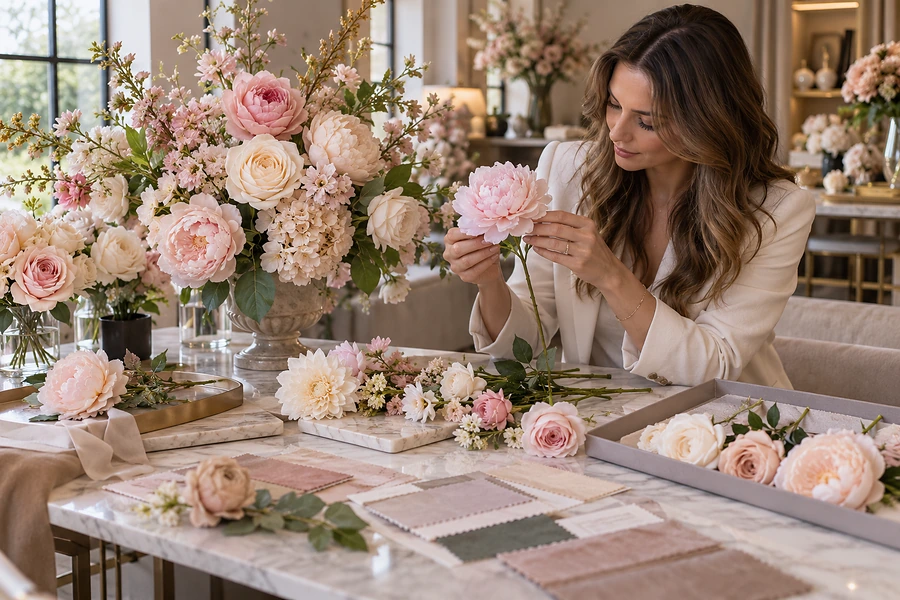

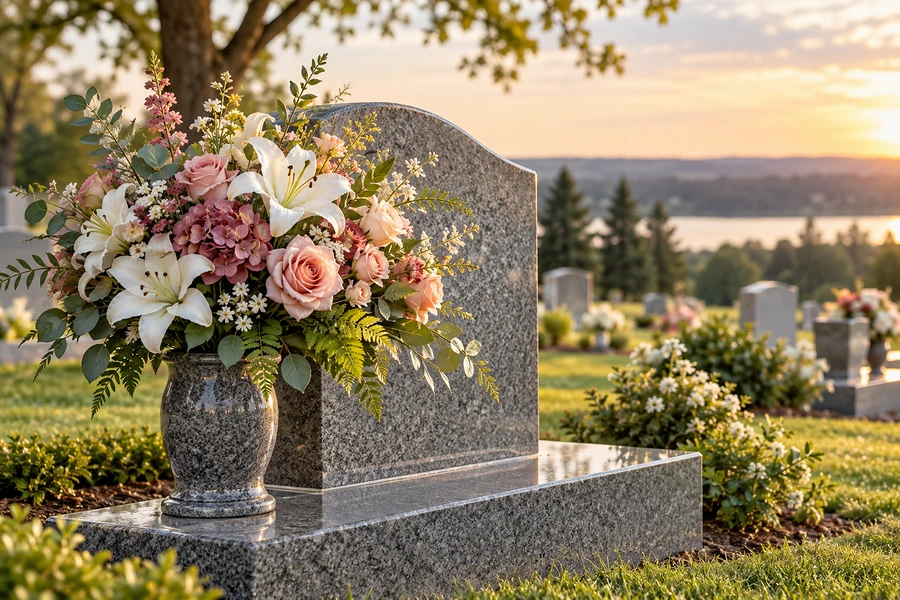
Flowers placed at a grave are more than decoration. They can express remembrance, mark an anniversary, continue a family tradition, or simply show that someone is still being thought of.
Artificial flowers for graves offer a long-lasting way to maintain a memorial when fresh flowers would quickly wilt or require frequent replacement. High-quality arrangements can retain color and shape through changing weather, but cemetery rules, seasonal restrictions, vase requirements, wind, UV exposure, and regular maintenance should all be considered before choosing them.
Cemetery rules for artificial flowers vary by location and season. Always check local policies first, then choose a respectful arrangement appropriate for the memorial site.
Why Choose Artificial Flowers for a Grave?
Artificial flowers are especially useful when a gravesite cannot be visited frequently or when weather makes fresh flowers short-lived.
The main advantages of artificial grave flowers are durability, consistent appearance, seasonal flexibility, and reduced replacement frequency. Unlike fresh flowers, they do not need water and can remain present through longer periods, although they should still be cleaned and replaced when they become faded, damaged, or unsightly. Cemetery rules always take priority over durability.
They Last Longer Than Fresh Flowers
Fresh flowers have a unique emotional quality, but their lifespan outdoors can be short.
Heat, wind, frost, strong sun, and lack of water can cause cut flowers to decline rapidly.
Artificial flowers avoid that problem.
A well-made arrangement can remain visually present long after a fresh bouquet would have wilted.
This can be especially meaningful for families who:
- Live far from the cemetery
- Cannot visit every week
- Want flowers present through a particular season
- Prefer a memorial that maintains a consistent appearance
That does not mean artificial flowers should simply be placed and forgotten.
Many cemeteries remove flowers once they become faded or unsightly. Arlington National Cemetery, for example, states that floral items may be removed when they have deteriorated, while VA national cemeteries may also remove items for mowing and grounds maintenance.
They Offer More Seasonal Flexibility
Artificial flowers also make it easier to create arrangements around:
- Birthdays
- Anniversaries
- Memorial Day
- Mother’s Day
- Father’s Day
- Easter
- Christmas
- Personal dates of remembrance
A person who loved roses can be remembered with roses even when fresh roses would be difficult to maintain outdoors.
A family can also select colors with personal meaning rather than being limited by what is seasonally available.
They Can Create Continuity
Memorial arrangements are often about continuity.
A recurring arrangement can become part of the way a family remembers someone.
The same flower species, colors, or style may be used year after year.
Artificial flowers make that consistency easier.
For example, a family may choose:
white lilies every Easter,
red roses on an anniversary,
or autumn-colored chrysanthemums during fall visits.
The emotional significance does not come from whether the flower is fresh or artificial.
It comes from the act of remembrance.
Are Artificial Flowers Allowed in Cemeteries?
This is the first question I would answer before buying anything.
Artificial flowers are allowed in many cemeteries, but not always year-round. Rules can specify permitted dates, flower height, approved containers, maintenance schedules, and whether arrangements may be attached to headstones. Some cemeteries prohibit artificial flowers on ground graves while allowing them in mausoleum or niche vases, so the specific cemetery policy should always be checked first.
Policies Can Vary Dramatically
The variation between current cemetery policies is significant.
Arlington National Cemetery allows artificial flowers on graves from October 10 through April 15, while fresh cut flowers may be placed year-round. It does not allow flowers or decorations to be attached to headstones or niche covers.
Bath National Cemetery similarly allows artificial flowers generally from October 15 through April 15, with additional allowances around Easter and Memorial Day.
Tallahassee National Cemetery uses a different schedule, permitting artificial floral arrangements from December 15 through February 15, plus a limited period around Memorial Day.
The National Memorial Cemetery of Arizona takes another approach: fresh-cut and artificial flowers may be placed at graves at any time, subject to size, vase, and maintenance rules.
That is why I would never assume that a rule from one cemetery applies to another.
Private Cemeteries Can Be Even More Specific
Private memorial parks may have rules that differ from national cemeteries.
For example, Oakdale Mortuary & Memorial Park currently says artificial flowers are allowed only in mausoleum, crypt, and niche vases, not generally on ground burials. Montecito Memorial Park publishes a similar restriction for artificial flowers.
This means a beautiful arrangement can still be removed if it does not comply with local policy.
Before ordering memorial flowers, I would check:
| Question | Why it matters |
|---|---|
| Are artificial flowers permitted? | Some cemeteries restrict them |
| Are they allowed year-round? | Seasonal periods may apply |
| Is a cemetery-supplied vase required? | Private containers may be prohibited |
| Is there a height limit? | Oversized arrangements may be removed |
| Can flowers be attached to the marker? | Often prohibited |
| Is there a removal schedule? | Important before anniversaries or holidays |
| Are wreaths or grave blankets allowed? | Separate seasonal rules may apply |
| Are wires or stakes permitted? | Maintenance-safety rules vary |
A short phone call to the cemetery office can prevent an arrangement from being removed shortly after placement.
What Are the Best Artificial Flowers for Graves?
The best memorial flowers should combine emotional meaning with realistic appearance and outdoor practicality.
For graves, I generally choose realistic roses, lilies, carnations, chrysanthemums, hydrangeas, peonies, orchids, or mixed seasonal flowers made for outdoor use. The strongest arrangements use natural-looking colors, matte foliage, secure stems, and materials designed to tolerate UV exposure and moisture. Flower choice can also reflect the personality, favorite colors, or traditions of the person being remembered.
Roses
Roses are one of the most versatile memorial choices.
They can communicate:
- Love
- Affection
- Respect
- Remembrance
Artificial roses work particularly well because they are available in almost any color.
I would favor softer botanical shades over intensely glossy or neon colors unless a bright color had personal significance.
Lilies
Lilies have long associations with funerals, remembrance, and peace.
White artificial lilies can create a restrained, traditional arrangement.
Their larger blooms also make them useful when the grave arrangement needs to remain visible from a distance.
Carnations
Carnations are practical for memorial arrangements because their layered flower heads create volume.
They can be combined with roses, chrysanthemums, or greenery without making the arrangement excessively large.
Chrysanthemums
Chrysanthemums are particularly appropriate for autumn memorials and are associated with remembrance in many cultures.
Artificial versions can hold the visual character of the season even where fresh chrysanthemums would deteriorate quickly.
Peonies and Hydrangeas
These are useful when I want a softer, fuller composition.
Peonies create a more romantic memorial style, while hydrangeas can add volume with relatively few stems.
For grave flowers, however, I would avoid arrangements that become so broad or tall that they interfere with adjacent graves or grounds maintenance.
The National Memorial Cemetery of Arizona, for example, limits floral arrangements to 24 inches high and prohibits arrangements that cover markers or encroach on adjacent graves.
The Most Meaningful Flower May Be a Personal One
Symbolism can be useful, but I do not think every memorial arrangement needs to follow traditional funeral-flower meanings.
If someone loved:
sunflowers,
lavender,
purple orchids,
wildflowers,
or bright red roses,
those may be more meaningful than a conventional white arrangement.
The most respectful flower is often the one that brings the person’s character to mind.
How Do You Make Artificial Grave Flowers Last Outdoors?
Artificial flowers are durable, but they are not indestructible.
To extend the life of artificial grave flowers, I choose products intended for outdoor use, favor UV-resistant materials and stable pigments, secure the arrangement using only cemetery-approved methods, avoid exposed fragile ornaments, and periodically clean or replace faded foliage. No artificial flower should be assumed to be permanently weatherproof simply because it is made from synthetic material.
Sunlight Is One of the Biggest Challenges
UV exposure can gradually fade artificial flowers and weaken some plastics or coatings.
This is especially noticeable in:
- Red flowers
- Purple flowers
- Dark greenery
- Cheap fabric flowers
For long-term outdoor use, I look for flowers specifically described as outdoor or UV-resistant rather than assuming all artificial flowers can handle full sun.
I also prefer color variation.
A flower with several subtle shades generally ages more gracefully than one coated in a single intense pigment.
Wind Matters Too
A grave is an exposed outdoor environment.
Wind can pull flowers from a vase or move an arrangement onto a neighboring grave.
However, securing flowers is one area where cemetery regulations become especially important.
Many national cemeteries specifically prohibit attaching decorations to headstones or markers. Arlington, Bath, Tallahassee, and other VA cemeteries all publish rules against securing floral items directly to grave markers.
So I never recommend tying, wiring, gluing, or otherwise fastening an arrangement to a headstone unless the cemetery explicitly permits it.
Instead, I use the approved vase or container system.
Avoid Hazardous Decorations
Additional accessories can look attractive but may create maintenance problems.
VA cemetery policies commonly prohibit or restrict objects that could become hazards around mowing equipment, including loose wires, beads, breakable materials, and similar items.
For me, that means simpler is usually better.
Flowers and foliage should remain the focus.
I avoid adding:
glass ornaments,
loose stones,
sharp wire,
large plastic decorations,
or anything likely to detach in wind.
Replace Flowers Before They Look Neglected
“Eternal” beauty is symbolic.
No outdoor artificial arrangement actually lasts forever.
Eventually, weather can cause:
- Fading
- Dust buildup
- Fraying
- Brittle leaves
- Bent stems
- Missing petals
When the arrangement begins to look neglected, replacing it is usually more respectful than trying to preserve it indefinitely.
Many cemetery policies explicitly state that faded, damaged, or unsightly flowers may be removed by staff.
I see that as a useful standard even in cemeteries without strict removal schedules.
How Should Artificial Grave Flowers Be Styled Respectfully?
Memorial flowers usually work best when they feel personal but restrained.
I style artificial grave flowers with a clear focal flower, a limited color palette, realistic greenery, and proportions appropriate to the grave marker. I avoid excessive accessories, overly bright plastic foliage, and arrangements large enough to cover inscriptions or intrude on neighboring graves. Respectful styling is less about decoration and more about making the memorial feel cared for.
Keep the Marker Visible
A memorial arrangement should complement the grave, not obscure it.
Names, dates, inscriptions, and symbols should remain visible.
This is also reflected in formal cemetery rules. The National Memorial Cemetery of Arizona prohibits flowers from covering a marker or encroaching on adjoining gravesites.
Use a Controlled Color Palette
I usually work with two or three related colors.
Examples include:
Traditional
White lilies + cream roses + muted greenery.
Romantic
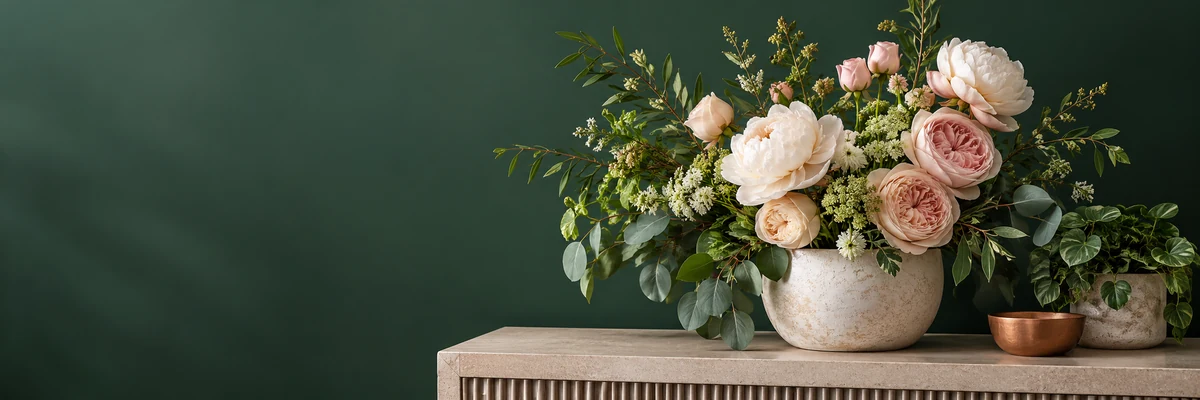
Blush roses + soft pink peonies + eucalyptus-style foliage.
Patriotic
Red + white + blue for an appropriate veteran memorial, subject to cemetery rules.
Autumn
Burgundy + rust + cream chrysanthemums.
Christmas
Deep red + white + evergreen foliage.
A restrained palette often looks more intentional than trying to include every color in one bouquet.
Natural Greenery Helps
Greenery gives flowers a more believable structure.
I prefer muted greens rather than one bright plastic tone.
A little foliage can also make fewer flower stems feel more substantial.
Avoid Perfect Symmetry
Artificial flowers can look especially manufactured when every bloom is exactly the same height.
I vary:
- Stem length
- Flower direction
- Bloom size
- Foliage position
The arrangement should still feel orderly, but not mechanically identical.
My insights: Artificial Flowers for Graves-Eternal Beauty and Remembrance
After comparing current cemetery regulations with the practical advantages of artificial memorial flowers, I think the most important idea is that “eternal beauty” should not mean permanent decoration.
Artificial Flowers for Graves: Eternal Beauty and Remembrance is really about creating a durable symbol of continuing memory. Artificial flowers can remain beautiful far longer than fresh blooms, but the most respectful arrangement is one that follows cemetery rules, withstands the local environment, remains proportionate to the memorial, and is periodically cleaned, renewed, or replaced.
My First Insight: Check the Cemetery Before Choosing the Flowers
This is the step I would put ahead of color, flower type, or price.
Cemetery regulations vary too widely to make assumptions.
Current examples illustrate the difference clearly:
- Arlington allows artificial flowers from October 10 through April 15.
- Salisbury allows them from November 1 through April 1.
- Tallahassee permits them mainly from December 15 through February 15 and around Memorial Day.
- National Memorial Cemetery of Arizona allows artificial flowers throughout the year subject to placement rules.
The VA’s 2025 national floral policy explicitly gives local cemetery directors responsibility for setting artificial-flower periods.
There is no universal schedule.
My Second Insight: Durability Should Not Replace Care
Artificial flowers eliminate watering.
They do not eliminate maintenance.
An arrangement covered with dust, faded by sunlight, or damaged by weather no longer communicates the same sense of care.
I would inspect memorial flowers periodically when possible.
I would replace them when:
colors become noticeably faded,
petals fray,
leaves become brittle,
or the arrangement loses its shape.
In other words, the flower may be artificial, but the act of caring for the memorial remains real.
My Third Insight: Simple Arrangements Often Feel More Timeless
A memorial does not need to be elaborate to feel meaningful.
Sometimes one carefully chosen bouquet works better than many decorative objects.
This is particularly important because cemeteries have to balance individual remembrance with:
grounds maintenance,
safety,
adjacent graves,
and the overall dignity of the cemetery.
VA cemetery policies commonly restrict statues, breakable objects, lights, permanent plantings, and decorations that could create hazards.
Flowers are effective precisely because they can communicate affection without overwhelming the setting.
My Fourth Insight: Personal Meaning Matters More Than Floral Symbolism
Traditional flower meanings can guide selection, but they should not become rules.
If someone’s favorite flower was yellow roses, I would not replace them with white lilies simply because white flowers are considered more conventional for memorials.
If someone loved a garden filled with purple flowers, that color may carry much stronger emotional meaning.
The memorial should reflect a person rather than merely follow a generic funeral aesthetic.
My Fifth Insight: Seasonal Rotation Can Be More Meaningful Than One Permanent Arrangement
Instead of trying to find one bouquet that stays outside all year, I often prefer a seasonal approach.
For example:
| Season or occasion | Memorial arrangement |
|---|---|
| Spring | Tulips, lilies, soft greenery |
| Memorial Day | Appropriate patriotic flowers |
| Summer | Roses, hydrangeas, sunflowers |
| Autumn | Chrysanthemums and warm foliage |
| Christmas | Red flowers and evergreen-style greenery |
| Birthday | Favorite flower or favorite color |
| Anniversary | Flowers connected to a personal memory |
This approach also fits the reality that many cemeteries have seasonal floral rules and cleanup periods.
Artificial arrangements can then become part of a continuing ritual rather than a one-time placement.
My Sixth Insight: Outdoor Quality Matters More Than Extreme Realism
For a bridal bouquet, I might prioritize the softest Real Touch petals.
For a grave arrangement, my priorities change.
I care more about:
- UV resistance
- Color stability
- Secure construction
- Weather tolerance
- Realistic appearance from normal viewing distance
A delicate premium indoor flower may look extraordinary but perform poorly after weeks outdoors.
For a memorial, durability and dignity should work together.
My Grave-Flower Checklist
Before placing an artificial floral memorial, I would check:
| Question | What I want to know |
|---|---|
| Are artificial flowers allowed? | Confirm cemetery policy |
| What dates are permitted? | Avoid seasonal removal |
| Which container is allowed? | Some cemeteries provide vases |
| Is there a height limit? | Keep within regulations |
| Can anything attach to the headstone? | Frequently prohibited |
| Is the arrangement outdoor-rated? | Improves weather performance |
| Is the foliage UV resistant? | Helps reduce fading |
| Are there loose wires or ornaments? | Avoid maintenance hazards |
| Does it cover the inscription? | The marker should remain readable |
| Could it encroach on another grave? | Respect adjacent memorials |
| When is cemetery cleanup? | Prevent unexpected removal |
| When should I replace it? | Maintain a cared-for appearance |
My Final View
When I think about Artificial Flowers for Graves: Eternal Beauty and Remembrance, I do not interpret “eternal” literally.
No artificial flower lasts forever outdoors.
Sun fades pigments.
Wind moves stems.
Rain and temperature changes age materials.
Cemetery maintenance schedules may require arrangements to be removed long before the flowers physically wear out.
The permanence lies somewhere else.
It lies in the remembrance.
Artificial flowers simply provide a practical way to express that remembrance for longer periods.
They can keep a grave looking cared for when family members live far away.
They can preserve a meaningful color or favorite flower beyond its natural season.
They can mark birthdays, anniversaries, holidays, and quiet ordinary days.
But I would always place respect before decoration.
I check the cemetery rules first.
I choose flowers appropriate to the outdoor environment.
I keep the arrangement proportional.
I avoid attaching objects to markers unless explicitly allowed.
And I replace flowers once they no longer look cared for.
That combination—personal meaning, appropriate materials, cemetery compliance, and continuing attention—is what makes artificial grave flowers feel dignified rather than merely decorative.
Conclusion
Artificial grave flowers can provide lasting beauty and meaningful remembrance. Choose weather-appropriate blooms, follow cemetery rules, keep arrangements proportional, and renew them when weather or time begins to show.