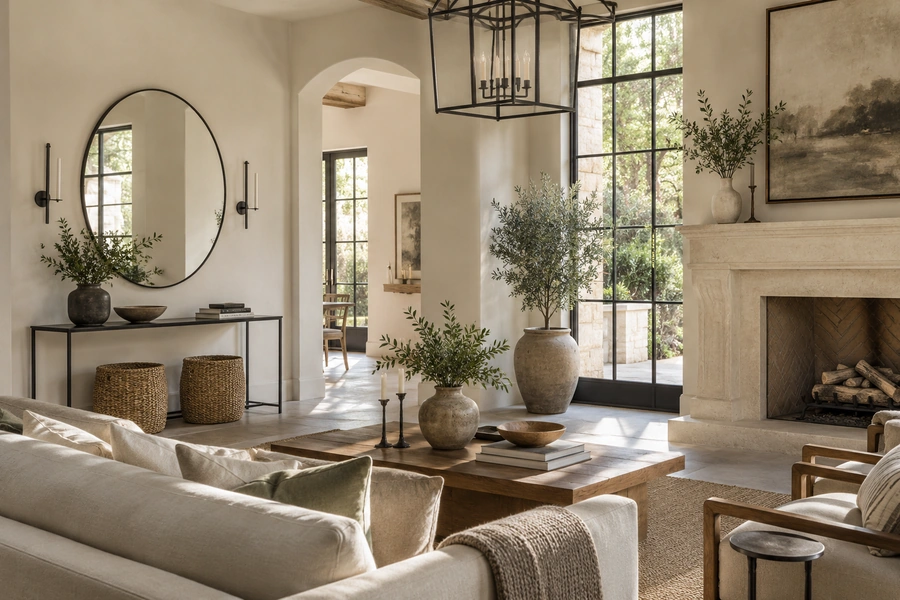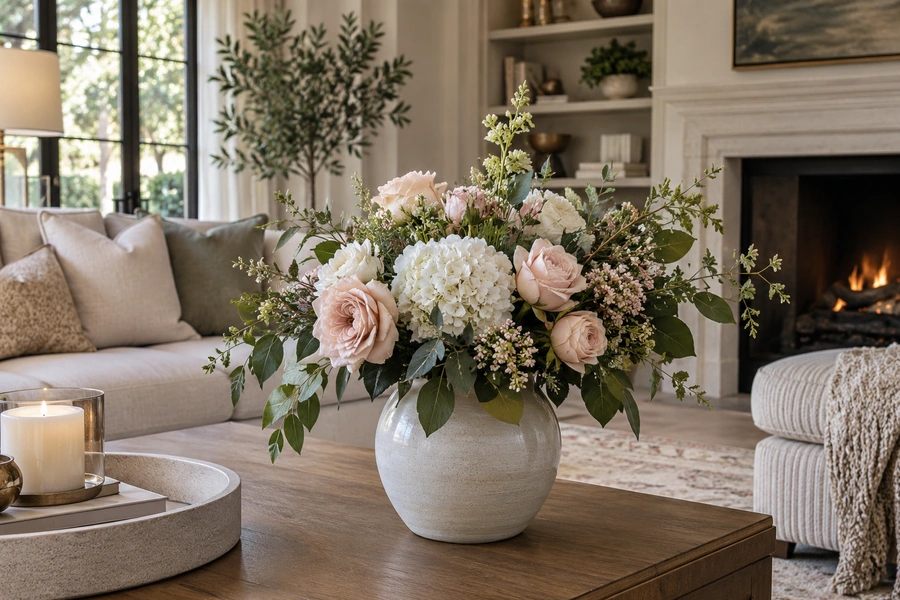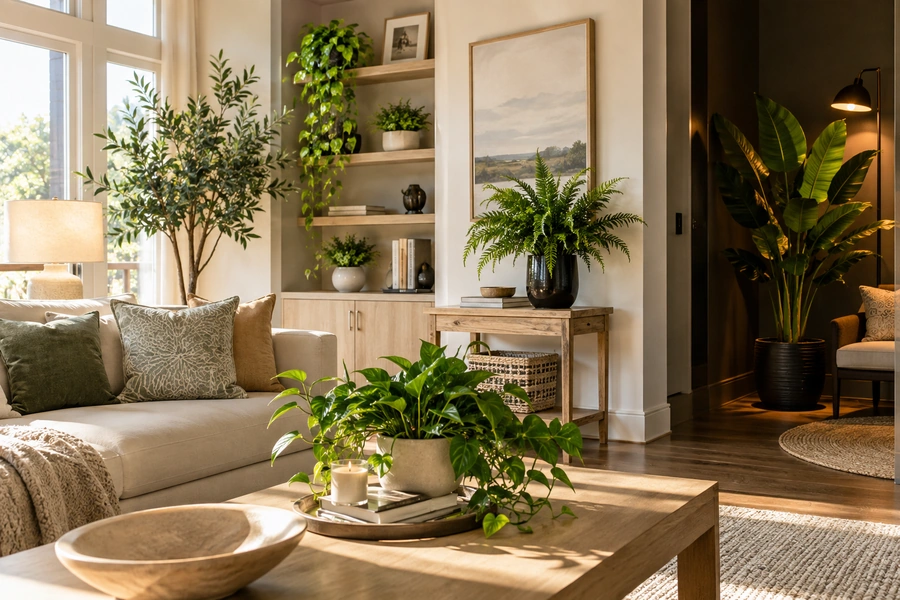

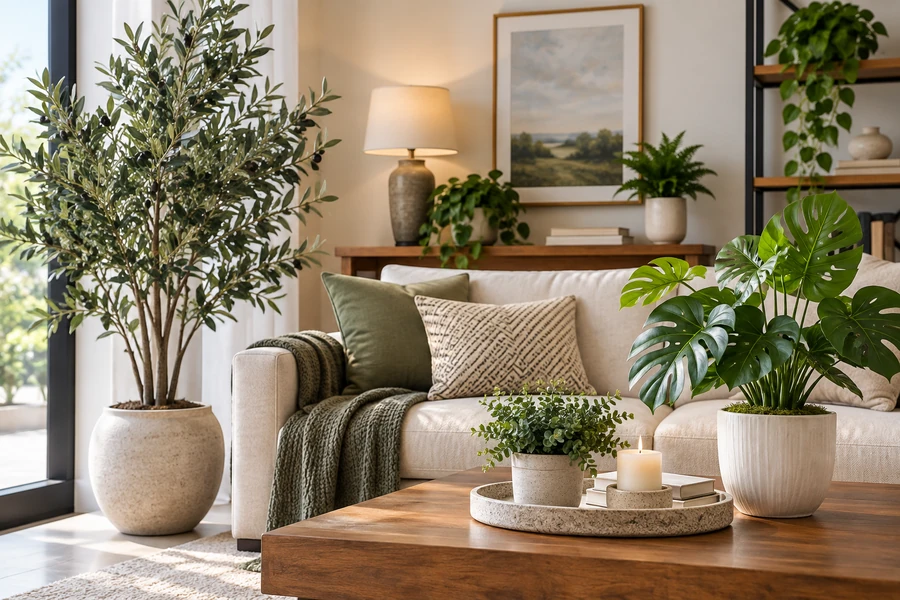
Fake plants once had a reputation for shiny leaves and obvious plastic stems, but modern artificial greenery can look very different when I choose and style it carefully.
No, fake plants are not automatically tacky in a house. I find that high-quality faux plants can look stylish and natural when they have realistic colors, varied leaves, convincing stems, and the right planter. Fake plants usually look tacky when they are overly shiny, poorly shaped, dusty, obviously plastic, or badly matched to the room.
The difference is often less about whether a plant is real or artificial and more about quality, scale, placement, and styling. I treat a faux plant like any other piece of home décor: it needs to fit the room rather than simply fill an empty corner.
Do Fake Plants Make a House Look Cheap?
A fake plant can make a room look cheaper when its artificial details are easy to see, but I do not think the problem comes from artificial greenery itself.
Fake plants can make a house look cheap when they have flat colors, glossy plastic leaves, unrealistic trunks, identical branches, or small nursery pots that expose foam at the base. I can avoid that effect by choosing realistic artificial plants with natural variation and displaying them in ceramic, stone, terracotta, or woven planters that suit the room.
I Look at the Leaves First
The leaves usually tell me very quickly whether a faux plant will work in a home.
Real foliage rarely has one perfectly uniform shade of green. Younger leaves may be lighter. Older leaves can be darker. Veins, edges, and surfaces also vary.
Cheap artificial plants often remove those details.
Every leaf may have exactly the same color. The plastic may reflect too much light. The edges may look unusually thick. The leaf veins may be printed rather than textured.
When I choose a realistic fake plant, I prefer subtle variation.
I look for:
- Different shades of green
- Matte or low-sheen surfaces
- Natural leaf veins
- Slight changes in leaf size
- Irregular leaf angles
- Realistic edges
- Believable stems and branches
Interior designers quoted by The Washington Post similarly recommend checking color variation and looking carefully at stems and trunks, because those details can quickly reveal that a plant is artificial.
The Trunk Matters as Much as the Leaves
Large faux trees can look convincing at eye level and still fail at the trunk.
A realistic artificial olive tree, fiddle leaf fig, ficus, or palm needs a believable structure.
I avoid trunks that look hollow, smooth, strongly molded, or uniformly painted. I prefer natural-looking bark texture, irregular branching, and proportions that match the species.
This becomes more important with tall artificial plants because the trunk occupies a large part of the visual space.
I Never Ignore the Planter
Even an expensive faux plant can look unfinished in a tiny black transport pot.
HGTV recommends upgrading the planter and hiding the original base with materials such as moss or real dirt. This helps remove one of the most obvious signs that a plant is artificial.
I usually place the original pot inside a larger decorative planter or basket.
Then I cover the visible base with something appropriate, such as:
| Top dressing | Visual effect |
|---|---|
| Preserved moss | Soft and organic |
| Bark | Natural and casual |
| Pebbles | Clean and modern |
| Decorative stones | Good for minimalist spaces |
| Natural-looking soil topper | Strong realism |
| Coconut fiber | Useful for larger planters |
I also choose a planter with enough visual weight.
A six-foot artificial tree in a very small plastic pot can look unstable even when the plant itself is realistic. A larger ceramic planter, textured basket, or stone-effect container makes the proportions feel more believable.
Scale Can Make a Good Plant Look Bad
I also consider the relationship between the plant and the room.
A tiny tree placed alone beside a tall ceiling can look lost.
An oversized palm squeezed between furniture can make the space look crowded.
I use faux plants in the same way I would use lamps, artwork, or furniture. I think about proportion first.
| Space | Faux greenery I might choose |
|---|---|
| Coffee table | Small potted plant or stems |
| Bookshelf | Compact trailing greenery |
| Console table | Medium arrangement |
| Empty corner | Tall olive, ficus, or palm |
| Dining table | Low greenery or floral arrangement |
| Bathroom | Small humidity-loving-looking species |
| Entryway | Medium or tall statement plant |
| High shelf | Trailing plant |
When the scale feels intentional, artificial greenery looks like part of the interior rather than an object added simply because a corner was empty.
How Do You Make Fake Plants Look Real in a House?
Buying a realistic artificial plant is only the first step. I can still make a good plant look artificial if I leave it compressed exactly as it came out of the shipping box.
I make fake plants look more realistic by reshaping every branch, creating an uneven natural silhouette, upgrading the planter, hiding the artificial base, keeping leaves clean, and placing the plant where a living version could reasonably grow. Mixing a few faux plants with real greenery can also make the entire arrangement feel more natural.
I Reshape Every Plant After Unpacking
Artificial plants are usually compressed for storage and shipping.
Branches may point straight upward. Leaves may overlap. A tree can arrive with a narrow, perfectly symmetrical silhouette.
I do not consider that the final shape.
I gently separate the branches and rotate leaves in different directions. If the stems contain wire, I bend them so that some branches extend outward while others rise or fall.
HGTV specifically recommends shaping artificial plants into less uniform growth patterns because plants that look too perfect are easier to identify as fake.
I try to create controlled imperfection.
Real plants respond to light, gravity, pruning, and available space. Their branches are rarely identical on every side.
That irregularity makes a faux plant look more believable.
I Put the Plant Somewhere That Makes Botanical Sense
Placement can expose a fake plant even when the plant itself looks excellent.
For example, if I place a large artificial tropical tree in a completely dark space with no nearby window, someone may immediately notice that a real version would struggle there.
The plant does not need perfect horticultural conditions because it is artificial. Still, the visual story should make sense.
I might place a faux olive tree near a bright window.
I could use a faux fern in a bathroom.
I might place a trailing plant on a shelf where its stems have room to hang.
I would be more careful about putting a large sun-loving tree in a windowless hallway.
This kind of placement makes the décor feel more natural.
I Keep the Leaves Clean
Dust is one of the easiest ways to make fake greenery look neglected.
Real plants can also collect dust, but they are watered, wiped, misted, handled, and naturally changed over time. Faux plants may sit in exactly the same position for years.
HGTV identifies regular cleaning as an important part of making artificial plants look convincing.
I therefore add fake plants to normal household cleaning.
For most products, I begin with a microfiber cloth, soft brush, or gentle duster. If I need deeper cleaning, I follow the manufacturer’s instructions because artificial leaves can use different coatings and materials.
A clean matte leaf usually looks much more natural than one covered in gray dust.
I Avoid Too Much Perfection
Artificial plants sometimes look fake because they look better than nature.
Every branch is straight.
Every leaf faces forward.
Every flower is fully open.
Every color is identical.
I prefer arrangements with different heights, different stem directions, partially hidden leaves, and natural gaps.
The goal is not to damage the plant deliberately. I simply avoid making it look mechanically symmetrical.
I Can Mix Real and Artificial Plants
I do not think a house has to choose one side.
Apartment Therapy notes that using faux and living plants in similar planters can help them visually harmonize.
I might keep an easy real pothos near a high-quality faux tree.
I could use fresh branches on a dining table while using artificial greenery in a darker corner.
I can also mix preserved moss, dried materials, and faux stems.
This creates layers of natural-looking texture without requiring every piece of greenery to be alive.
Where Should I Put Fake Plants in My House?
I get better results when I use artificial plants where they solve a decorating problem instead of spreading them randomly across every room.
I place fake plants where greenery improves the composition but maintaining a live plant would be inconvenient. Good locations include difficult corners, high shelves, guest rooms, entryways, bathrooms, home offices, vacation homes, and spaces that are hard to water regularly. I still place them in visually believable locations and choose a size that suits the furniture around them.
Darker Corners Can Be Practical Locations
A real plant needs a suitable amount of light.
A faux plant does not.
That makes artificial greenery useful in spaces where I want color and organic shape but where a real plant may not stay healthy.
I might use one in:
- A darker hallway
- An internal bathroom
- A guest bedroom
- A basement room
- An office corner
- A high shelf
- A difficult stair landing
I still think about visual plausibility.
If there is some indirect light or the location feels connected to nearby windows, the plant tends to look more convincing.
High Shelves Are Good for Faux Greenery
Trailing artificial plants work especially well on high shelving.
People see the overall shape more than the individual leaf material.
HGTV also suggests placing some faux plants higher because the artificial surface becomes less obvious when it is farther from direct eye level.
This can work with artificial pothos, ivy, philodendron, ferns, and other cascading greenery.
I use this technique carefully. One or two trailing plants can soften hard shelving. Too many can make the shelves look themed rather than styled.
Large Plants Can Fill Empty Corners
Tall plants can add height and help connect furniture to the architecture of a room.
A sofa, chair, and side table may occupy the lower half of a space. A tall olive tree or ficus can carry the eye upward.
I usually prefer a large realistic plant over many small artificial plants scattered around the same room.
One well-proportioned statement tree often looks more intentional.
Kitchens and Bathrooms Need Restraint
Small artificial plants can work in kitchens and bathrooms because these rooms often benefit from a little green color.
I avoid placing too many small fake succulents on every shelf and counter.
Repeated miniature plastic plants can begin to look decorative rather than botanical.
Instead, I might use one small arrangement near a sink, on an open shelf, or on a bathroom vanity.
Bedrooms Benefit From Simple Greenery
In bedrooms, I prefer a quiet approach.
A medium plant beside a dresser or one branch arrangement on a nightstand can soften the room.
I usually avoid filling every surface with artificial greenery.
A bedroom already contains many soft materials, such as bedding, rugs, curtains, and cushions. The greenery should support those materials rather than compete with them.
Is It Okay to Have Fake Plants Instead of Real Plants?
Real and artificial plants do not provide exactly the same experience, so I do not think one is a complete substitute for the other in every situation.
Yes, it is completely reasonable to use fake plants instead of real plants when I mainly want visual greenery without watering, pruning, pests, soil, or light requirements. However, artificial plants do not grow or provide the living quality of real plants. I choose between them according to the purpose of the room rather than treating one as universally better.
Real Plants Offer Something Artificial Plants Cannot
I like living plants because they change.
New leaves appear.
Stems grow toward light.
The shape changes over time.
That natural variation gives a room a kind of authenticity that artificial greenery cannot reproduce completely.
For someone who enjoys gardening and has appropriate light, real plants can be an excellent choice.
Fake Plants Solve Practical Problems
Artificial plants are useful for a different reason.
I do not need to coordinate watering schedules.
I do not have to move them when light changes.
They do not develop root rot from overwatering.
They do not drop leaves because I have been traveling.
They also allow me to use the visual form of a plant in places where keeping that species alive would be difficult.
Current design coverage reflects both opinions. Some designers still prefer authentic natural materials and living plants, while other respected designers use high-quality faux foliage and regard modern artificial plants as a practical décor option rather than an automatic design mistake.
For me, this means the decision does not need to become a rule.
I Choose According to the Space
| Situation | What I may choose |
|---|---|
| Bright room and I enjoy plant care | Real plant |
| Very dark space | Faux plant |
| Frequently empty vacation home | Faux plant |
| Hard-to-reach shelf | Faux plant |
| Kitchen herb area | Real plant |
| Large decorative tree | Real or high-quality faux |
| Short-term staging | Faux plant |
| Botanical hobby space | Real plants |
| Low-maintenance guest room | Faux plant |
| Mixed residential décor | Real and faux together |
I think the most convincing interiors often avoid extremes.
I do not need every leaf in the house to be artificial.
I also do not need to maintain a collection of living plants just to meet a decorating rule.
I choose what works for the room.
My insights: Are Fake Plants Tacky in a House
The more useful question is not whether fake plants are socially acceptable. I think the real question is what makes one artificial plant look thoughtful while another makes a room feel cheap.
No, fake plants are not inherently tacky in a house. I find that they become tacky when poor quality, unrealistic materials, incorrect scale, visible plastic pots, dust, excessive symmetry, or careless placement make the artificial nature of the plant the first thing I notice. A high-quality faux plant styled with restraint can look polished and appropriate in a modern interior.
Quality Matters More Than the Fake Label
Artificial plants have carried a poor reputation largely because older products were often easy to identify.
Architectural Digest noted that faux plants historically had a tacky reputation, while newer high-quality versions have increasingly become accepted by professional decorators.
Modern production can create much more detail.
Leaves can include realistic veins and color gradients.
Some stems use natural wood.
Higher-quality molded leaves may have matte surfaces instead of obvious plastic shine.
Real-touch materials can also make certain plants and flowers feel more convincing.
Because of these improvements, I do not judge an artificial plant simply because it is artificial.
I judge the finished result.
Styling Can Matter Almost as Much as Product Quality
An expensive artificial tree can still look bad if I leave it folded from shipping and display it in a tiny plastic pot.
A more moderately priced plant can sometimes look much better after careful shaping and repotting.
That tells me the finished appearance depends on a combination of factors:
| Factor | More natural look | More artificial look |
|---|---|---|
| Leaf color | Several related tones | One flat green |
| Surface | Matte or subtle | Very glossy |
| Branches | Irregular | Perfectly symmetrical |
| Trunk | Textured and varied | Smooth molded plastic |
| Planter | Ceramic, stone, basket | Small shipping pot |
| Base | Moss, bark, soil effect | Visible foam |
| Shape | Open and organic | Compressed |
| Scale | Fits the room | Too small or oversized |
| Cleaning | Dust-free | Thick dust |
| Placement | Botanically plausible | Random location |
This is why I see artificial plant styling as part of interior design rather than simply product selection.
Too Many Fake Plants Can Weaken the Effect
I also think quantity matters.
One large realistic artificial olive tree can look elegant.
A room filled with dozens of identical fake plants may begin to feel like a display area.
I prefer restraint.
I use greenery to solve specific visual problems.
I might add height to one empty corner.
I may soften a shelf.
I may add an organic shape beside furniture with many straight lines.
I may add color to a neutral bathroom.
Once the room feels balanced, I stop.
Artificial greenery works best for me when it supports the interior rather than becoming the entire theme.
I Prefer Plants That Match the Style of the House
Not every faux plant belongs in every interior.
For a warm Mediterranean-style room, I might choose an olive tree.
For a modern tropical interior, I may prefer a bird of paradise.
For a traditional room, a ficus, fern, or floral arrangement may feel more natural.
For a minimalist home, one sculptural branch arrangement may work better than several potted plants.
The planter should also fit the design language of the room.
Terracotta can feel relaxed and natural.
Stone can feel substantial.
Ceramic can work in modern or traditional spaces.
A woven basket can soften a casual living room.
This context helps the artificial plant feel intentional.
I Do Not Try Too Hard to Fool People
I also think there is a difference between realism and deception.
I want faux greenery to look beautiful and believable within the room.
I do not need guests to examine every leaf and believe that the plant is living.
If a high-quality faux olive tree looks attractive beside a sofa, complements the color palette, and adds useful height, it has already done its job.
The design succeeds because the room looks balanced.
Whether someone eventually notices that the leaves are artificial does not automatically make the décor tacky.
My Simple Rule Is Quality + Restraint + Context
When someone asks me, “Are fake plants tacky in a house?”, my answer is no.
But I use three conditions.
First, I choose quality.
I avoid obvious shine, unnatural colors, weak trunks, and cheap construction.
Second, I use restraint.
I do not fill every empty space with artificial greenery.
Third, I consider context.
I choose the correct size, plant style, planter, and location for the room.
These three decisions matter more to me than the artificial label itself.
I also keep the plants clean and reshape them when needed.
When I follow those principles, artificial plants can add color, texture, height, and a softer organic form without making a house look cheap.
If I ignore those details, even an expensive fake plant can look tacky.
So I do not ask whether fake plants are fashionable enough to use.
I ask whether the individual plant looks convincing and whether it improves the room.
That is a much more useful test.
Conclusion
Fake plants are not automatically tacky. I find that realistic quality, natural shaping, good planters, correct scale, clean leaves, thoughtful placement, and restraint make faux greenery look stylish at home.