
Real Touch flowers stay beautiful without watering, but sunlight, dust, heat, moisture, crushing, and incorrect cleaning can damage their soft surfaces faster than expected.
To care for Real Touch flowers, dust them gently, keep them away from prolonged direct sunlight and strong heat, handle petals with clean hands, and store them without crushing. Use water only when the manufacturer confirms the material allows it. Different Real Touch materials need different cleaning and reshaping methods.
Real Touch flowers are not a single standardized material category. Some use polyurethane, PEVA, PVC, silicone, latex-coated fabric, or related polymers, so a cleaning method that works for one flower may damage another.
How Do You Clean Real Touch Flowers?
Real Touch flowers usually need much less maintenance than fresh flowers, but dust should still be removed before it builds into a visible layer.
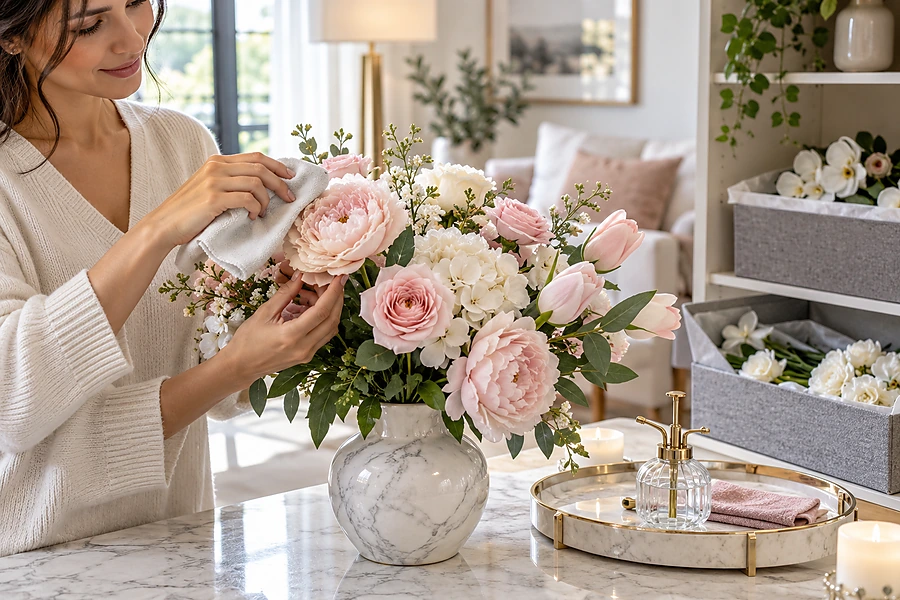
The safest cleaning method is to start dry: use a soft brush, microfiber cloth, feather duster, or cool low airflow. For deeper cleaning, use a slightly damp cloth only if the flower’s care instructions permit it. Avoid abrasive cleaners, strong chemicals, and aggressive rubbing that can damage soft coatings or color.
Start With the Gentlest Method
I would use this cleaning order:
- Soft brush
- Microfiber cloth
- Cool low airflow
- Slightly damp cloth if approved
- More thorough washing only when specifically allowed
This minimizes the risk of:
- Surface damage
- Color transfer
- Adhesive failure
- Petal distortion
Flovery currently recommends a soft brush or hair dryer on a cool setting and keeping faux flowers away from direct sunlight.
Use a Soft Brush for Detailed Flowers
A soft brush works especially well for:
- Peonies
- Roses
- Hydrangeas
- Orchids
- Ranunculus
because dust often settles between layered petals.
Use a clean:
- Makeup brush
- Artist brush
- Soft detailing brush
and work from the center outward.
Do not push the brush deeply into glued flower centers.
Use Cool Air for Loose Dust
A hair dryer on the cool setting can remove dust from flowers with many small surfaces.
The Real Touch manufacturer’s own maintenance guide recommends cold airflow for several material categories, including polyurethane and latex-coated textile products.
Keep the dryer:
- On low airflow
- At a reasonable distance
- Moving continuously
Do not use an industrial heat gun.
Real Touch’s care documentation warns that excessive heat can melt flower materials or adhesives.
Broad Petals Can Be Wiped
For broad:
- Calla lilies
- Tulips
- Large leaves
a soft cloth may be easier than a brush.
Wipe gently rather than scrubbing.
Prestige Botanicals currently recommends microfiber, feather dusting, or gentle wiping, with deeper cleaning depending on the product.
Clean Before Dirt Becomes Sticky
Light dust is easy to remove.
Dust mixed with:
- Cooking grease
- Hand oils
- Cosmetics
- Smoke
- Humidity
is harder.
This matters for flowers placed in:
- Restaurants
- Kitchens
- Hotel reception areas
- Event venues
A light routine is better than waiting for a heavy deep clean.
How Often Should You Clean Them?
There is no universal schedule.
For a normal home:
Every few weeks
- Inspect the flowers.
- Dust if visible.
For commercial displays:
Include them in routine housekeeping.
For rarely used seasonal arrangements:
Clean before storage and again after unpacking.
Cleaning Guide
| Condition | Best Starting Method |
|---|---|
| Light dust | Soft brush |
| Broad leaf dust | Microfiber cloth |
| Detailed flowers | Cool airflow |
| Small surface mark | Approved damp wipe |
| Heavy dirt | Check material instructions |
| Unknown material | Stay with dry cleaning |
| Sticky or damaged coating | Ask supplier before treatment |
Avoid Cleaning Sprays Unless Approved
A general household spray may contain:
- Alcohol
- Fragrance
- Solvents
- Oils
- Surfactants
that were never tested on the flower’s coating.
True Bloom currently recommends avoiding cleaning sprays on Real Touch stems and using light dry or damp cleaning instead.
When in doubt, simpler is safer.
Can Real Touch Flowers Get Wet?
Some can tolerate limited moisture, but others should not be soaked. The answer depends on the flower’s actual material and construction.
Do not assume every Real Touch flower is washable. Some manufacturers allow damp wiping or even washing for particular polymer materials, while other sellers advise keeping Real Touch stems out of water. If you do not know the exact material, use dry cleaning first and treat moisture as a product-specific option rather than a universal care method.
Why Online Advice Conflicts
You may see one care guide saying:
wipe with water
and another saying:
never get Real Touch flowers wet.
Both can reflect different product constructions.
Real Touch’s own technical care guide separates flowers according to material. It allows different cleaning approaches for polyurethane, PEVA, PVC, silicone, and latex-coated textile products.
Flovery, meanwhile, recommends cleaning without water for its own Real Touch flowers.
So the correct question is not:
Can Real Touch flowers get wet?
It is:
Can this exact Real Touch flower get wet?
Start by Identifying the Material
Ask the supplier:
- Are the petals PU?
- Latex-coated fabric?
- PEVA?
- PVC?
- Silicone?
- Another polymer?
Then ask for:
- Cleaning instructions
- Water restrictions
- Storage instructions
- Heat restrictions
This is especially important for wholesale purchases.
Damp Wiping Is Different From Soaking
A slightly damp cloth applies very little water.
Submerging the entire flower exposes:
- Petals
- Glue
- Stem joints
- Internal wire
- Leaves
to much more moisture.
These are not equivalent cleaning methods.
Internal Wire Can Be a Concern
Many artificial flowers contain metal wire inside:
- Stems
- Leaves
- Branches
Real Touch specifically warns that its flowers can contain internal metal wire.
That construction helps the flower hold shape, but it is another reason not to leave artificial stems soaking unnecessarily.
Avoid Putting Real Touch Flowers in Real Water for Display
A transparent vase filled with water may look realistic, but there is usually no practical reason to submerge artificial stems unless the supplier approves it.
Instead use:
- Opaque vase
- Dry clear vase
- Decorative stones
- Faux-water resin system
when appropriate.
What If the Flowers Are Heavily Soiled?
Do not jump directly to washing.
Try:
- Dry dust removal.
- Spot test on a hidden area.
- Slightly damp cloth if approved.
- Mild cleaning only if the supplier allows it.
- Air dry completely.
Prestige Botanicals permits mild soap cleaning for its own products when needed, but that guidance should not automatically be transferred to every Real Touch brand.
Test for Color Transfer
Highly saturated flowers may transfer pigment.
Real Touch’s storage guidance specifically warns that some dark shades can stain lighter flowers when stored together.
Before damp cleaning a:
- Burgundy rose
- Dark purple orchid
- Fuchsia hydrangea
test a hidden section with a white cloth.
If color transfers strongly, stop.
Water Decision Table
| Situation | Recommendation |
|---|---|
| Material unknown | Avoid washing |
| Light dust | Dry clean |
| PU flower | Follow supplier instructions |
| Latex-coated fabric | Use material-specific care |
| PVC | Some products may tolerate washing |
| Small stain | Spot test first |
| Vase display | Avoid unnecessary submersion |
| After damp cleaning | Dry fully before storage |
How Do You Keep Real Touch Flowers From Fading?
Light and heat are among the most important causes of premature color change in Real Touch flowers.
Keep Real Touch flowers away from prolonged direct sunlight, hot windows, heaters, fireplaces, and intense lamps. Indirect indoor light is usually the better display environment. White, pale, red, burgundy, pink, and purple flowers can show discoloration or color changes, so rotate displays and store unused flowers away from light.
Direct Sun Is the Main Placement Problem
A Real Touch arrangement may be artificial, but that does not mean the pigment is permanent.
Current care guidance from several suppliers recommends avoiding prolonged direct sunlight because it can:
- Fade color
- Yellow pale materials
- Change polymer surfaces
Flovery and True Bloom both currently recommend avoiding direct sun for long-term color protection.
White Flowers Deserve Extra Care
Real Touch’s manufacturer documentation specifically warns that:
- White
- Light pink
- Light blue
can be particularly vulnerable to yellowing over time.
That matters for:
- Wedding bouquets
- White orchids
- White roses
- Hotel arrangements
If an arrangement must remain bright white, avoid placing it permanently against a strong sunny window.
Dark Colors Can Transfer
Dark pigments create another problem.
The same manufacturer warns that saturated shades such as:
- Red
- Burgundy
- Dark pink
- Purple
can transfer color in storage under some conditions.
Store dark and pale flowers separately when the supplier recommends it.
Heat Can Damage More Than Color
Avoid placing Real Touch flowers:
- Above radiators
- Against heaters
- Directly beside fireplaces
- Under very hot lighting
The Real Touch technical guide specifically warns against open flame, heaters, and strong heat sources because flowers or adhesives may soften or melt.
Artificial Does Not Mean Fireproof
Keep arrangements away from:
- Candles
- Open fireplaces
- Flame-based event décor
unless the product has a specific fire-performance rating appropriate to the project.
Do not assume synthetic material is safe simply because it cannot wilt.
Rotate High-Value Arrangements
For commercial décor, consider rotating several arrangements rather than exposing one set continuously.
For example:
Arrangement A
- January–March
Arrangement B
- April–June
Arrangement C
- July–September
Arrangement D
- October–December
This reduces the total exposure of each arrangement to:
- Light
- Dust
- Handling
and helps seasonal décor feel intentional.
Protect Wedding Inventory Before the Event
Real Touch wedding flowers may be prepared weeks before a ceremony.
Store them:
- Away from windows
- Away from heat
- In clean boxes
- Without compression
Do not leave finished bridal bouquets displayed in a sunny showroom for months before the wedding.
Best Placement Guide
| Location | Care Rating |
|---|---|
| Interior dining table | Excellent |
| Shaded console | Excellent |
| Bedroom dresser | Excellent |
| Hotel reception away from window | Good |
| Bright indirect light | Usually good |
| Strong sunny windowsill | Poor |
| Beside heater | Poor |
| Beside open flame | Avoid |
How Should You Store Real Touch Flowers?
Storage should protect Real Touch flowers from light, dust, crushing, moisture, excessive heat, and color transfer.
Before storage, clean Real Touch flowers gently and make sure they are completely dry. Place them loosely in a box large enough to protect the petals without crushing them. Store the box in a cool, dry, dark location. Separate highly pigmented flowers from pale shades when the supplier warns about color transfer.
Clean Before Packing
Do not store dust with the flowers.
Dust left on a flower for months may combine with humidity or surface oils and become harder to remove later.
Before storage:
- Dust.
- Inspect.
- Repair loose parts where appropriate.
- Make sure the flowers are dry.
- Reshape lightly.
Then pack them.
Give Petals Enough Space
The biggest storage mistake is trying to fit too many flowers into one box.
Compression may create:
- Flat peonies
- Bent roses
- Crushed hydrangeas
- Creased leaves
- Damaged centers
Prestige Botanicals recommends loose wrapping and a box that does not crush the flowers.
Support Long Stems
For long-stem:
- Roses
- Orchids
- Calla lilies
- Delphiniums
use a container long enough to support the full stem.
Avoid sharp folds unless the product is specifically designed to bend that way.
Internal wire can usually be reshaped, but repeated severe bending may weaken the stem.
Protect Flower Heads From Pressure
Do not place:
- Books
- Heavy boxes
- Vases
on top of stored flowers.
The flower head is usually the most visually important and easily damaged section.
Separate Certain Colors
Real Touch’s own storage guide warns that some deeply pigmented colors may stain lighter flowers during storage.
For long-term inventory storage, I would separate:
Dark
- Burgundy
- Red
- Deep purple
from
Light
- White
- Ivory
- Pale blush
- Light blue
unless the supplier confirms they can safely remain in contact.
Keep Storage Cool and Dry
Avoid:
- Damp basement floors
- Hot attics
- Direct window light
- Boiler rooms
- Outdoor sheds with extreme heat
Better locations include:
- Interior storage closet
- Climate-controlled stockroom
- Dry shelving area
For commercial inventory, keep cartons raised off damp floors.
Label the Box
For wedding and wholesale stock, label boxes with:
- Flower type
- Color
- Material
- Quantity
- Purchase date
For example:
Real Touch Rose / Ivory / PU / 48 stems
This helps you use older inventory first and follow material-specific care.
How Do You Restore Squashed Real Touch Flowers?
This is another area where material matters.
Real Touch’s manufacturer guide gives different reshaping recommendations:
- Some textile-based roses and peonies can be reshaped with brief steam.
- PU flowers may also respond to controlled steam.
- PEVA flowers may respond to low or medium hair-dryer heat.
- Some PVC blooms may recover after standing in a warm room.
Do not apply that process blindly.
Too much heat can:
- Warp petals
- Melt polymer
- Weaken glue
Start Without Heat
When unpacking stored flowers:
- Remove packaging.
- Allow them to reach room temperature.
- Open petals with clean hands.
- Bend wired stems gently.
- Let them rest.
Only move to heat or steam if the manufacturer recommends it for that material.
Storage Checklist
| Storage Factor | Best Practice |
|---|---|
| Dust | Clean before packing |
| Moisture | Store completely dry |
| Light | Keep dark |
| Temperature | Cool and stable |
| Petal pressure | Avoid crushing |
| Long stems | Support full length |
| Dark colors | Separate when needed |
| Heavy boxes | Never stack on flowers |
| Reshaping | Follow material instructions |
| Inventory | Label by material/color |
My Insights: How to Care for Real Touch Flowers
The best Real Touch care routine is simple because most damage comes from overhandling, excessive light, heat, moisture, and poor storage rather than from normal indoor use.
To care for Real Touch flowers, start with gentle dry dusting, limit direct sunlight, avoid unnecessary heat and water, handle petals with clean hands, and store flowers loosely in a cool, dry place. Most importantly, identify the actual material first because PU, PEVA, PVC, silicone, and latex-coated flowers can require different cleaning and reshaping methods.
My First Insight: Material Comes Before Method
This is the most important rule.
Do not start by asking:
How do I clean Real Touch flowers?
Start with:
What material are these Real Touch flowers made from?
That single answer can determine whether you should use:
- Dry cloth
- Damp cloth
- Cool air
- Controlled steam
- Another approved method
My Second Insight: Start Dry Every Time
When the material is unknown, dry cleaning creates the lowest risk.
My preferred sequence is:
soft brush → cool air → dry cloth → approved moisture
This avoids introducing water unnecessarily.
My Third Insight: Sun Protection Creates More Value Than Frequent Cleaning
People often focus on cleaning products.
But keeping flowers away from intense direct sun may have a bigger effect on long-term appearance.
Current manufacturer guidance specifically warns about:
- Yellowing of white flowers
- Color changes
- Prolonged window exposure
Placement is part of maintenance.
My Fourth Insight: Do Not Overclean Real Touch Surfaces
Artificial flowers do not need aggressive weekly washing.
Every time you:
- Rub a coating
- Bend a petal
- Wet glue joints
- Apply cleaner
you introduce some mechanical or chemical stress.
Clean enough to remove dust.
Do not treat the flowers like washable household fabric unless the product is designed for it.
My Fifth Insight: Close-View Flowers Deserve More Care
Real Touch materials create the most value in:
- Bridal bouquets
- Dining arrangements
- Reception desks
- Coffee-table flowers
because people see them closely.
These are also the arrangements where:
- Fingerprints
- Dust
- Petal damage
are easiest to notice.
Inspect them more often.
My Sixth Insight: Wedding Bouquets Should Be Stored Like Keepsakes
A Real Touch bridal bouquet may become a long-term memorial item.
After the wedding:
- Dust it gently.
- Make sure it is dry.
- Support the bouquet shape.
- Protect it from crushing.
- Store it away from light and heat.
Do not simply push it into a small plastic bin.
My Seventh Insight: Commercial Buyers Need Material Labels
Hotels, florists, rental companies, and wholesalers may own hundreds of artificial stems.
Without material identification, staff can easily use the wrong cleaning method.
I would label inventory by:
species + color + material + cleaning method
For example:
Rose / Burgundy / Latex-Coated Textile / Dry Clean
This turns flower care into a repeatable system.
My Eighth Insight: Color Transfer Should Be Part of Storage Planning
Dark and light artificial flowers are often stored together because that saves space.
But Real Touch’s own documentation warns that some saturated colors may stain nearby pale flowers.
For bulk storage, separate high-risk colors.
My Ninth Insight: Heat Is a Tool Only When the Supplier Says So
Steam and warm airflow can restore some crushed flowers.
They can destroy others.
The same manufacturer’s care guide gives several different reshaping methods depending on polymer type.
Therefore, do not make “steam every artificial flower” your standard procedure.
My Tenth Insight: Replace Individual Stems Instead of Whole Arrangements
Real Touch arrangements do not always age uniformly.
One stem may:
- Fade
- Tear
- Become sticky
- Lose shape
while ten others remain excellent.
Replace that stem.
This is particularly useful for:
- Hotels
- Event rentals
- Permanent floral décor
where the arrangement may have substantial total value.
My Recommended Care Routine
| Frequency | Task |
|---|---|
| Weekly/when visible | Check for dust |
| Every few weeks | Gentle dusting |
| After handling/event | Inspect petals and stems |
| Before storage | Clean and dry |
| During storage | Keep dark, cool, pressure-free |
| Before reuse | Reshape gently |
| When color changes | Move/replace affected stem |
| When heavily soiled | Use material-specific method |
My Five Rules for Everyday Care
If you want the shortest possible care routine, remember:
- Dust gently.
- Keep out of prolonged direct sun.
- Avoid heaters and flames.
- Do not soak unless the exact product allows it.
- Store without crushing.
Those five rules prevent most avoidable damage.
My Buying Advice
Good care actually starts before purchase.
Ask the supplier:
- What are the petals made from?
- Can they be wiped with water?
- Can they be washed?
- Can they be steamed?
- Are they sensitive to heat?
- Do dark colors transfer?
- Are they intended for permanent sun exposure?
- What storage method is recommended?
A supplier who can answer those questions gives you much more useful information than one who only says:
Premium Real Touch.
My Final Answer
Real Touch flowers are easy to maintain, but the best method depends on what they are made from.
For routine care:
dust them gently, protect them from direct sunlight and strong heat, avoid unnecessary moisture, handle them carefully, and store them without pressure.
When deeper cleaning or reshaping is required, identify the material first.
That matters because one Real Touch flower may be:
- PU
- PEVA
- PVC
- Silicone
- Latex-coated textile
and those materials do not always respond to water or heat in the same way.
The safest principle is simple:
Use the gentlest effective care method, then increase cleaning or reshaping intensity only when the manufacturer’s instructions support it.
Conclusion
Care for Real Touch flowers with gentle dusting, low sun exposure, careful handling, dry storage, and material-specific cleaning. Avoid assuming every Real Touch flower tolerates water or heat.