
Artificial plants can look nearly identical online, yet material, texture, durability, cleaning needs, and price can be very different once you see them in person.
Real Touch plants usually use molded PE, polyurethane, soft polymer coatings, or similar materials to create three-dimensional leaves with a lifelike feel. Modern “silk” plants are usually polyester fabric rather than genuine silk. Real Touch is generally stronger for close-up realism, while silk excels at soft, lightweight foliage, delicate flowers, flexibility, and lower-cost large displays.
Neither type is automatically better. The smartest choice depends on viewing distance, plant species, budget, sunlight, cleaning access, expected lifespan, and whether people will actually touch the foliage.
What Is the Difference Between Real Touch and Silk Plants?
The biggest differences are construction and tactile realism. Real Touch usually emphasizes molded detail and surface feel, while silk plants rely more heavily on thin printed fabric.
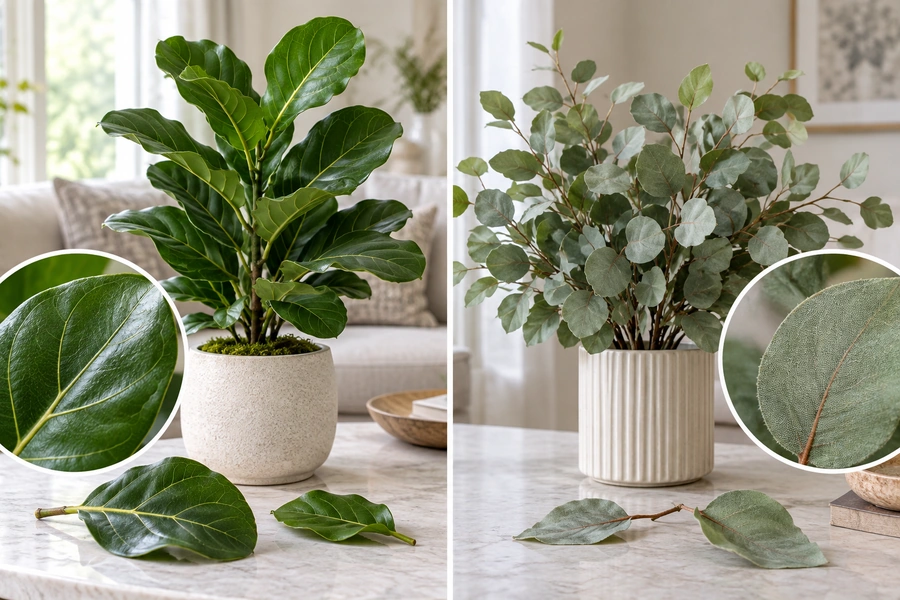
Real Touch artificial plants typically use polyethylene, polyurethane, or polymer-coated materials to reproduce leaf thickness, veins, curves, and natural softness. Silk plants usually use woven polyester fabric that is cut, printed, and shaped into leaves or petals. Real Touch is stronger for close inspection; silk is lighter, softer, and often better for delicate foliage and high-volume decoration.
Modern Silk Plants Usually Are Not Made From Silk
This is the first buying misconception to correct.
The word silk is largely a legacy trade term.
Modern silk plants commonly use:
- Polyester
- Synthetic textile blends
- Plastic stems
- Internal wire
- Molded plastic components
TidyPlant’s 2026 material guide describes polyester foliage as cut and printed fabric rather than molded three-dimensional leaves. Leaf’s current 2026 comparison makes the same distinction, noting that modern “silk” artificial plants are usually polyester rather than genuine silk.
So when a listing says:
Premium silk ficus
do not automatically assume natural silk fiber is involved.
Check the specification.
What Does Real Touch Mean?
Real Touch is less straightforward.
Current suppliers use the term for foliage designed to reproduce not only how a living plant looks but also how it feels.
Materials may include:
- PE
- PU
- Latex-like coatings
- Other soft polymers
- Polymer-coated fabric
TidyPlant describes real-touch as commonly involving polyurethane applied over a base material to give leaves a subtle yielding, matte, waxy feel. Other current suppliers describe real-touch plants more broadly as high-quality plastics with soft rubber- or latex-style surfaces.
This means Real Touch is not a guarantee of one exact material formula.
Two artificial plants can both say “Real Touch” and still feel very different.
Molded Leaves vs Fabric Leaves
This difference affects appearance immediately.
Real Touch / Molded PE or PU
Can reproduce:
- Raised veins
- Leaf thickness
- Curved edges
- Natural wrinkles
- Three-dimensional surfaces
Silk / Polyester
Can reproduce:
- Fine printed veins
- Soft movement
- Thin leaf edges
- Lightweight flowers
- Delicate foliage
TidyPlant notes that polyester works particularly well for plants where thinness and drape are botanically appropriate, including fine foliage, while molded PE is stronger for substantial leaves where three-dimensional shape matters.
Real Touch Is Usually Better to Touch
That sounds obvious, but it has a practical implication.
Imagine an artificial plant placed:
- On a desk
- Beside a sofa
- On a dining table
- At a reception counter
People may touch it.
Real Touch can provide more value there because the material is designed to survive close visual and tactile inspection.
A silk leaf may still look excellent.
But when someone touches it, the fabric construction may become obvious.
Silk Plants Can Look Better for Fine Foliage
Real Touch is not automatically more realistic for every species.
Consider a fern.
Real fern foliage is:
- Fine
- Lightweight
- Thin
- Flexible
A thick molded leaf may actually make it look less realistic.
Polyester can therefore be a good choice for:
- Ferns
- Grasses
- Blossom
- Delicate vines
- Fine flowering branches
TidyPlant specifically argues that fabric earns its place for fine and feathered foliage because its lightness is botanically appropriate.
Real Touch vs Silk: Core Comparison
| Feature | Real Touch | Silk / Polyester |
|---|---|---|
| Typical material | PE, PU, polymer coating | Polyester fabric |
| Surface detail | Often 3D molded | Usually printed/cut |
| Touch realism | Higher | More fabric-like |
| Weight | Usually heavier | Usually lighter |
| Best viewing distance | Close to medium | Medium to far |
| Delicate foliage | Good | Often excellent |
| Thick waxy leaves | Excellent | Less convincing |
| Price | Usually higher | Usually lower |
| Large installations | More expensive | Very practical |
| Cleaning | Often easier if molded | Can require gentler care |
| Outdoor use | Only if specifically rated | Usually indoor-oriented |
The material should match the species and the job.
Which Artificial Plants Look the Most Realistic?
Real Touch materials usually have an advantage at close range, but the most realistic artificial plant is the one whose construction matches the real species.
Real Touch plants generally look most convincing when reproducing thick or structured leaves such as monstera, rubber plant, fiddle-leaf fig, snake plant, succulents, agave, and some tropical foliage. Premium silk can look extremely realistic for ferns, grasses, blossom, flowers, and thin foliage because fabric creates natural movement and delicate edges.
Realism Is More Than Material
Architectural Digest’s current artificial-plant recommendations emphasize that not all fake plants are created equal and highlight factors such as color variation, realistic shapes, and better containers.
I would evaluate realism through six areas:
- Material
- Color
- Leaf geometry
- Branching
- Trunk
- Planter
A great leaf attached to a cheap plastic trunk still looks fake.
Best Real Touch Candidates
Real Touch works especially well for plants with visually substantial leaves.
Examples include:
Monstera
Look for:
- Natural fenestrations
- Several leaf sizes
- Raised veins
- Flexible stems
- Slightly uneven green tones
A flat polyester monstera leaf can reveal itself quickly at close range.
Rubber Plant
Real rubber-plant leaves already have:
- Thickness
- Some sheen
- Smooth surfaces
That makes molded PE or PU a natural fit.
Fiddle-Leaf Fig
The real plant has:
- Large leaves
- Pronounced veining
- Strong curvature
Those features benefit from three-dimensional molding.
Snake Plant
Snake plants are another good candidate because real leaves are:
- Upright
- Thick
- Structured
- Slightly waxy
High-quality molded material can reproduce these characteristics effectively.
Succulents and Agave
These may be among the strongest applications for PU and molded polymers.
Real succulent tissue is:
- Fleshy
- Thick
- Structured
A fabric succulent leaf can feel visually wrong even from a distance.
Where Silk Often Wins
Silk-style polyester can outperform Real Touch where the real botanical form is naturally light.
Examples include:
- Ferns
- Fine eucalyptus
- Flower blossom
- Grasses
- Delicate trailing vines
The fabric can move more naturally and avoid looking excessively thick.
Realism Depends on Color Variation
Nature rarely uses one green.
A good artificial plant may include:
- Dark mature leaves
- Pale new-growth tones
- Lighter undersides
- Slight yellow-green variation
- Subtle brown on stems
TidyPlant’s current realism guide emphasizes color variation and surface texture as major differences between convincing artificial plants and inexpensive ones.
Avoid Perfect Symmetry
One common fake-plant giveaway is manufacturing repetition.
If every branch:
- Has the same number of leaves
- Faces the same direction
- Sits at the same angle
the plant looks artificial.
After unpacking:
- Spread branches.
- Rotate leaves.
- Bend some stems.
- Create open spaces.
- Keep one side slightly fuller.
Real plants grow irregularly.
Faux plants should imitate that logic.
The Planter Can Change the Result Dramatically
Architectural Digest specifically recommends good vessels as a way to improve the visual quality of faux plants.
Avoid displaying a 6-foot tree permanently in a:
- Tiny black transport pot
- Visible foam block
- Cheap plastic nursery container
Instead use:
- Terracotta
- Ceramic
- Stoneware
- Woven basket
- Concrete-look planter
Then cover the visible base.
Viewing Distance Changes What You Should Buy
For a plant seen from 18 inches away, material detail matters heavily.
TidyPlant’s current desk-and-shelf guide recommends matte PE or real-touch material for close-view artificial plants because surface construction is easily visible at that distance.
For a tree across a hotel lobby, priorities change.
You may care more about:
- Overall silhouette
- Canopy size
- Height
- Trunk realism
than whether every leaf feels natural.
Buying by Viewing Distance
| Viewing Distance | Spend Money On |
|---|---|
| Under 2 ft | Real Touch texture and detail |
| 2–6 ft | Color + leaf shape |
| 6–15 ft | Canopy and trunk |
| High shelf | Silhouette and drape |
| Large lobby | Scale and architecture |
| Event backdrop | Overall density and color |
This can save money.
Not every artificial plant needs premium tactile material.
Are Real Touch Plants Worth the Higher Price?
Real Touch plants are usually worth paying more for when people will view or handle them closely. The premium provides less value in distant or high-volume installations.
Real Touch plants are worth the higher price for desks, reception areas, bridal or event focal pieces, luxury hospitality, premium retail, and other close-view locations. Silk plants usually provide better value for large arrangements, high shelves, background greenery, seasonal displays, and projects where quantity matters more than tactile realism.
What Are You Paying For?
The price difference can come from:
- More detailed molds
- More expensive polymers
- Multi-tone coloring
- Hand finishing
- Better stems
- Better trunks
- More complex assembly
- Natural-looking surface treatments
Real Touch is not expensive simply because a seller attached a luxury word to the product.
High-quality versions genuinely require more detailed manufacturing.
But not every item labeled Real Touch justifies a premium.
Buy Real Touch for Close-View Locations
I would prioritize it for:
- Reception desks
- Executive offices
- Coffee tables
- Dining tables
- Retail counters
- Wedding bouquets
- Premium hotel suites
These are locations where guests can see:
- Leaf edges
- Surface texture
- Seams
- Color transitions
and may touch the plant.
Silk Is Often Better for Volume
Suppose a wedding requires:
- 100 hydrangea stems
- 200 eucalyptus stems
- Large arch
- Ceiling flowers
- Backdrop
Using premium Real Touch for every stem may add cost without creating proportional visual improvement.
A stronger strategy may be:
Real Touch
- Focal flowers
- Close-view bouquets
Premium silk
- Filler
- High-volume background flowers
- Hanging décor
The same principle applies to plants.
Hybrid Construction Is Often the Best Value
Current artificial-plant material guidance describes premium compositions that deliberately combine materials instead of insisting every component use the same technology.
For example, a large artificial tree might use:
- PE primary leaves
- Polyester fine foliage
- Real-touch coating at eye level
- Real wood trunk
- Wired branches
That can be smarter than coating every interior leaf with an expensive tactile finish nobody will touch.
Cost Should Match Viewing Distance
A useful rule:
Closer = spend more on material realism
Farther away = spend more on silhouette and scale
For example:
Desk
Prioritize:
- PU/PE
- Fine veins
- Matte finish
Lobby
Prioritize:
- Height
- Canopy
- Trunk
- Planter
Ceiling
Prioritize:
- Color
- Density
- Lightweight construction
Real Touch Is Not Automatically Better Outdoors
This is an important buying mistake.
Soft Real Touch materials can be excellent indoors but are not automatically designed for:
- Full sun
- Rain
- Extreme heat
Current 2026 material comparisons generally treat polyester “silk” as indoor-oriented and note that exterior greenery needs an explicit UV-resistant or UV-stabilized specification.
For outdoor projects, buy according to:
UV performance first
not:
touch realism first.
Is Silk Still Worth Buying?
Yes.
Silk-style polyester offers several real advantages:
- Lightweight
- Easy to shape
- Broad species selection
- Excellent for delicate foliage
- Lower price
- Efficient shipping
- Practical for large projects
It is not simply the “cheap version” of Real Touch.
It is a different material tool.
Quick Buying Decision
| Situation | Better Starting Choice |
|---|---|
| Desk | Real Touch |
| Reception counter | Real Touch |
| Close-view luxury room | Real Touch |
| Bridal bouquet | Real Touch/hybrid |
| High shelf | Silk |
| Fern | Premium silk |
| Large arch | Silk/hybrid |
| Green wall | PE/hybrid |
| Hotel lobby tree | PE/Real Touch hybrid |
| Full outdoor exposure | UV-rated polymer |
| Budget bulk project | Silk |
| Premium close display | Real Touch |
Do Real Touch Plants Last Longer Than Silk Plants?
There is no universal lifespan guarantee. Material quality, sunlight, touching, dust, humidity, and cleaning often matter more than the marketing category alone.
Real Touch or molded PE plants can be more durable than silk plants in high-touch locations because molded foliage resists fraying and can often be cleaned more easily. Silk plants can still last many years indoors when protected from direct sun and handling. Outdoors, neither label is sufficient—choose a product specifically manufactured and tested for UV exposure.
Silk Has Two Common Aging Problems
Polyester foliage tends to age through:
- UV fading
- Edge fraying
Eververda’s current material and lifespan guides identify fabric foliage as more vulnerable to sunlight and repeated handling than molded PE.
A silk tree placed in a:
- Quiet bedroom
- Shaded corner
may last many years.
The same tree placed:
- Beside a busy restaurant table
- Against a sunny window
will age faster.
Molded PE Handles Touch Better
PE leaves are generally:
- Thicker
- Wipeable
- More resistant to fraying
- Better at holding shape
That makes them useful in:
- Hallways
- Offices
- Hotels
- Households with children
- High-traffic interiors
Eververda’s 2026 lifespan comparison specifically favors PE over silk when sunlight or repeated contact is involved.
Real Touch Coatings Can Have Their Own Weaknesses
Soft-touch material is not indestructible.
Depending on formulation, it may react poorly to:
- Strong heat
- Intense sunlight
- High humidity
- Harsh chemicals
Prestige Botanicals recommends protecting Real Touch-style products from prolonged direct sunlight, high humidity, and abrasive cleaning.
So the more sophisticated material is not automatically the more rugged material in every environment.
Dust Affects Both
Both silk and Real Touch plants collect dust.
The cleaning method may differ.
For molded leaves:
- Microfiber wiping can be easy.
For fine polyester foliage:
- Soft brushing or gentle dusting may be safer.
This is another reason to consider the plant species.
A large rubber plant has fewer broad surfaces.
A fern may contain hundreds of small leaves.
Sunlight Shortens Lifespan
Current published artificial-plant lifespan estimates vary widely, and most are seller or manufacturer claims rather than standardized independent durability data.
Eververda summarizes current industry guidance as roughly 7–10+ years indoors for well-protected artificial greenery, while outdoor exposure shortens service life substantially depending on UV stabilization and climate. It explicitly treats those numbers as directional rather than warranties.
That is the right way to interpret lifespan claims.
Do not buy based only on:
Lasts 10 years.
Ask:
- Indoors or outdoors?
- Direct sunlight?
- What material?
- What UV treatment?
- What test?
- What warranty?
Outdoor Plants Need UV Protection
Pacific Silkscapes notes that outdoor artificial foliage performance depends heavily on UV protection and direct sunlight exposure. Its supplier information cites up to five years of color consistency for some UV-stabilized exterior products in high-sun U.S. regions, but this is product-specific supplier guidance, not a universal artificial-plant guarantee.
That means neither:
silk
nor
Real Touch
is an outdoor specification by itself.
Look for:
- UV resistant
- UV stabilized
- Outdoor rated
and ask where the protection is applied.
Maintenance Comparison
| Care Factor | Real Touch / Molded | Silk / Polyester |
|---|---|---|
| Dusting | Easy to moderate | Moderate |
| Damp wiping | Often possible, product-dependent | More caution |
| Edge fraying | Low | Higher risk |
| Direct sun | Avoid unless rated | Avoid |
| Repeated touching | Better | Less ideal |
| Crushing | Can deform | Can crease |
| High humidity | Product-dependent | Not ideal |
| Outdoor use | Only if rated | Usually poor unless designed for it |
My Insights: Real Touch vs Silk Plants-Key Differences & Buying Guide
The best buying decision is rarely “Real Touch always wins.” The stronger approach is to match material quality to plant biology, viewing distance, use, and environment.
Choose Real Touch when close-up texture, molded leaf detail, and premium realism matter. Choose silk when the plant needs thin foliage, natural drape, lightweight construction, large volume, or tighter cost control. For many premium projects, the best answer is a hybrid: molded PE or Real Touch for focal foliage and polyester for delicate or background greenery.
My First Insight: Read the Material Line, Not the Product Name
This is the biggest buying rule.
“Silk” can mean polyester.
“Real Touch” can mean:
- PE
- PU
- Polymer coating
- Several mixed materials
Current 2026 material guides repeatedly show that these retail terms do not tell the full technical story.
Before buying premium artificial plants, ask:
What are the leaves actually made from?
My Second Insight: Real Touch Makes the Most Sense Within Arm’s Reach
Pay for tactile realism when people can appreciate it.
Strong locations include:
- Desk
- Dining table
- Reception counter
- Coffee table
A Real Touch finish six meters above a hotel lobby floor provides much less value.
My Third Insight: Silk Can Be More Botanically Correct
A thick polymer is not always more realistic.
For:
- Fern
- Grass
- Fine blossom
thin polyester may move and fold more naturally.
This is why material should follow botanical form.
My Fourth Insight: A Great Faux Plant Often Mixes Materials
The most convincing artificial tree may contain:
- PE leaves
- Polyester fine foliage
- PU coating
- Wire
- Natural wood trunk
It does not need a single material throughout.
In fact, mixed construction can produce better realism when each material is used where it performs best.
My Fifth Insight: Check the Trunk Before Paying a Premium
Many buyers focus only on leaves.
For a large artificial tree, the trunk occupies a huge part of what the eye sees.
Check for:
- Real wood
- Realistic bark texture
- Natural branching
- Visible seams
- Plastic shine
A $600 premium foliage tree can still look inexpensive if the trunk looks like a molded pole.
My Sixth Insight: Realism Has Five Buying Levels
I would inspect artificial greenery in this order:
- Silhouette
- Color
- Leaf shape
- Trunk/stem
- Surface touch
Surface feel comes last because a plant can fail visually before anyone touches it.
My Seventh Insight: Buy Samples for Commercial Projects
For:
- Hotels
- Restaurants
- Retail chains
- Wholesale
- Event inventory
do not approve from photographs alone.
Order samples and check them:
At 30 cm
- Surface
- Veins
- Edges
At 2 meters
- Color
- Branching
Across a room
- Silhouette
- Scale
Then touch and clean the sample.
My Eighth Insight: Photograph the Sample
A faux plant can look different under:
- Daylight
- Warm LEDs
- Cool LEDs
- Camera flash
Photograph it before bulk ordering.
Look for:
- Excess shine
- Flat green
- Visible fabric weave
- Repeated leaf shapes
This is particularly important for:
- Weddings
- Hotels
- Social-media interiors
My Ninth Insight: Outdoor Buying Is a Separate Decision
Do not ask:
Real Touch or silk for outdoors?
Ask:
Which product has documented outdoor and UV performance?
A premium soft-touch indoor plant may deteriorate faster outdoors than a less tactile PE product designed specifically for exterior exposure.
My Tenth Insight: Spend According to Visibility
My preferred strategy is:
Close view
- Premium Real Touch
Mid-distance
- Molded PE or high-quality silk
Long-distance
- Good silhouette and color
Large installation
- Hybrid materials
Outdoor
- UV-rated polymer
This avoids overspending on material detail where nobody can see or feel it.
Real Touch vs Silk Buying Scorecard
| Buying Factor | Real Touch | Silk |
|---|---|---|
| Close visual realism | ★★★★★ | ★★★★ |
| Touch realism | ★★★★★ | ★★ |
| Fine foliage | ★★★ | ★★★★★ |
| Natural drape | ★★★ | ★★★★★ |
| Lightweight construction | ★★★ | ★★★★★ |
| High-volume affordability | ★★ | ★★★★★ |
| Easy broad-leaf cleaning | ★★★★★ | ★★★ |
| High-touch durability | ★★★★ | ★★★ |
| Indoor decorative use | ★★★★★ | ★★★★★ |
| Outdoor suitability | Product-specific | Usually limited |
| Premium positioning | ★★★★★ | ★★★ |
| Bulk event use | ★★★ | ★★★★★ |
My Buying Checklist
Before purchasing either type, check:
- Actual leaf material
- Whether “silk” means polyester
- Whether Real Touch is PE, PU, or coating
- Leaf color variation
- Visible seams
- Surface shine
- Leaf-edge quality
- Branch adjustability
- Trunk material
- Planter quality
- Cleaning instructions
- Indoor/outdoor rating
- UV treatment
- Viewing distance
- Sample quality before bulk purchase
My Recommended Choice by Project
| Project | Recommended Choice |
|---|---|
| Luxury home | Real Touch / hybrid |
| Desk plant | Real Touch |
| Hotel reception | Real Touch / molded PE |
| Hotel lobby tree | Hybrid |
| Restaurant ceiling | Silk |
| Wedding bouquet | Real Touch / hybrid |
| Wedding arch | Silk / hybrid |
| Fine artificial fern | Silk |
| Monstera | PE / Real Touch |
| Succulent | PU / Real Touch |
| Large wholesale project | Silk / mixed |
| Outdoor project | UV-rated PE/polymer |
My Final Answer
When comparing Real Touch vs Silk Plants, do not treat Real Touch as automatically premium and silk as automatically cheap.
They solve different problems.
Choose Real Touch when you need:
- Close-up realism
- Natural tactile feel
- Thick or structured leaves
- Premium presentation
- High-visibility focal greenery
Choose silk/polyester when you need:
- Fine foliage
- Soft movement
- Delicate flowers
- Low weight
- Large quantities
- Better cost control
And use a hybrid when you need both.
The most important buying question is not:
Is this Real Touch or silk?
It is:
What material is being used, why is it appropriate for this plant species, and how closely will people see or touch it?
That question leads to a much better purchase.
Conclusion
Real Touch provides stronger tactile realism; silk offers softness, drape, variety, and value. Check actual materials, viewing distance, UV exposure, and plant type before deciding.