
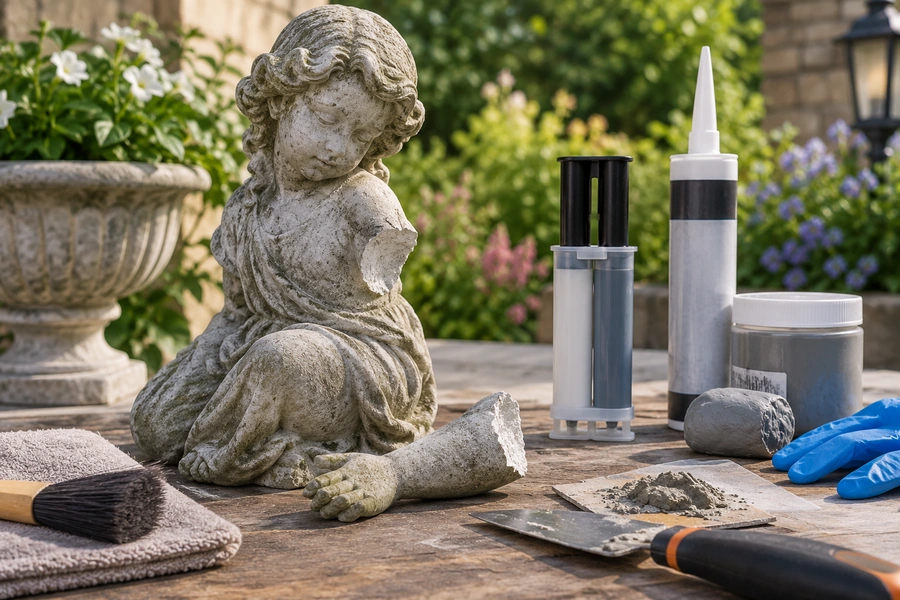
A broken concrete statue is heavy and porous, so ordinary household glue can fail when the repaired joint faces rain, temperature changes, and the weight of the ornament.
For most broken concrete statues, a two-part structural epoxy made for concrete or masonry is the best starting choice because it creates a strong, rigid bond between clean concrete surfaces. Exterior polyurethane or polymer construction adhesive is useful when some flexibility, moisture tolerance, or gap filling is needed. Epoxy putty works well for rebuilding missing chips.
The right adhesive depends on whether you are reattaching a clean break, filling missing concrete, repairing a crack, bonding the statue to another material, or fixing a piece that will remain permanently outdoors.
What Glue Works Best on Concrete Statues?
For a clean break where two concrete pieces still fit together closely, a two-part concrete epoxy is usually the strongest and most predictable adhesive choice.
Use a two-component epoxy specifically rated for concrete, masonry, or structural bonding when reattaching a broken arm, head, wing, base, or other rigid section of a concrete statue. Products designed for concrete repair offer high bond strength and can fill small irregularities between broken surfaces. Avoid ordinary craft glue, hot glue, or indoor-only adhesives.
Why Two-Part Epoxy Works Well
Epoxy consists of two components:
resin + hardener
When properly mixed, they react and cure into a strong rigid material.
That makes epoxy useful for concrete because the adhesive can bond to the porous surface while filling small imperfections between two broken faces.
QUIKRETE describes its Epoxy Concrete Repair as a high-strength, rapid-curing, two-component adhesive intended for bonding and repairing concrete, brick, stucco, stone, concrete block, and related materials. Its non-sag formulation also makes it suitable for vertical repairs.
Sika similarly offers two-part structural epoxy products designed to bond concrete elements and other construction materials. Current Sikadur-32+ specifications describe high initial and final mechanical strength, very good adhesion, and suitability for dry or matt-damp concrete.
For a broken garden statue, those characteristics are usually more relevant than simply buying the glue with the fastest curing time.
Best for Clean Breaks
Imagine a concrete angel whose wing has snapped off.
If the two broken surfaces:
fit together closely, remain structurally sound, and contain enough surface area for bonding, a thick two-part concrete epoxy is a strong choice.
The same principle applies to broken:
| Broken Part | Suitable Starting Adhesive |
|---|---|
| Statue head | Two-part concrete epoxy |
| Arm | Two-part structural epoxy |
| Wing | Epoxy, possibly with reinforcement |
| Small decorative piece | Epoxy |
| Base section | Structural epoxy |
| Large clean break | Structural epoxy + mechanical support if needed |
For particularly large or heavy components, adhesive alone may not be enough. Pins, dowels, threaded rod, or another engineered mechanical connection may be appropriate.
When Epoxy Putty Is Better
A perfect break is easy to imagine.
Real statues often lose material.
You may have:
a chipped nose, missing corner, damaged ear, eroded edge, or gap where the broken pieces no longer meet.
A moldable concrete-repair epoxy putty can be more useful here because it can both bond and rebuild missing volume.
For example, current statuary-specific repair products use epoxy putty for concrete fountains and garden ornaments where chips, missing corners, and larger voids need to be reconstructed.
The distinction is useful:
Epoxy adhesive: primarily joins pieces.
Epoxy putty: joins while also rebuilding shape.
What About Concrete Bonding Adhesive?
Products called concrete bonding adhesive are not always intended to glue two broken statue pieces together.
Some are designed to improve the bond between:
old concrete and new cementitious mortar or concrete.
That can be useful when rebuilding a damaged area with a cement-based repair compound.
It is different from reattaching a broken statue head with structural epoxy.
Always read the stated application rather than relying only on the word bonding.
Avoid General-Purpose Indoor Glues
I would not rely on ordinary:
PVA wood glue, craft adhesive, hot-melt glue, or basic super glue
for a large outdoor concrete repair.
The joint must tolerate a porous substrate, statue weight, moisture, and temperature changes.
Use a product whose technical instructions explicitly include:
concrete, masonry, stone, or cement-based materials.
Is Epoxy or Polyurethane Better for Concrete Statues?
Epoxy is generally better for rigid structural bonding, while polyurethane or flexible polymer construction adhesive can be better when a repair needs moisture tolerance, gap filling, or limited movement.
Choose epoxy for a strong, rigid concrete-to-concrete repair where the pieces fit well and movement should be minimal. Choose an exterior polyurethane or compatible polymer construction adhesive when the joint is somewhat irregular, the substrate may be damp, or small thermal movements need to be tolerated. Neither chemistry is universally best for every statue repair.
Epoxy: Best for Rigid Repairs
Concrete Network’s guidance on concrete crack repair makes the basic chemistry distinction clear: when a crack requires structural repair and the goal is restoring strength, epoxy is generally favored; polyurethane is more commonly used where flexibility or stopping active water is the priority.
A statue is not a building foundation, but the principle still helps.
When reattaching a rigid broken piece, you normally do not want the joint moving independently.
That favors epoxy.
Polyurethane: Useful for Outdoor and Irregular Bonds
Polyurethane construction adhesives can be very strong while remaining somewhat more accommodating than rigid epoxy.
Loctite’s current PL Premium specifications list bonding to concrete, stone, masonry, brick, metal, wood, and many other construction materials. The manufacturer also states that it is intended for interior and exterior applications and can be applied to wet or frozen surfaces according to its instructions.
That makes polyurethane particularly useful when a project involves:
concrete-to-stone, concrete-to-wood, concrete-to-metal, or a joint with small irregular gaps.
Advanced Polymer Adhesives Are Another Option
Not every construction adhesive is polyurethane.
QUIKRETE currently offers an Advanced Polymer Construction Adhesive specifically described for permanently bonding concrete, masonry, brick, stone, wood, plastic, and other substrates, including the repair of broken concrete.
This is a reminder that product rating matters more than chemistry name alone.
A product explicitly approved for exterior concrete repair may be a better choice than an unspecified epoxy bought simply because it says “extra strong.”
Polyurethane Concrete Repair Products Also Exist
3M’s Scotch-Weld Concrete Repair DP600 is a two-component polyurethane product designed for cracks, spalls, and breaks in concrete, masonry, and stone.
So the simple statement:
Epoxy is strong and polyurethane is weak.
would be inaccurate.
Both chemistry families can produce high-performance repair products.
The real question is:
What repair was this specific adhesive engineered to perform?
Epoxy vs Polyurethane Comparison
| Factor | Two-Part Epoxy | Polyurethane / Flexible Polymer |
|---|---|---|
| Rigid concrete-to-concrete bond | Excellent | Very good |
| Structural repair | Strong choice | Product-dependent |
| Gap filling | Good with thick formulations | Often good |
| Flexibility | Low | Higher |
| Damp surfaces | Product-dependent | Often more tolerant |
| Outdoor use | Excellent if rated | Excellent if rated |
| Mixed materials | Good | Often excellent |
| Vertical repair | Use non-sag grade | Thick construction adhesive works well |
| Missing chips | Epoxy putty preferred | Less suited to sculpting |
| Fine visible seam | Can work very well | May remain more flexible |
My Selection Rule
For a clean broken concrete statue, I would normally start by looking for:
two-part, non-sag, exterior-rated concrete epoxy.
For attaching the statue to a:
wooden base, masonry pedestal, stone surface, or another dissimilar material,
I would also investigate a compatible exterior polyurethane or advanced polymer construction adhesive.
How Do You Glue a Broken Concrete Statue Back Together?
Adhesive strength depends heavily on surface preparation. Strong epoxy applied over dust, loose concrete, paint, algae, or unstable material can still fail.
To glue a broken concrete statue, remove loose material, clean both broken surfaces, confirm that the pieces fit correctly, let the substrate reach the moisture condition required by the adhesive, mix and apply the product exactly as directed, align the pieces, support them throughout curing, remove excess adhesive, and protect the repair until full cure.
Surface Preparation Is Critical
Concrete breaks often leave:
- Dust
- Powder
- Weak fragments
- Loose aggregate
These interfere with bonding.
Current independent adhesive guidance recommends exposing sound concrete by removing weak material, coatings, dirt, and other contaminants before structural adhesive application.
You want the adhesive attached to:
sound concrete
not:
a thin layer of loose concrete dust.
Dry or Damp Depends on the Product
Older repair instructions often insist that concrete must be fully dry before using epoxy.
That remains correct for many products.
But it is not universal.
Some modern structural epoxies, including current Sika formulations, are specifically designed to bond to dry and matt-damp concrete.
Therefore:
follow the moisture requirement on the exact adhesive.
Do not assume every epoxy accepts damp surfaces.
Test the Fit Before Mixing
Two-component adhesive starts curing after mixing.
Do not discover afterward that you have forgotten how the broken pieces align.
Dry-fit the statue first.
Check:
- Position
- Orientation
- Gaps
- Support method
Then separate the pieces and prepare the adhesive.
A Reliable Repair Sequence
For a typical broken statue, use this workflow:
- Remove loose or crumbling concrete and surface contamination.
- Dry-fit the broken pieces and decide how they will be supported.
- Prepare the concrete to the adhesive manufacturer’s specified cleanliness and moisture condition.
- Mix the two components thoroughly in the required ratio.
- Apply enough adhesive to produce continuous contact without flooding the visible surface.
- Join the pieces and align them accurately.
- Brace, tape, clamp, or otherwise support the component without damaging the statue.
- Remove excess adhesive before it becomes difficult to finish.
- Leave the repair undisturbed for the full required cure.
- After curing, finish or paint the repair only with compatible materials.
The product instructions override any generic timing advice.
Heavy Parts May Need Pins
Suppose the broken piece is a large:
- Head
- Arm
- Wing
- Finial
The weight can create leverage at the adhesive joint.
For significant loads, professional repairs may combine adhesive with:
- Stainless pin
- Threaded rod
- Suitable dowel
installed into drilled holes.
The adhesive bonds the pieces and secures the reinforcement.
This approach requires careful alignment and sufficient sound concrete around the holes.
For valuable, historic, very large, or potentially dangerous statues, professional repair is more appropriate than improvising a structural connection.
Do Not Clamp Fragile Concrete Too Hard
Woodworkers often apply significant clamp pressure.
That is risky with old concrete.
Too much force can:
- Chip edges
- Crush weathered surfaces
- Misalign pieces
Support the repair firmly enough that it cannot move, but do not treat a decorative statue like solid hardwood.
Repair the Seam After Bonding
Once the main joint has cured, small visible imperfections can be blended using a compatible:
- Epoxy repair putty
- Concrete repair mortar
- Cosmetic patch
depending on the finish.
A repair product specifically intended for concrete and statuary is safer than trying to disguise the seam with ordinary household filler.
Is Concrete Adhesive Waterproof for Outdoor Statues?
Some concrete adhesives are designed for exterior moisture exposure, but not every adhesive is waterproof or suitable for permanent outdoor service.
For an outdoor concrete statue, choose an adhesive whose manufacturer explicitly approves exterior use and concrete or masonry bonding. Check its resistance to water, temperature changes, and the expected service conditions. A weather-resistant adhesive helps, but the repaired statue still needs drainage and freeze-thaw protection because moisture can damage the surrounding concrete itself.
Exterior-Rated Is Essential
A garden statue can experience:
- Rain
- Irrigation
- Dew
- Summer heat
- Winter cold
- Freeze-thaw cycles
The adhesive must tolerate the environment without softening or losing adhesion.
Loctite currently describes PL Premium as suitable for exterior applications and water-resistant, while QUIKRETE’s construction adhesive is specifically marketed for permanent concrete and masonry bonding.
Always check the actual product label and technical sheet available where you live because formulations and regional specifications can differ.
Waterproof Adhesive Does Not Waterproof the Statue
This distinction matters.
Even if the repair adhesive is highly moisture resistant, water can still enter concrete around it.
The statue may continue to suffer from:
- Freeze-thaw damage
- Existing cracks
- Surface scaling
- Reinforcement corrosion
Therefore, successful repair also requires addressing why the statue broke.
If water collected in the crack every winter, simply gluing the pieces together without correcting moisture exposure may lead to another failure.
Seal After Repair?
Possibly.
A compatible penetrating concrete sealer may help reduce future moisture absorption on an unpainted statue.
But first allow the repair adhesive to cure fully and verify compatibility.
Do not automatically coat fresh epoxy, polyurethane, paint, and concrete with one random sealer.
Each layer should be compatible with the next.
Paint Can Hide the Repair
Painted concrete statues are often easier to restore cosmetically.
After the structural adhesive and surface repair have fully cured according to their instructions, a compatible exterior masonry coating can help visually blend:
- Seam
- Patch
- Rebuilt chip
with the rest of the statue.
Natural unpainted concrete is more difficult because epoxy color rarely matches aged concrete perfectly.
Outdoor Adhesive Checklist
| Requirement | What to Check |
|---|---|
| Concrete compatibility | Explicitly listed |
| Exterior use | Manufacturer approved |
| Water resistance | Product specification |
| Application temperature | Within stated range |
| Moisture condition | Dry/damp according to instructions |
| Gap size | Within adhesive capability |
| Vertical application | Non-sag if needed |
| Cure time | Full cure before weather exposure |
| Paintability | If statue will be refinished |
| Joint movement | Rigid vs flexible adhesive |
My Insights: What Is the Best Adhesive for Concrete Statues
The best adhesive depends on the type of damage, but a thick two-part concrete epoxy is the most useful default for repairing a clean broken concrete statue.
For concrete-to-concrete statue repairs, my first choice is an exterior-rated, non-sag two-part structural epoxy designed for masonry. Use epoxy putty when material is missing and a compatible polyurethane or advanced polymer construction adhesive when flexibility, damp-surface tolerance, mixed materials, or larger irregular gaps make a rigid epoxy joint less suitable.
My First Insight: Buy by Repair Type, Not Brand Name
The word concrete adhesive can describe very different products.
Before buying, classify the problem.
| Damage | My Starting Choice |
|---|---|
| Clean break | Two-part structural epoxy |
| Missing chip | Epoxy repair putty |
| Irregular concrete-to-concrete joint | Thick epoxy or construction adhesive |
| Concrete to stone | Epoxy or compatible polymer adhesive |
| Concrete to metal | Structural epoxy |
| Small nonstructural crack | Concrete crack repair product |
| Moving/wet crack | Flexible polyurethane system may be better |
| New mortar onto old statue | Cementitious bonding system |
| Large heavy broken section | Epoxy + engineered mechanical reinforcement |
That decision is more useful than trying to name one universal tube of glue.
My Second Insight: “Strongest” Does Not Always Mean “Best”
A rigid structural epoxy can produce an extremely strong bond.
But if the joint is expected to move significantly, rigidity can become a disadvantage.
Similarly, a flexible construction adhesive may tolerate movement well but be harder to disguise on a fine sculpture repair.
Match the adhesive to:
load + movement + moisture + appearance.
My Third Insight: For Most Garden Statues, I Start With Non-Sag Epoxy
Garden-statue breaks are commonly:
- Vertical
- Curved
- Irregular
A liquid adhesive that immediately runs out of the joint is inconvenient.
QUIKRETE specifically highlights the non-sag character of its epoxy concrete repair product for vertical work.
For decorative statuary, this can be almost as important as maximum strength.
My Fourth Insight: Surface Preparation Can Matter More Than Switching Brands
If concrete is:
- Powdery
- Dirty
- Wet beyond the product limit
- Covered in loose paint
even premium adhesive may fail.
Current concrete adhesive guidance consistently emphasizes bonding to sound, properly prepared substrate.
I would spend more time preparing the break than comparing two high-quality epoxies with similar specifications.
My Fifth Insight: Do Not Use Adhesive to Replace Missing Concrete
If a 2-inch chunk is missing, simply filling the entire cavity with runny glue is usually inefficient and difficult to shape.
Use a product designed to rebuild material, such as a suitable:
epoxy putty or concrete repair compound.
Statuary-specific epoxy putties are currently sold precisely for rebuilding damaged corners, chips, and missing sections.
My Sixth Insight: Heavy Pieces Need a Mechanical Plan
A 10-ounce decorative piece and a 40-pound concrete head are different repairs.
The heavier the piece and the greater its leverage, the more I would consider whether it needs:
pin + adhesive
rather than adhesive alone.
This is especially true where failure could injure someone.
My Seventh Insight: Outdoor Durability Is a System
A good repair involves more than glue.
Think:
sound concrete + correct adhesive + proper curing + drainage + moisture protection
A waterproof or water-resistant adhesive cannot stop the surrounding concrete from deteriorating if the statue remains saturated every winter.
My Eighth Insight: Do Not Rush Cure Time
“Sets in 30 minutes” and “fully cured” are not necessarily the same thing.
Loctite, for example, distinguishes initial setting from its stated full cure period for PL Premium.
Large repaired sections should remain supported for the complete period specified by the manufacturer.
Do not move the statue simply because the adhesive feels hard at the edge.
My Ninth Insight: Test Color Before Visible Repairs
Concrete is gray.
Concrete epoxy is also often gray.
That does not mean the colors match.
Old outdoor concrete may be:
- Warm gray
- Green-gray
- Brown-gray
- Weathered white
A visible epoxy seam can stand out.
For valuable decorative pieces, plan the cosmetic finish before bonding.
My Tenth Insight: My Default Buying Specification
If I were buying an adhesive today for a broken outdoor concrete garden statue, I would look for these words on the technical specification:
two-part epoxy
concrete/masonry compatible
exterior suitable
high-strength
non-sag or paste consistency
gap-filling
paintable if necessary
If the concrete were damp or the joint needed flexibility, I would compare that against an exterior polyurethane or advanced polymer construction adhesive instead.
Epoxy vs Polymer Decision Table
| If Your Priority Is… | Start With… |
|---|---|
| Maximum rigid bond | Structural epoxy |
| Clean concrete break | Structural epoxy |
| Vertical repair | Non-sag epoxy |
| Rebuilding missing detail | Epoxy putty |
| Slight joint movement | Polyurethane/polymer |
| Mixed materials | Polyurethane or compatible epoxy |
| Damp substrate | Moisture-tolerant rated product |
| Fast cosmetic patch | Product-specific repair epoxy |
| Heavy structural piece | Epoxy + mechanical reinforcement |
My Final Answer
For most broken concrete garden statues, the best overall adhesive is a high-quality two-part structural epoxy specifically rated for concrete or masonry.
QUIKRETE currently markets a two-component epoxy specifically for high-strength concrete and stone repair, while Sika’s structural epoxy systems are explicitly designed for bonding concrete elements.
Choose polyurethane or advanced polymer construction adhesive when you need greater flexibility, exterior moisture tolerance, or bonding between concrete and another material. Current Loctite and QUIKRETE products in these categories explicitly list concrete and exterior construction applications.
Choose epoxy putty when part of the statue is missing and you need to rebuild the shape as well as bond it.
Above all, do not choose by the word strong on the package.
Choose an adhesive whose technical data specifically matches:
concrete + outdoor exposure + joint size + moisture condition + repair load.
That produces a much more reliable statue repair.
Conclusion
Use structural concrete epoxy for most clean breaks, epoxy putty for missing sections, and exterior polyurethane or polymer adhesive where flexibility or mixed-material bonding is more important.