
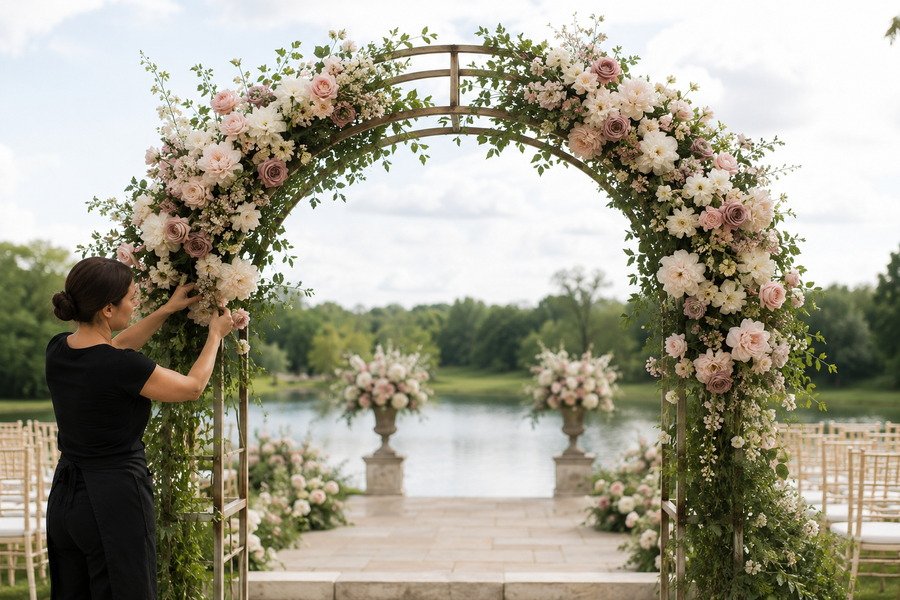
A plain wedding arch can look empty in photos. The problem grows when flowers are loose, uneven, or poorly attached. A clear process fixes that fast.
Decorate a wedding arch with artificial flowers by securing the frame first, adding greenery as the base, attaching flower bundles with floral wire or zip ties, placing large blooms first, filling gaps with smaller flowers, and checking the design from the front, sides, and photo distance.
A wedding arch is more than a frame. It becomes the visual center of the ceremony. It also appears in many photos, so each flower should support the full shape instead of looking like a random decoration. With artificial flowers, the process is easier because the stems are flexible, durable, and reusable. The key is to build the arch in layers, not all at once.
How Do You Attach Artificial Flowers to a Wedding Arch?
Loose flowers can fall, twist, or look messy during the ceremony. This is why the attachment method matters as much as the flower choice.
Attach artificial flowers to a wedding arch by grouping stems into small bundles, wrapping them with floral tape, then fixing each bundle to the arch with floral wire, zip ties, or green cable ties. Hide the fasteners behind leaves, large blooms, or fabric draping.
Start With the Right Attachment Points
A good floral arch starts with strong points of contact. These points are usually the top corners, side posts, and base areas. Do not attach every flower as a single stem at first. Small bundles are easier to control. They also create a fuller look with less work.
For most artificial flower wedding arch designs, each bundle should include one focal flower, one or two medium flowers, and a few greenery stems. The bundle should feel balanced but not too thick. If it is too heavy, it may pull forward on the arch.
Choose Fasteners Based on the Frame
| Arch Frame Type | Best Fastener | Why It Works |
|---|---|---|
| Metal arch | Zip ties or floral wire | Strong grip and easy to tighten |
| Wood arch | Floral wire, small hooks, or staples | Holds well without slipping |
| PVC arch | Zip ties | Simple and secure |
| Circular arch | Flexible floral wire | Follows the curve better |
| Fabric-covered arch | Floral pins and hidden ties | Keeps the surface clean |
Layer the Flowers Instead of Forcing Them
Begin with greenery garlands or long faux vines. These cover the structure and create a soft base. Then place the largest artificial flowers at the main visual points. These areas are usually the upper left corner, upper right corner, or one side of the arch if the design is asymmetrical.
After that, add medium flowers around the focal blooms. Use smaller flowers, berries, baby’s breath, or extra leaves to cover gaps. Step back often. The design should look natural from six to ten feet away, not only from close up.
What Supplies Do You Need to Decorate a Wedding Arch with Artificial Flowers?
A beautiful arch can fail if the supplies are weak. The flowers may be pretty, but the design needs tools that keep everything stable.
You need an arch frame, artificial flowers, faux greenery, floral wire, zip ties, floral tape, wire cutters, scissors, floral foam or chicken wire if needed, and optional fabric draping. For outdoor weddings, add sandbags or weights to stabilize the frame.
Basic Supply List
The most important supply is the arch frame. A metal frame works well for modern weddings. A wood frame gives a rustic or garden look. A circular frame creates a soft romantic shape. The frame must be stable before any flowers are added.
Artificial flowers should be sorted before decorating. Group them by color, size, and type. This saves time and helps avoid uneven color blocks. For example, keep roses in one pile, peonies in another pile, greenery in another pile, and fillers in a small tray.
Helpful Tools for a Cleaner Finish
| Supply | Purpose |
|---|---|
| Floral wire | Secures flower bundles tightly |
| Zip ties | Holds heavy garlands or large clusters |
| Floral tape | Wraps stems and hides rough edges |
| Wire cutters | Cuts faux flower stems cleanly |
| Greenery garlands | Creates the base layer |
| Floral foam | Holds stems for fuller installations |
| Chicken wire | Adds structure without too much bulk |
| Chiffon or tulle | Softens the frame and adds movement |
Do Not Skip Frame Stability
The arch should not wobble after flowers are attached. Artificial flowers are lighter than fresh flowers in many cases, but large garlands and dense arrangements still add weight. Outdoor wind can also shift the frame.
Use base weights, sandbags, or heavy planters if the wedding is outside. Cover these supports with greenery, fabric, or flower clusters. The arch will look polished, but it will also stay safer during the ceremony.
How Many Artificial Flowers Are Needed for a Wedding Arch?
Buying too few flowers creates empty spaces. Buying too many can make the arch look heavy, crowded, and expensive.
A small corner arrangement may need 20 to 40 artificial flower stems. A half-covered arch may need 60 to 100 stems. A full flower arch may need 120 to 200 stems or more, depending on flower size, greenery volume, and arch width.
Estimate by Coverage Style
The number of flowers depends on the look. A minimalist wedding arch uses open space as part of the design. A lush floral arch uses flowers across most of the frame. A garden-style arch needs more greenery and mixed stem lengths.
| Arch Style | Flower Amount | Best For |
|---|---|---|
| One corner cluster | 20–40 stems | Simple ceremonies, small budgets |
| Two corner clusters | 40–70 stems | Balanced but not too full |
| Half arch design | 60–100 stems | Modern asymmetrical weddings |
| Full floral arch | 120–200+ stems | Luxury ceremony backdrops |
| Greenery-heavy arch | Fewer flowers, more leaves | Outdoor, garden, rustic themes |
Use Greenery to Create Volume
Greenery is the easiest way to make a wedding arch look full without using too many flowers. Eucalyptus, ivy, fern, ruscus, willow leaves, and olive branches work well. They cover the frame and create movement.
Large flowers should not be spread evenly like dots. They should be grouped. A large bloom looks better when it has smaller flowers and leaves around it. This creates a natural cluster. It also helps the arch look more expensive.
Plan for Photos
The arch does not need to be equally full on every side. The front view is most important. Side views matter too if guests will walk around the arch. The back can be simpler unless the arch will be reused at the reception.
Before the wedding day, take test photos. Stand where the photographer will stand. Check if the flowers frame the couple’s faces. If the top is too heavy, move some blooms lower. If the sides look empty, add trailing greenery.
How Do You Make Artificial Flowers Look Real on a Wedding Arch?
Artificial flowers can look flat if they are used straight from the box. A few small steps can make them look softer and more natural.
Make artificial flowers look real by steaming or gently shaping petals, mixing several flower sizes, adding realistic greenery, hiding plastic stems, using asymmetrical placement, and leaving small open spaces. Realistic arches look layered, not perfectly even.
Shape the Flowers First
Many faux flowers arrive compressed. Open the petals with your fingers. Bend the stems slightly. Turn some blooms outward and others to the side. Real flowers do not face the same direction, so artificial flowers should not either.
If the material allows it, use gentle steam at a safe distance to soften creases. Do not overheat the flowers. Test one stem first. Some artificial flowers respond well, but cheaper materials may warp.
Mix Texture and Size
A realistic floral arch needs contrast. Use large roses or peonies as focal flowers. Add medium flowers for body. Use small blossoms, berries, and baby’s breath for detail. Greenery should not be one flat color. Mix soft leaves, long vines, and textured branches.
| Realistic Detail | Simple Method |
|---|---|
| Natural movement | Bend stems in different directions |
| Depth | Place some flowers forward and some deeper |
| Soft edges | Add trailing greenery |
| Hidden mechanics | Cover wire and zip ties with leaves |
| Better color | Use 2–4 related tones, not one flat shade |
Avoid Perfect Symmetry
Perfect symmetry can make artificial flowers look staged. A slightly uneven arch feels more natural. One side can be fuller. One corner can have a larger flower cluster. The other side can use more greenery.
This does not mean the design should look random. It should still feel balanced. If one side has more flowers, the other side can have longer greenery or fabric. Balance can come from shape, color, or movement.
My Insights: How to Decorate a Wedding Arch with Artificial Flowers Step by Step
A wedding arch looks professional when each step supports the next. Skipping the structure, base layer, or photo check often makes the final design feel weak.
The best way to decorate a wedding arch with artificial flowers is to build it in order: secure the frame, prepare flower bundles, add greenery, place focal flowers, fill gaps, hide mechanics, balance the shape, and test the arch in real ceremony lighting.
Step 1: Secure the Arch Frame
Place the arch where it will be used. Check the ground. If the floor is uneven, adjust the base before adding flowers. For outdoor weddings, add weights to both sides. The frame should stand firm when lightly pushed.
Step 2: Prepare the Flowers
Cut long stems with wire cutters. Keep enough stem length for attaching. Sort flowers by size. Prepare small bundles before placing them on the arch. This step saves time and keeps the design consistent.
Step 3: Add Greenery First
Wrap or attach greenery to the frame. Start at the base and move upward. Let some greenery point outward. Let some trail down. This gives the arch a soft garden look. The greenery should hide much of the frame before flowers are added.
Step 4: Place Large Flowers
Add the largest flowers at the main visual points. These are the areas that guide the eye. For a classic design, use flowers on both upper corners. For a modern design, make one side fuller and let the other side stay lighter.
Step 5: Add Medium and Small Flowers
Place medium flowers around the large blooms. Then use smaller flowers to fill holes. Do not cover every inch. Open space helps the design breathe. It also keeps the arch from looking bulky.
Step 6: Hide Wires and Ties
Look closely at the arch. Hide zip ties, floral wire, and tape with leaves or small flowers. Trim the ends of zip ties. Turn sharp wire ends inward so they do not scratch fabric, hands, or clothing.
Step 7: Add Fabric If Needed
Chiffon, tulle, or silk fabric can soften the whole design. Drape fabric before the final flower layer if it needs to sit under the blooms. Use fabric after flowers only if it is meant to flow on top.
Step 8: Check the Final Shape
Stand back and look at the arch from the aisle. Then look from the left and right. Take phone photos. A design can look full in person but uneven in photos. Move flowers until the couple will be framed clearly.
| Step | What to Check | Common Mistake |
|---|---|---|
| Frame | Stable and weighted | Adding flowers before testing support |
| Greenery | Covers the structure | Using flowers too early |
| Focal flowers | Clear visual points | Spreading large blooms too evenly |
| Fillers | Soft gaps and edges | Overfilling the whole frame |
| Final check | Looks good in photos | Only viewing from close up |
Conclusion
Decorating a wedding arch with artificial flowers is simple when the frame is stable, the layers are planned, and every flower supports the final photo-ready shape.