
Wedding flowers affect photographs, table settings, ceremony décor, and the overall atmosphere. Choosing between fresh and artificial flowers can therefore feel like a much bigger decision than it first appears.
I choose real wedding flowers when natural fragrance, organic movement, and fresh botanical detail matter most. I choose fake flowers when durability, predictable colors, early preparation, out-of-season varieties, or reuse are more important. For many weddings, a mix of fresh and high-quality artificial flowers provides the most practical balance.
The best choice is not simply real versus fake. I look at the wedding budget, season, venue, weather, installation size, photography, and how closely guests will interact with each arrangement.
Are Real Flowers Better Than Fake Flowers for a Wedding?
Fresh flowers have qualities that artificial flowers still cannot reproduce completely. At the same time, premium artificial flowers solve several practical problems that come with using perishable materials.
Real flowers are better when I want natural fragrance, botanical variation, and the experience of fresh blooms. Artificial flowers are better when I need predictable availability, resistance to wilting, advance preparation, or reusable décor. Neither option is automatically better for every wedding; the strongest choice depends on what matters most for each floral element.
Why I Might Choose Real Flowers
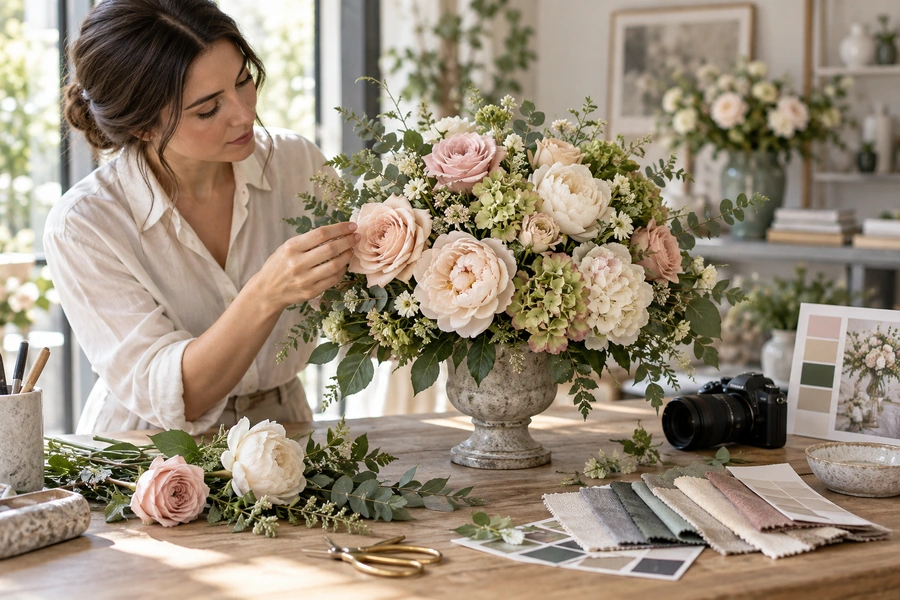
Fresh flowers have natural variation.
Two roses from the same bunch will not open in exactly the same way.
Petals curve differently.
Leaves turn in different directions.
Stems bend naturally.
That slight imperfection creates an organic quality that can be difficult to reproduce completely with manufactured flowers.
Fresh flowers also provide fragrance.
If I want the scent of roses, gardenias, sweet peas, stock, or another fragrant flower to become part of the wedding atmosphere, artificial flowers cannot provide that naturally.
For bouquets that will be viewed and photographed closely, these details can matter.
I may especially choose fresh flowers for:
- The bridal bouquet
- Boutonnieres
- Corsages
- Small table arrangements
- Sweetheart-table flowers
- Detail photography
Fresh flowers also allow a florist to work with seasonal material.
Seasonal flowers can create a sense of place and time that is difficult to reproduce with standardized artificial stems.
Why I Might Choose Fake Flowers
Artificial wedding flowers solve a different set of problems.
They do not wilt.
They do not need refrigeration.
They can be prepared long before the wedding day.
They also allow me to use flower varieties regardless of their natural blooming season.
Zola identifies year-round availability, advance preparation, durability, and freedom from wilting as major benefits of artificial wedding flowers.
That makes faux flowers especially useful for:
- Hot outdoor weddings
- Destination weddings
- Long setup periods
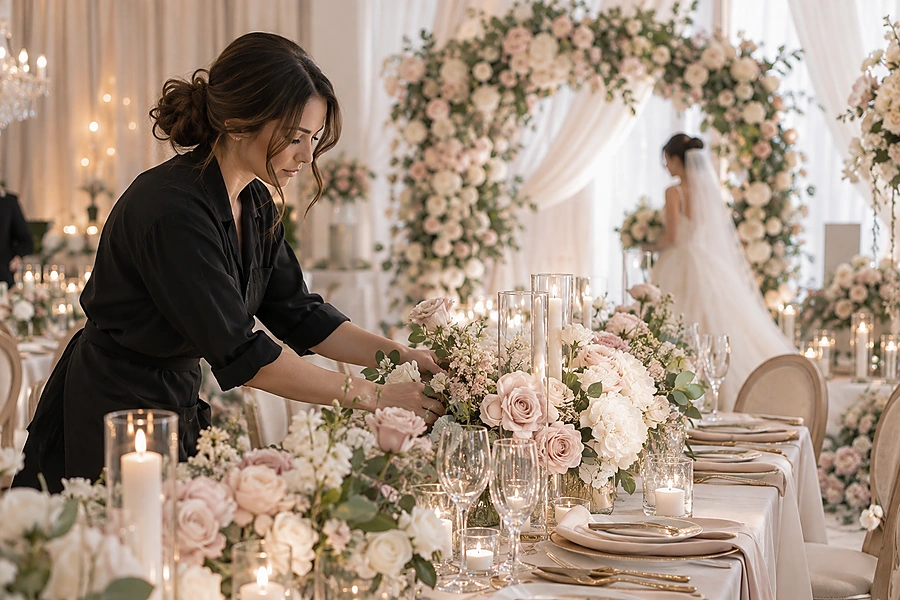
- Large ceremony installations
- Floral walls
- Hanging installations
- DIY arrangements
- Keepsake bouquets
- Rental floral packages
I also have more control over color.
A fresh flower can vary slightly from photographs or previous batches.
Artificial flowers remain more predictable.
If the exact shade of dusty blue, blush, burgundy, or ivory is central to the design, that consistency can be useful.
What About Appearance?
This is where quality matters.
Cheap artificial flowers can have:
- Shiny petals
- Flat colors
- Visible plastic seams
- Identical flower heads
- Unnatural leaves
- Thick plastic stems
High-quality artificial flowers can look dramatically different.
Real-touch and premium artificial flowers are designed to imitate botanical shapes, color variation, and even petal texture.
The Knot notes that realistic artificial flowers generally cost more than basic versions, so choosing fake flowers does not automatically mean choosing the cheapest flowers available.
I therefore judge the actual flower rather than the category.
Are Fake Flowers Cheaper Than Real Flowers for a Wedding?
Budget is one of the main reasons couples consider artificial flowers, but the comparison is more complicated than simply assuming plastic flowers always cost less.
Fake flowers can be cheaper, particularly when I rent arrangements, reuse them throughout the wedding, or design them myself. However, premium real-touch flowers, custom arrangements, delivery, setup, and large artificial installations can still be expensive. I compare complete floral proposals rather than assuming faux flowers will automatically reduce the budget.
Fresh Wedding Flowers Can Represent a Significant Expense
The Knot’s 2026 Real Weddings Study, based on 10,474 U.S. couples who married in 2025, found that average spending on wedding flowers was $2,800. The median spending level reported in its budget breakdown was $1,900, while couples in the upper spending quartile averaged $4,800.
Those numbers include more than the flowers themselves.
A professional fresh-floral proposal may include:
- Flower sourcing
- Stem preparation
- Conditioning
- Refrigerated storage
- Floral design labor
- Containers
- Delivery
- Installation
- Ceremony setup
- Reception setup
- Room flips
- Breakdown
The season also matters.
The Knot reports that flower costs vary according to seasonality, guest count, the ratio of flowers to greenery, location, and logistics.
That means a couple wanting large quantities of imported out-of-season flowers may face a very different budget from a couple choosing locally available seasonal blooms.
Artificial Flowers Have Their Own Cost Range
Artificial flowers can begin at relatively low prices, but the most realistic products cost considerably more.
Zola’s artificial wedding flower guide notes that artificial bouquets, centerpieces, corsages, garlands, and other floral pieces vary widely in price according to size, material, and quality. It also notes that real-touch or other high-quality artificial options are generally among the more expensive faux choices.
So I do not compare:
cheap artificial flower vs. premium florist-designed fresh flower.
That is not an equivalent comparison.
I compare:
professionally designed fresh arrangement vs. professionally designed premium artificial arrangement.
That gives me a more realistic picture.
Rental Flowers Can Change the Budget
One important advantage of artificial flowers is rental.
Fresh flowers generally cannot be rented because they are perishable.
Artificial arrangements can be used for one wedding and then returned.
The Knot reports that wedding flower rental companies use high-quality artificial flowers rather than fresh blooms.
Rental can be attractive when I need:
- Bridal and bridesmaid bouquets
- Centerpieces
- Aisle flowers
- Ceremony arrangements
- Large statement pieces
and do not want to store them afterward.
I still include:
- Shipping
- Setup
- Pickup
- Return shipping
- Damage fees
- Late fees
when comparing costs.
Reuse Can Also Reduce the Number of Arrangements
Artificial flowers can move easily from ceremony to reception.
An aisle arrangement might become reception décor.
A ceremony installation may be moved behind the sweetheart table.
Bridesmaid bouquets can become bar or cake-table decorations.
This can reduce the total number of separate pieces I need.
Fresh flowers can also be repurposed, of course, but artificial arrangements are less vulnerable to heat, dehydration, and damage during the move.
Do Fake Wedding Flowers Look Cheap in Photos?
Wedding photography makes people especially nervous about faux flowers. High-resolution photographs can reveal details that are easy to miss when viewing an arrangement from across a room.
Good artificial wedding flowers do not automatically look cheap in photographs. The result depends on flower quality, color, texture, arrangement style, lighting, and viewing distance. I use the most realistic faux flowers in bouquets and low centerpieces, while less tactile artificial flowers can work well in large installations that appear farther from the camera.
I Pay More Attention to Focal Flowers
Not every flower in a wedding receives the same amount of visual attention.
A bridal bouquet may appear in:
- Portraits
- Flat-lay photographs
- Ceremony photos
- Reception photos
- Close-up social media images
That makes it a high-priority arrangement.
If I choose an artificial bridal bouquet, I invest more in the roses, peonies, orchids, tulips, or other large focal flowers.
A ceiling installation is different.
Guests see it from farther away.
Photographers usually capture its overall shape rather than every individual petal.
I can therefore allocate the artificial-flower budget differently.
Color Is Critical
An artificial flower can have excellent shape but still look unrealistic if the color is too flat.
Fresh flowers usually contain subtle tonal variation.
A white rose may include:
- Cream
- Pale green
- Ivory
- Slight blush
A pink peony may become lighter toward its outer petals.
Artificial flowers with only one strong flat color can photograph more harshly.
I therefore prefer faux flowers with subtle gradients.
Shine Can Reveal Artificial Materials
Bright plastic shine is another problem.
Natural petals may reflect light, but their surfaces tend to reflect it differently from glossy plastic.
For photography, I prefer:
- Matte finishes
- Soft-textured petals
- Realistic centers
- Natural-looking leaves
I also view the flowers in daylight before committing to them.
Wedding venues often contain large windows, outdoor ceremonies, flash photography, and strong directional lighting. A flower that looks convincing in a dim shop can look different under brighter conditions.
Natural Arrangement Style Helps
The arrangement itself also matters.
I avoid making every artificial bloom face forward.
I vary:
- Flower height
- Stem direction
- Bloom openness
- Greenery placement
- Spacing
Natural asymmetry helps the arrangement feel more botanical.
Even expensive artificial flowers can look manufactured when they are arranged in a perfectly symmetrical dome.
What Are the Pros and Cons of Real vs. Fake Wedding Flowers?
When I compare the two options directly, I find that each has advantages that matter in different wedding situations.
Fresh flowers offer natural scent, texture, movement, and seasonal character, but they are perishable and require careful timing. Artificial flowers provide durability, predictable availability, advance preparation, and reuse, but premium realistic versions can be expensive and do not provide the natural fragrance or exact tactile quality of fresh blooms.
Real vs. Fake Wedding Flowers at a Glance
| Factor | Real flowers | Fake flowers |
|---|---|---|
| Natural fragrance | Excellent | None naturally |
| Botanical variation | Excellent | Depends on quality |
| Close-up realism | Natural | Excellent in premium products |
| Seasonality | Can affect availability | Available year-round |
| Wilting | Possible | No |
| Advance preparation | Limited | Excellent |
| Color consistency | Variable | Predictable |
| Reuse | Limited without preservation | Excellent |
| Keepsake potential | Requires preservation | Excellent |
| Rental | Rare | Common |
| DIY timeline | Short | Flexible |
| Outdoor heat | Can be challenging | Often easier |
| Maintenance during event | Requires care | Minimal |
| Cost | Highly variable | Highly variable |
This table explains why I do not view one option as universally superior.
Real Flowers Make Sense When Experience Matters Most
I lean toward fresh flowers when I care strongly about:
- Fragrance
- Organic texture
- Seasonal flowers
- Natural movement
- Traditional floristry
- Close-up detail
If flowers are one of the major emotional or visual priorities of the wedding, fresh flowers may justify a larger part of the budget.
Fake Flowers Make Sense When Logistics Matter Most
I lean toward artificial flowers when I care strongly about:
- Preparing everything early
- Avoiding wilting
- Keeping the bouquet
- Using out-of-season flower varieties
- Reusing arrangements
- Renting florals
- Maintaining identical colors
This can be particularly useful for DIY weddings because artificial arrangements can be assembled and adjusted repeatedly without the short working window that fresh flowers require.
Zola specifically notes that artificial flowers can be prepared well in advance and rearranged repeatedly, unlike fresh bouquets that need to be made close to the wedding date.
Can I Use Both Real and Fake Flowers at My Wedding?
I do not have to make one decision for every floral arrangement. In many weddings, fresh and artificial flowers can work together effectively.
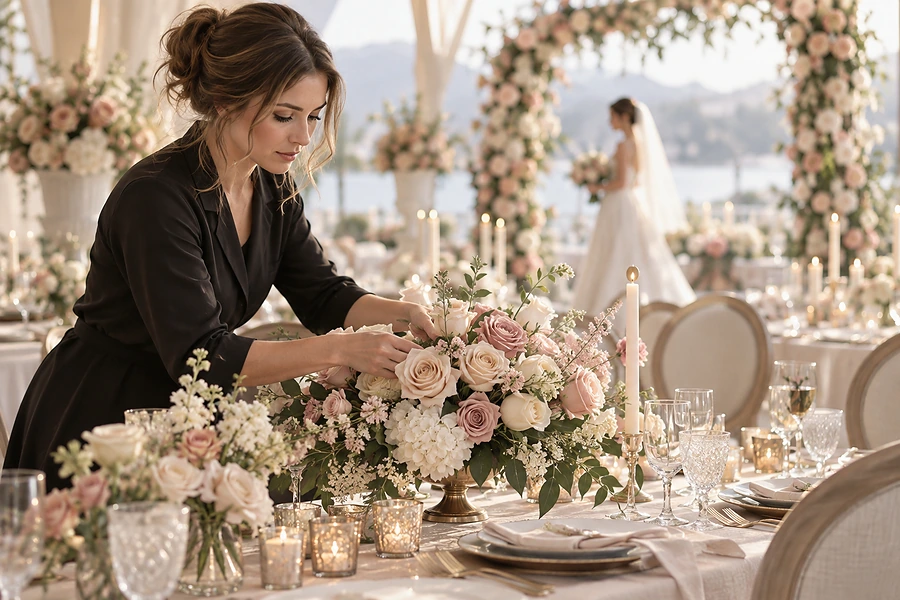
Yes, I can mix real and fake wedding flowers. I might use fresh flowers for the bridal bouquet and table arrangements while choosing artificial flowers for ceremony arches, floral walls, or other large installations. I can also mix premium faux focal flowers directly into fresh designs when color, availability, durability, or budget makes that useful.
Hybrid Flowers Can Give Me More Control
Suppose I want fresh white roses and greenery for personal flowers.
I also want a huge peony-covered ceremony arch.
If peonies are difficult or expensive to source in the required quantity, high-quality artificial peonies can provide scale without forcing me to change the entire wedding design.
Another wedding might use artificial bouquets as keepsakes while spending more of the floral budget on fresh centerpieces.
There is no fixed formula.
One Design Language Matters More Than One Material
For hybrid florals, I focus on consistency.
I match:
- Color palette
- Flower scale
- Greenery
- Arrangement shape
- Level of formality
I do not want the fresh arrangements to look loose and garden-inspired while the artificial arrangements are rigid and symmetrical.
Both materials should appear to belong to the same wedding.
I Tell the Florist Early
Some wedding florists work only with fresh flowers.
Others specialize in artificial designs.
Some work with both.
I therefore discuss the plan before booking.
If I purchase a large quantity of artificial stems without talking to the florist first, I may discover that the florist does not work with outside materials or cannot incorporate them into the planned mechanics.
Planning the hybrid strategy together usually creates a more cohesive result.
My insights: Should I Do Real or Fake Flowers for a Wedding
After comparing current wedding-flower costs, artificial-flower options, rental services, and the practical differences between fresh and faux materials, I do not think every wedding needs the same answer.
I choose real flowers when natural scent, botanical detail, and the emotional experience of fresh flowers are my priorities. I choose fake flowers when durability, early preparation, reuse, predictable colors, or year-round availability matter more. If I want both benefits, I use a hybrid approach and reserve each material for the part of the wedding where it performs best.
My First Insight: I Would Decide by Floral Moment, Not by the Entire Wedding
I think this is the most useful approach.
I do not ask:
Should my whole wedding be fresh or fake?
I ask:
What should my bridal bouquet be?
What should my arch be?
What should my tables use?
What should my entrance display use?
Those decisions may produce different answers.
A fresh bouquet and artificial arch can make perfect sense together.
So can an artificial keepsake bouquet with fresh table flowers.
My Second Insight: I Would Spend for Realism Where Guests Get Closest
Viewing distance matters.
The bridal bouquet receives close attention.
So do low centerpieces.
An arrangement twenty feet above the dance floor does not.
If I use artificial flowers, I spend more on premium stems where guests and cameras will be closest.
For distant installations, overall color and silhouette become more important than the tactile quality of every petal.
This strategy can give me a more polished result without buying the most expensive artificial flower for every location.
My Third Insight: Artificial Does Not Automatically Mean Budget
This is probably the biggest misconception.
The Knot’s 2026 data puts average U.S. wedding-flower spending at $2,800, but actual fresh-flower budgets vary enormously according to location, guest count, flower selection, and installation complexity.
Artificial flowers also have a wide range.
Basic fabric flowers can be inexpensive.
Premium real-touch flowers can cost much more.
Custom faux installations still require professional design, transportation, and setup.
So I calculate the complete design rather than comparing individual stem prices.
My Fourth Insight: Rental Makes Artificial Flowers Much More Interesting
If I do not want artificial flowers permanently, renting changes the decision.
I can use a professionally designed faux bouquet or centerpiece collection without having to:
- Source every stem
- Build every arrangement
- Store everything afterward
- Resell the flowers myself
The Knot confirms that wedding flower rental vendors operate specifically with artificial arrangements.
For a couple that likes the available rental designs, this can be one of the simplest ways to use faux flowers.
My Fifth Insight: The Best Choice Should Support the Wedding, Not Become Another Rule
There is no requirement that a sophisticated wedding use fresh flowers.
There is also no reason to replace fresh flowers simply because artificial flowers are easier.
I think about what I actually value.
If I have always imagined carrying fragrant garden roses, I would prioritize the fresh bouquet.
If my wedding is outdoors in strong heat and I want a huge installation to remain perfect all day, artificial flowers may solve that problem better.
If I want specific flowers that are not naturally available during my wedding season, faux versions can maintain the design.
If I care about keeping my bouquet afterward, an artificial bouquet gives me that without preservation.
The best choice supports those priorities.
My Simple Decision Guide
| If this matters most to me… | I would consider… |
|---|---|
| Natural fragrance | Real |
| Natural botanical variation | Real |
| Traditional fresh-flower experience | Real |
| Seasonal floral design | Real |
| Advance preparation | Fake |
| No wilting | Fake |
| Keeping the bouquet | Fake |
| Exact color consistency | Fake |
| Out-of-season flowers | Fake |
| Rental | Fake |
| Large installations | Fake or hybrid |
| Close-up luxury | Real or premium real-touch |
| Flexible budget allocation | Hybrid |
| Ceremony-to-reception reuse | Fake or hybrid |
My Final View
When someone asks me “Should I do real or fake flowers for a wedding?”, I would not make the decision based on whether one category is more fashionable or socially acceptable.
Both are established wedding options.
Artificial wedding flower specialists currently design entire weddings using faux blooms, while the fresh-floral industry continues to provide the natural materials many couples value.
I would start with three questions:
What do I want the flowers to feel like?
If scent, fresh texture, and natural botanical variation matter deeply, I lean toward real flowers.
What do I need the flowers to do?
If they need to survive heat, travel, long installations, advance preparation, or repeated reuse, I lean toward artificial flowers.
Where should I spend my floral budget?
If I want the greatest flexibility, I combine the two.
For many weddings, that hybrid approach is particularly practical because I can place fresh flowers where their natural qualities are most noticeable and artificial flowers where their durability provides the greatest advantage.
The goal is not proving that every flower is real.
The goal is creating a wedding that looks cohesive, photographs beautifully, works within the available budget, and performs reliably throughout the day.
Conclusion
I choose real wedding flowers for natural fragrance and botanical detail, fake flowers for durability and flexibility, or a hybrid design when I want the strongest practical benefits of both.