
Choosing between fresh and artificial wedding flowers does not have to be an all-or-nothing decision. I can use both materials strategically and still create one cohesive floral design.
Yes, I can mix real and fake flowers at a wedding. A hybrid floral design can combine the fragrance and natural movement of fresh flowers with the stability, availability, and reusability of high-quality artificial blooms. Many couples use fresh flowers for bouquets and faux flowers for arches, centerpieces, or larger installations to balance realism, budget, and practicality.
The key is consistency. I want the fresh and artificial flowers to share similar colors, flower shapes, greenery, scale, and arrangement style. When the materials are chosen carefully, guests may notice the overall floral design rather than which individual stems are fresh or faux.
Is It Okay to Mix Real and Fake Flowers for a Wedding?
Artificial flowers used to be associated with stiff petals and obvious plastic construction, but modern wedding florals now include premium silk, molded flowers, and real-touch materials that can be much more convincing.
Yes, mixing fresh and artificial flowers is a practical wedding-floral strategy, and professional planners and florists already use it. The Knot reports couples using fresh flowers on guest tables while using silk florals elsewhere, and floral professionals say mixing the two can help couples work within their flower budgets while maintaining a cohesive visual result.
I Treat Fresh and Faux as Two Design Materials
I do not think of artificial flowers as a replacement that needs to imitate every fresh flower perfectly.
I think of them as another material available to the florist.
Fresh flowers give me qualities artificial stems cannot completely reproduce. They have natural fragrance, small botanical imperfections, real movement, and the subtle changes that happen as flowers open throughout the day.
Artificial flowers give me a different set of advantages.
They can be prepared well before the wedding. They do not wilt during a long ceremony. Their color and shape remain predictable. They can also reproduce flowers that may be difficult or expensive to source fresh during a particular season.
The Knot specifically recommends combining real and artificial wedding flowers when couples want difficult-to-source or out-of-season varieties.
When I use both, I decide what each material should accomplish instead of trying to make every arrangement follow one rule.
Professional Wedding Vendors Already Offer Hybrid Florals
Hybrid flowers are not limited to DIY weddings.
Current wedding vendors advertise services that combine fresh and faux flowers. Your Story Events, for example, currently offers both and notes that couples frequently choose combinations such as fresh bridal bouquets with artificial ceremony arch arrangements.
The Knot also features a florist whose client specifically described combining artificial and fresh flowers to create the desired arrangements while controlling the floral budget.
This tells me that the important question is no longer whether mixing is acceptable.
The better question is where each material will perform best.
Where Should I Use Fresh and Artificial Flowers at a Wedding?
I get the best result when I assign fresh and faux flowers according to viewing distance, handling, weather exposure, installation complexity, and emotional importance.
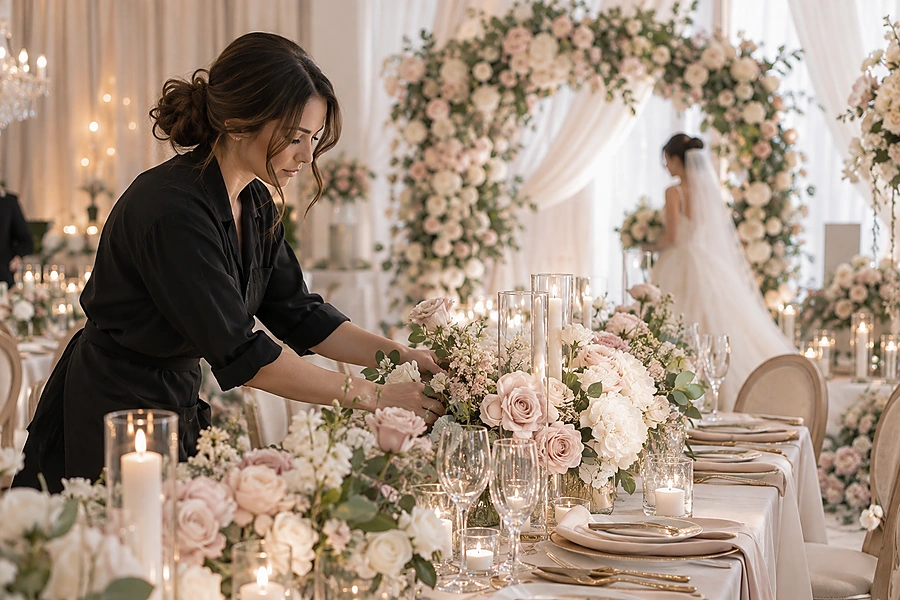
I usually prioritize fresh flowers for highly personal, close-up arrangements such as the bridal bouquet, boutonnieres, and selected table flowers. I use realistic artificial flowers for large arches, aisle arrangements, floral walls, stage installations, and other décor that needs to stay stable for many hours. However, I can reverse that formula when a keepsake bouquet or rental floral package better suits the wedding.
Fresh Flowers Work Well for Close-Up Moments
The bridal bouquet is one place where fresh flowers can have a strong emotional impact.
I hold the bouquet.
It appears in detailed photographs.
It may sit beside the wedding dress and rings.
The fragrance can become part of the experience.
For these reasons, some couples choose a fresh bridal bouquet even when much of the ceremony and reception décor is artificial.
The Knot describes couples using exactly this approach: fresh bouquets combined with faux centerpieces or other larger wedding decorations.
Boutonnieres and corsages can also be fresh when I want real botanical texture close to the body.
However, artificial personal flowers have their own advantage. A real-touch bridal bouquet can become a keepsake without requiring professional preservation.
So I treat this as a preference rather than a rule.
Artificial Flowers Are Especially Useful for Large Installations
Large floral arches can require a considerable quantity of flowers.
They may be installed hours before the ceremony.
Outdoor heat or wind can also make fresh-flower installation more challenging.
Artificial flowers remove the need to keep every bloom hydrated.
They also give the florist more time to build complicated structures before the wedding.
Current faux-floral wedding vendors specifically offer arches and aisle arrangements that can be moved and reused during the reception. SoCal Flower Studio, for example, currently markets ceremony flowers designed to be repurposed from one part of the wedding to another.
That reuse can make faux flowers particularly effective for ceremony décor.
Centerpieces Can Go Either Way
I can use fresh, faux, or a combination on guest tables.
The decision depends partly on how close guests will sit to the flowers.
A small low centerpiece will receive close inspection.
If I use artificial flowers there, I choose higher-quality stems with natural coloring and realistic flower centers.
A tall centerpiece is different. Much of the arrangement may sit above eye level, so the overall silhouette matters more than the tactile quality of every petal.
One strategy reported by The Knot involved using fresh florals on guest tables while using silk flowers in other parts of the wedding.
Another wedding could do the opposite.
The design goal matters more than following a universal formula.
| Wedding element | Fresh can work especially well | Faux can work especially well |
|---|---|---|
| Bridal bouquet | Fragrance and natural close-up detail | Keepsake and predictable shape |
| Bridesmaid bouquets | Natural texture | Easy preparation and reuse |
| Boutonnieres | Traditional fresh detail | No wilting during heat |
| Centerpieces | Close guest interaction | Consistency and rental options |
| Ceremony arch | Natural luxury | Stability and large-scale value |
| Aisle flowers | Organic movement | Easy repurposing |
| Floral wall | Expensive in fresh material | Strong faux application |
| Hanging installation | Natural movement | Easier advance preparation |
| Welcome display | Either | Particularly practical in faux |
| Sweetheart table | Fresh detail | Reused ceremony flowers |
I use this table as a planning tool rather than a strict rule.
How Do You Mix Real and Fake Flowers Without Them Looking Obvious?
The biggest risk is not simply that guests will identify an artificial flower. The bigger problem is when the fresh and fake materials look like they came from two completely different floral designs.
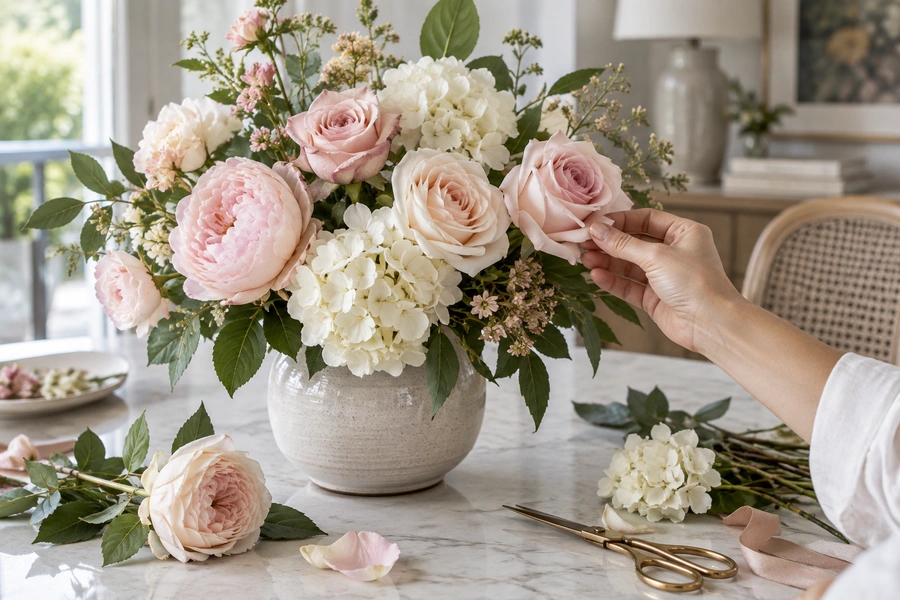
I make fresh and faux flowers blend by matching their color temperature, flower size, botanical style, and overall arrangement shape. I use high-quality artificial focal flowers, vary stem heights, avoid perfect symmetry, and repeat the same greenery throughout the wedding. Fresh greenery can also help visually connect artificial flowers with fresh arrangements.
I Match Color Before I Match the Exact Flower
Color inconsistencies are easy to notice.
Imagine fresh ivory roses with warm cream undertones beside artificial roses that are bright optical white.
Even if both flowers are realistic individually, the difference can make the faux flowers stand out.
I compare stems under the lighting used at the venue whenever possible.
I look at:
cream versus pure white, warm blush versus cool pink, muted sage versus bright green, and dusty lavender versus saturated purple.
Afloral’s current wedding-flower guidance recommends combining related tones and varying stem heights to create a more natural arrangement rather than an overly rigid one.
I use the same logic when combining fresh and artificial flowers.
I Avoid Artificial Perfection
A fresh wedding bouquet contains natural variation.
One rose may be more open than another.
One stem curves outward.
A leaf may turn at an unexpected angle.
Artificial flowers sometimes arrive looking much more uniform.
Every bloom faces forward.
Every stem has the same height.
Every petal is perfect.
I reshape faux stems before mixing them with fresh flowers.
Wired artificial stems can often be bent into softer positions. Afloral similarly advises gently bending artificial wedding greenery after unpacking so it does not appear flat or mechanically arranged.
I want the faux flowers to participate in the organic movement of the arrangement.
Fresh Greenery Can Help Bridge the Two Materials
Fresh greenery is particularly useful in hybrid arrangements.
Eucalyptus, ruscus, olive foliage, ferns, and other natural leaves can create movement around artificial focal flowers.
The Knot has specifically reported florists layering silk flowers into fresh designs when they need to achieve a desired scale or compensate for flower availability.
I can also do the opposite: artificial greenery can extend a design when fresh greenery would wilt or be difficult to install.
The key is consistency.
If the bridal bouquet uses one style of eucalyptus and the ceremony arch uses completely different glossy artificial leaves, the two designs may feel disconnected.
I try to repeat the same visual language across both.
Real-Touch Flowers Help in Close-Up Arrangements
When faux flowers will sit beside fresh blooms, quality becomes especially important.
A low-quality artificial rose may look acceptable alone but become more obviously artificial when positioned directly beside a fresh rose.
Real-touch flowers can reduce that contrast because their petals are designed for more realistic texture and shape.
Current artificial wedding flower products include real-touch roses with flexible wired stems that can be bent and incorporated into floral designs.
I do not require every artificial flower to be real touch.
I prioritize higher quality for the focal blooms that guests will see most closely.
Is Mixing Real and Fake Wedding Flowers Cheaper?
A hybrid strategy can reduce costs, but artificial does not automatically mean inexpensive. Premium fake flowers and professional floral labor still cost money.
Mixing real and artificial flowers can help control a wedding floral budget, especially when faux flowers replace large quantities of fresh blooms in arches, centerpieces, or rental installations. However, premium real-touch stems, custom design, delivery, setup, and large floral structures can still be expensive. I compare complete proposals rather than assuming the artificial option is always cheaper.
I Use Faux Flowers Where Quantity Is Highest
This is where hybrid design can make financial sense.
Suppose the bridal bouquet requires 30 premium flowers.
The ceremony arch might require hundreds.
If fresh floral detail matters most in the bouquet, I can allocate the budget there and use artificial material for the much larger structure.
Another wedding might have the opposite priority.
The couple may want a dramatic fresh ceremony arch and be comfortable renting artificial bouquets and reception pieces.
The Knot reports both strategies being used: some couples use fresh bouquets and faux centerpieces, while others rent faux bouquets and spend the savings on a fresh floral installation.
I like this approach because it treats the floral budget strategically.
Rental Faux Flowers Can Change the Economics
Purchasing premium artificial flowers means I own them afterward.
That can be useful when I want keepsakes or plan to reuse the décor.
If I do not want to store hundreds of flowers, renting may make more sense.
Wedding flower rental services generally rent faux florals rather than fresh flowers. The Knot notes that couples choose rental flowers partly for savings, convenience, and reuse.
Rental also gives me access to larger ready-made arrangements without purchasing every stem individually.
I still check:
delivery charges, setup costs, return shipping, damage policies, pickup requirements, and whether installation is included.
Those details can significantly change the final comparison.
Can a Florist Mix Fresh and Fake Wedding Flowers?
Some florists specialize in fresh flowers, some focus entirely on artificial arrangements, and others deliberately work with both.
Yes, some professional wedding florists mix fresh and artificial flowers. I tell the florist from the beginning that I want a hybrid design so the flower selection, mechanics, color palette, and budget can be planned together. I do not buy a large collection of faux flowers first and assume any florist will automatically incorporate them.
I Discuss the Hybrid Plan Before Booking
This conversation should happen early.
Fresh flowers need hydration and specific handling.
Artificial flowers behave differently.
A florist who understands both materials can plan where each one should go.
I ask about the overall design rather than treating artificial flowers as a last-minute substitute.
I want to know whether the florist can provide both materials, whether rented faux pieces are available, whether I can supply my own stems, and whether ceremony arrangements can be repurposed at the reception.
The Knot specifically advises couples considering a mixture of fresh and faux flowers to discuss the plan with their florist.
This reduces surprises.
I Also Think About Water
Fresh stems often need water.
Artificial flowers do not.
Some artificial materials can tolerate moisture, but others may not be designed to sit in water for long periods.
If I am combining both materials in the same vase, I let the florist determine the appropriate mechanics.
Separate water tubes, floral foam systems, hidden containers, or other techniques can allow the fresh flowers to receive hydration without unnecessarily soaking the artificial materials.
This is a technical issue that should be solved during design, not on the wedding morning.
My insights: Can You Use a Mix of Real and Fake Flowers at Your Wedding
After comparing current wedding-planning guidance with working florists and faux-floral vendors, I think a hybrid approach is most successful when I stop thinking about which type of flower is “better” and instead decide where each one offers the greatest value.
Yes, I can use a mix of real and fake flowers at my wedding, and the combination can look cohesive when it is planned as one floral design. I use fresh flowers where fragrance, natural texture, and close-up detail matter most, while I use premium faux flowers where scale, longevity, advance preparation, reuse, or budget control matters more.
My First Insight: I Design the Wedding First and Assign the Material Second
I do not start by deciding that the wedding must be 50 percent fresh and 50 percent faux.
That number tells me almost nothing.
Instead, I look at every floral moment.
The bridal bouquet has one purpose.
The ceremony arch has another.
The guest tables have another.
The photo backdrop has another.
Then I assign the material.
A fresh bouquet plus a faux arch may make sense.
A faux keepsake bouquet plus fresh bud vases may also make sense.
Current wedding professionals use both of these strategies depending on the couple’s priorities.
My Second Insight: Hybrid Flowers Work Best When Guests Do Not See a Visual Boundary
I do not want one side of the ceremony to look fresh and organic while the other looks rigid and artificial.
The materials should share one design language.
I repeat colors.
I repeat greenery.
I use similar flower sizes.
I keep the same level of formality.
I avoid one arrangement being perfectly round while another is loose and garden-inspired.
If the design is consistent, fresh and faux become materials within the same visual system.
My Third Insight: I Put My Best Faux Flowers Closest to the Viewer
This is where I spend carefully.
A large installation can include high-quality but less tactile artificial flowers because guests see much of it from several feet away.
A flower placed beside a fresh bloom in a low centerpiece deserves more realism.
I may use real-touch roses or peonies in that location.
That approach lets me control the budget without making every artificial stem equally expensive.
My Fourth Insight: Repurposing Is One of the Strongest Advantages
Artificial arrangements can move much more easily through the wedding day.
An aisle arrangement can move to the reception entrance.
Arch flowers can sometimes become a sweetheart-table backdrop.
Faux floral vendors currently market exactly this type of ceremony-to-reception repurposing.
This is a practical advantage that goes beyond the fresh-versus-fake appearance debate.
I can get more design impact from the same arrangements.
My Fifth Insight: I Would Not Hide the Hybrid Strategy
I do not think I need to treat faux flowers as something embarrassing.
Modern artificial wedding flowers are an established part of the wedding market. The Knot reports planners working with mixed fresh and silk weddings, while current Zola listings include florists offering both materials professionally.
I care about whether the wedding looks beautiful and functions well.
If a premium artificial arch stays perfect through a hot ceremony while fresh roses in the bridal bouquet provide fragrance and natural detail, both materials are doing exactly what I need them to do.
My Final Approach
When someone asks me, “Can you use a mix of real and fake flowers at your wedding?”, my answer is yes.
I would first identify the floral moments that matter most emotionally and photographically.
I would then identify the installations that require the largest quantity of flowers or need to stay stable for the longest period.
I would use fresh flowers where their natural qualities provide the greatest benefit.
I would use realistic artificial flowers where their durability, predictability, advance preparation, rental possibilities, or reuse create a practical advantage.
Then I would ask one florist or design team to connect both materials through the same colors, greenery, scale, and arrangement style.
The goal is not to make every artificial flower impossible to identify.
The goal is to make the whole wedding floral design feel intentional.
When that happens, fresh and faux flowers can work together rather than compete with each other.
Conclusion
Yes, I can mix real and fake wedding flowers. The best hybrid designs use fresh blooms for natural detail and faux flowers for scale, stability, reuse, and flexibility while keeping one consistent floral style.