
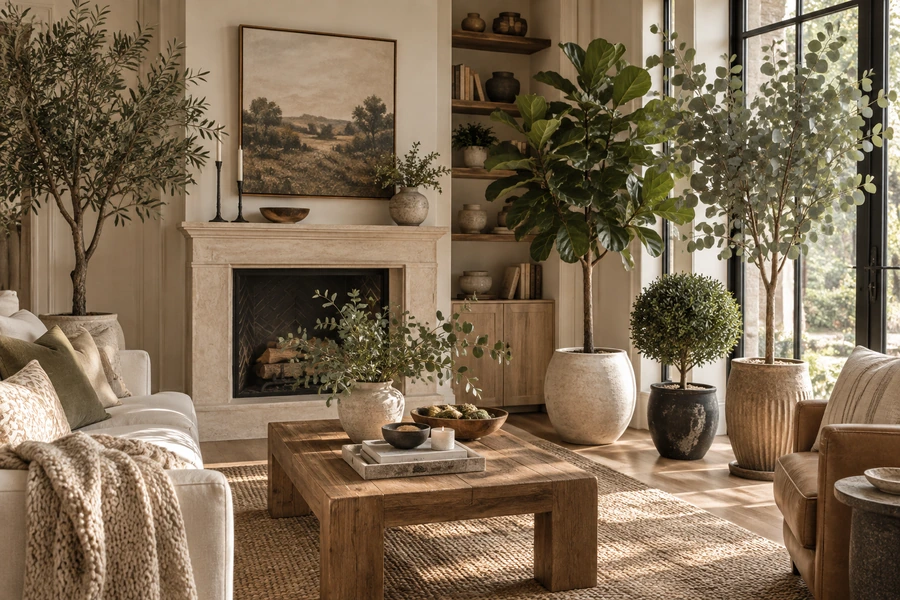
An empty corner can make a finished room feel incomplete. The right faux tree adds height, softness, color, and an organic shape without demanding sunlight or regular watering.
Faux olive trees, ficus trees, fiddle leaf figs, palms, eucalyptus, citrus trees, bamboo, dracaena, Japanese-style trees, and topiaries can all look great in homes. I get the best results by choosing a realistic tree whose size, foliage density, trunk shape, and planter suit the room rather than simply buying the trendiest species.
Artificial greenery remains part of current interior design, although quality and individuality matter more than ever. House Beautiful’s 2026 styling coverage notes that today’s better faux greenery can look surprisingly convincing, while Architectural Digest continues to include realistic artificial trees among useful decorating options.
What Are the Best Faux Trees for Indoor Decor?
Different faux trees create very different moods. I choose a species according to the architecture and the amount of visual weight I want in the room.
Some of the best faux trees for indoor decor are olive, ficus, fiddle leaf fig, palm, eucalyptus, citrus, bamboo, dracaena, and Japanese-inspired branching trees. Olive trees feel airy and Mediterranean, ficus and fiddle leaf figs create stronger statement greenery, palms add tropical movement, while slender bamboo and dracaena work particularly well in tighter spaces.
1. Faux Olive Trees
The faux olive tree has become one of the most recognizable artificial trees in contemporary interiors.
I understand why.
Its narrow gray-green leaves and open branching give me height without creating a dense wall of greenery. It works especially well with:
- Warm minimalism
- Mediterranean interiors
- Organic modern rooms
- Scandinavian-inspired spaces
- Coastal homes
- Neutral interiors
House Beautiful’s 2026 guide to faux olive trees specifically highlights intentionally sparse versions because the open form can look more natural than an excessively full artificial canopy.
That is exactly what I look for.
I prefer an olive tree with visible branches, several leaf tones, an irregular canopy, and a believable trunk.
However, I would not automatically put an olive tree in every house.
Its popularity has made the generic faux olive tree extremely common. Recent designer commentary looking toward 2027 has even identified ubiquitous artificial olive trees as an overused decorating shortcut.
For me, that does not mean olive trees suddenly look bad.
It means I choose one because the tree suits the room—not merely because I have seen it everywhere online.
2. Faux Ficus Trees
Ficus is one of my favorite alternatives when I want something fuller.
This category includes several distinct looks:
- Weeping ficus
- Ficus Alii
- Fiddle leaf fig
- Rubber-tree-inspired designs
Ficus also has unusual relevance in 2026. The National Garden Bureau named 2026 the Year of the Ficus, and current design coverage describes the genus as particularly versatile for interiors.
A faux ficus gives me that same visual versatility without needing to reproduce the plant’s growing conditions.
A weeping ficus has many smaller leaves and produces a softer canopy.
A Ficus Alii has narrower foliage and can feel more contemporary.
A fiddle leaf fig has much larger leaves and creates a bold statement.
I often use ficus-style faux trees when an olive tree looks too delicate for the scale of the room.
3. Faux Fiddle Leaf Fig Trees
A fiddle leaf fig is one of the strongest choices when I want a sculptural indoor tree.
Its broad leaves have immediate visual presence.
Unlike an olive tree, which tends to fade gently into the room, a fiddle leaf fig usually announces itself.
House Beautiful’s artificial fiddle leaf fig coverage emphasizes qualities such as varied leaf sizes, realistic trunks, and repositionable wired foliage as key details that help faux versions look convincing.
I especially like them beside:
- Sofas
- Large windows
- Sideboards
- Reading chairs
- Media units
Because the leaves are large, however, quality becomes important.
A glossy artificial leaf is much more noticeable when it is ten inches wide than when it is a tiny olive leaf.
I therefore look for matte surfaces, believable veins, irregular positioning, and several leaf sizes.
4. Faux Palm Trees
Palms create an entirely different atmosphere.
The long leaves introduce movement and immediately make a room feel more relaxed.
I might choose a faux:
- Areca palm
- Kentia palm
- Majesty palm
- Traveler’s palm
- Fan palm
Palms work especially well in bright, casual interiors, sunrooms, bedrooms, and large living spaces.
I often use them when the room already has natural materials such as rattan, linen, wood, and stone.
A palm can also fill more horizontal space than a narrow olive tree.
That makes it useful when the empty corner is wide rather than simply tall.
5. Faux Citrus Trees
Lemon and orange trees give me more color than ordinary green artificial trees.
They are particularly effective in:
- Kitchens
- Breakfast rooms
- Sunrooms
- Mediterranean interiors
- Farmhouse-inspired spaces
I usually prefer faux citrus trees when the rest of the room is relatively simple.
The yellow or orange fruit already attracts attention.
If the tree also sits beside brightly patterned curtains, colorful art, and several decorative objects, the composition can become busy.
I also check the fruit carefully.
An otherwise convincing citrus tree can look artificial if every lemon has exactly the same size, color, and position.
6. Faux Bamboo and Dracaena Trees
These are my choices when floor space is limited.
Both tend to have vertical growth.
A faux bamboo tree can introduce a lighter, more delicate silhouette.
A dracaena has a stronger architectural form with clusters of long leaves.
I like them in:
- Hallways
- Offices
- Bedrooms
- Apartment corners
- Bathrooms
- Narrow spaces beside furniture
They can give me six feet of vertical greenery without requiring the broad footprint of a full ficus.
7. Japanese-Inspired and Branching Faux Trees
I also like artificial trees that have more visible branch structure.
These may imitate:
- Japanese maple
- Quince
- Maple
- Birch
- Sparse ficus varieties
Architectural Digest has previously highlighted designers using artificial maple trees successfully in interiors, while current designer Shea McGee recommendations include faux Japanese quince and other looser branching forms alongside olive trees and topiaries.
These trees can feel more individual than the standard mass-market olive tree.
Their visible branches also create interesting shadows against walls.
8. Faux Topiary Trees
Topiaries are more formal.
Instead of trying to imitate unrestricted natural growth, they reproduce intentionally clipped plants.
I may choose:
- Ball topiary
- Double-ball topiary
- Olive topiary
- Rosemary topiary
- Boxwood form
These work best when the room has some traditional or architectural structure.
I especially like them around entryways, kitchens, conservatories, and more formal rooms.
I use topiary sparingly because symmetry is already built into the plant.
Two matching topiaries can look elegant around a doorway.
Six matching topiaries throughout the house can start to feel themed.
Which Faux Tree Looks the Most Realistic Indoors?
Species helps, but construction quality has a much bigger impact on realism. A poorly made olive tree will not look more natural simply because olive trees are fashionable.
The most realistic faux trees have convincing trunks, matte leaves, several shades of green, varied leaf sizes, irregular branches, and a natural silhouette. Olive, ficus, fiddle leaf fig, and branching trees can all look highly realistic when these details are handled well. I avoid trees with strong plastic shine, identical leaves, perfectly symmetrical canopies, or obviously artificial trunks.
I Look at the Trunk Before the Leaves
People often focus on foliage when shopping for artificial trees.
I inspect the trunk first.
A six-foot tree contains a lot of visible trunk area. If that trunk looks like one smooth molded plastic pole, the whole plant becomes harder to believe.
I look for:
- Natural color variation
- Uneven bark
- Branch taper
- Irregular joints
- Variation in trunk thickness
Some higher-quality faux trees even incorporate natural wood components to improve the effect.
I Prefer Irregular Foliage
Real plants do not grow like copied-and-pasted graphics.
Some leaves overlap.
Some point downward.
Some grow toward the light.
One branch may extend farther than the branch opposite it.
House Beautiful’s 2026 faux-plant styling advice recommends manipulating and reshaping artificial stems rather than leaving them compressed in the form they had during shipping.
I do the same with trees.
I pull branches apart.
I bend them gently.
I turn leaves in different directions.
I create a slightly uneven silhouette.
The goal is not messiness.
It is believable variation.
Matte Leaves Usually Look Better
Strong shine is one of the easiest ways to identify a fake plant.
Natural leaves can certainly be glossy, but artificial plastic sometimes reflects light much more uniformly.
I prefer controlled sheen.
This matters especially for large-leaved trees such as fiddle leaf figs.
A small glossy olive leaf may be easy to overlook.
Twenty huge reflective fiddle leaves are much more obvious.
The Planter Is Part of the Tree
A beautiful faux tree can still look unfinished if I leave it inside the tiny black nursery container used for shipping.
I almost always place the original base inside a larger decorative planter.
I might choose:
| Interior style | Planter I would consider |
|---|---|
| Mediterranean | Terracotta or aged clay |
| Warm minimalism | Textured ceramic |
| Organic modern | Stone-effect pot |
| Coastal | Woven basket |
| Contemporary | Simple plaster-look planter |
| Traditional | Aged ceramic or classic urn |
I also cover the artificial base with moss, bark, stone, or another suitable top dressing.
That small change can make the entire tree look more intentional.
Where Should I Put a Faux Tree in My Home?
Placement changes how realistic and stylish an artificial tree feels. I do not simply put one into every empty corner.
I place faux trees where their height can solve a design problem: beside a sofa, near a window, in an empty corner, behind an accent chair, beside a console, or between architectural zones. I usually position them where a real plant could plausibly grow because visually believable placement helps an artificial tree feel more natural.
Living Room
The living room is usually the easiest place to use a large faux tree.
I may place one:
- Beside the sofa
- Behind an accent chair
- Near a window
- Beside the fireplace
- In a large empty corner
For a neutral room, an olive tree can add height without adding too much visual weight.
For a larger room, a ficus or fiddle leaf fig can provide more presence.
Current interior-design advice on layering plants also recommends beginning with a large statement plant such as a fiddle leaf fig or olive tree because taller greenery creates architectural structure before smaller plants are added.
I use the same principle with faux greenery.
Bedroom
Bedrooms usually need softer greenery.
I often choose:
- Olive
- Ficus Alii
- Bamboo
- Dracaena
I avoid extremely broad, dense trees when the bedroom is small.
I want the tree to soften the corner rather than dominate the bed.
Dining Room
Dining rooms can handle slightly more sculptural trees.
A tall olive tree beside a sideboard works well.
A citrus tree can introduce a warmer Mediterranean mood.
A branching faux tree can also balance a large dining table.
I generally keep the canopy away from the chairs so guests do not brush against artificial leaves every time they sit down.
Entryway
The entryway can handle a more structured form.
I may use:
- Topiary
- Olive
- Ficus
- Citrus
If I use two trees symmetrically, I keep the rest of the space relatively quiet.
If I use one loose tree, I may allow the furniture arrangement to remain asymmetrical.
Near Windows
One of my favorite tricks is placing faux trees near windows.
The tree does not need the sunlight, but the position makes visual sense.
It also allows natural daylight to illuminate the leaves and create shadows.
Current 2026 design coverage of warm, indoor-outdoor interiors similarly emphasizes using taller trees near windows to visually connect interior space with exterior greenery.
That logic works even when the indoor tree is artificial.
How Do I Choose a Faux Tree That Does Not Look Tacky?
Artificial trees usually look wrong because of scale, quality, placement, or repetition rather than simply because they are artificial.
I avoid tacky-looking faux trees by choosing realistic foliage, an appropriate scale, a convincing trunk, and a substantial planter. I also use artificial trees sparingly. One well-selected six- or seven-foot statement tree generally looks more intentional than many small generic faux plants scattered throughout the room.
Scale Comes First
I measure before buying.
I check:
- Ceiling height
- Available floor width
- Furniture height
- Planter height
- Canopy width
A four-foot tree beside a tall sectional can look undersized.
An eight-foot spreading ficus under an eight-foot ceiling can look cramped.
I usually want some visible space between the top foliage and ceiling.
That gives the tree room to breathe visually.
I Choose the Silhouette for the Space
Not every empty corner needs the same shape.
| Room condition | Faux tree I might choose |
|---|---|
| Small narrow corner | Dracaena or slim olive |
| Large living room | Ficus or fiddle leaf fig |
| Neutral modern room | Olive or Ficus Alii |
| Mediterranean interior | Olive or citrus |
| Tropical room | Palm |
| Traditional entry | Topiary |
| Minimal room | Sparse branching tree |
| Small apartment | Bamboo or slim dracaena |
| Large open-plan room | Full ficus or large palm |
This is much more useful to me than simply buying whichever tree is currently trending.
I Avoid Too Many Identical Faux Plants
The current design conversation increasingly favors personal, collected interiors instead of mass-produced repetition. Better Homes & Gardens’ September 2026 coverage similarly emphasizes warmer tones, mixed textures, vintage influence, and objects with more individuality.
I think this matters for faux plants too.
If the exact same artificial olive tree appears in the living room, bedroom, office, and hallway, the house can begin to feel staged.
I would rather vary the forms.
I might use:
an olive tree in the living room, a branching arrangement in the bedroom, and a small topiary in the kitchen.
The greenery connects the rooms without making them identical.
I Keep Faux Trees Clean
Dust can destroy realism.
Large artificial leaves are particularly good at collecting it.
I include faux trees in my regular cleaning routine.
A microfiber cloth or other manufacturer-approved cleaning method is usually enough for routine dust.
I also inspect:
- Leaf edges
- Branch intersections
- Trunk
- Pot rim
- Top dressing
A clean medium-priced faux tree can look more convincing than an expensive one covered in dust.
My insights: What Kind of Faux Trees Look Great in Homes
After looking at current interior-design coverage and the different forms available, I do not think there is one faux tree that belongs in every stylish home.
Faux olive, ficus, fiddle leaf fig, palm, citrus, bamboo, dracaena, branching Japanese-inspired trees, and topiaries can all look great in homes. My preferred choice depends on the room’s scale and style. The strongest faux trees look botanically believable, fit their surroundings, and function as intentional statement greenery rather than generic filler.
My First Insight: Olive Trees Still Work, but They Are No Longer the Only Answer
The faux olive tree became popular for good reasons.
It is light.
It is sculptural.
It fits neutral interiors.
House Beautiful was still testing and recommending realistic faux olive trees in 2026.
At the same time, some designers are beginning to push back against the sheer number of generic faux olive trees appearing in homes.
I think both observations can be true.
A beautiful olive tree in the right room still works.
Buying one automatically because every online interior contains one is less interesting.
I therefore consider ficus, Japanese quince, branching maple-style trees, palms, and citrus more often than I might have a few years ago.
My Second Insight: Ficus Is Especially Relevant Right Now
Ficus is an interesting category for 2026 because the National Garden Bureau selected it as its houseplant focus for the year, and designers continue to use its many forms for height and architectural greenery.
For faux trees, this gives me several silhouettes rather than one look.
I can choose a dramatic fiddle leaf fig.
I can choose a delicate weeping ficus.
I can use Ficus Alii when I want longer, narrower foliage.
That variety makes ficus particularly flexible.
My Third Insight: One Large Tree Often Looks Better Than Many Small Plants
A large tree can solve an architectural problem.
It fills vertical space.
It softens a hard corner.
It balances tall furniture.
It can also visually connect indoor and outdoor space.
Architectural Digest has documented the broader design interest in full-size indoor trees, including both living and faux examples used as major architectural statements.
I apply that principle at a smaller residential scale.
Instead of putting five tiny artificial succulents around the room, I might buy one realistic six-foot tree.
The room often looks calmer and more intentional.
My Fourth Insight: Realism Depends on Styling as Much as Price
I can make an expensive tree look fake if I leave it compressed in a tiny plastic pot.
I can improve a moderately priced tree considerably by:
reshaping the branches, rotating the leaves, upgrading the planter, hiding the base, and positioning it thoughtfully.
House Beautiful’s 2026 styling guide emphasizes exactly this type of hands-on reshaping and thoughtful presentation.
My simple formula is:
| Element | What I prefer |
|---|---|
| Trunk | Irregular and believable |
| Leaves | Matte with color variation |
| Branches | Adjustable and asymmetrical |
| Canopy | Appropriate to the species |
| Height | Proportional to the room |
| Planter | Substantial |
| Base | Concealed |
| Placement | Visually plausible |
| Quantity | Restrained |
| Maintenance | Dust-free |
If those details work together, the faux tree usually looks much better.
My Fifth Insight: The Best Faux Tree Is the One That Solves a Specific Design Problem
This is ultimately how I choose.
If I need delicate height, I choose an olive tree.
If I need a stronger focal point, I look at ficus or fiddle leaf fig.
If I want movement, I choose a palm.
If I need something narrow, I use bamboo or dracaena.
If I want color, I consider citrus.
If I want formal symmetry, I use topiary.
If I want something less predictable, I look for Japanese-inspired or loose branching trees.
The species becomes a solution rather than a trend.
My Final View
When someone asks me “What kind of faux trees look great in homes?”, I would start with realistic olive, ficus, fiddle leaf fig, palm, citrus, bamboo, dracaena, and branching trees.
But I would not stop at the species name.
I would look at the room.
A six-foot olive tree might be perfect beside a linen sofa in a warm minimalist living room.
A full ficus may work better in a large family room.
A slim dracaena might be ideal for an apartment corner.
A citrus tree may bring exactly the right amount of color into a Mediterranean kitchen.
A topiary may suit an entryway where a loose palm would feel out of place.
Then I would inspect the construction.
Does the trunk look convincing?
Are the leaves matte?
Do they contain more than one green tone?
Can I reposition the branches?
Is the tree too perfectly symmetrical?
Finally, I would upgrade the planter and reshape the tree before judging it.
That process matters more than choosing whichever artificial tree happens to be most fashionable.
The faux trees that look best in homes are the ones that feel intentional, properly scaled, and connected to the architecture and materials already in the room.
Conclusion
Olive, ficus, fiddle leaf fig, palm, citrus, bamboo, dracaena, and branching faux trees can all look beautiful when their scale, realism, planter, and placement suit the home.